Austrian e-commerce market: What can we expect in 2026
What does the future hold for Austria’s e-commerce market by 2026? Uncover key trends and insights that will redefine online shopping experiences.
Austria rarely dominates headlines in discussions about European online retail. Markets like Germany, the UK, or France usually take that spotlight because of their scale. Yet the Austrian market in 2026 offers something different: a mature digital retail ecosystem that continues to grow steadily while adapting to new cross-border dynamics and shifting consumer expectations.
Austria’s e-commerce sector has already gone through its fastest expansion phase during the pandemic years. What follows now is not explosive growth but structured, stable expansion. That stability makes the Austrian market particularly interesting. Retailers operating there deal with consumers who are digitally experienced, comfortable with cross-border shopping, and strongly influenced by neighboring markets.
Looking toward the Austrian market in 2026, several forces shape the outlook. Revenue continues to grow, online penetration expands, and international platforms remain extremely influential. At the same time, local retailers, payment preferences, and logistics networks still maintain strong roles in the market structure.
Understanding these dynamics helps explain what businesses can realistically expect from Austria’s e-commerce environment in the coming years.
What businesses should expect from the Austrian market in 2026
Let us begin with the general and move on to the specific.
The Austrian market in 2026 will likely continue evolving along several lines at once. Growth will remain steady rather than explosive, online penetration will gradually increase, and cross-border competition will stay intense.
At the same time, Austria’s high purchasing power and stable economic environment make it an attractive market for digital retailers.
So, summing up, these are several trends will likely shape the 2026 and coming years:
- stronger competition from international shops/marketplaces
- increasing importance of delivery speed and convenience
- growing influence of mobile shopping and digital wallets
- steady growth in online retail penetration
What opportunities wait for retailers
Retailers entering the Austrian market in 2026 should focus less on rapid expansion and more on strategic positioning. The market rewards companies that deliver strong customer experiences and reliable services.
Sure, Austria may not be Europe’s largest e-commerce market, but its structure offers valuable lessons about how mature digital retail ecosystems continue evolving in the second half of the decade.
One of the most interesting opportunities lies in how convenient it is for Austrians to buy from foreign platforms.
Austrian consumers are already accustomed to buying from international platforms, particularly German ones, which means barriers to entry for foreign retailers are relatively low. A store that operates in German, offers EU-wide shipping, and communicates clearly about delivery times can realistically reach Austrian customers without establishing a full local presence. For many brands, Austria becomes a natural extension of German-language e-commerce operations rather than a completely separate market.
Another opportunity comes from category specialization.
While large marketplaces dominate general retail, niche stores can perform well when they focus on expertise, curated product selections, or specialist categories. Austrian consumers often research products carefully before buying, especially in categories such as electronics, outdoor equipment, home improvement, or hobby products. Retailers that provide detailed product information, helpful guides, and transparent pricing can build trust quickly in these segments.
The strong purchasing power of Austrian households also creates room for premium positioning.
Customers are generally willing to pay for higher quality, sustainability credentials, or reliable service. Retailers that emphasize product durability, brand reputation, and responsible sourcing often resonate well with Austrian shoppers, particularly in fashion, electronics, and home goods.
There is also growing potential in mobile and platform-driven commerce.
Austrian consumers use smartphones extensively for product discovery, price comparison, and browsing online stores. Retailers that invest in mobile-optimized websites, smooth checkout processes, and clear product presentation will find it easier to capture attention in this environment.
Are there any threads?
The challenges here are rarely dramatic or unpredictable, yet it’s worth being aware of potential difficulties.
So firstly, there is a strong international competition. Large marketplaces such as Amazon and Zalando already hold a strong position in the market – this does not make entry impossible, but it means new retailers must clearly communicate what makes them different. Competing purely on price is difficult when major platforms benefit from scale, logistics efficiency, and brand recognition.
Another factor worth watching is price transparency. Retailers entering the market should think carefully about their pricing strategies and product positioning. Instead of relying only on discounts, many successful sellers focus on product value, reliable delivery, customer service, etc.
Moreover, logistics expectations are relatively high. Austrian consumers are used to fast delivery times and clear shipment tracking, especially when ordering from large international platforms. Retailers that underestimate delivery speed or return logistics may struggle to meet customer expectations.
None of these factors should be seen as unbreakable barriers. Instead, they reflect the characteristics of a well-developed e-commerce ecosystem. Retailers that approach the Austrian market in 2026 with realistic expectations and thoughtful strategies often find it to be a stable and rewarding environment for long-term growth.
Austrian market 2026: The specific data
And now let’s focus on specifics. Here we examine the numbers that shape the Austrian market in 2026. Data from ECDB offers a clear snapshot of how the country’s e-commerce sector is evolving.
Growth trajectory is positive
Austria’s e-commerce sector continues to expand at a steady pace, even after the extraordinary growth experienced during the early pandemic years. According to ECDB market estimates, the country generated $11.398 million in e-commerce revenue in 2024, about $13,000 million in 2025, with projections pointing to $14.151 million in 2026.
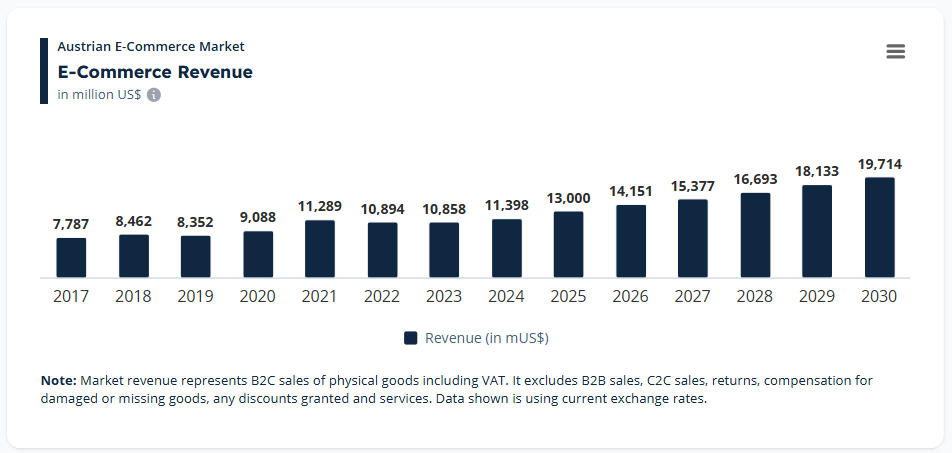
This trajectory places the Austrian market in an interesting position within Europe. It is not among the largest markets, but it demonstrates consistent growth and strong purchasing power. Forecasts suggest the market could reach nearly $20 million by 2030, indicating sustained momentum rather than a short-term spike.
Looking at annual growth patterns helps illustrate this shift. After a sharp 24.2% growth surge in 2021, the market slowed as pandemic demand stabilized. Growth briefly dipped in 2022 and 2023 but began recovering afterward. By 2025, annual growth was expected to reach 14.1%, before stabilizing around 8–9% annually between 2026 and 2030.
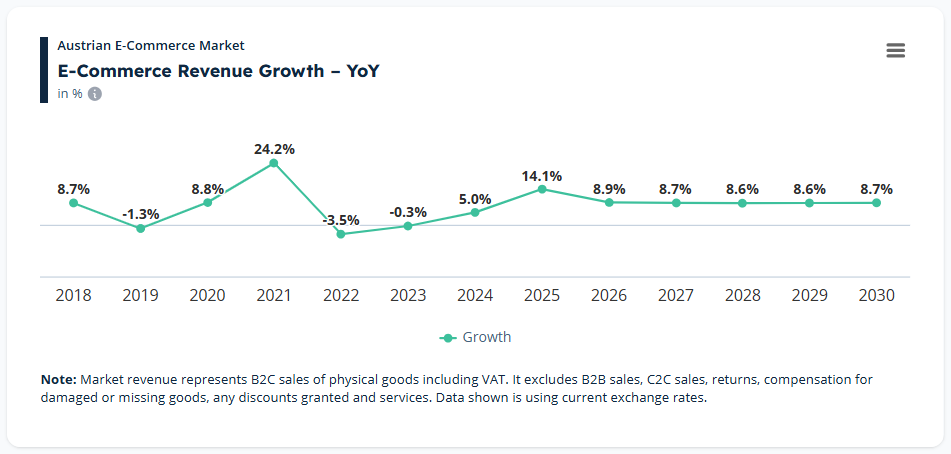
This type of growth pattern reflects a market moving into maturity. Consumers already shop online frequently, and e-commerce now represents a normal part of retail behavior rather than an emerging trend.
Austria also benefits from its position within the European single market. Online retailers from neighboring countries can serve Austrian customers relatively easily, which increases competition but also improves product availability.
So the key takeaway here is clear: growth will continue.
Online retail penetration continues to deepen
Another indicator of e-commerce maturity in Austria is the growing share of online sales within the broader retail market. Online channels have steadily gained importance over the past decade, and that trend is expected to continue through the second half of the 2020s.
E-commerce represented roughly 15.5% of Austria’s retail market in 2024. By 2025 the share is projected to reach 17.5%, and in 2026 it is expected to approach 19.4%.
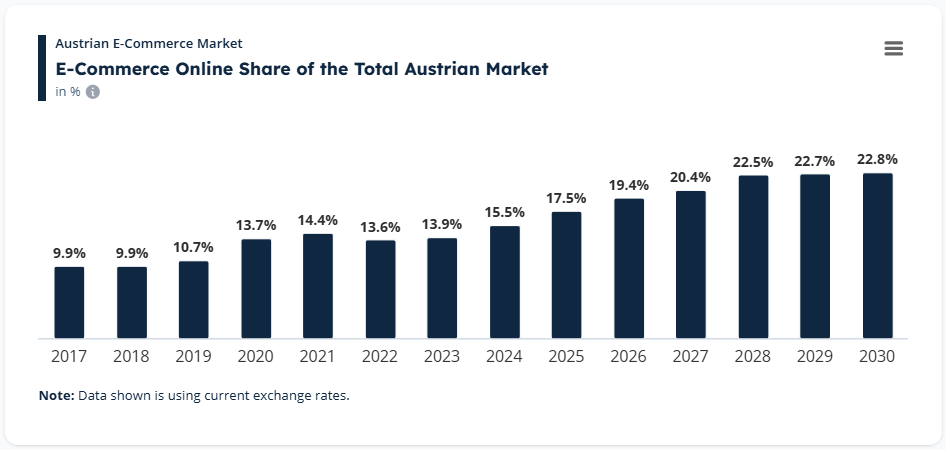
Looking further ahead, projections indicate that e-commerce could account for more than 22% of Austria’s retail activity by the end of the decade.
This growth in online penetration reflects deeper changes in consumer habits. Austrian shoppers increasingly move between physical and digital channels without treating them as separate environments. Many customers research products online before buying in stores, while others start browsing in physical stores and complete purchases online later.
Several trends contribute to this shift:
- improved mobile shopping experiences
- faster delivery services across urban areas
- better integration between physical and digital retail channels
- rising familiarity with international e-commerce platforms
Another important factor is generational change. Younger consumers have grown up with digital marketplaces and see online shopping as the default option for many product categories. As these consumers gain more purchasing power, e-commerce penetration naturally increases.
At the same time, traditional retailers in Austria have invested heavily in omnichannel strategies. Many brick-and-mortar brands now operate integrated online platforms, click-and-collect services, and digital customer loyalty programs.
For retailers and platforms entering the Austrian market in 2026, the implication is straightforward: e-commerce is becoming one of the core components of retail strategy.
Cross-border shopping and international platforms
One of the defining features of the Austrian e-commerce market is the strong presence of cross-border retail. Austrian consumers frequently purchase goods from international online stores, particularly those based in Germany.
This dynamic is clearly visible in marketplace performance. Among the top e-commerce platforms serving Austrian customers, Amazon’s German domain (amazon.de) dominates the market by a large margin. Its gross merchandise value associated with Austrian buyers reaches $5.936.3 million, far exceeding any local competitor.
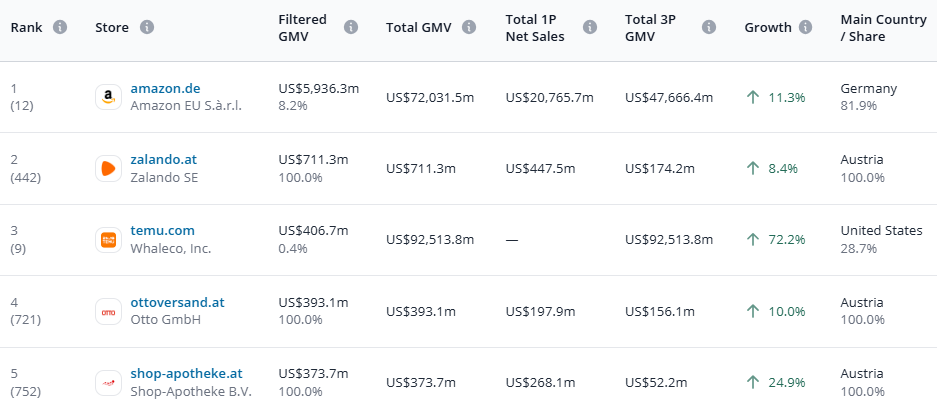
Other prominent players include:
- Zalando.at, generating about $711.3 million in GMV
- Temu.com, which has rapidly expanded to roughly $406.7 million
- Ottoversand.at, with about $393.1 million
- Shop-Apotheke.at, at approximately $373.7 million
The presence of German e-commerce platforms reflects both geographic proximity and consumer familiarity. German online retailers often operate German-language websites that already serve Austrian customers naturally.
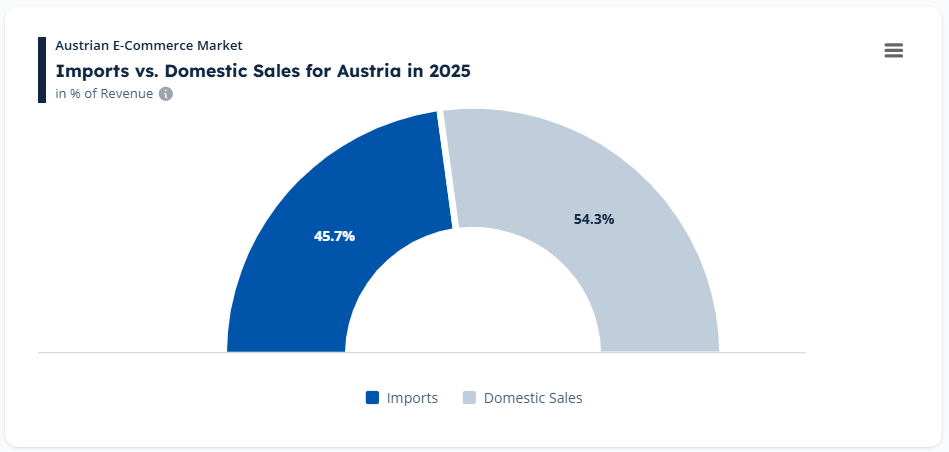
This cross-border behavior is also visible in import patterns. In 2025, roughly 45.7% of e-commerce revenue in Austria came from imported goods, while domestic retailers accounted for about 54.3%.
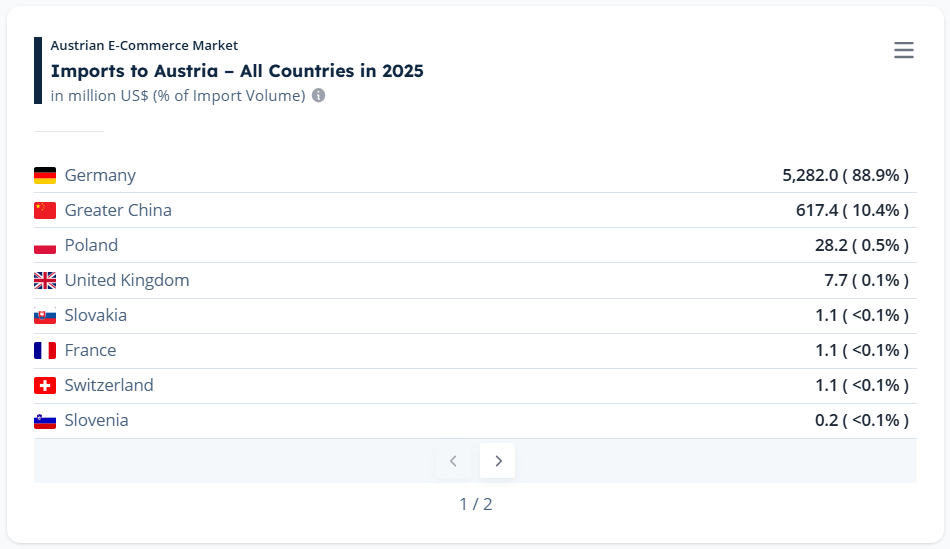
Among imports, the overwhelming majority comes from Germany. German e-commerce suppliers account for nearly 88.9% of import volume, followed by a smaller share from Greater China at around 10.4%.
Several factors explain this dominance:
- shared language and similar product standards
- well-established logistics connections
- strong German e-commerce platforms
- high trust in German brands
This cross-border dynamic shapes the competitive environment in Austria. Local retailers compete not only with domestic rivals but also with large European marketplaces.
Product categories shaping Austrian e-commerce
Another useful lens for analyzing the Austrian market in 2026 is the distribution of e-commerce revenue across product categories.
While several segments contribute to online retail, a few categories consistently generate the largest shares of revenue.
Fashion and electronics remain particularly influential. Fashion alone account for roughly 20–23% of e-commerce revenue, making it one of the most significant categories in Austria’s online market.
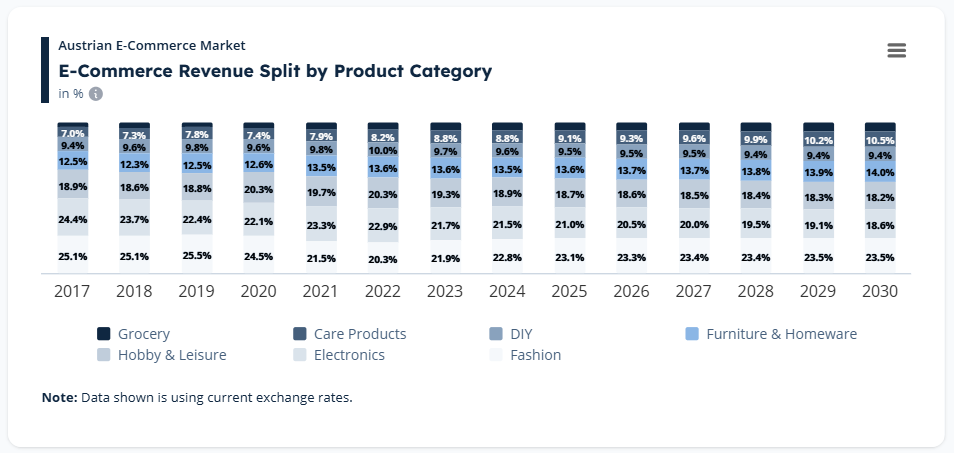
Other important sectors include:
- hobby and leisure products
- home and furniture items
- DIY and home improvement goods
- care products
- grocery e-commerce
The dominance of electronics reflects broader European trends. Products such as smartphones, laptops, home appliances, and consumer electronics are particularly suited for online retail because buyers can easily compare specifications and prices across platforms.
Fashion also remains a strong e-commerce category. Platforms like Zalando have built large customer bases by offering extensive product selection, free returns, and flexible delivery options.
The structure of category distribution in Austria reveals an important pattern. Rather than one category dominating the market entirely, several segments contribute meaningful shares. This diversification helps stabilize the e-commerce sector and reduces dependence on any single industry.
Retailers entering the Austrian market in 2026 should pay close attention to category dynamics. Consumer expectations, return policies, delivery speed, and product discovery methods often differ significantly between categories.
Delivery expectations
Reliable logistics infrastructure is another reason the Austrian e-commerce market continues to grow steadily.
Austria benefits from an efficient transportation network and well-developed courier services. Several delivery companies dominate e-commerce shipping across the country.
Among them, Österreichische Post plays the largest role. The national postal operator handles roughly 52.4% of e-commerce shipments, making it the backbone of Austria’s parcel delivery ecosystem.
Other major logistics providers include:
- DHL, used by about 34.7% of online retailers
- DPD, serving roughly 29% of stores
- GLS, used by around 19.9%
- UPS, present in about 11.9% of e-commerce operations
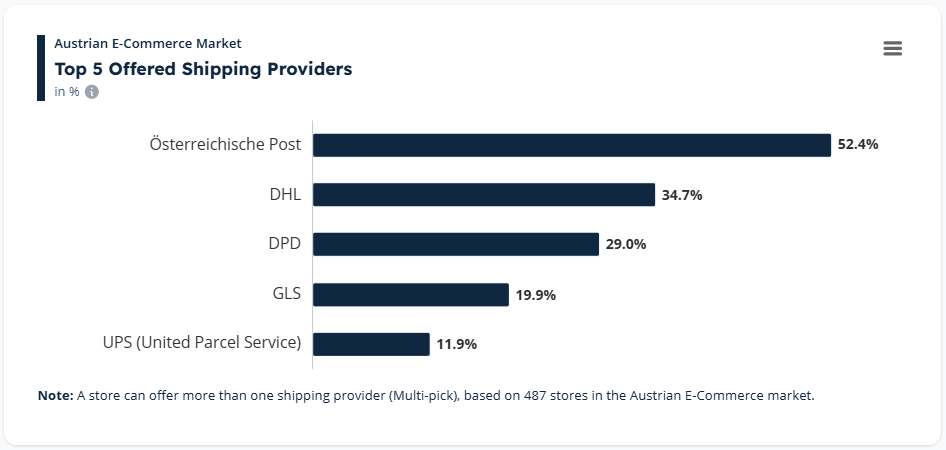
This diversified logistics landscape helps maintain fast and reliable delivery across both urban and rural areas.
Consumers in Austria increasingly expect delivery experiences that match those offered by major international marketplaces. These expectations include:
- predictable delivery times
- flexible pickup options
- clear tracking information
- simple return processes
Logistics innovation will therefore remain a critical factor shaping the Austrian market in 2026. Retailers that invest in delivery reliability and convenience will have a significant advantage in attracting and retaining customers.
Last words on Austrian market in 2026
Austria remains a highly competitive environment. International platforms play a major role, consumers compare prices carefully, delivery expectations remain high. Retailers that succeed here usually focus on reliability, truth, clear product positioning, and smooth customer experiences.
For businesses watching the Austrian market in 2026, the message is relatively simple. The country may not deliver explosive e-commerce growth, but it offers something equally valuable: a stable, mature market where companies that build trust and deliver consistent service can grow steadily over time.