Behind the Click Podcast with Larissa Schmid: How small brands take on industry giants
Written by
Editorial TeamPublished on
Discover how saint sass scaled from a Berlin startup to a global brand. In this Behind the Click episode, Larissa Schmid, Co-Founder & CEO of saint sass shares real insights on Meta ads, growth and competing with giants.
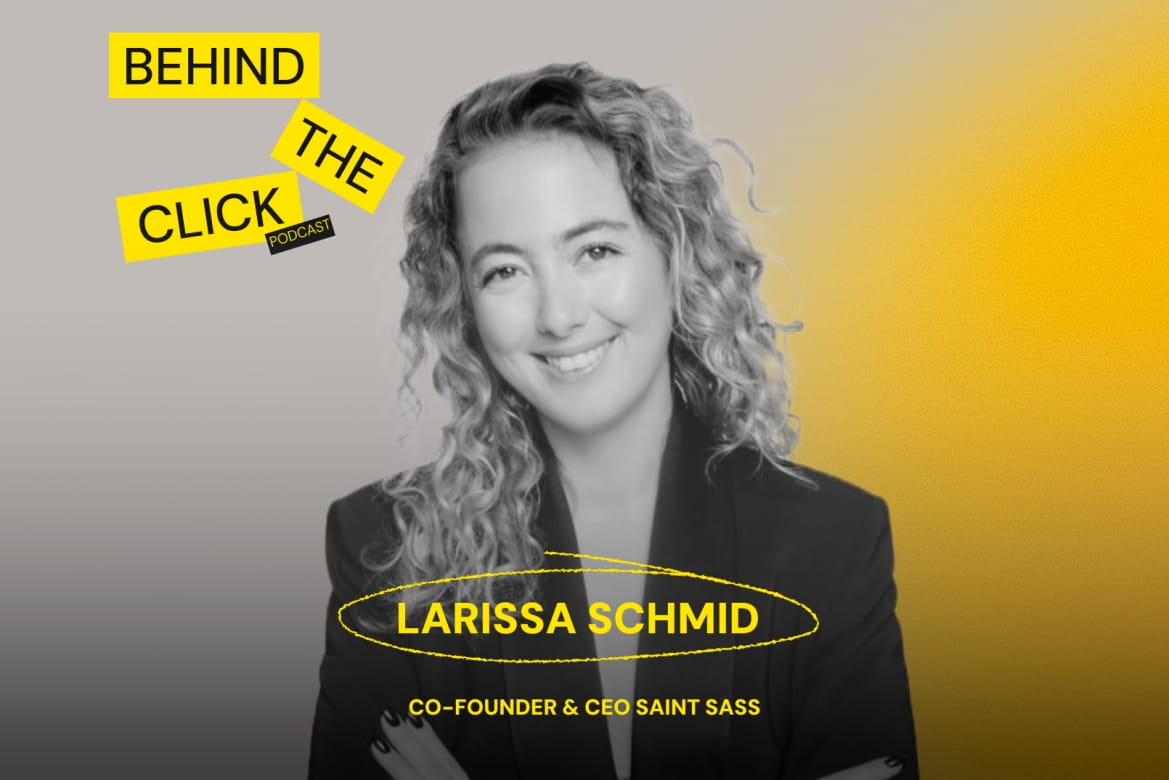
In the latest episode of Behind the Click Podcast, our host Janine Vanessa Heinrich talked with Larissa Schmid, Co-Founder & CEO of saint sass, tracing the company’s path from a Berlin startup to a globally recognized brand worn by names like Madonna and Cynthia Erivo.
But the conversation quickly moved past the headline moments. What emerged instead was a story about timing, testing and a very deliberate focus on cultural relevance.
The truth about celebrity impact
The mythology of brand growth often starts with celebrity. In saint sass’s case, it didn’t.
“We didn’t start by thinking, okay, how can we build a brand that Madonna wants to wear,” Larissa said. “We thought, how can we build a brand that is social, shareable and that people want to be associated with.”
That distinction runs through the entire story.
The company’s breakout product – its statement tights – wasn’t just a design decision. It landed at a moment where bold, self-expressive messaging aligned with a broader cultural shift. The product gave customers a way to signal identity, not just style.
Celebrity adoption, when it came, followed that foundation, not the other way around.
Quote / Larissa Schmid, Co-Founder & CEO of saint sassWe didn't start by thinking how can we build a brand that Madonna wants to wear.
When Madonna wore saint sass, it didn’t instantly translate into revenue on its own. The effect depended on what happened next.
“It depends a lot if the celebrity tags you,” Schmid said. “ (…) if they don’t tag us, the effect is way less on revenue.”
In Madonna’s case, the impact was amplified because the moment didn’t stay isolated. It spread through PR, media coverage, and social channels. “We were basically everywhere PR-wise,” Larissa recalled.
That amplification loop – celebrity visibility followed by media pickup – is what turned attention into measurable business results. Without it, even high-profile exposure can remain just that: exposure.
Why emotion outperformed everything else
If there is one tactical takeaway from the episode, it’s how saint sass approached performance marketing from the beginning.
While competitors focused on product features, durability, quality, technical benefits, saint sass discovered early that this angle simply didn’t resonate. Instead of explaining the product, the brand focused on expressing what it represents: confidence, identity, attitude.
“It’s a feature, you know – it’s not an emotion,” she added, referring to traditional product-led messaging. Years later, that principle still holds. Emotion-led creatives continue to outperform feature-driven ones.
Testing before building
Another thread running through the conversation was how little saint sass relied on assumptions in the early days.
From day one, the team used Meta ads as a testing engine, trying different hooks, formats, and narratives, then scaling what worked. The same philosophy carried into international expansion.
When entering the US, they didn’t start with infrastructure. They started with validation.
“We always test with a very small budget on Meta,” Schmid explained. “Only if the country shows any potential, we then optimize shipping and website.”
The signal in the US came quickly and clearly. Performance metrics outpaced Germany, even though the brand was already established there.
For saint sass, that was enough. The rest came later.
Competing with giants – and being copied by them
As saint sass grew, it inevitably attracted attention from much larger players. At one point, a major tights brand launched a campaign closely resembling their concept. But the response wasn’t legal – it was strategic.
By that point, saint sass had something more defensible than product design: recognition. They leaned into it, positioning themselves as the original and using their voice to communicate it.
The reaction from customers was immediate. Community support translated into increased awareness and even a rise in revenue.
For Schmid, the lesson is clear: speed and brand identity can be more powerful than scale.
What remains non-negotiable
Toward the end of the episode, our host asked Larissa what small brands should focus on if they want to compete today.
Her answer wasn’t about channels or tactics.
“I think the courage to build a brand that is true to your values and that has cultural relevance,” she said. “Absolutely non-negotiable.”
It’s a simple statement – but one that reflects everything behind saint sass’s growth: not just performance marketing discipline, but clarity about what the brand stands for and why it exists.
To hear interview with Larissa in full, in her own voice and with all the nuance that can’t fit on a page, watch the complete episode of Behind the Click:
You can also listen to the episode on the Spotify or Apple Podcasts.