“True success happens when technology amplifies the human side of commerce”: 10 lessons from Armand Farsi, Fanatics Inc.
Written by
Editorial TeamPublished on
Discover 10 valuable e-commerce lessons from Armand Farsi, General Manager Germany at Fanatics Inc. as he shares his insights on the future of online retail to mark the 10th anniversary of the E-commerce Berlin Expo. [EXCLUSIVE INTERVIEW SERIES]
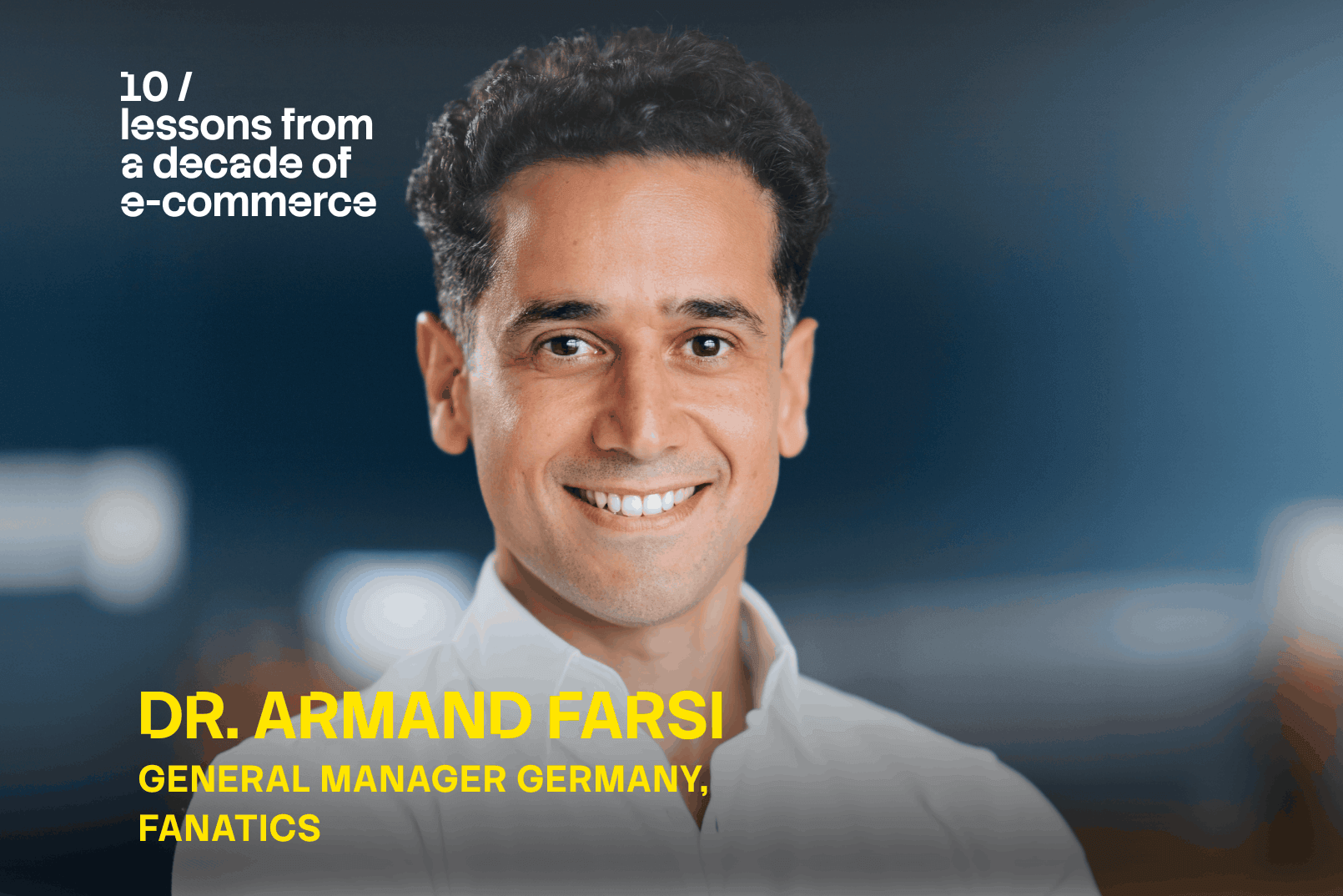
The E-commerce Berlin Expo celebrated its 10th anniversary in 2026. To mark this milestone, we interviewed some of the world’s most influential leaders about the future of online retail, asking them to share their 10 valuable lessons in e-commerce. Their insights were featured in our special album, showcasing the most powerful voices in online retail, which we decided to share with you on E-commerce Germany News.
This time, we’re featuring an exclusive interview with Armand Farsi, General Manager Germany at Fanatics Inc. See what e-commerce lessons he shared with us below!
PERFECTION IS THE ENEMY OF GOOD
What first drew you to this industry?
ARMAND: After my career start in strategy consulting, followed by a PhD program, I wanted to enter a “proper” field of expertise. Back in 2012, e-commerce was still nascent. When approached by a headhunter for an exciting role at Europe’s leading e-commerce outsourcing provider, it was a no-brainer to embark on that ride.
Which early failure taught you something that still guides you today?
ARMAND: “Perfect is the enemy of good.” In the consulting world, you are paid to bring an outside-in perspective, always very polished, sophisticated – and sometimes a bit theoretical. While this is what’s often needed, only once you start owning the real-life execution yourself you realize that not every outcome of an analysis or what’s on flashy slides is possible when faced with operational realities and limitations.
Quote / Armand Fars, General Manager Germany, Fanatics Inc.Over time, I’ve realized that efficiency is essential, but it’s not enough. True success happens when technology amplifies the human side of commerce
When you think of the past decade of e-commerce, what do you miss – and what are you glad we left behind?
ARMAND: What I miss most from the early days is the sense of discovery – the feeling that we were collectively shaping a new frontier of customer experience. Every innovation felt like unlocking a new way to bring passion to life. At the same time, I’m glad we’ve moved past the era of chasing surface-level growth and simplistic metrics. E-commerce today is richer, more emotional, and more human than it was a decade ago. We understand far better that fandom isn’t transactional – it’s about identity, loyalty, and belonging. Leaving behind the old playbook allowed our industry to evolve into one that celebrates the depth of that connection.
What is the single most important business lesson you have learned throughout your career?
ARMAND: There is a book called “The Hard Thing about Hard Things” by Ben Horowitz. Lots of truth to it.
IT’S ALL ABOUT EXPERIENCE
How would you define success in e-commerce today, and how has your view of it changed over time?
ARMAND: My definition of success has shifted from operational optimization to emotional resonance. In sports, fans don’t just buy products – they express loyalty, memories, and identity. Today, success means being able to translate that emotional energy into seamless, inspiring experiences across every touchpoint. It’s about serving fans with the right product, at the right moment, in a way that feels personal and meaningful. Over time, I’ve realized that efficiency is essential, but it’s not enough. True success happens when technology amplifies the human side of commerce and when fans feel genuinely seen, valued, and understood.
What do you see as the biggest opportunity in e-commerce today?
ARMAND: For my industry (sports fan gear): The biggest opportunity lies in closing the gap between digital commerce and the emotional intensity of live sports. Fans want more than convenience – they want connection, storytelling, and products that make them feel part of something bigger. Advances in AI and personalization make it possible to serve fans in ways that mirror how they experience their favourite teams: passionately, instantly, and authentically. Brands that can bring these worlds together – the scale of e-commerce and the soul of fandom – will unlock remarkable growth. The next wave of innovation will be defined by experiences that go beyond shopping and become moments of participation and pride.
What’s the most counterintuitive or unconventional thing your company does today that actually works?
ARMAND: For selected moments and capsules, we intentionally lean into scarcity and storytelling in a world that prizes endless availability. Instead of offering everything all the time, we create curated, moment-driven drops that mirror the emotional rhythm of sports – anticipation, excitement, celebration. It may sound counterintuitive, but limiting choice amplifies meaning. Fans connect more deeply with products tied to a story, a moment, or a shared feeling. By designing for emotion rather than abundance, we consistently see stronger engagement and more loyal communities.
Progress in e-commerce is rarely linear
What guiding principle do you personally refuse to compromise on, no matter the trend or pressure?
ARMAND: I refuse to compromise on being fan-first (that is, customer-first). Technology evolves, platforms change, and trends rise and fall – but the emotional core of our work remains constant. Fans entrust us with something deeply personal: the symbols of their identity and devotion. I believe every decision, big or small, should honour that trust. Staying true to the fan perspective provides clarity in complexity and integrity in growth. If we keep the fan at the centre, everything else aligns naturally.
Looking ahead, what will define the next decade of e-commerce, and how does thinking about the future make you feel – optimistic, excited, concerned, or something else?
ARMAND: The next decade will bring more intuitive, personalized experiences where technology quietly supports the emotional side of commerce. AI agents will help simplify choices and anticipate what feels meaningful to each fan, making interactions smoother and more natural. This evolution makes me optimistic, because it allows e-commerce to become more human – not less – and to strengthen the passion and connection that define sports fandom.
If you could leave a message for future e-commerce leaders, what would it be?
ARMAND: Never forget that behind every order is a person. Lead with empathy, curiosity, and respect for the role your brand plays in someone’s life. And remember: Progress in e-commerce is rarely linear – embrace change with confidence and humility. If you stay customer-focused, values-driven, and open to learning, you’ll shape not only your business, but potentially the future of your industry.
ARMAND’S BIO
Armand Farsi was born and raised in Hamburg, Germany, as the son of Persian immigrants. He studied business in Germany, Spain, and the USA. He started in strategy consulting at BCG, earned a PhD in sociology, and in 2012 entered the world of e-commerce at Arvato/Bertelsmann. Lately, he has focused on sports fans at the core, in a broader role beyond e-commerce at Fanatics. See his LinkedIn profile.