BEHIND THE CLICK PODCAST WITH ISABELL WEISER: WHY LIVE COMMERCE IS MOVING FAR BEYOND COLLECTIBLES
Written by
Editorial TeamPublished on
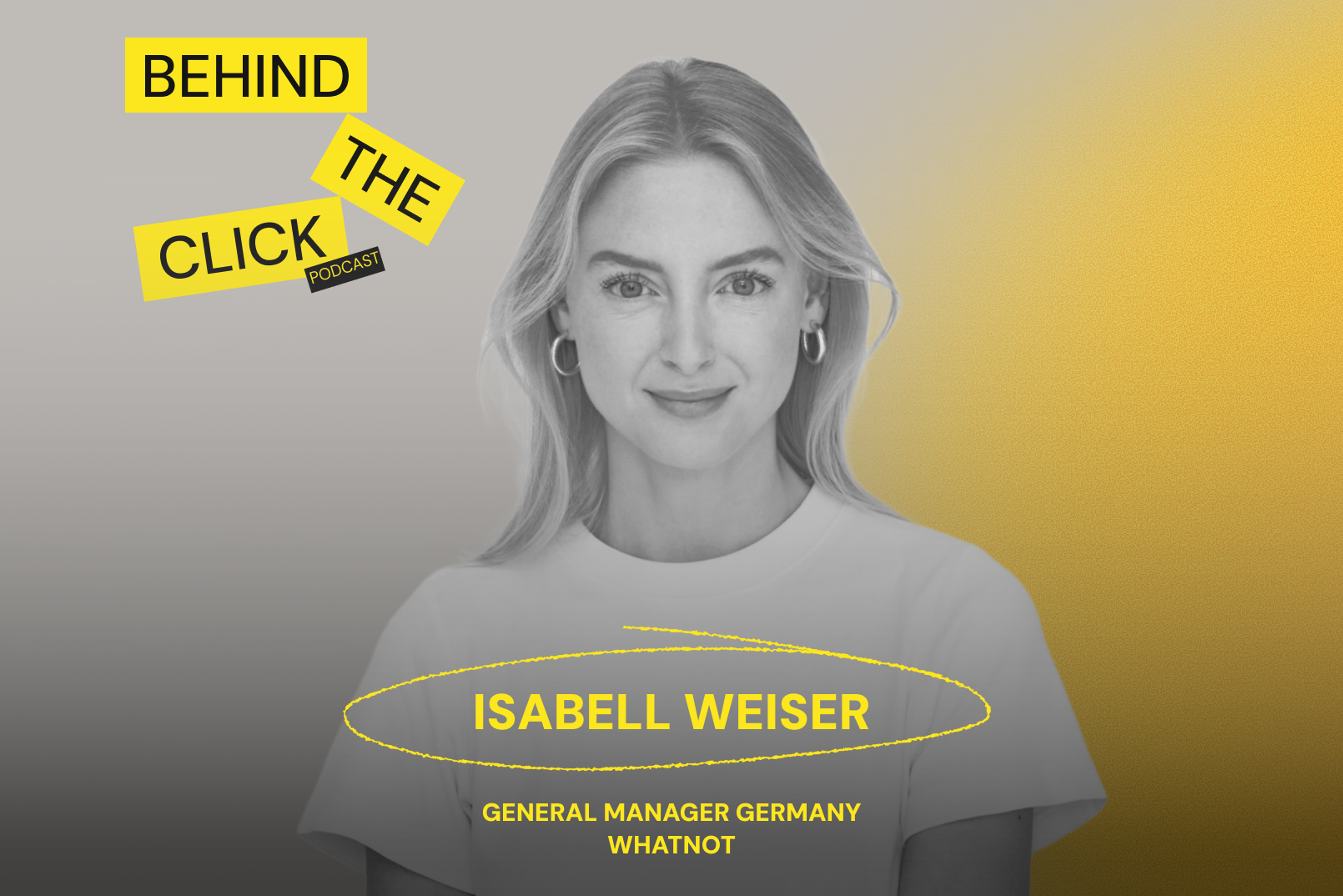
Discover how Isabell Weiser, General Manager Germany at Whatnot, explains why live commerce is no longer just for collectors, why seller personality matters more than price, and what retailers should ask themselves before going live, in the latest Behind the Click Podcast episode.
What happens when shopping stops being just a transaction and starts becoming a community?
That was the question at the heart of the latest episode of Behind the Click, hosted by Janine Heinrich. This time, Janine was joined by Isabell Weiser, General Manager Germany at Whatnot, for a conversation that moved from Pokémon cards and sugar sachets to fashion, trust, company culture and the future of shopping in an age of AI.
And one idea kept resurfacing throughout the conversation:
Seller personality is the number one reason people come, ahead of price and product selection.
Live commerce is not social commerce
Live shopping has been called “the next big thing” for years without ever quite arriving. According to Isabell, many early experiments were white-label solutions: heavily curated streams that felt closer to an advertorial than to a real conversation. They could work for a moment with a great deal, but they rarely built anything lasting.
She drew a clear line between two models that are often lumped together:
- Social commerce is usually content-first. An algorithm suggests a video, and a shoppable link lets you buy later. The format is still largely static.
- Live commerce is interactive, seller-first and discovery-based. You browse live streams in the categories you care about, talk to the seller and to other viewers, and buy in the moment.
Whatnot, she stressed, does only live commerce, and has done so since its founding in 2019. Live shopping took off in China first, where she said it makes up almost 30% of e-commerce, compared with single digits in the US. In her view, Whatnot was the first company to prove that the model also scales in the Western world.
Because every viewer has entered a credit card and a shipping address, she explained, the audience is made up of buyers with intent. A live stream therefore needs far fewer concurrent viewers to be successful.
Starting with collectors, but not staying there
Whatnot began with Funko Pops, then moved into Pokémon, sports cards and other collectibles. According to Isabell, that niche was an ideal starting point. A marketplace faces a classic chicken-and-egg problem, and a small, passionate user group makes it much easier to understand their problems and build real value for them.
But the platform has changed. She said Whatnot now has more than 200 categories, and fashion is the biggest one. It spans small boutique brands, vintage, luxury resale (especially handbags), sneakers and streetwear, and surplus stock. Collectible sneakers and handbags were the bridge that led organically from collectibles into fashion.
A playbook for launching categories, but every launch starts from zero
Is there a repeatable formula for entering a new category? Isabell’s answer was both yes and no.
There is a Whatnot playbook that defines the key levers and the metrics that show whether a launch is on track. But each category is a new cold start. Great sneaker sellers mean nothing to coin sellers.
What the playbook always includes is going deep into the community. When Isabell started in Germany, the “GM” title was a fancy name for being the only person in the country. Launching Pokémon cards meant messaging around 100 sellers a week on Instagram, spending time at card shows and onboarding each seller personally through a one-to-one Zoom call.
That is why Whatnot gives one smart person holistic ownership of each launch, equipped with the right tools and a little guidance, and then lets them figure it out. In her words, it is both playbook and entrepreneurial thinking.
Why Germany needed more trust than anywhere else
Launching across markets taught Isabell more about cultural differences than anything else in her career. She openly said she had underestimated how much trust German sellers and consumers would need, along with a healthy skepticism towards anything new.
Her answer was education: explaining how live commerce works, why it works, how sellers can make it work for them and what has worked elsewhere, one conversation at a time.
The upside of that skepticism is loyalty. Live shopping is still far from mainstream in Germany, but she argued that once people have tried it, the format builds trust naturally. A real person stands in front of the camera, shows the product live and keeps coming back to the same audience, which is very different from an opaque listing page. And once you have won the trust of German consumers, as she put it, you are in.
Trust is built into the platform
Because streams are fast and auction-style, trust cannot be left to chance. Isabell called it one of the company’s most important topics and said a third of employees work in trust and risk. The measures she described include:
- verification of all sellers, including two-factor checks via Stripe
- monitoring of live streams and a way for viewers to report problems
- buyer protection if something goes wrong
- a clear ban on shill bidding, with systems (increasingly AI-supported) that detect when someone related to the seller is bidding
- a relaunched Trust Center, which she called particularly important for the German market
She said the average seller rating on the platform is above 4.9.
Personality, consistency, product
Asked what matters more, who is selling or what is being sold, Isabell was clear. Based on user research, seller personality is the number one reason people come, ahead of price and product selection. A good selection, she said, is almost a hygiene factor, although amazing inventory can compensate to some extent.
The host cited a figure of around €475 in GMV per live stream hour for German sellers, which Isabell described as the average across all German sellers. Top sellers, she said, earn significantly more. If she had to boil down the difference to three things, they would be:
- Personality: the banter and the chat in between, and the way sellers greet viewers by name
- Consistency: the most successful sellers are live almost every day, because people want to be able to join their favourite seller at any time rather than put a stream in their calendar
- Product
On retention, she cited 80% month-over-month. She also said buyers purchase roughly ten items per week, while noting she would need to check the latest number. Smart bundling combines items from the same live stream into one parcel to reduce shipping costs, though it does not yet work across different sellers.
Dogfooding: everyone goes live
One of the more unusual parts of Whatnot’s culture is dogfooding. According to Isabell, employees are expected to use the product as customers: they go live themselves, buy on the platform and handle a few customer support tickets every quarter, and this is part of performance reviews. A seller also joins the weekly all-hands to answer questions from the whole company.
The reasoning is simple. It is hard to advise sellers on how easy it is to get started if you have never done it yourself, and sellers do not always report every small annoyance. When employees go live, they discover issues themselves. The biggest shared learning, she said, is that shipping and packing are the least fun part, which is why simplifying it is a constant focus.
Isabell herself usually sells fashion, mostly clearing out a few items from her own closet. As the company grows, she said, accountability, tracking and very careful hiring are how the culture is protected.
Fresh fish and the future of shopping
Looking ahead, Isabell is particularly excited about the fresh foods category, including fishermen who go live from their boats and ship the catch overnight. It also connects to her own earlier startup, a creator platform for culinary influencers, where she saw the same pull towards live interaction and asking experts questions.
As for AI and agentic commerce, she believes two things can be true at once. A significant share of shopping will be automated, but people will then have more time for the things they enjoy and will still look for human interaction. Her view is that live commerce will work in every category, but as a segment within each one. You would not spend time in a stream for something you can reorder with one click, but almost every category has a high-involvement part people want to spend time on.
Before you go live, know why
Her advice for retailers considering live commerce was to be very clear about why you are doing it. Do you want to sell more, move a specific type of inventory, talk to your community, or create a fun marketing moment? Then commit: she recommends at least three months of going live multiple times a week, and approaching it as an experiment. You do not need a studio. A phone, maybe a tripod, and a willingness to talk to the people in the chat are enough.
The recurring message across the episode is consistent: build real relationships, stay close to your community, and let the human side of shopping lead.
Watch the full episode with Isabell Weiser
The full conversation goes much deeper into launching categories, German market culture, trust and safety, seller economics and Whatnot’s dogfooding culture. To hear Isabell explain it in her own words, watch the complete episode of Behind the Click:
You can also listen to the episode on Spotify and Apple Podcasts.