Black Friday approaches for e-commerce
Discover 5 expert-backed approaches to Black Friday, from month-long sales to skipping it entirely, and learn which strategy fits your brand best.

Black Friday is no longer a single-day shopping frenzy. Some brands actually turn it into a month-long revenue machine, others treat it as their only sale of the year, and some choose to sit it out entirely. No matter which camp you’re in, Black Friday remains one of the most important moments of the retail calendar.
In this article, we’ve pulled together 5 different questions revolving around different approaches to Black Friday and included exclusive perspectives from e-commerce experts from well-known brands which may help you decide which way is the one for you.
Question 1: Should you go along with Black Friday or sit it out?
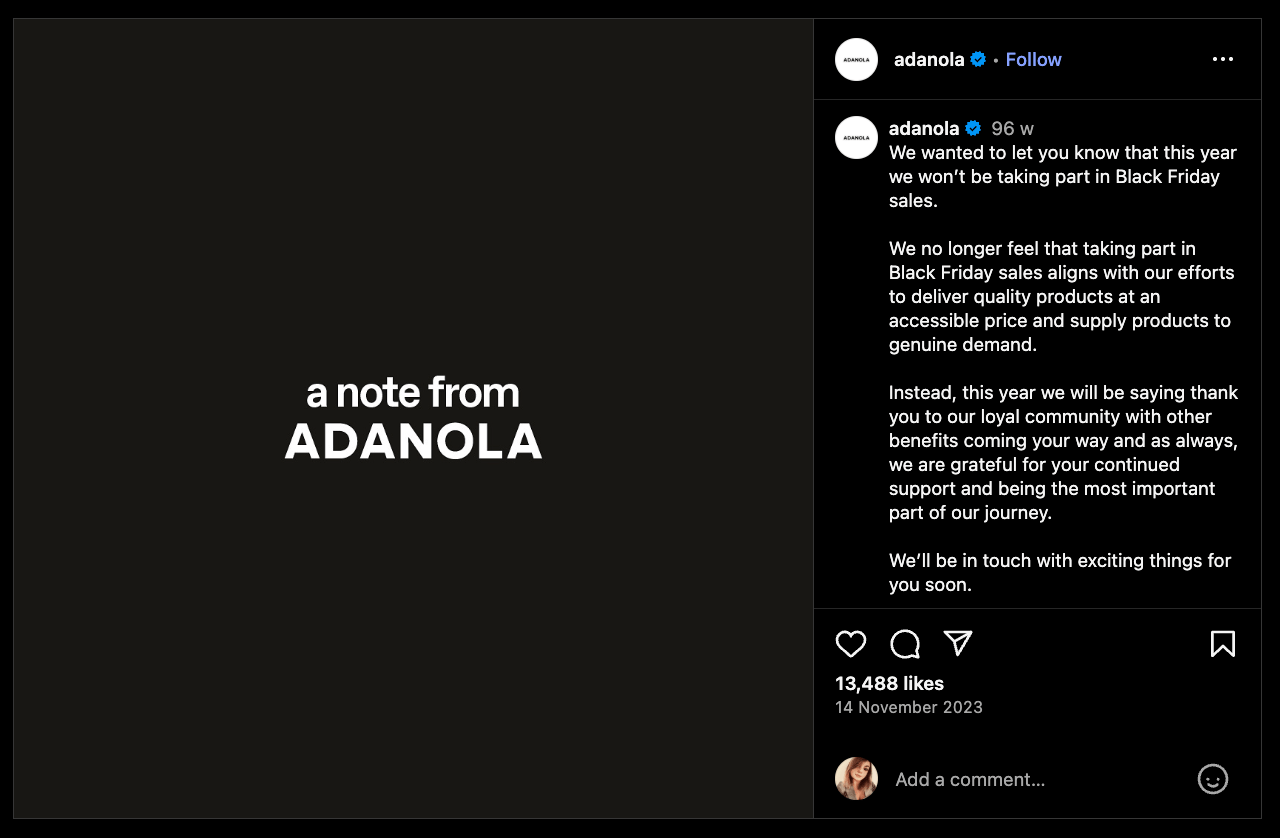
Nowadays when approaches to Black Friday vary significantly, there is no surprise that some brands decide to say no to it. One such example is Adanola (UK activewear) which made headlines in November 2023 when they posted on Instagram: “We won’t be taking part in Black Friday sales.” Their reasoning: they felt the event didn’t align with their goal of delivering “quality products at an accessible price” and supplying “genuine demand.”
But is sitting out a wise choice for most brands? According to Nele Odzuck, Group Vertical Director at TikTok, “In most cases, skipping Black Friday is a significant miss”.
As she explained “Especially in the current economic environment, consumers are much more deliberate about their spending and are waiting for key shopping moments like Black Friday to make bigger purchases. Studies show that 38% of German consumers plan to spend more during Black Friday / Cyber Monday than in previous years, while 71% of global shoppers cite discounts as their primary motivation.
For brands, sitting out often means missing a critical opportunity for visibility and new customer acquisition. On TikTok Shop, the data speaks for itself: in the UK, shoppers increased 165% year-over-year during Black Friday / Cyber Monday, and over $100 million in sales happened on Black Friday alone – triple the year before. This illustrates how important the event has become, both for driving immediate sales and for building long-term customer pipelines”.
She’s also not sure if skipping Black Friday can help sales long-term.
“If done strategically, perhaps – for example, premium brands can use non-participation to emphasize exclusivity. But for the majority, skipping Black Friday entirely is not advisable. The better path is to analyze customer insights and find the discount “sweet spot” that satisfies demand without damaging margins or brand perception.
On TikTok, even brands that are cautious about deep discounting can still participate meaningfully by focusing on limited-edition drops, bundles, or TikTok-first product launches. This way, they remain part of the cultural moment without turning their brand into a “discount-first” player”.
But not every brand opts to sit out. Some have other ideas. For example, Tentree prefers to choose an alternative, reframing the season entirely. Rather than joining in with standard promotions, they run “Green Friday”: a mission-driven alternative to BF that combines sustainability, planting trees, ethical supply, and purpose. In their recent campaign, they planted over 1 million trees via Green Friday promotions, which helped drive community engagement and loyalty.
Nele Odzuck is much more aligned with this approach to Black Friday. As she mentioned to us, alternatives that often work well from her perspective involve “Single day specials” or “playful formats”: for example birthday-sales (celebrating brand’s founding), or flash deals targeted at specific customer segments. Experiential or content-led offers also tend to work well. In this approach, instead of blasting prices, brand builds engagement via content challenges, creator-driven unboxing, or live shows – with exclusive offers embedded, rather than feeling like traditional discounting.
“We also see generic “Promotion Days” within TikTok Shop driving strong results. The system automatically increases ad spend when it detects extra GMV potential, often leading to +47% higher sales. And with ROI Protection, if campaigns underperform despite following best practices, brands automatically receive ad credits back – providing a performance safety net” commented Nele Odzuck.
Additional, exclusive insights from Nele Odzuck, Group Vertical Director at TikTok:

How to balance customer expectations for deals with maintaining pricing integrity?
It’s vital to be transparent, strategic, and selective. Some tactics:
Segmented deals: e.g. “members only”, “core customers”, or early-access promos. These allow brands to offer value without undermining full-price perception for everyone.
Pre-announced deals: Build awareness and anticipation before the moment, so that consumers are ready and the volume is there. On TikTok, strong performance during Black Friday / Cyber Monday came from campaigns that started well ahead of the date window. For example, TikTok Shop saw ~165% year-on-year growth in shoppers over the Black Friday / Cyber Monday period, and a surge in content & live events before the actual day. Newsroom | TikTok+1
Deal “sweet spots”: Study which discounts are meaningful to your audience but still allow margin. Sometimes smaller, frequent deals can outperform one deep discount that hurts perception or margin.
Align deals with brand values: If your brand stands for exclusivity, craftsmanship, sustainability, etc., the nature of the deal – and how it’s communicated – must reflect those values. E.g. limited-edition drops, bundles, or exclusive access.
On TikTok, the most successful brands balance pricing integrity with creativity. For instance, affiliate content allows fans, creators, and loyal customers to do the storytelling. Campaigns with affiliate content on TikTok Shop drive 1.6× higher GMV growth, because more authentic and diverse creatives connect better with audiences. In other words: more content = better performance = less effort for the brand.
If you do participate, how do you ensure it aligns with your brand values?
Key principles:
Put yourself in the customer’s shoes: What do they expect? Would they feel betrayed if a time-limited deal is extended or doubled? Transparency is essential. Don’t promise something like “24-hour only” then stretch it later – it hurts trust.
Match the type of offer to your values: If your brand is about exclusivity, luxury, craftsmanship, then perhaps offer exclusive bundles, early access, or curated sets rather than mass deep discounts.
Use creative storytelling: Leverage TikTok’s formats (short video, live, creator partnerships) to explain why the deal exists – not just that it exists. For instance: “we reduced margin so more people can try us,” or “we’re partnering with creators to offer limited-edition items,” or “a portion goes to charity” etc.
Short-term vs long-term value: Deals should drive acquisition but also retention. Use this period to capture new customers, but ensure your service, packaging, post-sales follow up, retention incentives are strong, so that the relationship continues beyond the sale.
On TikTok, authenticity is everything. That’s why tools like smart+ and GMV Max, our AI-driven performance commerce solution, are so effective. GMV Max optimizes organic, paid, and affiliate content to surface the creatives that truly drive sales. For brands, this means less manual campaign tweaking and more time focusing on telling the brand story in ways that resonate with customers.
Final note from Nele Odzuck:
Black Friday on TikTok is not just transactional – it’s cultural. With billions of views on hashtags like #TikTokShopBlackFriday (4B+) and #TikTokShopCyberMonday (3.5B+), brands that combine authentic content, strategic discounting, and performance tools like affiliate content and GMV Max can turn this seasonal peak into long-term growth.
Question 2: What and how to discount?
Slashing prices might win clicks, but if done wrong it can leave your finance team with a holiday hangover. Black Friday is notorious for margin erosion, especially if you discount across your entire store without a plan. Instead of racing to the bottom, it’s better to choose tactics that preserve value and delight customers.
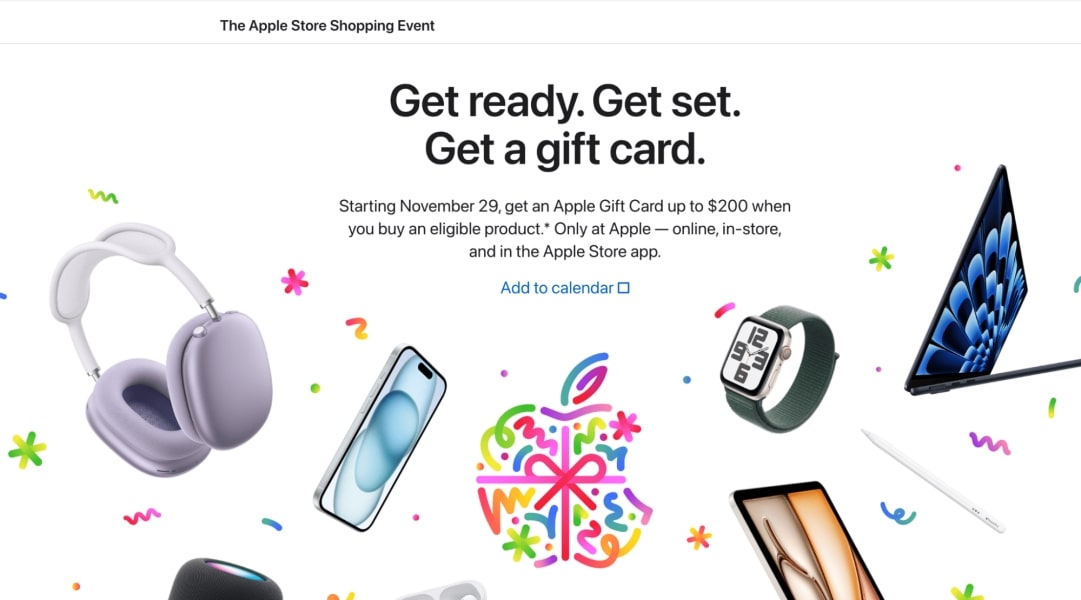
One smart approach is to offer perceived value without cutting list prices. Apple’s Black Friday playbook is a masterclass: during the 2024 Black Friday-to-Cyber Monday Apple Store Shopping event, Apple offered gift cards worth US$25–US$200 with the purchase of eligible iPhones, Macs, iPads, and more… instead of lowering prices on the devices themselves which drives urgency, rewards customers, and keeps their premium positioning intact.
You can also decide to take an alternative approach to Black Friday in this regard, for example, as shown by Nø Cosmetics. In the words of its CEO and Co-Founder, Caroline Renée Kroll:
“At Nø Cosmetics, we decided not to center Black Friday around discounts. Since 2022, we have closed both our retail stores and onlineshop on that day and instead highlighted charitable organizations that deserve more attention. For us, it’s less about choosing products and more about asking how we can engage with this phenomenon in a responsible way. Over time, this has become a yearly tradition that we feel strongly about continuing”.
“Instead of focusing on short-term sales, our “Nø Black Friday” campaigns highlight social causes and invite our community to reflect on their choices” added Caroline Renée Kroll. “It’s our way of adding purpose to a day that is usually dominated by consumption – and we’re excited to see how we can evolve this concept further this year”.
However, it doesn’t mean that they don’t offer promotions altogether, especially because they can see that the economic situation has become more difficult for many people. As Caroline said: “Last year, we received feedback from customers who shared that discounts are important to them, and some felt left out when we closed our shop. That’s why we try to create balance: for example, our brand’s birthday in early November has become our biggest sales moment of the year, where we offer meaningful promotions and gifts with purchase. In a way, this celebration has become our alternative to Black Friday and who knows, maybe this year’s edition will hold a few surprises”.
Additional, exclusive insights from Caroline Renée Kroll, CEO and Co-Founder of Nø Cosmetics:

Do you have any special advice on how brands could prepare for Black Friday?
Every brand has its own values, so there’s no one-size-fits-all approach. What worked for us was asking: how can we handle Black Friday in a way that feels authentic to our DNA? For some, that might mean discounts; for others, it could be campaigns with a charitable angle, or finding creative ways to engage customers before or after Black Friday. My advice would be to think carefully about how this day can be used to build trust and long-term relationships, not just short-term revenue.
Question 3: How to prioritize products and avoid store-wide chaos?
One of the fastest ways to burn through margin is to discount everything. A smarter play often is to focus on hero SKUs (the products that drive most of your revenue, bring in first-time buyers, or deliver the best margins) and leave the rest full price.
This approach keeps your offer compelling without turning your store into a bargain bin. It also helps you control inventory and forecast demand.
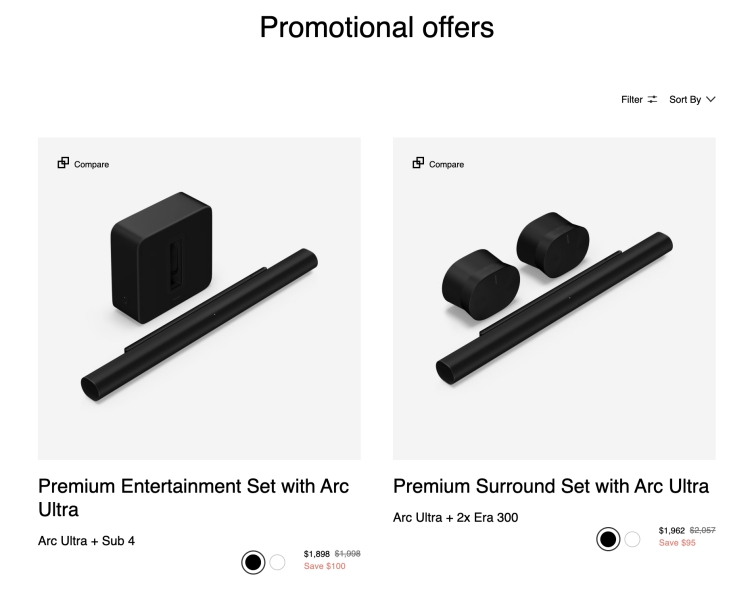
For example, Sonos consistently limits its Black Friday deals to a handful of high-demand products like the Arc, Era 100, and Ray soundbar. In 2024, they offered $180 off the Arc and $100 off Era 300 – enough to draw buyers in, but not so broad that it cheapens the brand.
Other example, Zara applies Black Friday discounts only to selected collections. Fashion roundups regularly note that it’s not a blanket discount but a curated selection of items. They also offer 1-hour early access for users of the ZARA app, allowing them to shop before the website sale begins.

Serkan Otles, Senior Director and Global Head of Business Development shared with us another interesting approach – at Phillips they choose bundling or tiered discounts on products that go well together:
“In the grooming and beauty category, perceived value often outweighs nominal discounts. We’ve successfully used premium bundles, exclusive accessories, and extended warranty offers – these deliver consumer excitement without price degradation. Value-adds like free personalization or limited-edition packaging enhance brand desirability and retention, especially in our premium segments.
We use solution-based bundling – combining products that solve a complete grooming or beauty routine. This increases perceived value while maintaining margin integrity. Tiered discounts are selectively deployed to reward higher baskets rather than encourage over-discounting. It’s about shaping shopper behavior, not chasing it”.
What he doesn’t really believe in is running a loss-leader for Black Friday. He sees it as a challenge, saying that: “A loss-leader can make sense if it fuels entry into the ecosystem or amplifies brand visibility in a competitive channel. But it must be intentional, time-bound, and paired with strong uptrade or cross-sell mechanics. For Philips, profitability discipline is key; brand trust erodes faster than margin recovers when deep discounts become the expectation”.
Additional, exclusive insights from Serkan Otles, Senior Director and Global Head of Business Development at Philips:

How do you calculate a “safe” discount threshold that doesn’t destroy margins?
At Philips, we start with a value-based approach rather than a percentage mindset. We assess the incremental volume elasticity versus margin dilution per product line. A “safe” threshold is one that protects brand equity and contributes to long-term category growth – not just short-term sell-out. Every discount is validated against contribution margin models and halo impact across channels, ensuring we drive profitable demand, not erosion.
What is the most important advice for brands preparing for Black Friday from your experience?
Treat it as a brand moment, not a clearance event. Start planning months ahead, aligning assortment, pricing, and storytelling under one brand narrative. Test and learn early with controlled offers to understand elasticity. And most importantly, ensure post-event continuity – the best brands turn Black Friday traffic into loyal, long-term customers, not one-off transactions.
At Philips, we’ve seen this approach pay off tangibly – we achieved consecutive market share gains across multiple Black Friday events in recent years thanks to this disciplined, brand-led mindset.
Question 4: How to avoid promo cannibalization?
When several promotions overlap (think Singles’ Day, flash sales, pre-Black Friday deals) they often eat into each other’s impact. If you run a big sale too early, customers may hold off, anticipating deeper discounts. If you follow up immediately with something else, it dilutes the urgency of Black Friday itself.
We asked Sabrina Thielgen, Head of Brand at MissPompadour about their approach to balance different occasion without discounting too often. This is what she said:
“Over the past few years, we’ve tested various strategies and repeatedly found that our products come with unique challenges around Black Friday and the holiday season. Paint is simply not a typical gift product. In addition, many of our customers are already caught up in pre-Christmas stress during November and December – which means painting isn’t usually top of mind, either in terms of time or budget.
That’s why our biggest campaign of the year takes place in October. During that period, our customers’ purchasing power for home improvement projects is at its strongest, allowing us to offer the most attractive deals. In doing so, we intentionally position ourselves ahead of the heavy discount period – before other brands launch their big sales and customers start allocating their budgets to gifts or tech products. As a result, our campaign peak already happens at the end of October.
For Singles’ Day and Black Friday, we focus on smaller, more targeted campaigns aimed primarily at existing customers. This approach enables us to segment our discounts more precisely. Not every customer group receives every offer. We spread our activities across different timeframes and communication channels to avoid an extended, broad-based discount phase. Instead of offering uniform discounts, we tailor different offers to match the specific needs of each customer segment”.
She explained to us that this thinking on their part is the result of seeing earlier campaigns eating into their Black Friday scores in the past. “This experience has encouraged us to separate campaigns more clearly in timing and to define our key promotional periods more deliberately – for instance, by focusing on October as our main sales window”.
Sabrina Thielgen also admitted that that they use data to time promotions, in a pragmatic way. “Over the years, we’ve identified certain monthly cycles where promotions tend to perform particularly well” she said. “We also rely on search trends, especially for seasonal topics. For instance, when it comes to outdoor paints and varnishes, we align our communication with the moments when search interest peaks and when our customers are typically ready to tackle these kinds of projects”.
Additional, exclusive insights from Sabrina Thielgen, Head of Brand at MissPompadour:

How do you create distinct messaging so each campaign feels unique?
We always build our campaigns around storytelling that connects with customers based on where they currently are in their journey. The discount itself is never the hero – instead, we focus on the project, the inspiration, or the tangible benefit the offer provides. This allows us to present fresh, relevant perspectives even in a highly discount-driven quarter like Q4.
Visually, our campaigns are also designed to look and feel distinct from one another. We adapt our creative formats to fit each channel. For example, on Instagram we completely avoid simple discount templates and instead use authentic, spoken stories that create a sense of closeness and personality – and fit the platform’s tone.
How do you manage customer expectations so they don’t “wait it out” for a lower price?
Our customers have never been conditioned to expect high discounts – mainly because our products are high-quality and our pricing is already fair. We’re selective in how we use promotions and avoid blanket discounts across all customer groups. We also communicate transparently about when the best deals of the year take place – namely during International Women’s Day in March and our major promotion week in October.
Overall, sales campaigns make up only a small part of our marketing activities. Our main goal is to inspire people to paint and create – and to deliver content that adds real value based on our community’s interests. When our customers feel inspired and ready for a project, they buy – regardless of discounts. Of course, there will always be those who wait for a better deal, but that’s part of the game. The key is to stay intentional, strategic, and disciplined when it comes to the timing and depth of our discounts.
In summary, the past few years have clearly shown that Black Friday is not the strongest sales day of the year for our type of products. Instead of continuously increasing our discounts, we chose to take a step back and follow our own timing – while still maintaining a presence around key shopping events like Singles’ Day and Black Friday. This approach allows us to remain authentic, true to our brand values, and strategically focused on sustainable growth.
Question 5: How to build hype before you drop prices?
The most successful Black Friday campaigns don’t usually start on Friday but weeks before. By warming up your audience, you can build anticipation, collect leads, and create a sense of exclusivity that boosts conversion rates once the sale goes live.
Pre-launch strategies include teaser emails, waitlists, countdowns, and VIP early access offers. These don’t just drive excitement – they help you predict demand and plan inventory more accurately.
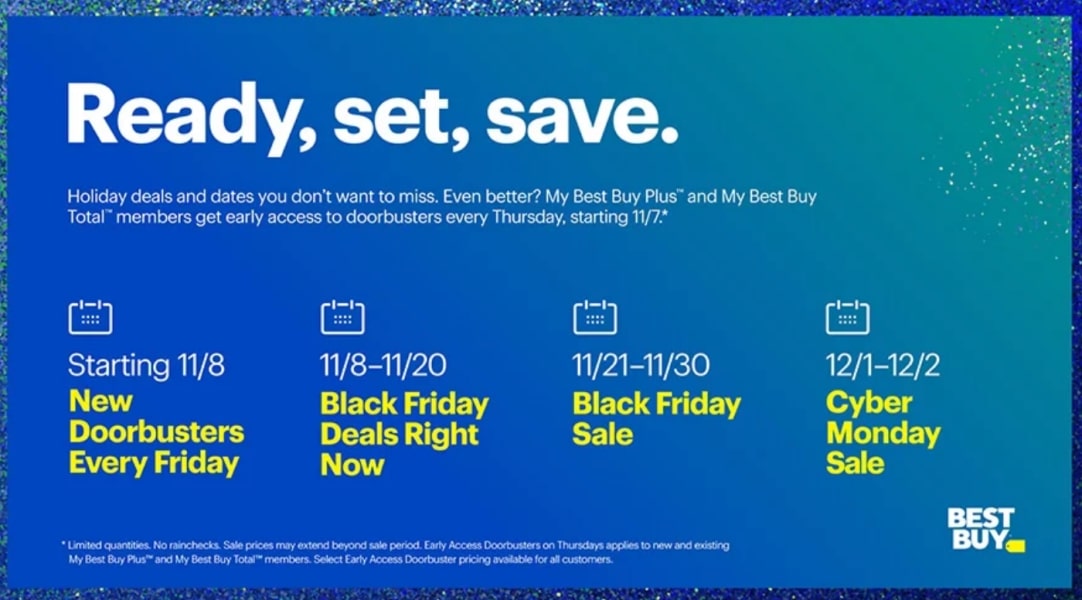
For example, Best Buy runs early Black Friday events (pre-Black Friday “Black Friday sales”) and gives Totaltech members a “Black Friday Price Guarantee,” promising a refund if prices drop further, which reassures buyers and encourages them to shop early, but not only. Best Buy is trying to entice customers to sign up by suggesting highly sought items will be locked behind that paid membership door.
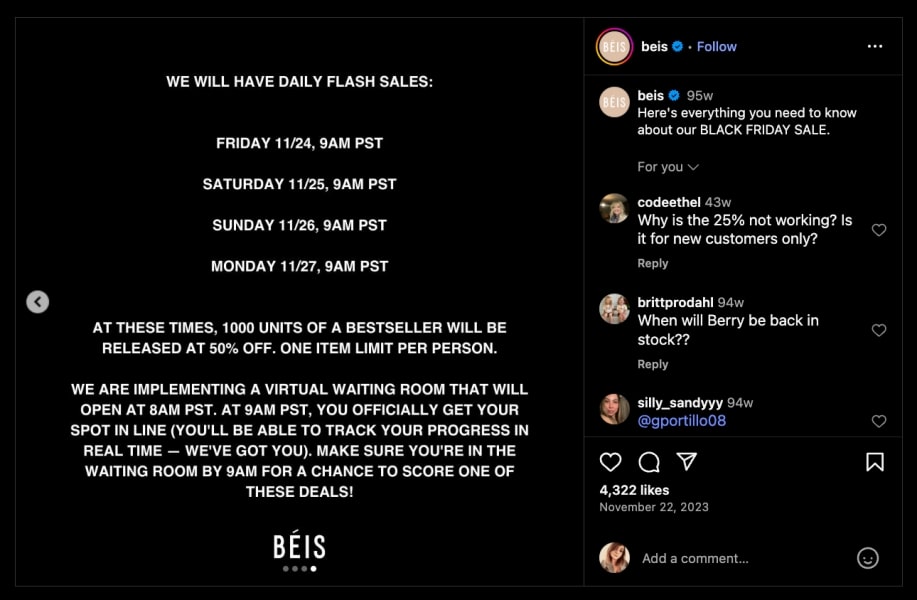
Another example, Beis introduced clear rules including waitlists and flash sales for everyone hunting for their Black Friday deals.
What e-commerce experts think about building a hype before Black Friday? Samira Kuljurgis, Lead project & process manager, and Laura Hoekstra, Senior Content Manager from camelactive told us about the most effective pre-Black Friday teaser they’ve run:
“In 2024 we introduced WhatsApp as a brand-new channel, complementing our existing email and social campaigns. Starting November 22nd, customers could sign up via newsletter or WhatsApp to unlock early discounts as part of our “up to 50% off selected styles” campaign. Combining this with user-generated content and engaging product highlights created strong anticipation. Compared to the previous year, this pre-phase drove a significant uplift in both traffic and engagement”.
They also shared with us that offering VIP access had important impact on their results. “From November 22nd to 28th we offered exclusive early access as part of our Black Week campaigns across newsletter, WhatsApp, social media, ads, and more. This phase delivered the strongest conversion uplift, with CR peaking around Black Friday through Cyber Monday. It also contributed to subscriber growth across all channels, resulting in a 10% increase in newsletter subscribers and strengthening long-term loyalty”.
Samira and Laura also told us about their approach to gamification and what their customers can expect from them in the future regarding new features especially for Black Friday: “While we haven’t yet run full-scale gamified wishlists, the “unlock early” mechanism and extended access already created excitement and exclusivity. Looking ahead, we are planning to expand this with a wishlist feature. Customers will be informed ahead of Black Week that they can add items to their wishlist, making it possible to transfer them into their cart with just one click once the campaign begins”.
Additional, exclusive insights from Samira Kuljurgis, Lead project & process manager, and Laura Hoekstra, Senior Content Manager from camelactive:

How do you use email and SMS differently in the lead-up to Black Friday?
We use both email and WhatsApp marketing, with WhatsApp implemented last year. Customers are always the first to be informed about offers, receiving early access updates through both channels. While email remains our core storytelling platform – where we highlight the best offers, style inspiration, and curated products – WhatsApp functions as a more direct, personal, and time-sensitive tool. Because revenue per message is relatively higher on WhatsApp, we can trigger it less frequently while still achieving at least the same results. This makes it especially effective for “act now” moments and exclusive codes delivered straight into the customer’s pocket.

How do you balance building excitement without spoiling the surprise?
To build excitement without revealing everything upfront, we limit previews to highlight pieces of our collection and communicate the core message “up to 50% off selected styles.” This creates clear value while keeping curiosity high.
To maintain exclusivity, we also consider formats such as a password-protected early-access page for subscribers, time-limited drops during the week, or personalized on-site messages for specific customer groups. Wishlist functions or unlock codes can further activate customers in a simple, effective way.
This approach keeps the campaign relevant and dynamic, with enough anticipation while still preserving the surprise for Black Week itself. However, we have no experience with this type of campaigns yet.
Outro
Black Friday is a demanding time for e-commerce and deciding on a fitting approach beforehand is a good idea. Use insights from real-world examples included and unique perspectives of e-commerce experts that we asked for comments on different approaches to Black Friday in order to make informed decisions and plan smarter.
And once the dust settles, don’t stop there: review what worked, what broke, and what you’d do differently next year. There’s nothing better than learning from experience.