E-commerce hits 25% of global retail as categories diverge
Discover how e-commerce reached 25.4% of global retail in 2026, with ECDB insights on category growth across Grocery, Fashion, Electronics, and more. (Ad)

By Nadine Koutsou-Wehling, Data Journalist
E-Commerce is growing to claim an ever-larger share of global retail revenues. By 2026, one in four retail dollars is spent online. That reflects how important online shopping has become to global commerce. The rise is supported by consumer preferences and the rapid development of digital infrastructure and fulfillment networks.
What forces are behind this development? And how do different categories contribute? ECDB examined the online market and its importance within total retail. For more insights like these, find them in the Global E-Commerce Compass by ECDB.
One in Four Retail Dollars Is Made Through E-Commerce in 2026
In 2026, 25.4% of global retail revenues were generated via online channels. That marks an increase of 21.5% since 2021, when the online share was at 20.9%.
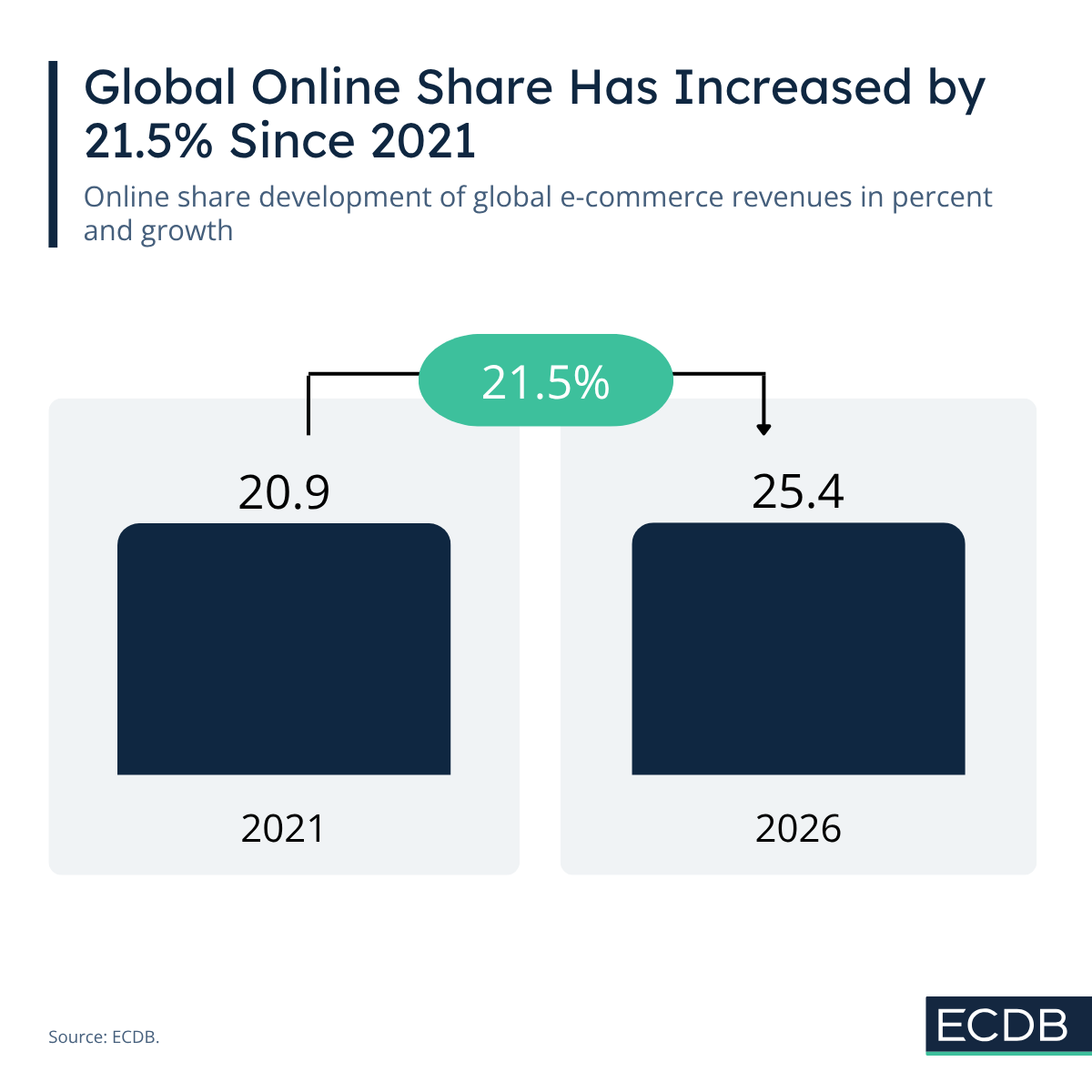
It is remarkable that even after the post-pandemic normalization of the market, the significance of e-commerce for global retail revenues has continued to grow. Rather than reverting to pre-2020 patterns, consumers have retained many of their digital shopping habits, while retailers have continued to expand their online capabilities.
This development suggests a structural shift in the workings of the global market. And nowhere is this more visible than in specific product categories.
Consistent Growth at Varying Degrees Across Categories
All categories in global e-commerce have grown their online share since 2021, although at different rates. Grocery and Electronics lead in growth, with Electronics expanding from a much higher baseline.
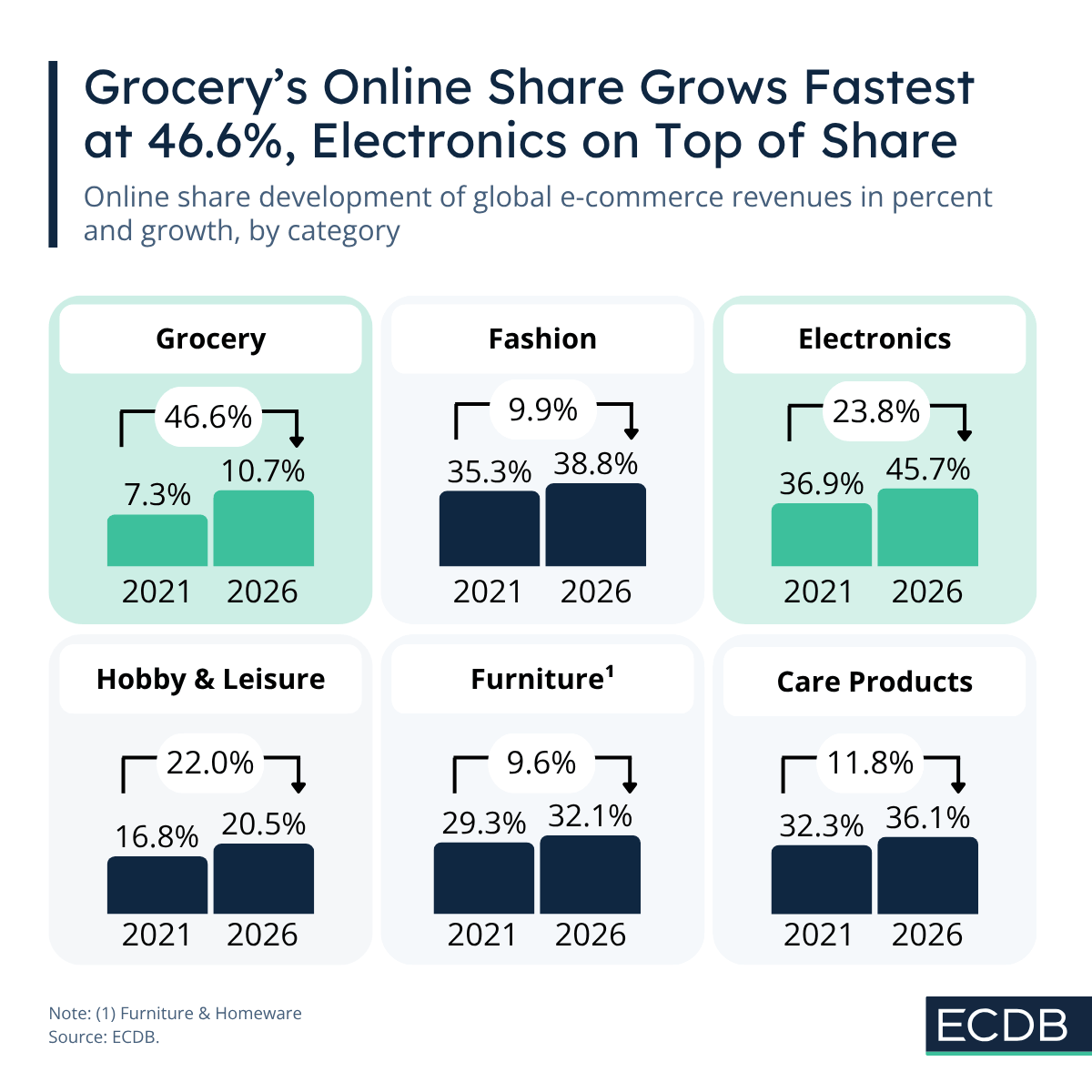
Both categories represent different dynamics in the online market. Grocery is a fast-growing niche that is gaining importance in global e-commerce, while Electronics is much more established and is approaching digital maturity
Grocery
Grocery e-commerce has accelerated rapidly, driven by changing consumer habits and improvements in last-mile logistics. Due to perishability and low margins, the category was once considered difficult for online retail, but it has become one of the most dynamic growth areas.
The leading countries for Grocery in terms of online share and growth are China, the UK, South Korea and the US. They thrive through providers who offer time-saving solutions like same-day delivery, subscription models and quick commerce.
Fashion
As one of the earliest e-commerce categories, Fashion remains one of the largest and most competitive segments online. Its online share growth of 9.9% since 2021 indicates that Fashion has reached a more mature stage. In 2026, the online share of Fashion stands at 38.8%, meaning that nearly 40% of fashion retail spending occurs online.
The category is shaped by high return rates, fast-changing trends, and increasing consumer expectations around sustainability and personalization. Brands are investing heavily in omnichannel strategies, virtual try-ons, and AI-driven recommendations to differentiate themselves.
Electronics
Electronics ranks second in online share growth and reaches a substantial 45.7% online share. The online channel complements physical retail particularly well in this category, supported by detailed product information, reviews and price transparency.
Countries with especially high online shares include the Netherlands, the UK and Russia. Electronics remains highly competitive and price-sensitive, with marketplaces and direct-to-consumer brands continuously optimizing logistics, pricing and customer experience.
Hobby & Leisure
Hobby & Leisure grew by 22.0% since 2021 and is at an online penetration of 20.5% in 2026. Leading countries in the category are Türkiye, the UK and US. The category saw a significant boost during recent years as consumers invested more in home-based activities, sports, and personal interests.
This momentum has continued, though at a more normalized pace. Hobby & Leisure benefits from strong community engagement, niche targeting, and content-driven commerce.
Furniture & Homeware
Furniture and Homeware e-commerce has benefited from improvements in visualization tools such as augmented reality and better delivery solutions for bulky items. Nonetheless, it grew at a more moderate rate of 9.6% since 2021. Its online share is still high, with almost 1 in 3 retail dollars made through e-commerce.
Purchasing decisions are still more considered and less frequent, but digital channels are becoming a primary source of inspiration and research. The category continues to expand as retailers bridge the gap between online convenience and the tactile nature of physical shopping.
Care Products
Care Products include personal care, household care and health care items. While not the fastest growing at 11.8%, Care Products are still at a substantial online share level of 36.1%. The category benefits from repeat purchases, brand loyalty, and the rise of direct-to-consumer brands. Subscription models and personalized product recommendations are key growth drivers.
In beauty, social commerce and influencer endorsements heavily influence purchase decisions. These factors make it one of the digitally most engaged in e-commerce.
Outlook: E-Commerce Online Share Development
E-Commerce is moving closer to becoming a default channel for retail rather than an alternative. The variation across categories shows that there is still significant room for growth, particularly in segments that have only recently begun to grow online. The digital shift is far from complete and will continue to shape retail in the years to come.