The State of Fashion 2026: 10 Trends Reshaping Fashion Retail
Explore the State of Fashion 2026 report, from AI shopping and resale to tariffs, jewellery, luxury and changing consumer priorities.

Fashion has stopped waiting for things to return to normal.
The latest State of Fashion 2026 report from The Business of Fashion and McKinsey & Company describes an industry that has accepted constant disruption as part of doing business. Tariffs are redrawing supply chains, shoppers are questioning what products are worth and artificial intelligence is changing both internal operations and product discovery.
The report, titled When the Rules Change, is the tenth edition in the annual State of Fashion series. Its message is clear: fashion brands won’t be able to rely on market recovery alone. Growth will depend on operational discipline, sharper positioning and a better understanding of how customers now discover, compare and value products.
Here are the most important findings from the report and what they mean for fashion retailers and e-commerce businesses in Europe.
The State of Fashion 2026 at a glance
The overall outlook remains difficult, although opinions among industry leaders are becoming more divided.
According to the BoF-McKinsey executive survey:
- 46% of fashion executives expect industry conditions to worsen in 2026
- 25% expect conditions to improve
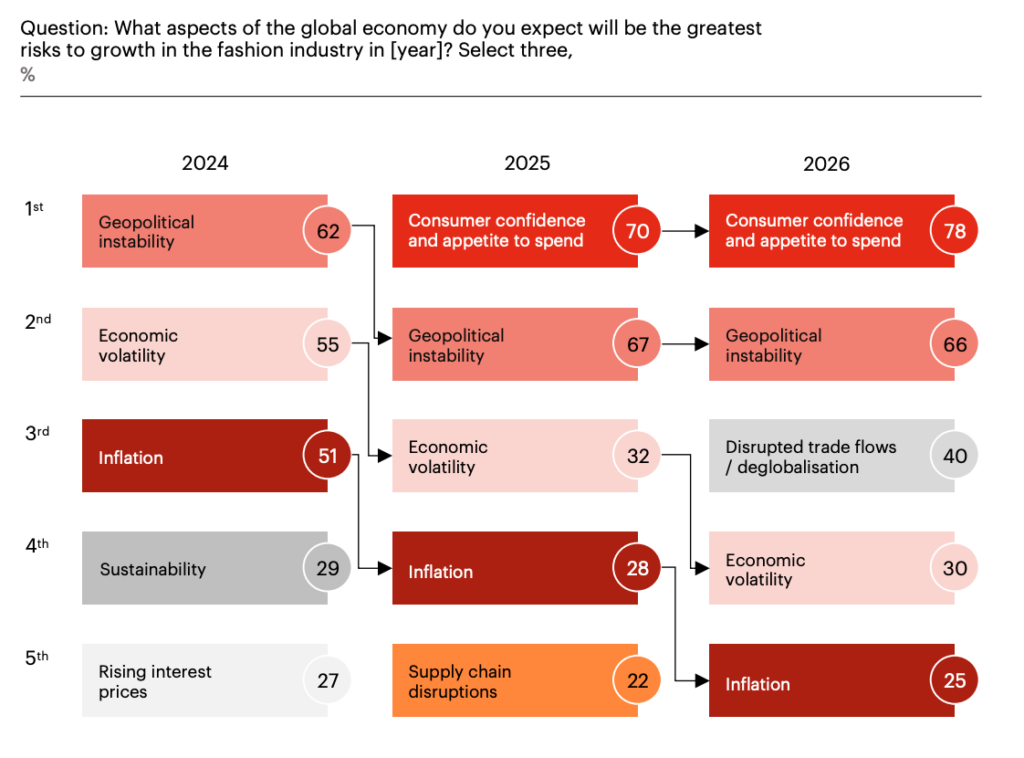
- 78% see consumer confidence and appetite to spend as a major risk
- 76% believe trade disruption and rising duties will affect the industry
- more than 35% already use generative AI in selected business functions
- 59% of global consumers are likely to buy secondhand fashion in 2026
McKinsey expects the global fashion industry to record another year of low single-digit growth. Europe’s economy may remain relatively stable, but shoppers are still expected to trade down and scrutinise discretionary purchases more carefully.
1. Slow growth has become the working assumption
Fashion executives aren’t building their 2026 plans around a strong market rebound.
Consumer confidence remains the most frequently cited risk, followed by geopolitical instability. Disrupted trade flows and deglobalisation have also climbed rapidly up the agenda. In 2024, the topic didn’t appear among executives’ five leading concerns. For 2026, 40% name it as one of the three greatest risks to growth.
The outlook differs between markets and segments.
European GDP growth is expected to remain relatively steady, helped by stable employment. That doesn’t automatically translate into stronger fashion spending. Customers are still looking for deals, delaying purchases and choosing products that feel more useful or durable.
Luxury may experience modest improvement after a difficult 2025, but the wider fashion market is likely to grow slowly. Brands therefore need to win market share from competitors rather than wait for the whole category to expand.
For e-commerce teams, the lesson is practical: traffic growth won’t fix a weak proposition. Merchandising, retention, margin and product relevance will matter more.
Fashion remains one of the world’s leading online retail categories. In Germany, China, the UK and the US, it accounts for a particularly large share of e-commerce revenue. You can explore the wider category data in our analysis of why fashion remains the number-one e-commerce category in major markets.
2. Tariffs are forcing brands to reconsider sourcing and pricing
Trade policy has moved from a background risk to an operational priority.
The report estimates that tariff increases introduced between January and August 2025 could add around $27 billion in duties to apparel and footwear imported into the US, assuming import volumes remained unchanged. China, Vietnam, India, Bangladesh and Indonesia account for most of the estimated impact.
As a result, brands are reviewing where products are made, how suppliers are selected and how quickly production can move between markets.
Some businesses will pass part of the cost to shoppers. Nearly three-quarters of executives surveyed expect to increase retail prices in 2026. Within the fashion segment, 26% plan rises above 5%, compared with 18% among luxury executives.
Price increases still carry risk. Customers already feel that many fashion products cost more without offering a noticeable improvement in design, quality or durability. A blanket price rise can therefore damage conversion and retention even when it protects short-term margin.
Fashion retailers will need more granular decisions:
- model margins at product and market level
- identify products with enough demand to support higher prices
- reduce dependence on one sourcing country
- renegotiate terms with strategic suppliers
- simplify ranges that create cost without adding meaningful demand
- track competitor price movements before changing the whole catalogue
Agility matters more than finding one supposedly perfect sourcing market. Trade conditions can change faster than a fashion brand can rebuild its entire supply chain.
3. AI is moving from isolated tests to everyday infrastructure
Fashion companies have spent several years experimenting with generative AI. The next phase is less about generating a few product descriptions and more about redesigning how work gets done.
More than 35% of fashion executives say their businesses already use generative AI for selected activities such as customer service, image creation, copywriting, consumer search or product discovery.
McKinsey estimates that around 30% of employee time across industries in Europe and the US could be automated with generative AI and other technologies by 2030. In fashion, some of the biggest potential gains sit in marketing, sales, procurement, finance and operational support.
The hard part won’t be gaining access to another AI tool. It will be changing workflows.
A retailer can generate product copy faster, for example, but the result won’t help much when material data is missing, size information is inconsistent or teams still need several rounds of manual approval.
Strong AI adoption requires:
- clean and connected product data
- clear rules for human review
- ownership of AI-assisted processes
- training for existing employees
- measurement tied to cost, speed or commercial performance
- coordination between marketing, merchandising, technology and legal teams
Research into AI adoption in DACH retail shows the same gap. Many businesses have made AI part of their strategy, but far fewer can point to measurable business value.
Fashion brands should select use cases where AI removes a real bottleneck rather than launching pilots because competitors are doing the same.
4. The AI shopper changes how products get discovered
The most important AI shift may happen outside the retailer’s organisation.
Consumers are beginning to use large language models to find products, compare options and receive personalised recommendations. Some tools already act as digital style advisers. More advanced agents may eventually monitor prices, build outfits or complete purchases on a shopper’s behalf.
Traditional search remains dominant, but the direction is visible:
- 23% of consumers primarily use generative AI to discover products
- 53% of US consumers who used AI for search in Q2 2025 also used it for shopping
- 41% say they trust generative AI results more than paid search advertising
- 85% of US AI-shopping users report a better experience than with conventional methods
- shopping-related generative AI searches grew 4,700% between July 2024 and July 2025
AI-driven recommendations are particularly relevant to fashion because customers often need help narrowing large catalogues, understanding fit or selecting products for a particular occasion.

For fashion retailers, AI discoverability begins with product information.
An AI assistant needs to understand more than a product name and price. Useful data may include:
- fabric composition
- fit and silhouette
- measurements
- colour and pattern
- occasion
- season
- care requirements
- compatibility with other products
- delivery and return conditions
- stock availability
- customer review themes
Descriptions should also explain differences between similar items. A shopper might ask for a lightweight black jacket suitable for business travel, machine washable and available for delivery before Friday. A catalogue built around vague product names won’t give an AI system enough information to make a confident recommendation.
Our guide to preparing product feeds for AI-assisted shopping explains how retailers can make catalogue data easier for AI platforms to access and interpret.
AI visibility won’t replace traditional SEO overnight. It adds another discovery layer. Brands will need to monitor how products appear in search engines, marketplaces, retailer assistants and independent AI tools.
5. Jewellery is fashion’s standout growth category
Not every part of fashion is moving at the same speed.
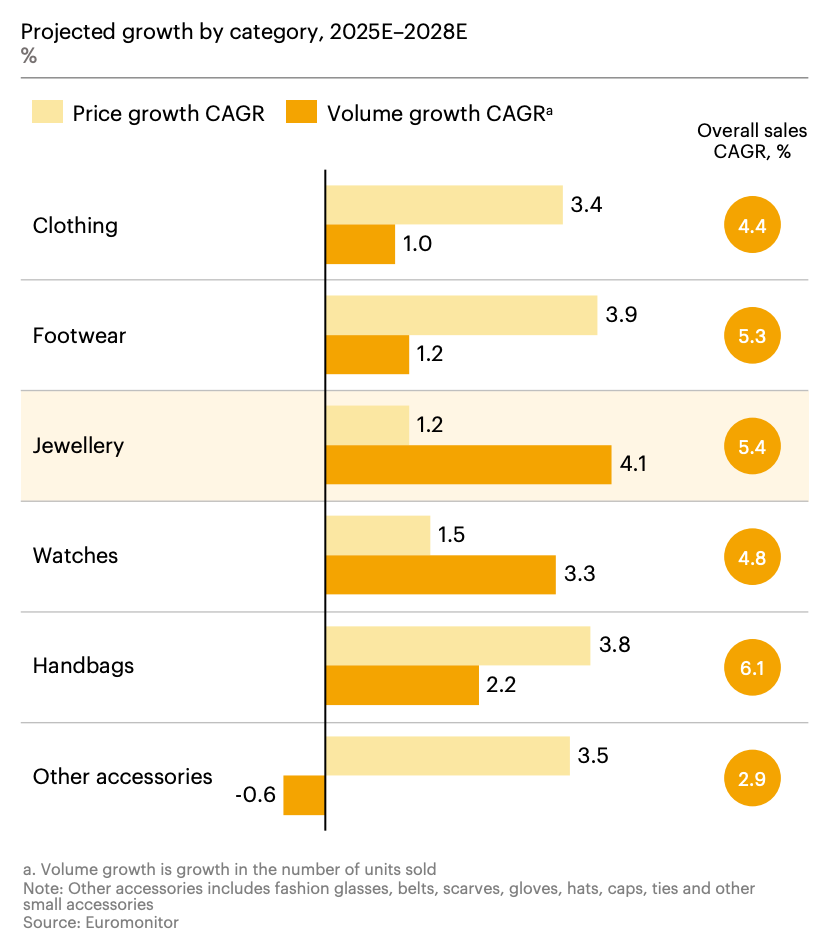
Jewellery is forecast to achieve annual unit growth of 4.1% between 2025 and 2028. That’s around four times the expected rate for clothing. Both fine and costume jewellery are expected to benefit.
Several consumer shifts support the category.
Jewellery works as a long-lasting purchase during a period when shoppers are questioning the value of fast-changing clothing collections. It also combines emotional meaning, self-expression and perceived investment value.
Self-purchasing is becoming more common. In the report’s research, 42% of women and 35% of men said they were buying more jewellery for themselves than two or three years earlier.
Branded jewellery is also gaining ground. It represented 25% of the market in 2024 and grew faster between 2021 and 2024 than unbranded jewellery.
The opportunity isn’t limited to traditional jewellery businesses. Fashion and lifestyle brands can enter the category through products that reflect their existing identity, materials or design language.
However, a logo placed on a generic product won’t create a credible jewellery proposition. New collections need a clear connection to the brand, supported with stronger product photography, material information and storytelling around craftsmanship.
Retailers should also consider more male, gender-neutral and personalised collections as self-gifting expands beyond traditional customer groups.
6. Smart glasses may become fashion’s next technology category
Smart eyewear has spent years looking like a technology product searching for a mass-market use case. The category is now moving closer to fashion.
The report expects smart frames equipped with multimodal AI to become one of the leading wearable formats. The market could exceed $30 billion by 2030 as technology becomes smaller, more useful and easier to integrate into recognisable eyewear designs.
The commercial opportunity sits between function and personal style.
Customers may use smart frames to take photos, listen to audio, translate conversations or access an AI assistant without holding a phone. At the same time, glasses remain a highly visible part of someone’s appearance. Technology companies therefore need fashion brands, eyewear specialists and designers that understand comfort, identity and fit.
For fashion retailers, smart frames also illustrate a wider shift. Category boundaries are becoming less clear. Fashion can overlap with consumer electronics, health, sport and digital services.
Brands don’t need to manufacture their own device to participate. Partnerships, accessories, retail distribution and complementary products may offer more realistic entry points.
7. Well-being is taking a larger share of consumer attention
Fashion doesn’t compete only with other fashion brands.
Consumers are directing more discretionary spending towards health, fitness, travel, beauty and experiences. The report describes well-being as increasingly central to how customers spend and define themselves.
The shift creates pressure and opportunity.
A customer spending more on exercise classes, skincare or a weekend retreat may reduce their clothing budget. At the same time, fashion brands with a credible connection to movement, rest or personal care can expand into adjacent categories.
Possible examples include:
- activewear built around real performance needs
- comfortable clothing designed for travel or recovery
- collaborations with fitness and hospitality brands
- physical spaces that combine retail with community activities
- events based on movement, creativity or social connection
The risk is launching a generic wellness campaign with no connection to the product. Customers will quickly notice when a brand borrows the visual language of well-being without offering anything useful.
The opportunity should start with the customer’s existing relationship with the brand. A sportswear company, outdoor retailer or sleepwear label has a natural route into the category. A formalwear business may need a more carefully defined link.
8. Resale is becoming part of the mainstream fashion model
Secondhand fashion is no longer a small circular-commerce experiment.
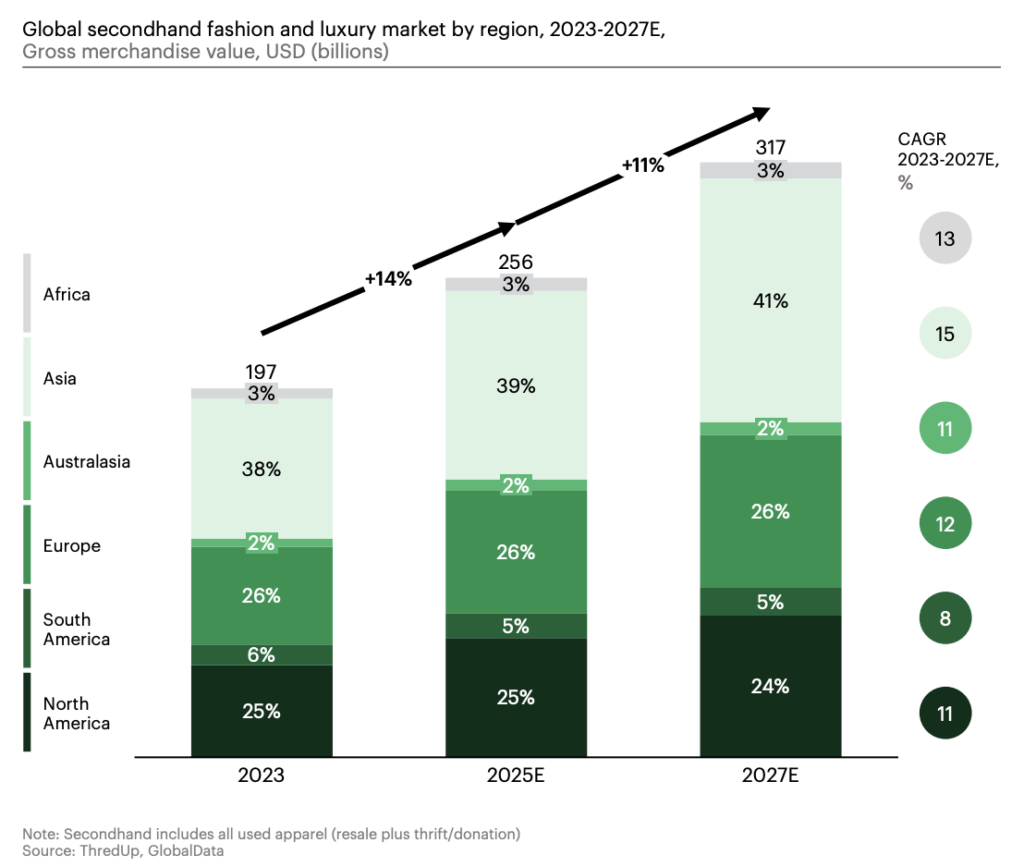
The global secondhand apparel market is expected to reach $317 billion by 2027. It is forecast to grow two to three times faster than the firsthand market between 2025 and 2027.
Globally, 59% of consumers say they are likely to buy secondhand in 2026. Interest is highest among Gen Z and millennials, but older shoppers are also participating.
Europe already has strong resale platforms and active consumer demand. Vinted increased its net profit by more than 330% between 2023 and 2024, according to the report. Brand-led programmes are expanding too.
Brands can choose between several resale models:
- a partnership with an existing marketplace
- trade-in credit for returned products
- a resale section powered by a specialist provider
- a fully managed in-house programme
- repair and refurbishment linked to resale
- authentication services for high-value products
The correct model depends on product durability, resale value and operational capacity.
Outerwear, handbags, footwear and premium products are natural candidates because they retain enough value to support inspection, cleaning and fulfilment costs. Very low-priced or fragile products may be harder to resell profitably.
Resale can do more than generate a second transaction. It can introduce aspirational customers to the brand, demonstrate product durability and create a reason for existing customers to return.
German consumers are already active in the category. Our overview of the re-commerce market in Germany found that 55% of respondents had purchased used goods online during the previous 12 months.
9. Mid-market and value brands are moving up
Low-cost competition has made it difficult for traditional value brands to win on price alone.
At the same time, luxury price increases have left some aspirational customers looking for products that still feel special but cost less. Brands between discount fashion and traditional luxury see room to move upwards.
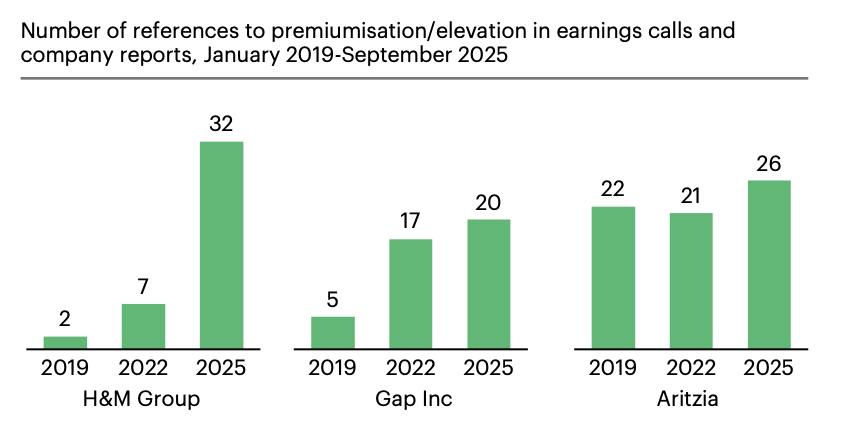
McKinsey calls the shift “the elevation game”.
Value and mid-market businesses are improving materials, introducing higher-priced hero products and investing in store presentation. Some are reducing the share of products in their lowest price tiers. Others are cutting back on permanent promotions to rebuild full-price credibility.
Luxury prices rose by an average of 61% between 2019 and 2025, according to the report. The resulting gap has encouraged customers to explore affordable luxury, premium and design-led mid-market brands.
Elevation depends on three connected elements:
Product
Customers must be able to see or feel an improvement. Better fabrics, construction, durability and fit can support a higher price.
Price architecture
A brand can add premium products without moving every SKU upwards. Entry-level products may remain important for acquisition while hero products improve perception and margin.
Experience
Photography, packaging, customer service, stores and delivery all influence perceived value. Raising prices while leaving the rest of the customer experience unchanged rarely works.
Brands also need discipline. Moving too quickly can alienate existing customers without attracting a new premium audience.
For context on the brands currently shaping the German market, see our ranking of the leading clothing retailers in Germany in 2026.
10. Luxury needs to rebuild trust rather than rely on price
Luxury’s slowdown has exposed the limits of price-led growth.
Many luxury brands raised prices rapidly in recent years. Customers didn’t always see a comparable improvement in creativity, craftsmanship or service. Aspirational buyers were pushed out while high-net-worth clients became more selective.
The report expects luxury houses to refocus on:
- recognisable creative direction
- product quality and craftsmanship
- stronger service
- clearer segmentation
- distinctive brand storytelling
- a more consistent experience across physical and digital channels
Higher product quality and better in-store service are among the leading factors that could encourage wealthy customers to buy more. The exact priorities differ between China, the UK and the US, but price alone is no longer a sufficient growth engine.
Luxury brands also need different propositions for different customer groups. A high-net-worth collector, an occasional buyer and a resale customer don’t enter the brand through the same door.
Digital channels must support that segmentation without making the experience feel transactional. Product access, editorial content, clienteling and post-purchase care can all matter more than another broad acquisition campaign.
Our analysis of luxury e-commerce across DACH looks more closely at the pressure on premium growth and the role of marketplaces, data and specialised customer experiences.
What the State of Fashion 2026 means for European e-commerce brands
The ten themes cover different parts of the market, but several priorities connect them.
Make product information usable outside your website
Products will increasingly be interpreted through marketplaces, search engines, AI assistants and shopping agents. Accurate attributes, clear availability and semantically rich descriptions are becoming distribution infrastructure.
Protect margin at product level
Slow growth, tariffs, returns and rising acquisition costs can hide behind a healthy revenue number. Retailers need to know which products, channels and customer groups generate a real contribution.
Compete on a clear definition of value
Value doesn’t always mean the lowest price. It may mean durability, fit, design, convenience, resale potential or service. Brands need to choose what value means for their customer and prove it consistently.
Invest in retention before chasing more traffic
More than half of the executives surveyed see retention as an important theme for 2026. Loyalty won’t come from points alone. Better products, useful personalisation, repair, resale and reliable service can all give customers a reason to return.
Use AI to remove friction, not add novelty
AI can support discovery, service and internal productivity. Each use case should still solve a defined problem. Retailers should measure faster execution, better conversion, lower cost or improved customer satisfaction rather than the number of AI features launched.
Build a portfolio of growth opportunities
The overall market may remain slow, but jewellery, resale, smart eyewear and well-being-related categories offer more momentum. Not every opportunity will fit every brand. The goal is to identify adjacencies that feel credible and can use existing customer trust.
Final thoughts
The State of Fashion 2026 doesn’t predict an easy year. Growth remains limited, consumers are cautious and trade conditions continue to disrupt costs and supply chains.
Yet the report isn’t entirely pessimistic.
Customers are discovering products in new ways. Resale is creating an additional route into brands. Jewellery is outperforming larger categories. Mid-market players are finding space between discount and luxury, while AI can remove inefficiencies that fashion businesses have tolerated for years.
The strongest brands won’t try to follow every trend at once. They’ll decide where they can offer distinctive value, improve the economics behind it and make the product easy to find wherever the next shopping journey begins.
The full State of Fashion 2026 report is available from McKinsey & Company.
Frequently asked questions
What is the State of Fashion 2026 report?
The State of Fashion 2026 is the tenth annual fashion industry report published by The Business of Fashion and McKinsey & Company. It examines economic conditions, consumer behaviour, technology and changes to the global fashion business.
What are the biggest fashion trends for 2026?
Major trends include tariff-related supply chain changes, AI-supported work, generative AI product discovery, jewellery growth, smart eyewear, well-being, operational efficiency, resale, premiumisation and a strategic reset in luxury.
How is AI changing fashion e-commerce?
AI is changing both retail operations and shopping. Brands use it for content, customer service and product discovery, while consumers increasingly use AI assistants to compare products and receive recommendations. Rich product data is becoming more important for visibility.
Why is fashion resale growing?
Customers are using resale to access lower prices, find distinctive products and buy from aspirational brands. Better marketplace technology and specialist resale providers are also making secondhand commerce easier to scale.
What should fashion retailers prioritise in 2026?
Retailers should focus on product-level profitability, AI-readable catalogue data, retention, clear value positioning and selected growth categories. Broad expansion without operational discipline will be difficult in a low-growth market.