The year in numbers: Key stats that shaped world e-commerce in 2025
See the most important global e-commerce stats for 2025 in one place. Market size, growth, B2B, cross-border, and what to watch in 2026.

Global ecommerce in 2025 feels calmer than the rollercoaster years before.
Growth is slower, but still clearly positive. Online shopping keeps taking share from stores, while brands fight for profit, not only for GMV charts.
Think of 2025 as a reset year. Shoppers keep buying online, B2B ecommerce grows even faster than consumer sales, and cross-border shopping becomes normal for many buyers. At the same time, ad prices climb, rules get stricter, and returns plus sustainability questions force brands to rethink their model.
And now, you have all the main numbers from 2025 in one place.
You get clear stats, short takeaways, and a base for your own story about what changed in e-commerce during 2025 and where growth can still come next year.
Global e-commerce in 2025 at a glance
2025 did not break records for crazy growth, but it did prove one thing. Online shopping is now a normal part of retail, not a side project.
Most large trackers put global retail ecommerce for 2025 somewhere between 6.4 and 6.9 trillion US dollars. That is roughly one fifth of all retail spending on the planet.

You can keep this quick picture in mind:
- Around 6.42–6.8 trillion USD in global online retail sales in 2025
- About 20–21% of total retail spent online
- Roughly 2.8–3.0 billion people buying online
- Year-on-year growth in the mid single digits, around 7–8%
Where the money moved in 2025?
Capital One Shopping expects global retail ecommerce sales to reach about $6.42 trillion USD in 2025, up 6.9% from 2024, with ecommerce taking 20.5% of retail. Other trackers, like Netguru, read the same year a bit higher, at around $6.8 trillion USD and roughly 21% of retail.
Different methods, same story. Growth is slower than during the pandemic surge, but online keeps grabbing more share from stores.
Regional picture and China’s weight
China still dominates. Some estimates say it holds around half of global online retail sales in 2025. The US stays in second place. US retail ecommerce alone is expected to hit about $1.47 trillion in 2025.
So, most online spending still comes from a few large economies, but cross-border shopping keeps spreading demand across borders.
How people shopped online in 2025
Mobile keeps winning. Flowlu’s 2025 stats put mobile commerce at around 59% of all online retail sales.
That means most customers now discover, compare, and pay on a phone screen. Desktop is still important for high-ticket items and B2B, but for daily shopping the phone rules.
Plus, social commerce is no longer an experiment. Global social commerce sales in 2025 are expected to reach about 1.17 trillion USD.
TikTok Shop alone is now roughly the size of eBay. Wired reports that TikTok Shop generated about 19 billion USD in sales from July to September 2025, with 4–4.5 billion USD in the US.
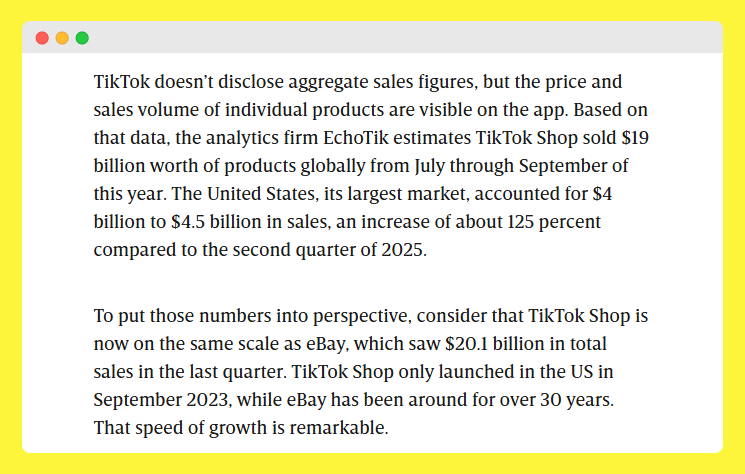
This shows two things.
- Short-video content now drives real order volume.
- And social platforms have become serious sales channels, not only ad channels.
Moreover, cross-border goes mainstream
DHL’s 2025 shopper trends say 59% of global shoppers buy from retailers outside their home country, and over one third do it at least once a month. And Capital One Shopping finds that cross-border ecommerce makes up about 18.8% of online sales in 2025.
Another deep-dive by Amra & Elma suggests cross-border may account for around 31.2% of global online retail, depending on how you define it, with a 551.23-billion-USD market size in 2025 for a narrower slice of that activity. For many shoppers, buying from another country now feels normal, especially in fashion, beauty, and electronics.
B2B ecommerce quietly dwarfs B2C
B2B ecommerce remains the giant in the background.
Mordor Intelligence estimates the global B2B ecommerce market at about $32.8 trillion in 2025, with a path toward roughly 61.9 trillion by 2030.
Another summary from Fortenext points to $38.5 trillion in combined B2B and B2C ecommerce revenue in 2025, with B2B representing more than 80% of that total.
No matter which exact number you prefer, business buyers now conduct most of their purchasing through digital channels.
What changed for buyers and sellers in 2025?
More B2B platforms now mimic consumer shopping. Searchable catalogs, instant quotes, and self-service reorders are standard in many sectors.
At the same time, margins are under pressure. Wholesale buyers expect consumer-grade UX plus custom terms, all inside one portal.
For your 2025 summary, this matters because B2B ecommerce growth holds up the digital commerce story, while B2C slows slightly.
What got better in 2025?
Market overall
Right, eMarketer’s Worldwide Retail Ecommerce Forecast notes that growth slows in 2025, mostly because of a weaker Chinese economy and trade frictions. But the market still expands, and analysts expect 2026 to bring a mild rebound.
So 2025 looks like a cooling phase. Brands that treat this as “normalization” rather than a crisis will read the year more calmly.
Logistics and payments
DHL’s 2025 E-Commerce Trends reports highlight faster cross-border delivery, more local warehouses, and more reliable tracking as key upgrades noticed by both shoppers and merchants.
On the payments side, new projects like PayPal World aim to link local wallets and rails into one cross-border rail for up to two billion users, starting from late 2025.
In short, shipping and paying for international orders feels smoother in late 2025 than only a few years ago.
What got harder in 2025?
Prices
Several 2025 reports talk about higher ad prices and more competition on marketplaces and social platforms. Retail media and social ads keep growing, but budgets stretch thinner.
Plus, most brands now sell through at least two sales channels: roughly three-quarters use their own site, around two-thirds use social, and a similar share use marketplaces
This multi-channel mix is great for reach but pushes up content, tech, and ad costs.
Regulations
Cross-border trade runs into new rules. One visible move in 2025 is the end of the US duty-free threshold for many parcels under $800 from China and Hong Kong.
That change means extra fees and more admin for many fashion and gadget sellers that ship straight from Asia. Some will need new pricing and fulfilment models to stay attractive.
At the same time, online fraud, fake reviews, and spammy discount sites still hurt shopper trust.
Stronger rules on data, product safety, and consumer protection keep coming, especially in Europe and North America.
Returns & sustainability pressure
Reports across 2025 show high return rates in fashion and some electronics, plus growing concern about waste from packaging, shipping, and unsold stock.
Younger shoppers in DACH region and other regions ask for proof of greener practices and fair pricing. That pushes brands toward resale, repair, and more transparent pricing models.
What looks promising for 2026?
AI and new sales models
Across many 2025 trend pieces, AI sits at the center of almost every ecommerce roadmap. Merchants use it for product recommendations, dynamic pricing, content creation, and fraud checks.
Marketplaces and retail media networks give brands new growth options without building every feature themselves. 2025 feels like a setup year here: lots of investment, experiments with marketplace storefronts, and better ad products inside those platforms.Mirakl+1
If growth in 2024 felt driven by raw demand, growth after 2025 will come more from smarter merchandising, smarter bids, and smarter logistics.
Cross-border and emerging markets
Cross-border still has room to run. With around one fifth of online sales already cross-border, and many shoppers saying price and choice push them abroad, there is plenty of space for brands that localize content, payments, and returns in smart ways.
Emerging regions in Asia-Pacific, Latin America, and the Middle East show strong optimism about cross-border growth in 2025 surveys.
That sets up 2026 as a year where growth may shift more toward these markets, while mature markets focus on profitability and loyalty.
How to turn 2025 ecommerce stats into action
Start with channel mix. Most shoppers now move between marketplace, social shop, and brand site. Your 2025 stats give a hint where you are overexposed. If 80 percent of your online revenue sits on one marketplace, that is risk, not comfort.
Moreover:
#1 Look at device split
If mobile brings most traffic but desktop converts better, you have clear homework on UX, forms, and payment flow on phones. The global numbers for 2025 show mobile as the default screen, so poor mobile performance hurts more each quarter.
#2 Review cross-border demand
Use your own orders by country and compare them with 2025 cross-border shares from DHL and other reports. If global buyers are happy to shop abroad and your international share is tiny, there is likely room to grow with better local payment methods, translated product pages, and clear return rules.
#3 Do a simple B2B check if you sell to other companies
Global B2B ecommerce volume for 2025 is many times larger than B2C, so even a small shift from manual orders to online reorders can change your numbers fast. Look for product lines where repeat buyers still send emails or PDFs instead of using a portal, then move them step by step.
#4 Finally, connect all this with unit economics
Use the 2025 benchmarks on ad costs, margins, and return rates as a reality check. The main question for 2026 is not “How big can we get?” but “Where do we grow without burning margin or breaking trust with customers?”
Conclusion
2025 confirms that ecommerce is no longer a side project or a short pandemic spike. It is a standard piece of retail and B2B trade, with growth that is slower than before yet still strong when you look at trillions of dollars and high shares of total retail.
For brands, the big shift is from expansion at any cost to smarter growth. That means better use of data from each channel, realistic goals for cross-border, cleaner logistics, and honest answers on returns and sustainability.
If you treat the 2025 stats as a scoreboard, 2026 becomes easier to plan.
You know where shoppers spend, how they pay, and where regulation or margins hurt most. From there, you can pick a small set of bets for next year instead of chasing every new trend at once.
Key sources used in this report:
- Capital One Shopping – eCommerce statistics 2025
- Netguru – Ecommerce statistics 2025
- Amaka – e-commerce trends 2025
- Ecommerce Germany – Global e-commerce overview 2025
- Global Times – Share of global retail e-commerce sales
- Flowlu – E-commerce statistics 2025
- Wired – TikTok Shop is now the size of eBay
- DHL – 2025 cross-border buying trends
- Amra & Elma – Cross-border ecommerce statistics 2025
- Mordor Intelligence – Global B2B ecommerce market
- Fortenext – B2B e-commerce is 5x bigger than B2C
- eMarketer – Worldwide Retail Ecommerce Forecast
- DHL – E-commerce Trends Report 2025
- PayPal World announcement – TechRadar Pro
- DHL – 2025 E-commerce Trends: Business Edit
- E-commerce and the Digital Economy