From China to Southeast Europe: Where e-commerce growth is concentrating
Explore the regions driving global e-commerce growth, from Asia’s dominant marketplaces to fast-rising markets in Southeast and Eastern Europe in this material from ECDB. (Ad)

By Nadine Koutsou-Wehling, Data Journalist
E-Commerce is growing, surpassing the milestone of US$5 trillion in revenues this year. At ECDB, we are interested in the broader picture behind the numbers. Who is driving that growth? Where is e-commerce headed in the foreseeable future?
Apart from Asia, there are some markets in Europe to consider. Find more insights and statistics on the region in our latest report in cooperation with Mastercard; The State of E-Commerce in Central Europe.
But first things first: Who is at the forefront of e-commerce growth in the world?
Asia Is the Largest E-Commerce Region and Continues to Grow
While North America and Europe remain among the world’s largest online retail markets, Asia has established itself as the clear leader in e-commerce revenue and continues to widen the gap. The region’s size, innovation, and ongoing digital transformation make it the undisputed number one region in global online retail.
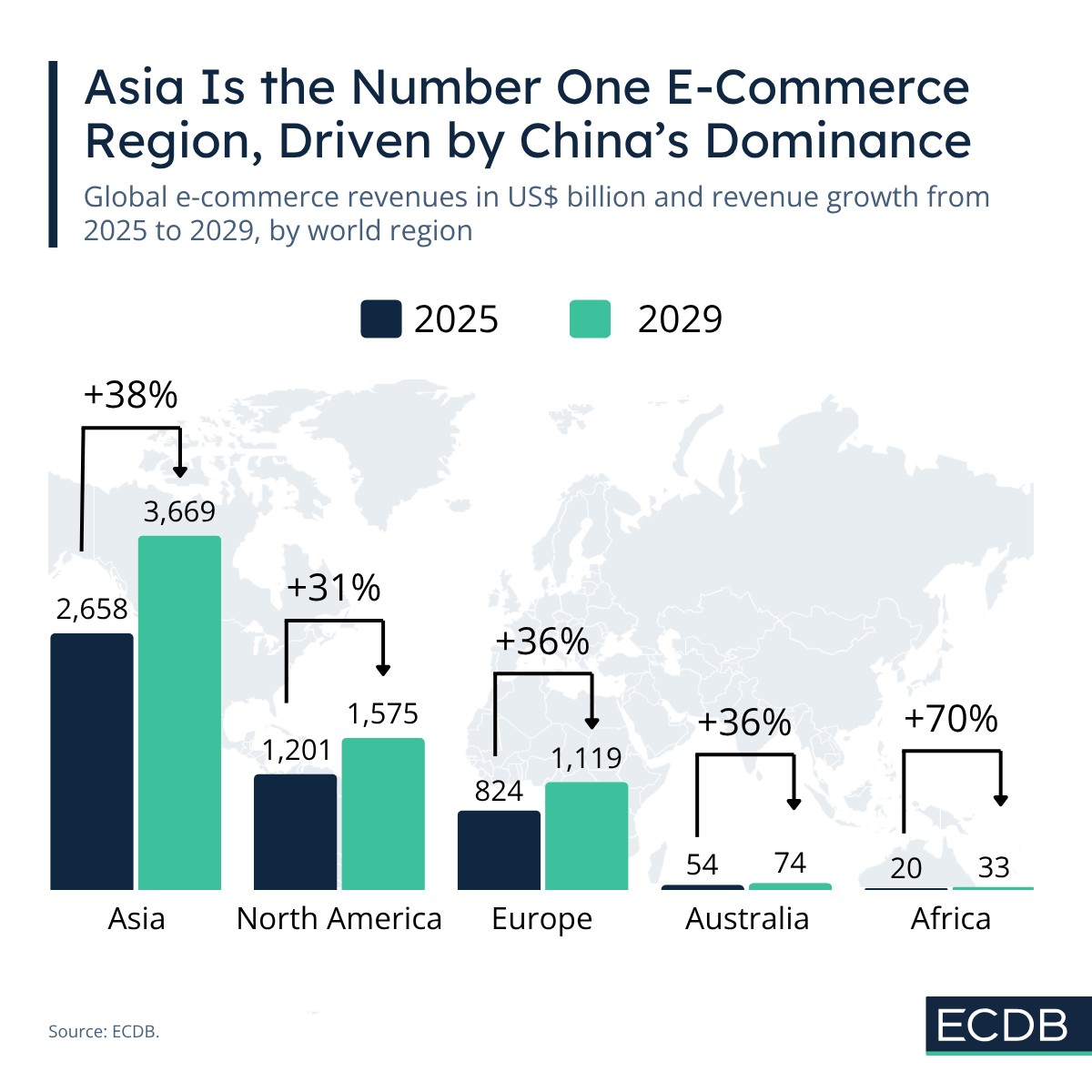
By 2029, Asia is projected to generate US$3.7 trillion in e-commerce revenues, more than double the expected size of North America’s US$1.6 trillion market and well ahead of Europe’s US$1.1 trillion. Australia and Africa are also expected to grow, reaching US$74 billion and US$33 billion respectively, though from a much smaller base.
The reasons behind Asia’s dominance are both structural and strategic. China remains the primary engine of growth, but the region’s future is increasingly being shaped by the rise of India and Southeast Asia.
China’s sheer market size and quick digitization account for its leadership in world e-commerce. Its market revenues exceed US$2 trillion in 2025, placing it far ahead of the second largest market, the USA, at double its revenue.
This dynamic becomes further visible in the top 10 ranking of global e-commerce platforms, where Amazon leads but is being pressured by quickly ascending Asian platforms.
Asian Platforms Dominate Top 10 Ranking, Amazon Remains Number One – for Now
While Amazon remains the world’s largest e-commerce platform with a Gross Merchandise Value (GMV) of US$846.1 billion in 2025, the broader picture tells a much bigger story. Of the world’s top 10 e-commerce platforms, only two are Western companies: Amazon and Walmart. The remaining 80% of the ranking is dominated by Asian players.

Among the most notable names are Pinduoduo and Douyin, which have secured the second and third positions globally with GMVs of US$780.5 billion and US$656.4 billion respectively.
What makes these companies particularly significant is that their ambitions extend far beyond their domestic markets. Both platforms recently ventured abroad with Western-facing offshoots, actively reshaping how consumers purchase and discover products worldwide.
In a combined view, however, Alibaba takes center stage. Its two flagship platforms, Taobao and Tmall, together generate more than US$1 trillion in GMV. Although they have fallen in the rankings since 2020, Tmall and Taobao exemplify the influence of Chinese e-commerce platforms on global shopping behaviors, from mobile integration to live-stream shopping and AI-powered retail experiences.
Shopee and AliExpress represent the significance of cross-border e-commerce for growth: Shopee by building a significant presence in Southeast Asian and Latin American markets, and AliExpress by supplying Chinese goods to worldwide audiences.
Entirely absent from this ranking is another important world region for growth; Europe. More precisely, Southeastern and Eastern European markets are driving the region’s revenue acceleration.
European Growth Hotspots in the Southeast and East
Eastern and Southeastern Europe are emerging as the continent’s fastest-growing digital commerce regions as they offer significant opportunities for e-commerce.
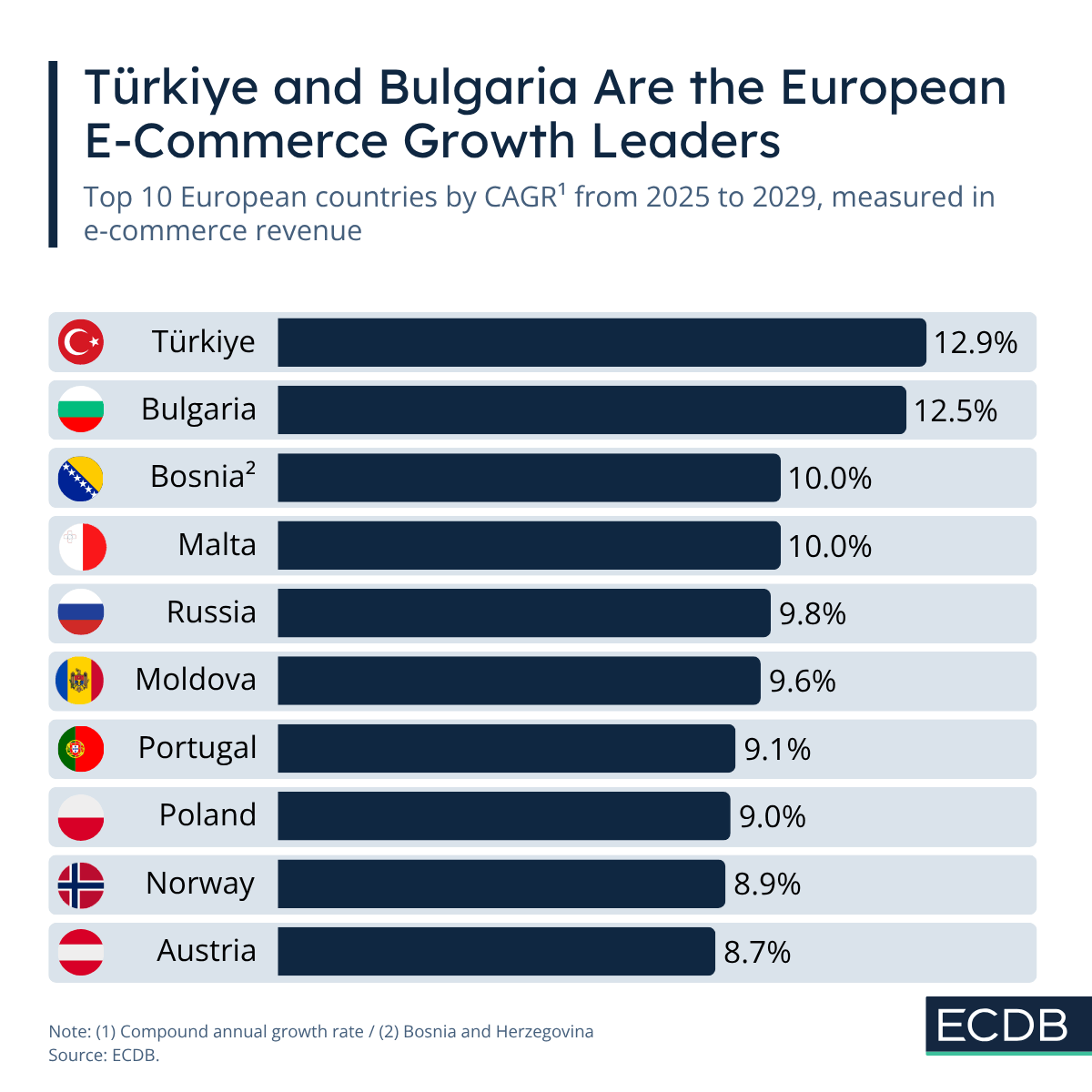
According to our latest data, Türkiye and Bulgaria are expected to lead Europe in e-commerce revenue growth between 2025 and 2029, with compound annual growth rates (CAGRs) of 12.9% and 12.5%, respectively.
But the story extends far beyond these two markets. Countries such as Bosnia and Herzegovina, Moldova, Poland, Malta and Portugal demonstrate substantial catch-up potential as online retail adoption accelerates and digital infrastructure improves.
The growth momentum in these markets is being driven by several structural factors. They pose significant room for e-commerce penetration to grow as the addressable consumer base continuously expands. This leaves important room for marketplace ecosystems to take ground and flourish, both domestically and internationally.
Increasing digital payment adoption and improving e-commerce infrastructure reinforce this trend. Structural developments reduce friction in payment and delivery, which leads to higher overall trust and sales.
Many of the markets in this group also share a dominant mobile commerce structure, meaning smartphones have become the primary channel for e-commerce purchases. Trends like quick commerce further accelerate e-commerce development in emerging markets, as it is accessible, fast, and convenient.
Growth Regions in E-Commerce Hint at Future Potential
In e-commerce growth, Asia sets the pace at scale. China’s dominance is increasingly shared with India and Southeast Asia. In addition to that, Chinese platforms are exporting their playbook to the rest of the world through cross-border expansion. The platform ranking shows where that power currently sits: still led by Amazon, but no longer a Western-dominated field.
Europe’s growth is being written on its margins. While Western Europe’s mature markets grow incrementally, it is the Southeast and East, Türkiye, Bulgaria, the Balkans, and parts of Central and Eastern Europe, where the steepest growth curves are forming.
This correlates with the earlier stage of development for many of these markets, where rising digital commerce penetration reflects infrastructure and consumer sentiment finally catching up. Asia and Europe’s periphery are proof of the same rule: the steepest growth belongs to markets still catching up, not the ones that got there first.