Global outlook: predictions for e-commerce in 2026
ECDB’s insights reveal global e-commerce will surpass $5T in 2026, fueled by Latin America’s rapid growth, rising grocery demand, and dominant marketplaces. Read more inside! (Ad)

By Nadine Koutsou-Wehling, Data Journalist
As the year draws to a close, it is time to look ahead into the year 2026. Rest assured, a major new milestone is the surpassing of the US$5 trillion threshold in world e-commerce.
After a period of stagnation, online retail is seeing new records again. One of these includes the acceleration in growth of Latin America, the rise of Grocery and Care Products as a category, and marketplace dominance in world e-commerce.
Are you curious to find out what 2026 brings? Here is everything you need to know.
Global e-commerce is going to surpass US$5 trillion in revenues
A major new development this coming year is going to involve breaking the US$5 billion revenue threshold in world e-commerce. Between 2022 and 2024, global e-commerce revenue growth stagnated due to post-pandemic readjustment.
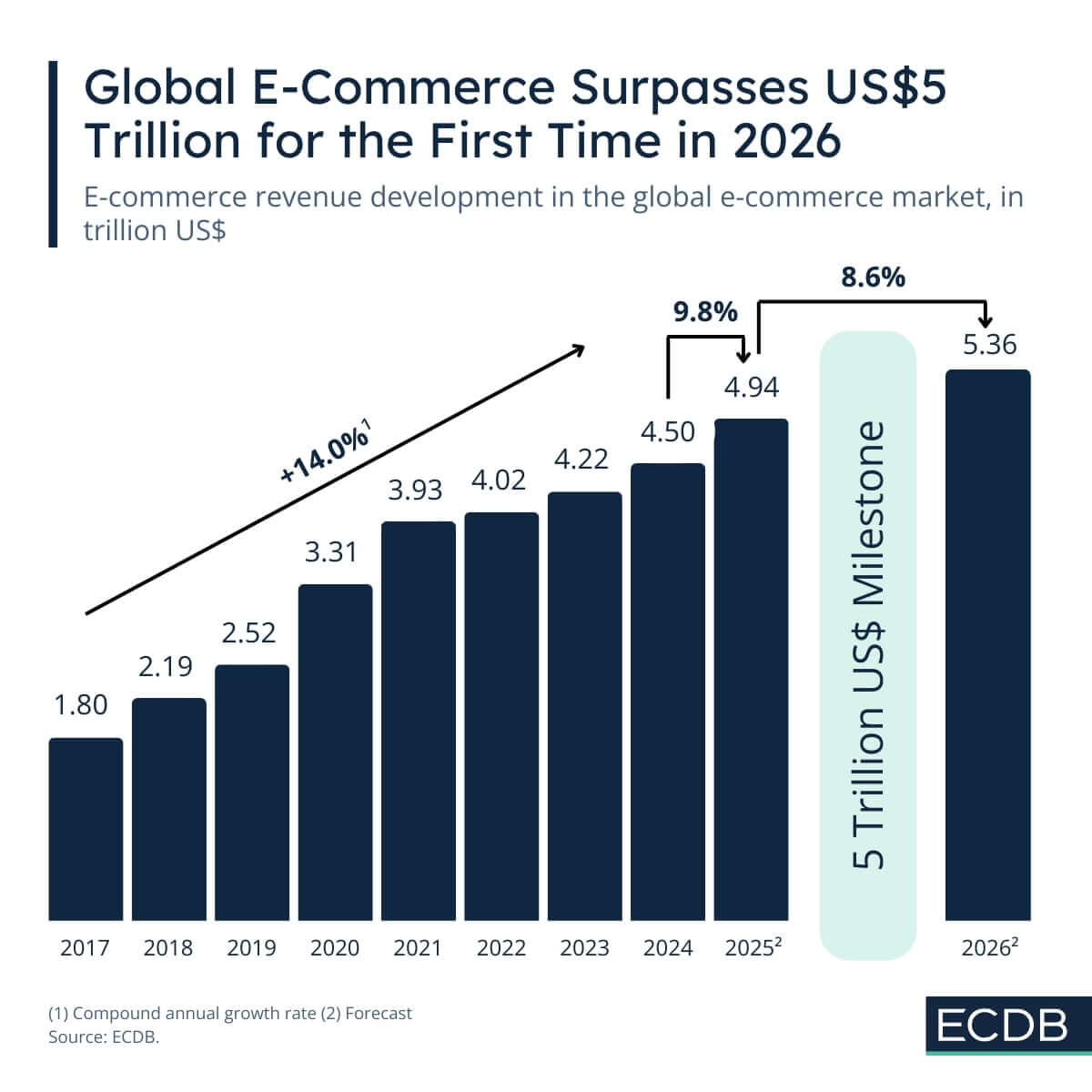
Now, in 2025 and 2026, revenue growth is picking up pace again. From 2024 to 2025, revenue grew by 9.8% from US$4.5 billion in 2024 to US$4.94 billion in 2025. Despite challenges in established markets like consumer uncertainty, inflation, economic slowdowns and increasing saturation, e-commerce is on an upward trend globally.
In 2026, a growth rate of 8.6% is expected. This leads to a new record revenue of US$5.36 billion for the year. Reasons for this positive development in e-commerce can be found in improved worldwide logistics, rising adoption of online shopping in global regions and a continued shift from offline to online in emerging markets.
Latin America leads among the world regions in e-commerce growth
The entire e-commerce market is growing, but it depends where you look for the trend to become most visible. Latin America is leading in growth, for instance, with a 2025/2026 rate of 12.4%.
Compared to that, the GSA region (Germany, Switzerland and Austria) is at a much lower rate of 4.6%. Their developmental stage surely has to do with this difference: GSA is at a higher level of e-commerce maturity than Latin America.
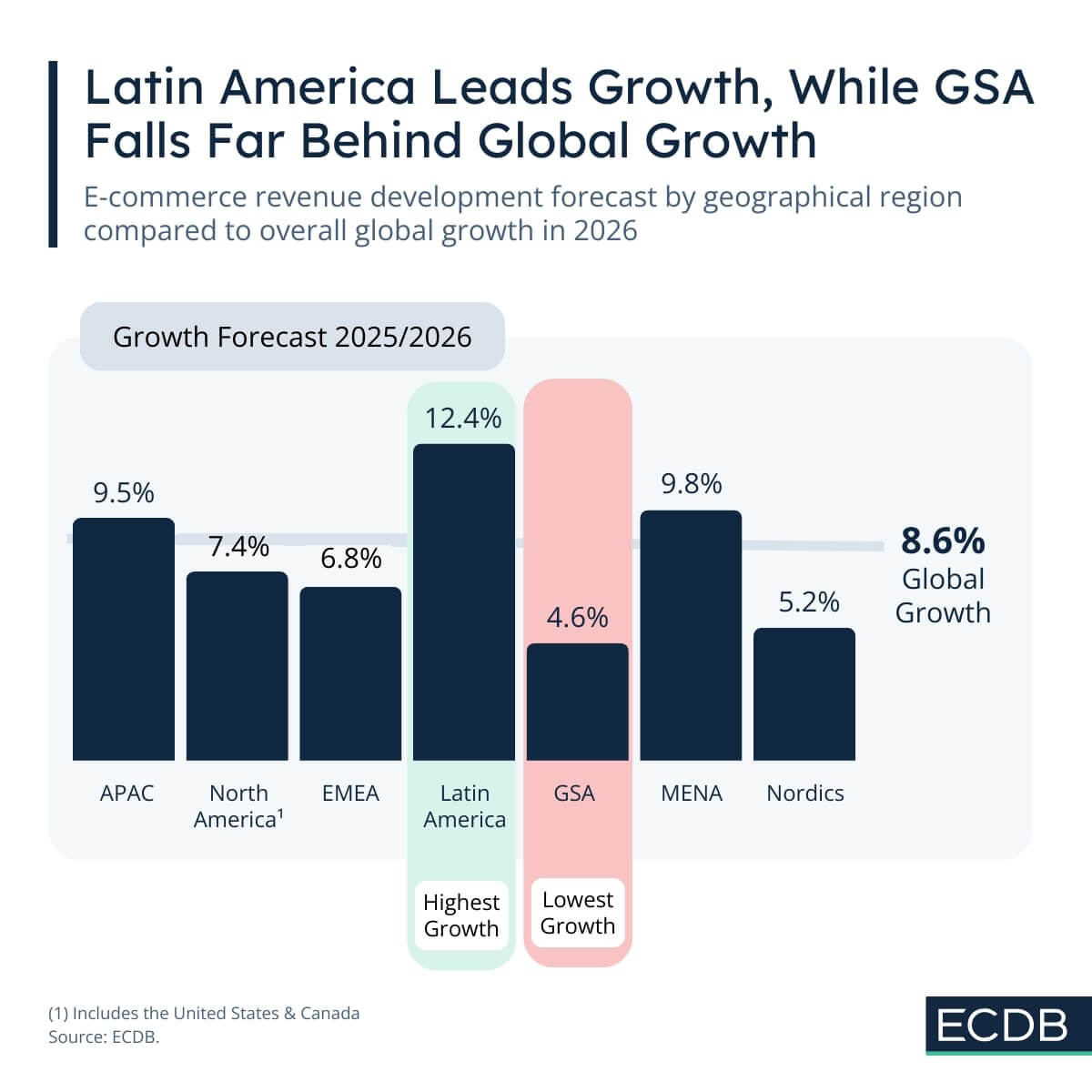
Yet maturity alone doesn’t explain all variations. North America is at a similar e-commerce maturity level as GSA and still grows at a rate of 7.4%. This higher growth reflects factors such as population expansion, market size, technological adoption, and favorable regulatory environments that support e-commerce acceleration.
Grocery and care products increase in significance for e-commerce this coming year
Grocery continues to be a key driver of global e-commerce growth. By 2026, Grocery is expected to contribute more than 10% to global e-commerce revenues. Compared to the leading categories, which see declining shares, Grocery is on an upward trend.
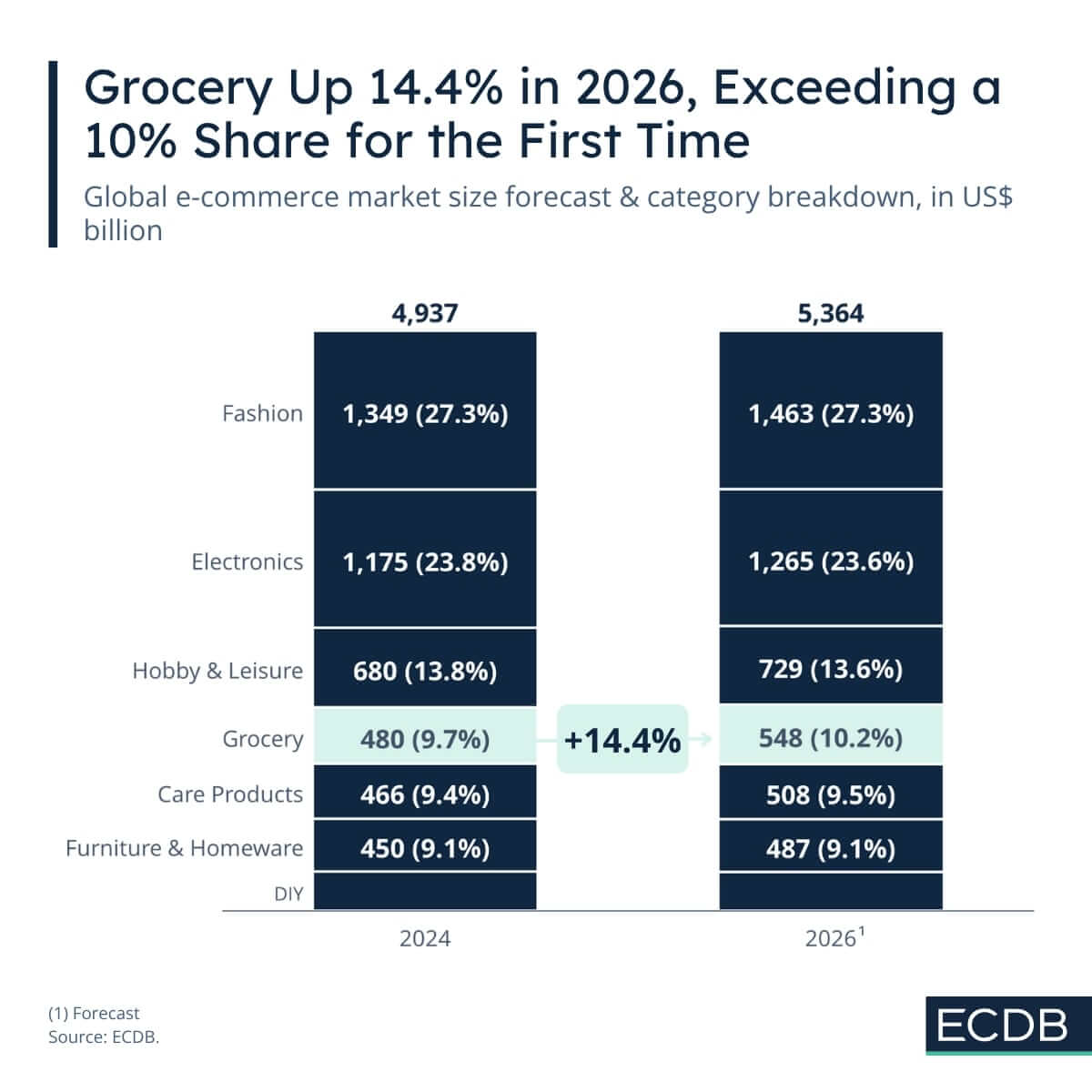
Fashion remains the largest single category. It generates US$1.463 trillion in global e-commerce revenues, accounting for 27.3% of the market. While Fashion’s share remains steady, Electronics and Hobby & Leisure see declining shares at overall growing revenues.
Care Products increase their share slightly, from 9.4% in 2024 to 9.5% in 2025. This development underlines how everyday essentials become more significant for online shopping, as e-commerce enhances the convenience of purchases and broadens product availability.
All categories are growing in absolute revenue, but the distribution of total market share is shifting toward everyday products. Slower growth in Electronics and Hobby & Leisure may be due to market saturation, a partial shift back to physical retail, and consumer trends favoring essential purchases over discretionary spending.
Marketplaces account for almost 90% of world e-commerce revenues
Marketplaces are ahead of online stores in terms of revenue from physical goods. By 2026, 87% of world e-commerce revenues will expectedly flow through online marketplaces, which will leave standalone online stores trailing far behind.
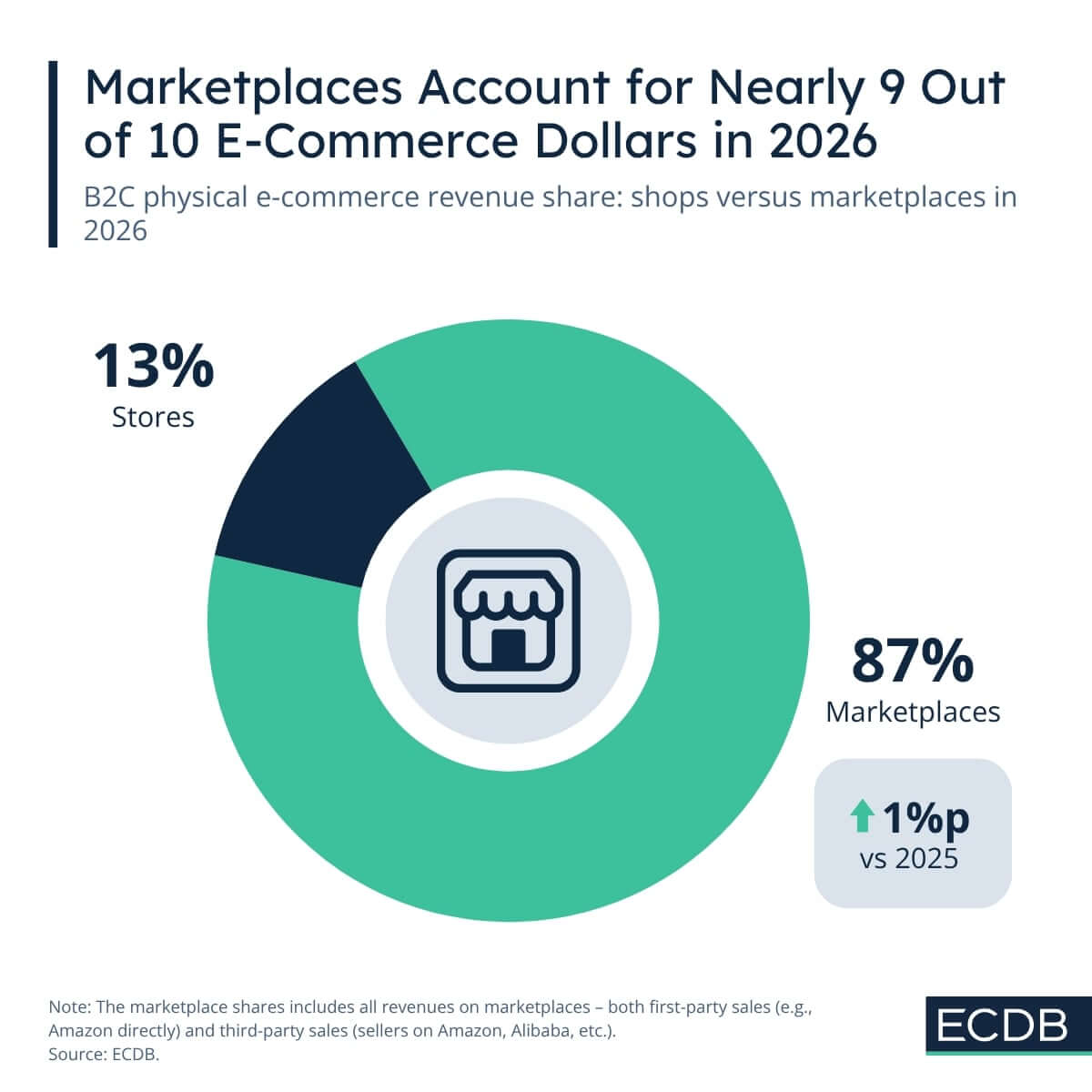
These changes are happening because marketplaces typically offer a vast product selection through multiple sellers offering their merchandise through the platform. Factors like streamlined logistics and trusted customer experience make marketplaces the preferred destinations for online shoppers.
Individual online stores tend to be more prevalent in matured markets, as they represent a model from previous decades. They tend to remain important in brand-specific strategies, but are falling behind the general trend in e-commerce, as the broader ecosystem benefits marketplace strategies for the aforementioned reasons.
Conclusion: New milestones and notable developments in e-commerce this coming year
Taken together, the trends shaping 2026 highlight an industry firmly back on an upward track. The developments point to a shift toward greater convenience in online shopping, the growing influence of markets across the Americas, and the expanding role of marketplaces that unite countless sellers and products under one roof. These dynamics set the stage for a year in which global e-commerce reaches new scale and cements its position as a central pillar of consumer commerce worldwide.