How German brands are expanding to international marketplaces
Discover why German e-commerce brands expand internationally, the barriers they face, and how streamlined integrations accelerate global marketplace success. (Ad)

Germany remains one of Europe’s largest and most dynamic e-commerce markets. In 2025, total online retail sales are approaching €90–92 billion. Yet growth is flattening domestically: and many sellers are realizing that relying on a single platform or a single country severely limits long-term potential.
Meanwhile, cross-border and multichannel commerce across the EU and globally represent a massive, underexploited opportunity. Through expanding beyond Germany’s borders, brands can tap into new customer segments, diversify revenue streams, and hedge against local economic fluctuations.
At the same time, consumer behavior across Europe is shifting: more and more shoppers are comfortable purchasing from foreign sellers, and cross-border e-commerce is becoming a normalized route for buying products online.
For many German brands, the question is no longer “if” they should expand – but “when” and “how.”
The shift: from single-marketplace to multichannel & cross-border
Recent market commentators note a clear trend: German sellers are increasingly viewing multichannel presence – across several marketplaces – as the baseline rather than the exception.
But at the same time, the pressure is mounting. Sellers managing multiple channels describe a “constant pressure to keep descriptions, categories and prices aligned everywhere.”
It’s no longer just about reaching German buyers. For many, the next logical step is international marketplaces (across Europe or globally) to increase reach and capture demand outside their domestic market.
In some quarters, the advice has become blunt: success for e-commerce brands will come down to “go global in 2026 or go home.”
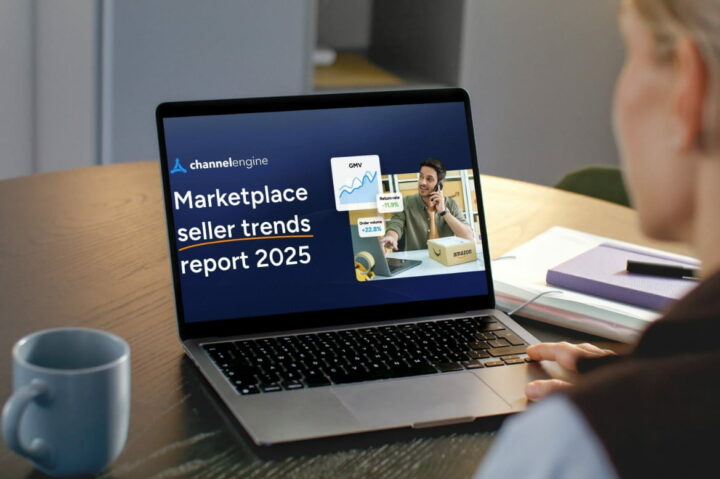
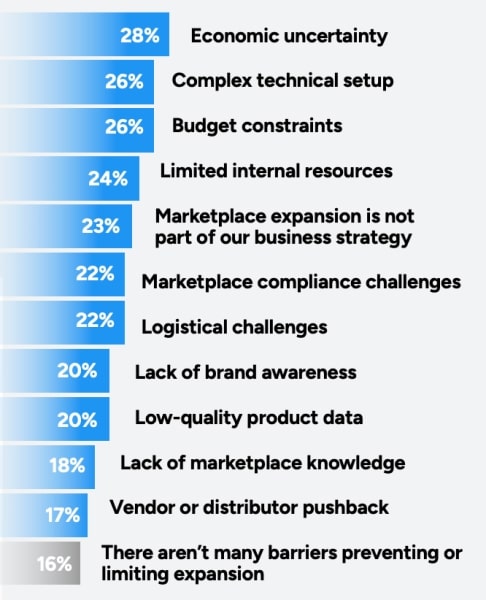
Yet despite this urgency and promise, a significant share of sellers remain hesitant to take the leap. According to the Marketplace Seller Trends Report 2025, 26% list complex technical setup and budget constraints as important barriers preventing them from scaling to other marketplaces.
Across Europe – including for many German sellers – there is growing recognition that operating on just one platform is no longer enough. This trend reflects a broader recalibration: brands increasingly treat multichannel presence as the baseline, not the exception. Selling in multiple marketplaces boosts visibility, tap-in to diverse customer bases and hedge against regional market risks.
Yet with multichannel come pressures: sellers managing multiple channels often report a “constant strain to keep descriptions, prices, and categories aligned everywhere.” That pushes many to consider cross-border expansion (beyond domestic platforms) as the next frontier.
And for those looking ahead, many market experts frame 2026 as a milestone year: a “go global or risk stagnation” kind of moment for brands seeking scalable growth.
What REALLY holds brands back: key barriers to expansion
Why do more than a quarter of sellers hesitate even when market potential is obvious?
- Fragmented technical integrations → each marketplace often demands a separate data feed, unique order management flows, and distinct inventory and pricing handling. For brands without dedicated engineering resources, this fragmentation can quickly become unmanageable.
- Operational overhead and risk → maintaining consistent product data, localized descriptions, translations, compliance with different regulatory regimes (country-specific taxes, shipping rules, returns, consumer rights) introduces complexity. Mistakes can hurt brand reputation and erode margins.
- Resource constraints for mid-size / smaller brands → while large retailers may have in-house infrastructure, many SMEs cannot afford the time or money to build and maintain a bespoke multi-marketplace stack.
- Lack of centralised visibility and control → dealing with multiple dashboards or integrations makes it hard to keep inventory, orders, and pricing in sync; this increases the risk of overselling, stock-outs, or inconsistent customer experience across channels.
All these factors reinforce the inertia: sticking to a single familiar marketplace seems safer than risking a complicated, error-prone expansion.
What the 2025 Marketplace Seller Trends Report reveals about the urgency to expand
ChannelEngine’s Marketplace Seller Trends Report 2025 offers a reality check on how fast the landscape is shifting; and why German and DACH brands feel the pressure to expand sooner rather than later.
The data shows that sellers are no longer operating on one or two platforms. The average seller is active on six marketplaces, and more than a third already manage seven or more.
Only 2% remain on a single marketplace. This confirms a structural shift: multichannel is the norm, not the exception.
The report also highlights why many teams feel stuck. 36% of the working week disappears into manual marketplace tasks (equivalent to almost two full days) with 21% of sellers spending half their week fixing listings, updating prices, or troubleshooting errors.
No surprise, then, that keeping product data aligned across channels ranks among the most frequent operational challenges.
And most importantly for expansion: 26% of sellers cite complex technical setup as one of the main factors preventing them from adding new marketplaces.
For DACH brands eyeing international markets, this aligns exactly with what we see in practice: the ambition is there, but fragmented integrations slow growth.
The report’s conclusion is unambiguous: those who simplify integrations and reduce operational load will scale faster. Teams want automation (91% see it as business-critical), better insights, and a way to break free from the manual overhead blocking expansion.
How ChannelEngine solves the problem
One integration, global reach.
This is where ChannelEngine becomes a game changer. The platform directly addresses the main pain points that keep 26% of sellers on the sidelines.
- One single integration (API + dashboard) gives brands access to more than 1,300 marketplaces worldwide, no need to build or manage separate integrations per channel.
- Centralized management of products, inventory, pricing, and orders — from a unified dashboard. This reduces manual work, minimises risk of discrepancies, and ensures consistent listings across marketplaces.
- Cross-border readiness. ChannelEngine supports localisation, handling of currencies, compliance with marketplace-specific requirements, and helps sellers adapt to different markets without heavy operational overhead.
- Scalability and agility. For German or DACH brands looking to grow fast, ChannelEngine offers a low-friction path: integrate once, and instantly unlock global reach; add new marketplaces without redoing the whole setup.
In effect, ChannelEngine transforms what used to be a barrier (for those who cite complex technical setup as a barrier to expansion) into a competitive edge, letting brands focus on growth instead of integration headaches.
Why 2026 is shaping up as a turning point for German/DACH brands
Given the current market dynamics: saturation at home, growing cross-border demand, and sellers’ growing ambition, 2026 is emerging as a critical inflection point.
Brands that haven’t embraced multichannel and global marketplaces by then risk being left behind. On the flip side, those who prepare early – especially by using smart integration tools – stand to gain first-mover advantage in less saturated markets, build cross-border brand recognition, and secure diversified revenue streams.
For German and DACH brands, that early-mover advantage could translate into long-term leadership across multiple European markets: not just Germany or DACH in general.
What you should do next (if you’re a German / DACH brand / retailer): your checklist for 2026
- Reassess your current sales channels. If you’re relying on a single marketplace (or your own webshop only) evaluate what share of your total potential market remains untapped internationally.
- Map out target geographies and marketplaces. Choose where demand and cultural fit are strongest (EU neighbors, high-volume markets), but don’t underestimate emerging opportunities outside immediate borders.
- Adopt an integration-first, automation-driven approach. Instead of adding marketplaces one by one manually, use a centralized tool (like ChannelEngine) to manage all channels, inventory, orders, content, pricing, and compliance.
- Focus on data and localisation. Ensure your product data, descriptions, pricing, and logistics are adapted to local markets, but avoid the complexity of manual maintenance.
- Monitor performance per channel. Track sales performance, conversion rates, and cost efficiency per marketplace to prioritise the ones that work best.
Over to you
The market unmistakably points toward cross-border, multichannel expansion as the next frontier for German e-commerce brands. But ambition alone is not enough. Technical complexity, compliance demands, and operational burden keep many from taking the leap.
ChannelEngine changes the equation. With a single integration, centralized dashboard, and built-in cross-border tools, it helps DACH brands break through technical barriers and scale globally, fast.
See how ChannelEngine helps DACH brands break through technical barriers and sell cross-border with a single connection.