High stakes, high opportunities: Scaling luxury e-commerce across DACH
Surge years give way to a new phase of disciplined growth driven by algorithmic discovery, price transparency and marketplace-led distribution. Read our quick overview with more details below.

In a world where everyone seems to be obsessed with €5 gadgets from Shein and the rising price of butter, can luxury e-commerce survive? Or better – get sharper?
It feels like a paradox. We are living through a “normalization phase,” yet the stakes for high-end brands are rising.
Luxury and premium growth across specialized networks slowed to a modest 1.8%. On paper, that sounds like a cooling engine. In reality, it’s the sound of the market maturing.
Online success is no longer about just “showing up” and waiting for the orders to roll in. Now, it’s focused on strategic control in a world where the customer journey is more fragmented than a broken Hermès mirror.
The DACH powerhouse by the numbers
When we talk about DACH, we’re talking about the economic heart of Europe.
Germany continues to be the undisputed heavyweight, holding a massive 46% share of all luxury e-commerce GMV in the EU. Think about that—nearly half of the digital luxury spend in the entire Union happens between the Rhine and the Oder.
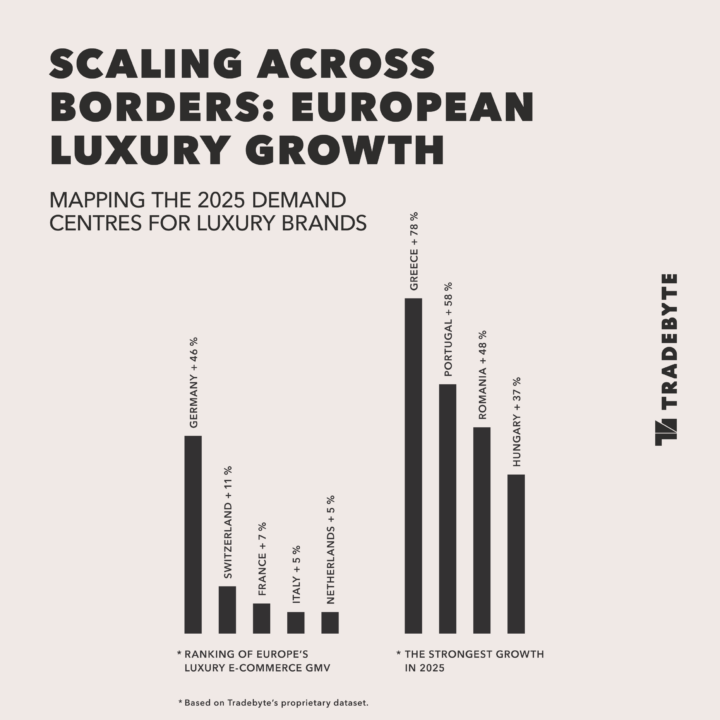
Then we have Switzerland at 11%. On the surface, 11% might look small compared to Germany’s 46%, but remember: Switzerland has a population of roughly 9 million people compared to Germany’s 83 million. While a German shopper might buy three premium items, a Swiss shopper is likely buying one ultra-luxury item that costs three times as much. Thus, this 11% share represents a highly concentrated, “recession-proof” pocket of the market.
So while Germany provides the scale, its neighbors provide the momentum and the margin. In 2025, Austria recorded a staggering 14% increase in overall e-commerce spending, with fashion remaining the crown jewel of categories. Meanwhile, Switzerland remains the world’s laboratory for high-end digital adoption. With e-commerce market volume in Switzerland projected to hit $20.56 billion in 2026 – and $37.99 billion in 2031!
But here is the question that keeps CEOs up at night: if inflation is biting and cost-of-living is rising, who is actually buying that €3,000 bag?
The answer lies in a deepening polarization of the market: we are moving from “aspirational luxury” to “ultra-high-net-worth (UHNW) resilience.”
While the middle class (the former engine of “entry-level” luxury) is indeed feeling the pinch of inflation and trading down to premium or even high-street brands, the truly affluent consumer remains largely insulated. For them, a €3,000 bag can be viewed even as an investment in “hard assets” that retain or even increase in value.
Furthermore, we are seeing a shift where 74% of consumers are willing to pay a premium for products with verifiable sustainability and origin. It suggests that when people do spend, they are choosing “fewer, better” items that promise longevity rather than fleeting trends.
Is luxury e-commerce becoming “more luxury” and can fight off China?
It’s a fascinating showdown. On one side, you have the “ultra-fast” giants from the East offering instant gratification for the price of a sandwich. On the other, you have the legacy of European craftsmanship.
Interestingly, the rise of low-cost platforms hasn’t killed luxury. It has forced it to evolve.
When everything is cheap, disposable, and algorithmic, “true” luxury e-commerce becomes the ultimate rebel act. Luxury brands are doubling down on what the algorithms can’t easily replicate: heritage, scarcity, and “Quiet Luxury.”
However, they are also getting pragmatic.
The era of brands dreaming of 100% Direct-to-Consumer (DTC) is largely over. Why? Because you can’t afford to be invisible. In a world of declining general sales, even the most prestigious houses are realizing they need the reach of established marketplaces. They’ve moved from “full control” to “strategic presence.”
The rise of the digital butler: Agentic commerce
If you think Gen Z is just scrolling TikTok for dance moves, think again. By 2026, 33% of Gen Z consumers are using AI as their primary research tool for luxury purchases. We are entering the age of Agentic Commerce.
This isn’t just a fancy chatbot. We can call it a shift where the “discovery journey” is delegated to algorithms. Your future customer might not even visit your website; their AI agent will compare your brand’s value, price consistency, and reviews across the web before presenting a final recommendation. And of course, you want that recommendation to point out your store.
What you should know:
- AI-driven discovery is compressing the time between “I want” and “I bought.”
- Curated ecosystems are replacing old-school brand navigation. Loyalty is now earned through the interface.
- Radical price transparency means that if your price varies wildly between a boutique in Munich and a platform in Milan, the AI will find out in milliseconds.
- Operational complexity is the new tax on growth—managing stock across multiple regions and partners is now the #1 barrier to scaling.
The direction toward “delegated decision-making” creates a new, invisible battlefield for brand equity. You have a beautiful storefront or a glossy campaign? Cool, but if your back-end data is a mess, you won’t achieve much.
Your “brand” is essentially being audited by an algorithm in real-time. If an AI assistant can’t verify your sustainability claims or if it finds a broken link in your checkout process, you are effectively “de-ranked” from the consideration set before a human ever sees your product. Scaling now depends on making your brand “machine-readable” while keeping it “human-desirable.
The examples of regional champions
Regional champions in the DACH market are rewriting the rules of high-end retail. These companies act as cultural institutions, balancing long-standing traditions with aggressive digital speed. They have successfully integrated the “soul” of craftsmanship into the “brain” of high-tech logistics.
Germany
German luxury is defined by Vorsprung, a technical edge that translates into digital reliability.
- Hugo Boss moved from traditional tailoring to a 24/7 lifestyle identity. They are using this phase of market normalization to ensure their digital footprint is as sharp as their suits. They lead the charge in making luxury accessible through curated platform partnerships while maintaining a premium sheen.
- Mytheresa, born in Munich, remains a star performer. While other global platforms struggle with high churn, Mytheresa thrives by obsessing over “VICs” (Very Important Customers). Their average order value sits at a staggering €797. They prove that in Germany, precision in data management leads directly to prestige in sales.
- Rimowa transformed the humble suitcase into a tech-forward status symbol. By integrating digital tracking and immersive e-commerce storytelling, they turned a €1,000 aluminum box into an essential piece of mobile architecture for the digital nomad.
Switzerland
The Swiss approach focuses on digital longevity. These brands build ecosystems that feel as permanent as a mechanical watch movement.
- Rolex maintains a masterclass in brand control. While you cannot simply “add to cart” for most models, their digital presence is dominant. In 2026, they are pushing the “Perpetual Planet” initiatives through immersive storytelling, successfully justifying their massive secondary market value.
- On Holding redefined the premium performance category. Born in the Swiss Alps, they used a digital-first strategy to scale at a pace that legacy brands envy. They prove Swiss engineering applies to global e-commerce growth just as much as it does to horology.
- Bally leverages Switzerland’s high disposable income and digital adoption rates. They blend a 170-year heritage with high-speed, cross-border e-commerce operations, targeting a new generation of the global elite.
Austria
Austria brings Gemütlichkeit, a sense of sophisticated comfort, to the digital world, proving that tradition can be high-tech.
- Swarovski is executing a radical elevation strategy. They shifted from being a component supplier to a full-fledged luxury house. By using AI-driven personalization and “Five Moments of Truth” digital training, they ensure the online experience matches the brilliance of their physical crystals.
- Wolford sets the bar for circular luxury. By 2026, their focus on the “Digital Product Passport” made them a favorite for Gen Z shoppers who demand that luxury items come with a verifiable, ethical digital footprint.
- Riedel demonstrates how functional luxury dominates a niche. They proved that specialized glassware can sustain high-growth e-commerce by focusing on educational content and precision shipping.
These brands share a specific DACH DNA. Technology is not a threat to them, but the tool that ensures their history has a future. They are the reason why, even when volume growth slows to 1.8%, the market can continue to climb. They sell “Machine-Readable Heritage.”
Comparison
Luxury ecommerce operates with lower conversion rates (0.8–1.4% for fashion) but high AOVs: £400–£900 for fashion, £800–£2,500 for jewelry/watches, and £120–£250 for premium beauty. ROAS for mature paid media hits 4–8x, boosted by first-party data and quality product feeds, while repeat customers (18–35% rate) drive 60–70% of revenue. Cart abandonment stands at 80–88%, often due to deliberation time or shipping concerns.
| Metric | Luxury fashion | Premium beauty | Jewelry/watches |
|---|---|---|---|
| AOV | £400–£900 | £120–£250 | £800–£2,500 |
| Conversion rate | 0.8–1.4% | Similar | Similar |
| ROAS (mature) | 4–8x | 4–8x | 4–8x |
Brands integrate AI for personalization and try-ons to cut returns, while marketplaces claim 25% of luxury fashion by 2025. Emphasis grows on omnichannel blending, price transparency, and B2B features for pros, as seen in Lupine Lights. Events like Luxury DACH in Munich highlight networking and data-rich insights for suppliers.
Facing the future: Can we scale in 2026?
So, is the glass half full or half empty?
It depends on your infrastructure. The brands winning in the DACH region right now are the ones who stopped fighting the platforms and started mastering them. They realize that “Preis-Leistungsverhältnis” (the German obsession with the price-to-performance ratio) now applies to luxury too.
On the negative side, the operational “tax” on growth has never been higher.
Brands are grappling with a market where consumers have grown weary of the endless “direct-to-consumer” hype that promised intimacy but often delivered logistical headaches. High return rates in Germany remain a structural nightmare for margins, and the rising cost of living has turned even wealthy shoppers into “rational luxury” seekers. They are scrutinizing every Euro, looking for a justification beyond just a logo. There is also the looming threat of digital invisibility; if a brand’s data isn’t perfectly synchronized across every marketplace and AI discovery tool, it simply ceases to exist in the mind of the modern consumer.
Yet, the positive side of this shift reveals a market that is finally shedding its “analog” skin.
The transition to a disciplined growth phase is actually a gift for brands with a solid backbone. The end of the “surge years” means the noise is dying down, allowing true quality and heritage to stand out. We are seeing a renaissance of trust where the DACH consumer’s inherent risk-aversion becomes a competitive advantage for established players. If you provide that flawless return policy and secure payment structure, you won’t be just selling a product. You will ensure the peace of mind in an uncertain economy.
Last words
Luxury e-commerce isn’t fading, it’s just becoming more disciplined. The “surge years” were a fluke and 2026 is the reality. In this environment, the brands that scale won’t be the ones with the loudest ads, but the ones with the most consistent, “machine-readable” digital presence. The German-speaking market doesn’t want fluff—it wants authenticity, security, and flawless execution.
Are you ready to let the AI assistants recommend your brand based on your data integrity, or are you still hiding behind a “Coming Soon” landing page?
The stakes are high and the growth is there, so maybe it’s high time to scale?