5 ways German retailers can prepare their product feeds for AI-assisted shopping
AI is changing how products are discovered. Here’s how retailers in Germany can make their product feeds AI-ready for GEO, conversational AI, and LLM discovery. (Ad)

Consider the search,
“Welche Waschmaschine ist leise und energieeffizient?”
The question already contains the decision criteria. Capacity, noise level, efficiency, it’s all implied.
The goal isn’t to explore options endlessly. It’s to arrive at the right choice, based on clear and comparable information. What used to take multiple steps now happens in a single interaction. Currently, AI simply shortens the path to that outcome and delivers the answer upfront.
Instead of opening five tabs, users ask AI just once and expect a precise answer.
That answer is powered by your product data.
Which means product feed optimization for AI shopping is the foundation of visibility across:
- GEO (Generative engine optimization)
- AEO (Answer engine optimization)
- Conversational AI platforms like ChatGPT and Perplexity
So, if you’re wondering how to prepare your product feed for AI-assisted shopping, it starts here.
Prioritize true German-language localization, not just translation
A translated feed is not automatically an AI-ready feed.
Large language models do not simply look for words. They interpret relationships between words, product attributes, category logic, and intent. In German-language commerce, this becomes especially important because search phrases tend to be highly specific, densely packed, and attribute-driven.
Take a query like:
“kabelloser staubsauger tierhaare akku 60 minuten leicht”
That is not casual language. It is a compact buying brief. The user is signaling product type, use case, power source, runtime, and weight preference in one line.
If your catalog says:
- “Cordless vacuum cleaner”
- “Good for homes”
- “Long battery life”
You may be technically correct, but you are not commercially precise.
This is where LLM-ready product catalogs begin. The goal is not elegant translation. The goal is machine-readable relevance.
What to do next
- Build titles around how German users phrase needs, not how source catalogs describe products.
- Standardize terminology for materials, sizes, energy classes, compatibility, and technical features across Germany and the larger DACH region.
- Rework descriptions to clarify the product’s purpose, not just marketing language.
- Remove vague phrases like “premium quality” when a concrete attribute would convey the same meaning more clearly.
- Treat language localization as part of feed optimization for conversational AI, not just translation hygiene.
This is the foundation of LLM-ready product catalogs.
Prepare product data for discovery beyond search, including TikTok Shop
In 2026, discovery is happening in feeds, videos, and conversations.
TikTok Shop’s expansion across Europe signals a shift toward content-driven commerce.
It officially expanded into Germany, France, and Italy on March 31, 2025, after earlier expansion into Ireland and Spain. TikTok said the move followed strong growth in the UK market and would allow users in those countries to shop directly in-app.
Reuters also reported that TikTok partnered with brands including About You and Cosnova in Germany as part of the launch.
What to do next
- Adapt titles so they still communicate the most decision-critical attributes even outside traditional search results.
- Pair structured attributes with image quality, variant accuracy, and concise descriptions that make sense in faster discovery environments.
- Audit which fields are currently optimized only for Google Shopping and which can support multi-surface discovery.
- Build toward an optimized data feed for LLM discovery that can also support content-led channels.
- Think beyond “channel compliance” and toward reusable product meaning.
Ensure consistent product signals across channels for AI understanding
Here is a common German retail problem disguised as a channel strategy:
One product. Four endpoints. Five versions of the truth.
> On OTTO, the title is shortened.
> On Zalando, the style attribute is emphasized.
> On Kaufland, the taxonomy is slightly different.
> On Google, availability updates faster than anything else.
This inconsistency creates confusion for shoppers and AI.
What to do next
- Establish a single source of truth for product identity, core attributes, and variant logic.
- Define which fields are globally consistent and which are channel-specific adaptations.
- Standardize naming conventions for size, material, color, energy ratings, and product type.
- Reduce manual rewrites that create semantic drift across channels.
- Treat multichannel consistency as a prerequisite for product feed optimization for AI shopping.
Strong product feed management ensures consistent signals everywhere.
Make your product data accurate at the moment AI decides
Accuracy is not limited to product characteristics. The status of product availability, current price, and local delivery options all need to be up-to-date. In AI-assisted shopping, data freshness directly affects whether a product is surfaced, trusted, and selected.
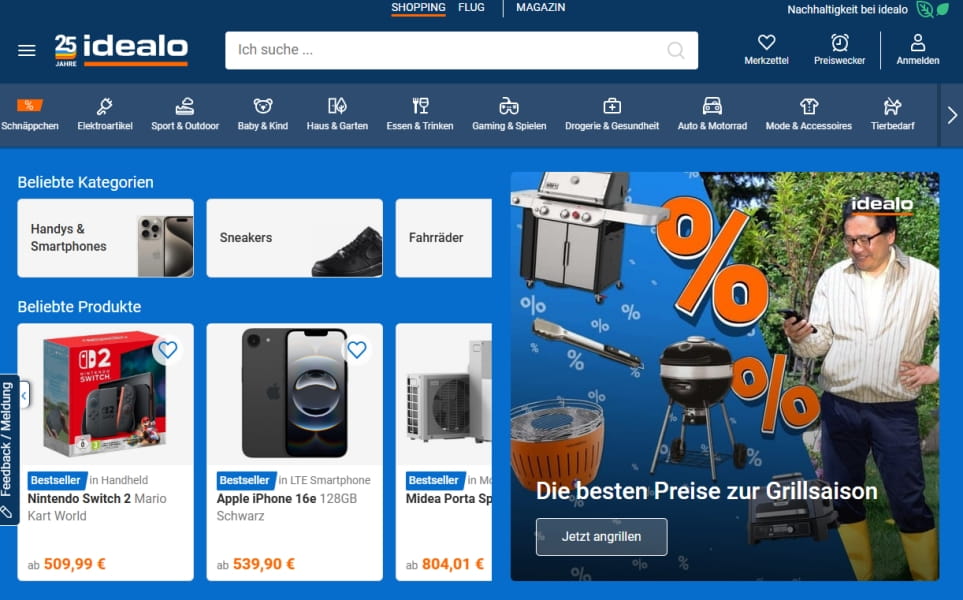
This is especially important in Germany because price-comparison platforms are not side channels. They are the central decision infrastructure. Nearly one in two online shoppers in Germany compares prices on a few websites before purchasing. At the same time, platforms like Idealo, with tens of thousands of merchant integrations, show just how central real-time pricing and stock data are to visibility.
If your feed says:
- in stock, but the product is unavailable
- delivery in 2 days, but the checkout says next week
- €499 in one channel and €529 in another
This isn’t just a small feed problem. You are undermining trust at the exact moment a shopper or AI assistant is trying to narrow the field.
What to do next
- Increase update frequency for price, stock, shipping windows, and promotional data.
- Sync availability logic across marketplaces, comparison engines, ad channels, and AI-driven platforms.
- Monitor delivery and stock mismatches as visibility risks, not just operational errors.
- Build an automated feed for LLM ingestion so freshness is maintained without manual lag.
Get ahead of digital product passports and transparency expectations
The next phase of product data in Europe is all about proving your product claims.
What is this made of?
Where did it come from?
Can it be repaired?
How long should it last?
What sustainability claims can actually be backed up?
Those questions are moving from brand storytelling into regulated product information.
The European Commission describes the digital product passport as a key innovation under the Ecodesign for Sustainable Products Regulation, designed to store and share data on sustainability, durability, and other environmental aspects with consumers, businesses, and authorities.
This is especially relevant for Germany because shoppers, marketplaces, and regulators already place a high value on technical detail, transparency, and documentation.
What to do next
- Structure sustainability, origin, repairability, and materials data so AI systems can interpret it, not just humans.
- Focus on categories where richer attributes improve both compliance and AI-driven recommendations.
- Separate verified product facts from marketing claims to strengthen AI trust signals.
- Make compliance data reusable across channels to support LLM visibility.
- Build flexible data models so new regulatory attributes can be added without reworking your feed.
| Interested in participating in the Productsup-Protokol DPP pilot program? As DPPs push product data toward greater structure and transparency, they also improve how AI systems understand and recommend products. Productsup is inviting companies to join its free pilot program, offering consulting support to plan and implement DPP strategies. Connect with the team to explore how your business can get on the path to compliance and build a stronger foundation for AI-driven discovery. |
The new gatekeeper of discovery: your product data
For years, German retailers have competed in structured environments shaped by filters, specifications, comparison shopping engines, and channel requirements.
AI-assisted shopping does not replace that model. It intensifies it.
The shopper still wants the same thing: a trustworthy answer, fast.
The difference is that now the answer may come from a single conversational interface.
That is why product feed optimization for AI shopping should be treated as a strategic priority, as it touches:
- product feed management
- product data for ecommerce
- feed optimization for GEO
- feed optimization for AEO
- and, increasingly, agentic commerce product feed management
Companies like Productsup can help German businesses prepare for this shift by improving data quality, syndication readiness, and AI-channel distribution. And there is a real opportunity to move early: pilot programs already exist for retailers that want to test how their catalogs perform in emerging AI-assisted commerce environments.
If your team is evaluating what comes next, book a demo to connect with the Productsup team. We’ll show you where your catalog is already strong, where it is invisible, and what needs to change as AI becomes a larger share of discovery.
Author bio
Marcel Hollerbach is Chief Innovation Officer and Co-Founder at Productsup, the leading enterprise feed management and syndication platform. As CIO at Productsup, he helped transform the company from a small agency startup out of Berlin into a multi-million dollar cloud-based SaaS platform that now has a global presence in more than 30 countries.
He is an active thought leader in the commerce and tech space, frequently interviewing with media and appearing on podcasts.
***
This article is part of a winner’s prize at the E-commerce Germany Awards 2026. If you’d like to learn more about the awards, visit this website: