Marketplaces dominate European cross-border e-commerce
The 2025 “TOP 100 Cross-Border Marketplaces Europe” report reveals the impressive growth of European e-commerce, with online marketplaces accounting for 70% of the market. Key players like Amazon and eBay continue to dominate, while new trends emerge.

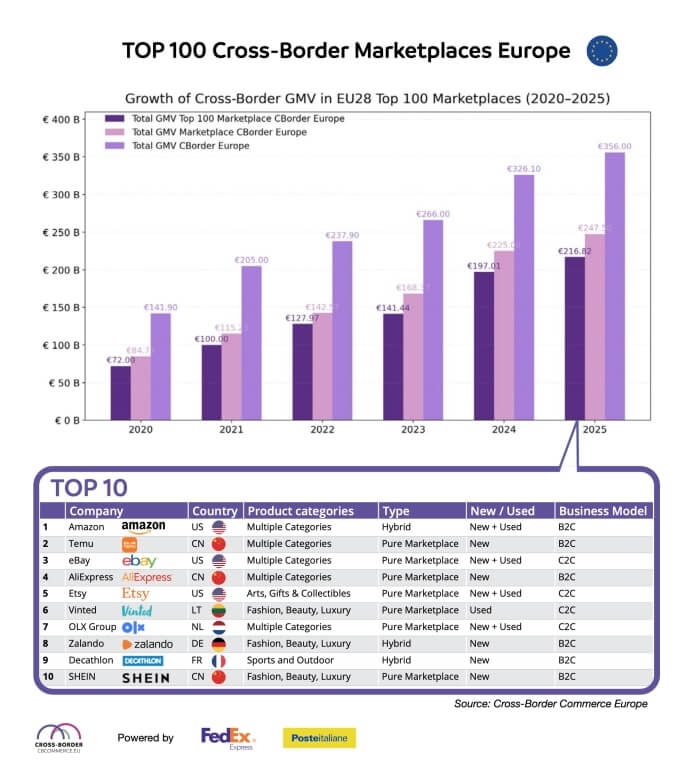
The European e-commerce landscape is experiencing a transformative surge, with online marketplaces standing at the forefront. The recently released sixth edition of the “TOP 100 Cross-Border Marketplaces Europe” report offers a deep dive into the thriving sector. As of 2024/2025, the European cross-border e-commerce market has soared to €358.7 billion, with marketplaces contributing a significant €247.5 billion, or 70%, of the total.
The study, conducted by CBCommerce with support from FedEx Express and Poste Italiane, highlights the pivotal role that online marketplaces play in driving cross-border trade. This is not just a trend but a dominant force shaping the European digital economy. The report also reveals that the top 100 marketplaces saw a combined turnover of €216.82 billion—a 10% increase from the previous year—illustrating the resilience and consistent growth of the marketplace ecosystem.
The top 10 cross-border marketplaces
The report identifies the key players in the European cross-border marketplace sector. Among the top 10 marketplaces, giants like Amazon, eBay, and AliExpress continue to dominate, but there’s increasing competition from newer platforms such as Shein. The full list includes:
- Amazon
- Temu
- eBay
- AliExpress
- Etsy
- Vinted
- OLX
- Zalando
- Decathlon
- Shein
These marketplaces not only lead in turnover but also set the tone for innovations in e-commerce, logistics, pricing strategies, and customer engagement.
Factors driving growth in European cross-border e-commerce
The key to the growth of European cross-border e-commerce lies in a combination of factors. According to the report, a thorough analysis of cross-border online sales across 28 European countries, SEO performance, and country coverage reveals the strength of these platforms. Secondary parameters, such as AI and Big Data strategies, customer services, and marketplace types, further shape the rankings.
One trend standing out in the report is the rise of hybrid third-party (3P) B2C marketplaces. These platforms combine business-to-consumer models with third-party sellers, allowing for higher sales volumes and enhanced cross-border GMV (Gross Merchandise Value). This flexibility is driving the expansion of the marketplace ecosystem across Europe.
Marketplace models and regional variations
Marketplaces in Europe are not one-size-fits-all. The study identifies three dominant models that define the market:
- Generalist marketplaces: Examples include Amazon and Allegro, offering broad product ranges, robust infrastructure, and massive reach, but they are highly competitive and price-driven.
- Vertical marketplaces: Marketplaces like Zalando, ManoMano, and Farfetch focus on specific categories and enjoy higher conversion rates but are more selective.
- C2C marketplaces: Platforms such as Vinted and Depop contribute to the circular economy and have low barriers to entry but face challenges in scalability and brand control.
These models offer varied approaches to growth and market penetration, depending on regional nuances and consumer preferences.
Regional differences in cross-border e-commerce success
The study also highlights how regional dynamics influence marketplace success across Europe. In Germany, Amazon and Otto maintain their dominance, although vertical marketplaces are increasingly gaining ground. In France, C2C platforms and fashion verticals reign supreme, while the UK market blends generalist and niche verticals. Central and Eastern Europe is experiencing rapid generalist marketplace growth, creating space for specialized entrants to thrive.
Looking forward: A maturing market
As European cross-border e-commerce continues to expand, there are indications that the marketplace sector may be reaching a point of maturity. Experts predict that while cross-border GMV will rise, the share of marketplaces in total e-commerce GMV is expected to remain steady until 2026. This suggests that the market might stabilize after years of rapid growth, yet new opportunities will emerge, particularly for platforms targeting specialized niches.
In conclusion, the sixth edition of the “TOP 100 Cross-Border Marketplaces Europe” report paints a picture of a rapidly expanding and highly dynamic European e-commerce landscape. As marketplaces continue to play a crucial role in shaping the future of cross-border trade, the next few years will undoubtedly bring even more innovation, competition, and growth to this vital sector.