Behind the Click Podcast with Dara from HDE: How AI is redefining the future of European retail
Written by
Editorial TeamPublished on
What will retail look like in the age of AI? Dara Kossok-Spieß joins Behind the Click to discuss Europe’s digital transformation, the future of shopping, and how retailers can prepare for the coming wave of AI agents.
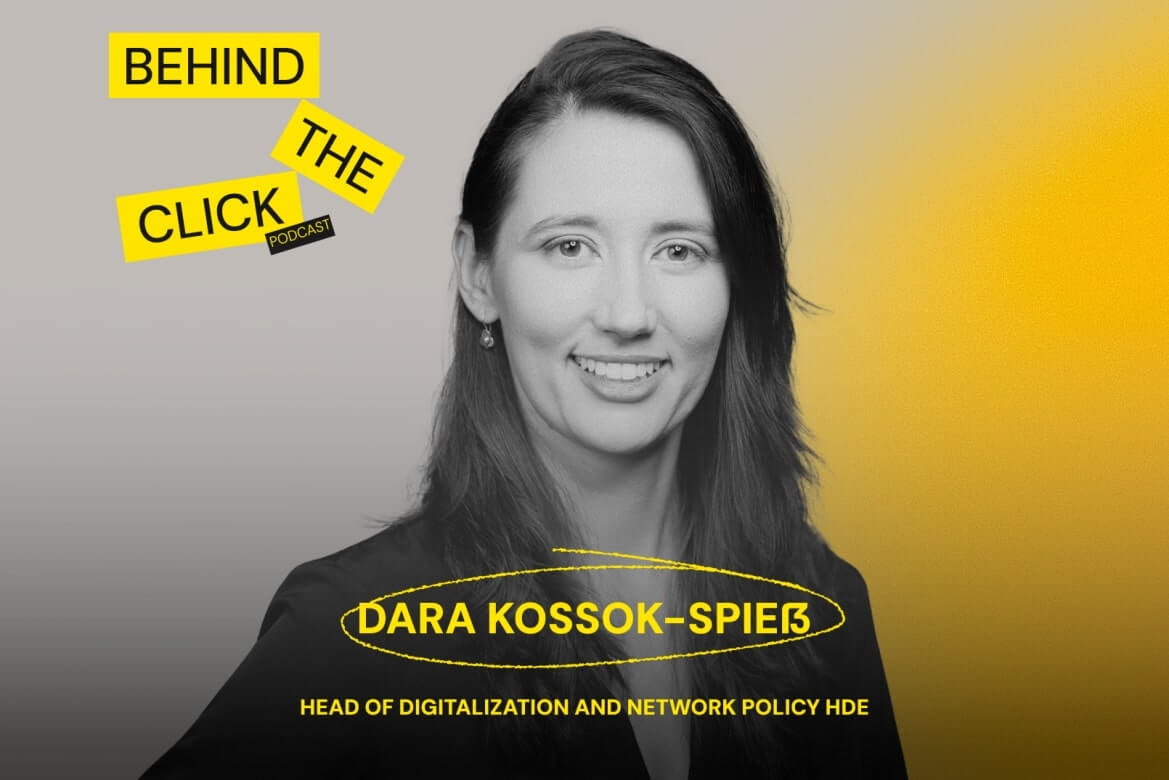
If you’ve ever wondered what the future of European retail really looks like, not the hype, but the hard reality, our latest episode of Behind the Click delivers a rare kind of clarity. In our conversation with Dara Kossok-Spieß, Head of Digitalization and Network Policy at German Retail Federation (HDE), one message came through louder than anything else:
AI isn’t the next big thing. It’s already the ground we’re standing on.
And for many retailers, that ground is shifting fast.
In this article, built entirely from our interview with Dara, we unpack her most striking insights from the widening AI gap between large and small retailers to the looming impact of AI agents that could transform shopping as we know it. Dara doesn’t sugarcoat the challenges. But she also offers a path forward filled with practicality, realism, and more optimism than you might expect.
Scroll on to explore what she sees coming and why now is the moment for retailers, policymakers, and consumers to pay attention.
Representing 280,000 retailers
Dara Kossok-Spieß describes her role at the German Retail Federation as “communication” between tech and tradition, business and politics, Berlin and Brussels.
The federation represents around 280,000 retail businesses and more than three million workers in Germany. It works on both the national and European level, while trying to defend something that is hard to quantify but easy to recognize: the particular atmosphere of European shopping streets, from small boutiques to family-owned stores.
“To preserve the tradition, you have to work with the future,” she says. “And that means also to work with tech.”
For her, this isn’t about turning every shop into a Silicon Valley startup. It’s about giving traditional retailers the tools they need to survive in a world where customers have become used to one-click convenience.
“Consumers, they’re lazy. Let’s be honest,” she says with a laugh. “They like convenience. I’m a consumer myself. Of course we are convenient. And therefore you have to be omnichannel. You have to go with the time to preserve your uniqueness.”
From hype to strategy: AI’s rapid rise in retail
The German Retail Federation has followed this shift closely through three dedicated studies on AI in retail, carried out in 2021, 2023 and now 2025.
In 2021, she recalls, AI was still treated as a kind of shiny object.
“We started with AI being this fancy tech topic,” she says. Much of the debate was tied to the AI act at European level, and the question in retail was still: where might AI possibly be useful?
By 2025, that question has flipped.
“The percentage of retailers using AI in [SMEs] doubled, even more than doubled,” Dara Kossok-Spieß says. “We’re not in the ‘what are the possibilities’- we’re in the ‘how can I use it strategically’ sphere.”
But that overall progress hides a dramatic divide.
According to the latest study, 73 percent of large enterprises are using AI, “most of them trying to use it strategically and holistically,” as she puts it. They are integrating AI into multiple parts of their business rather than treating it as a toy for the marketing department.
Among small and medium-sized businesses, the picture is very different. There, only 23 percent are using AI at all.
“There is a huge gap of knowledge,” she says. “But there is a huge gap of cultural change as well and of invest-money, to be honest.”
Crisis-layered reality for smaller shops
The reluctance of smaller retailers to embrace AI isn’t just stubbornness or technophobia. Dara paints a picture of owners overwhelmed by immediate survival.
In recent years, she notes, many German retailers have faced:
- Shops closing or running with no revenue
- The impact of the Russian invasion of Ukraine
- An energy crisis in which energy costs became one of the federation’s biggest topics
- Three years of recession
- A significant drop in consumer spending
Against that backdrop, buying into AI can feel like a luxury.
“So the topic of how much can I invest into the future to survive, and how much do I have to invest now to survive, is one of the main questions [SMEs] are having in retail,” she explains.
When these business owners say they have “so many problems” and AI is just one more thing they don’t want to deal with, Dara understands them emotionally. Strategically, though, she thinks they’re making a catastrophic mistake.
“Looking at it strategically, it’s the biggest mistake you can make,” she says. “We are not talking about trainings. We’re not talking about how to prompt. We are also talking about new business models and being prepared for those business models.”
AI as a multiplier – of money, work and data
If there is one phrase Dara returns to again and again, it is this: AI multiplies everything you put in, be it your money, your employees or data.
That last part, she argues, is where many small and medium-sized retailers hit a wall as they simply do not have their data in a usable form.
They may not own it properly, or it may be scattered across outdated systems and manual processes. It’s a problem a lot of SMEs have and it should be the first step to take care of if they plan to start using AI.
Where to start when AI feels overwhelming
For a small retailer listening to this, the combination of data work, culture change and regulation might sound paralysing. Our guest insists the way forward is to start small and concrete. Her advice is to identify one specific project and begin there.
“Take one project. Try it out. Look at your company or at your business and say: what’s the most time-consuming thing I get the least revenue from?” she suggests.
For some, that might be social media.
“Is it social media communication because it’s something you’re not the fan of, it’s nothing you can do authentically, so you have to sit there and think of new post ideas? Outsource it to AI. Try it out. Find a solution for that.”
Beyond that first experiment, she sees three practical pillars:
- Clean the data once, then maintain it.
- Use networks. “You’re not out there alone. Nobody is,” she says, pointing to communities and the federation’s own digital center, which showcases best practices from other small businesses.
- Involve top management. One of the strongest patterns they see in the research is that AI projects succeed when owners and top managers drive them, rather than delegating them to “the intern because he or she is young.”
“AI being a priority is already a key factor of success,” she says.
Fear of failure and the “German mentality”
Beyond budget and data, our guest sees a specifically cultural barrier to AI adoption in Germany.
“I think it’s German mentality,” she says when asked why so many companies feel they must do everything themselves from scratch.
She describes a strong reluctance to use “AI as a service” and a deep fear of failure.
“We have such a bad failure culture in Germany,” she argues. “Failure is one of the biggest things, the worst things that can happen to you. And we know from the American perspective, you have to fail. You have to fail fast to grow.”
The same fear shows up among employees, especially when AI is perceived as a threat to jobs. Here, she believes communication is crucial.
“If people know the sense and the impulse of something, and when they know it will suit me, it will benefit me, it will benefit the place I’m working, then they have an impulse to work with it,” she says.
If AI is introduced as another bureaucratic duty – something to “check” on a list – they will only go through the motions.
“You want workers to think with you,” she insists. “You don’t want workers just to be around and check boxes.”
AI literacy as a social issue
She notes how AI is already being used to generate fake images and videos at scale, and how many people cannot tell the difference between real and artificial content. She mentions receiving some of the worst disinformation from older people via messaging groups.
Dara Kossok-Spieß, is clear that AI and media literacy are not challenges businesses can solve alone. She believes that it should be taught in schools, universities and clubs for seniors, it’s something to be done together as a society. And then it will have impact on businesses also.
Within companies, she sees room for “in-store trainings” about AI culture and business use. But the deeper competence – recognising manipulation, assessing sources, understanding how AI content is made – must be built much wider.
A regulatory environment that freezes innovation
On the policy side, Dara Kossok-Spieß acknowledges that the European Union is very active on digital regulation. She says the German Retail Federation supported the AI act, particularly where it restricts genuinely dangerous uses.
But she sees two major problems.
First, new rules are being discussed and tightened before existing ones have been implemented.
“What we do at the moment, or what we see, is that we have the European Union deciding things… but we didn’t even implement it,” she says. “And now we’re already talking about stricter rules, new acts… changing something we didn’t even start implementing.”
Second, European businesses feel these rules apply more to them than to third-country platforms and imports.
She points to “trillions of parcels” coming into the EU without being properly controlled and asks why some non-European platforms seem less constrained by acts like the Digital Services Act and Digital Markets Act than local businesses.
“For us, it’s not a fair level playing field anymore,” she says.
The effect on investment, especially among smaller companies, is chilling.
“Businesses in this current state are very, very anxious about everything’s going on,” she explains. “They’re very insecure. So of course they freeze investments… and stay there like this rabbit in front of the snake: ‘We’ll wait until they decide what they really want to do… so then we know where to invest so we do not lose money.’ And that’s a huge, huge problem for any economic that wants growth.”
Her main ask is not wholesale deregulation, but a pause.
“I would love to see a shift from regulation to enabling competence,” she says. She wants the EU to focus on implementing what has already been decided, monitoring its impact, and ensuring that rules apply equally to all players on the market, rather than constantly adding new layers.
AI agents: convenience or catastrophe?
When we asked Dara which AI trend both excites and worries her, she didn’t hesitate: AI agents.
She sketches a near-future scenario in which:
- Your AI agent knows you buy sunscreen and a hat at the start of every summer and automatically orders them each May.
- Your regular food basket is ordered and delivered without you lifting a finger.
- You tell your agent: “Here’s 100 euros, plan everything I need for a weekend in Brussels,” and it handles research, travel and bookings.
As a mother of two, she admits that “it sounds delightful” to offload that much care work.
As a retail policy expert, she describes it as “the worst thing that could happen to humanity” and, in almost the same breath, “the best.”
Her concerns centre on three questions:
- Who decides what the agent buys?
Will agents be biased towards certain platforms because of hidden sponsorship, like paid search results? - Where do values like sustainability and supporting small businesses fit in?
Can consumers express those preferences clearly, and will agents actually act on them? - What happens to the market structure?
She fears AI agents will multiply current trends, pushing even more volume towards a handful of large platforms and squeezing out smaller players.
She also worries about what happens to cities and social life if shopping is heavily automated. Will we still have supermarkets and local shops, or just logistics centres at the edge of town and a stream of small delivery vehicles?
Identity, experience and community: the human edge
Despite these fears, Dara does not believe small retailers are doomed. In fact, she thinks they hold three key advantages that will matter more and more: identity, experience and community.
“At the end of the day, 2025, you have to ask: do I need more than 20 t-shirts?” she says. “What makes me buy the 21st t-shirt? And it’s identity. It’s community. It’s having the feeling to be part of a group, part of something I want to support.”
In her view, the retailers who succeed in the age of AI will be those who:
- Are transparent about their values and purpose
- Offer a memorable, human experience
- Build communities where customers feel they belong
This, she argues, is where SMEs have a real “competitive bonus”: they offer the warmth and human connection that many consumers feel is missing from large corporations.
Fear vs. AI
For all the complexity she describes – recession, regulation, data, AI agents – Dara’s closing message is surprisingly simple, we should use AI as a tool it is and see it as something that can be used in a good way or a bad way.
The responsibility, she suggests, lies with all of us: policymakers, businesses and consumers. To use AI aligned with our values. To push for a level playing field instead of an arms race. To stay connected rather than retreating into isolated, automated bubbles.
And above all, not to be paralysed by fear of any kind – be it AI, failure, regulation or bureaucracy.
The future of retail, she believes, will be online. But whether it will also be fair, human and diverse will depend on what Europe chooses to do with the tools it now has in its hands.
To hear interview with Dara in full, in her own voice and with all the nuance that can’t fit on a page, watch the complete episode of Behind the Click:
You can also listen to the episode on the Spotify or Apple Podcasts.