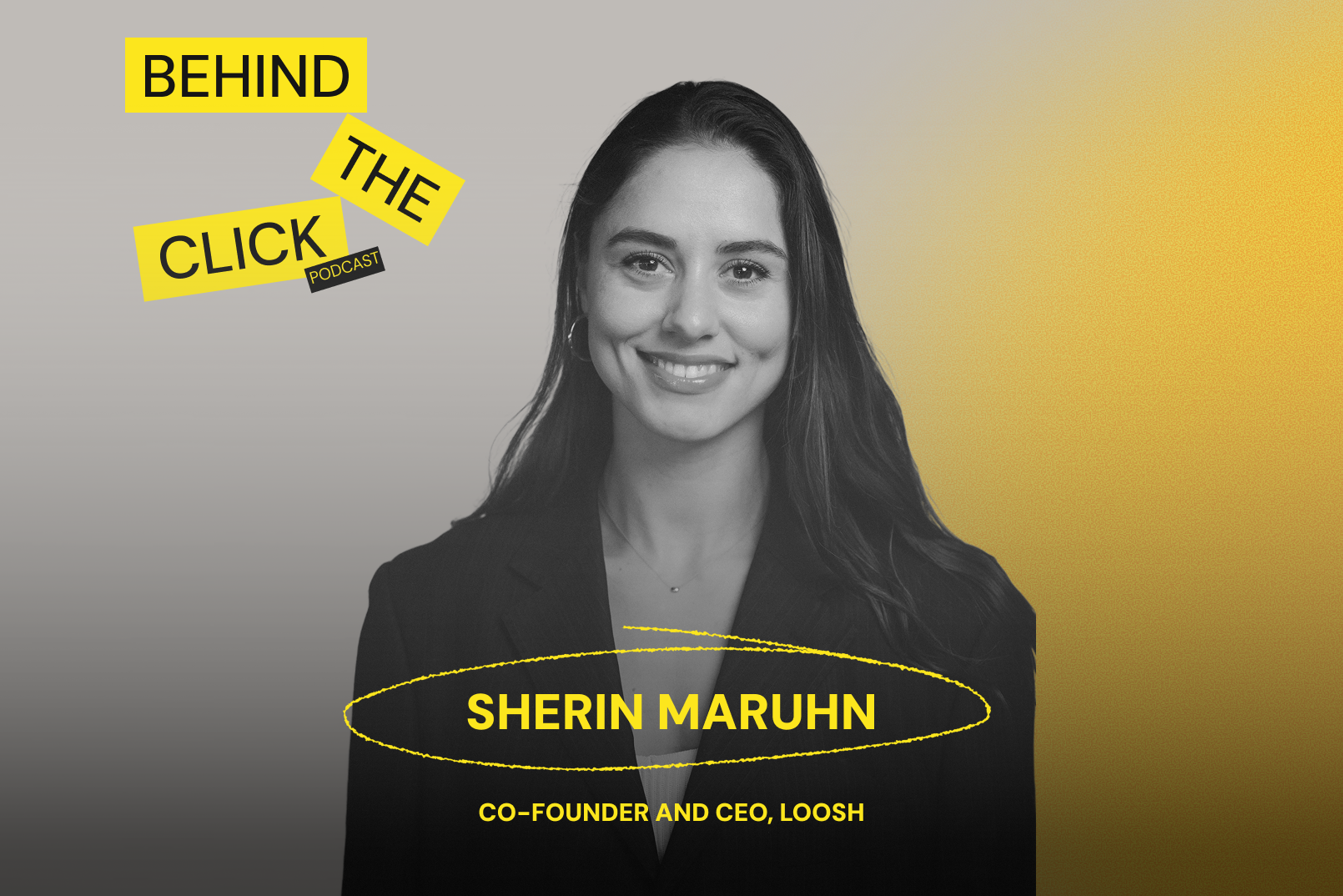
BEHIND THE CLICK PODCAST WITH SHERIN MARUHN: WHAT MAKES A CONSUMER BRAND INVESTABLE, AND WHY FOUNDING IS A MARATHON
Written by
Editorial TeamPublished on
Discover what makes a consumer brand investable, straight from someone who has seen it from every angle. Sherin Maruhn, Co-Founder and CEO of LOOSH, shares lessons from her time as a national-team sprinter and venture investor: choosing a co-founder, building a brand first, and why founding is a marathon.
From the 400 meters to the cap table
Sherin started running at five or six, after pestering her mother and her older brother’s coaches until they let her join. She stayed with track and field for 13 years, specialized in the 400 meters and made the national team. The key to that career, she says, was discipline, willpower and a coach who felt like a second father, someone who knew how to push her and how to get her back on her feet after a loss.
Her professional path began at 20 in the Berlin startup scene, at the accelerator Plug and Play, and moved through operations and on to the investor side, where she built a venture arm at PwC that invested in both funds and startups. Her point: to work in the startup world you need to understand the whole triangle of founders, venture capitalists and the limited partners behind the funds, because each side’s incentives shape the other’s behavior.
Why most startups shouldn’t raise venture capital
Sherin has said publicly that most startups should not raise venture capital. Her criteria for those that should:
- A big and growing market. It must be large enough to offer a potential return on the order of ten times a billion-dollar outcome, because a fund needs fund-returner companies.
- An honest view of your own ambition. Venture money comes with pressure and speed for seven to nine years, until an exit within a fund cycle of roughly ten years. Some founders would rather build a sustainable business at their own pace.
- A business model that fits. Some companies can become profitable on their own. Others, such as deep tech, genuinely need funding.
She also reminds founders that investors answer to their own backers. That affects follow-on rounds and portfolio support: if you are not one of the one or two companies expected to return the fund, support only goes so far. Her advice is to start with bootstrapping, an accelerator or angels, which buys a year of runway to learn what you are really building.
The most common mistake she sees in pitch decks is the market slide. Founders skip the research, inflate the market until it no longer fits their business model and often cannot explain the difference between TAM, SAM and SOM.
Taking the leap from investor to founder
In her early thirties Sherin received strong offers for senior roles at venture firms. She turned them down. A senior role means being tied to the carry, the fund cycle and a certain type of return for roughly ten years. It would have been comfortable, but she wanted the challenge and the learning that comes with understanding every process in a company end to end.
She also points to a gap between ecosystems: by her account, about 80% of general partners in the US have founder backgrounds, compared with roughly 20% in the DACH region, where consulting, banking and M&A backgrounds dominate. In her view, that is part of why European investors tend to be more risk-averse and less opportunity-driven.
The founder experience, she says, has been the steepest learning curve of her career. She spent her first 12 months without a coach, in contrast to 13 years of competing with one, and wishes she had had one. She leaned on a friend who has been an entrepreneur for around 30 years, but says that is not the same as someone who knows you and walks the whole journey with you.
Sprinting versus the marathon
Sherin found that elite sport and founding differ in one crucial way. Athletes have seasons: a high season, then a break in October and November where recovery is built in. Founders never get that pause, so they have to create it on purpose.
She describes herself as a natural sprinter who tends to overwork and drop into deep focus, and who had to learn the hard way that too little sleep is not sustainable. Her advice:
- Actively schedule recovery. In business, nobody will hand you the off-season.
- Have people close to you who will tell you to stop.
- Remind yourself that this is a marathon. If you sprint the whole time, you will not make it.
Host Janine Heinrich adds a related point from her own experience: most of what founders test will not work, and overworking yourself to reach the one win is a trap, because you do not know whether it will come on attempt 20 or attempt 50.
Angels with expertise, not just cash
LOOSH raised an angel round, which Sherin sees as a way to keep the venture option open without committing to it. Hydration is a large and growing category in Europe, and the UK and US have shown how big it can get. Both she and her co-founder came out of venture and had large networks, so the first round was relatively straightforward.
The more distinctive choice was who they let on the cap table. They focused on consumer founders who have exited their companies or still run them, so the angels bring knowledge in product, branding and marketing, and can be called on for workshops. She calls this smart money.
Stress-testing a co-founder
Before founding together, Sherin and her co-founder Lotte had already worked on a project together, a large event with sponsors, and had gone through the YC founder questions. They also signed up for a HYROX doubles race, untrained. Sherin’s reasoning: sport shows how someone behaves under pressure. Will they pull you along when you are weaker, or get angry when you miss a target?
Her checklist for choosing a co-founder:
- Values. They are the foundation of every relationship, and being co-founders is a kind of marriage.
- Work ethic. Work on a project together first and see whether the pace and sense of responsibility match.
- An honest view of the company you want to build. Remote or on-site, venture-backed or bootstrapped, how ambitious.
- Someone who has your back. She quotes a book describing the first two years before product-market fit as eating glass every day, and says founders feel only two emotions: terror and extreme hype.
On couples as founders, she says an old senior colleague warned against investing in them, but she has changed her mind. Shared values and deep trust can work as an advantage, and she points to Poppy and Bloom as examples.
Brand first, even when investors don’t ask for it
Sherin sees a clear difference between US and DACH investors. In her experience, European investors focus on traction, performance marketing KPIs and retention, while brand is appreciated early on but rarely rewarded. Cultural branding is capital-intensive, which is why early-stage investors do not push it. But she believes brand is what differentiates companies in the age of AI, and what decides whether a company keeps growing after year five. Performance-only brands, she says, eventually slump.
LOOSH went brand first, because brand strategy is one of the founding team’s in-house strengths. They wrote the brand strategy and manifesto in the first weeks. The brand’s assets:
- Loud colors. Red and black, deliberately unlike the typical supplement and hydration look.
- A tagline. “Recovery for the reckless.” The promise is that LOOSH brings back what intensity takes out, for people who live at their own speed.
- Consistent organic social. And discipline about what the brand does not do: activations it skips and creators it does not work with, to stay focused on a specific customer.
The payoff, 12 to 13 months in: bigger brands with 500,000 to 600,000 followers are inviting LOOSH to join brand activations and creator trips, without the company paying for it. Channels came second, tested once the brand base was built.
What she wants first-time founders to remember
Looking a year ahead, Sherin wants LOOSH to be a recognized brand and an established e-commerce company in Germany and the wider DACH region. She plans to keep the team lean, working with freelancers rather than building headcount that is not needed, and wants to stress less.
Her advice for aspiring consumer founders:
- Work in e-commerce first. If you have the time, a job in an e-commerce company teaches the skills you will need.
- Do the research before you start. Many first-time founders start too quickly and try to do everything at once.
- Take it one step at a time. Consumer brands do not blow up overnight. You have to build the culture, the branding and the activations, and do them well, because you do not get many chances.
- Don’t reinvent the wheel.
Watch the full episode with Sherin Maruhn
The full conversation goes much deeper into the investor-founder triangle, the realities of the first 12 months, co-founder chemistry, the US and DACH investment mindset and brand-building on a lean budget. To hear Sherin in her own words, watch the complete episode of Behind the Click.
You can also listen to the episode on Spotify and Apple Podcasts.