Introducing shopping research in ChatGPT: A new way to find the right products
New shopping research in ChatGPT delivers personalized product guides using smart questions, deep research, and real-time refinement across reliable sources.

Shopping for the right product can often mean sifting through dozens of websites, comparing specs, reading reviews, and trying to make sense of endless options. With the launch of shopping research in ChatGPT, announced in the OpenAi’s blog post, that work becomes far simpler. This new experience transforms product discovery into a guided, conversational process that helps an user find exactly what fits their needs, preferences, and budget.
A smarter way to find the right products
Hundreds of millions of people already use ChatGPT to research and compare items. Shopping research in ChatGPT is designed specifically for deeper decision-making, especially when you need more than a quick answer. Instead of browsing multiple sites, you can simply describe what you’re looking for – whether it’s “the quietest cordless stick vacuum for a small apartment”, “a gift for a four-year-old who loves art”, or help comparing several products.
ChatGPT then asks clarifying questions, gathers accurate information from high-quality sources across the web, and uses details from past conversations (if memory is enabled) to provide a personalized, well-researched buyer’s guide.
This feature is rolling out on mobile and web for logged-in users on Free, Go, Plus, and Pro plans. To support seasonal shopping, nearly unlimited usage is available across all plans during the holidays.
How shopping research helps you decide
Turning product discovery into a conversation
Unlike a standard quick-response query, shopping research in ChatGPT handles complex, constraint-heavy requests, categories such as electronics, kitchen appliances, beauty, home and garden, and outdoor gear.
It:
- Asks smart, targeted questions
- Pulls up-to-date details (availability, specs, reviews, price)
- Synthesizes insights from trusted, high-quality sources
- Learns your preferences through memory if enabled
This creates a personalized guide that normally would require extensive manual work.
Examples of what you can do
- Discover new products: “Help me find a powerful new laptop suitable for gaming under $1000.”
- Find lookalikes: “Find a full-length version of this dress under $250.”
- Compare items side by side: Evaluate strollers, bikes, or appliances with trade-offs clearly explained.
- Choose gifts: Get tailored suggestions based on hobbies or needs.
- Find deals: Including Black Friday prices and student discount eligibility.
Shopping research also extends into ChatGPT Pulse for Pro users, where ChatGPT may proactively suggest personalized guides based on prior conversations.
How to use shopping research in ChatGPT
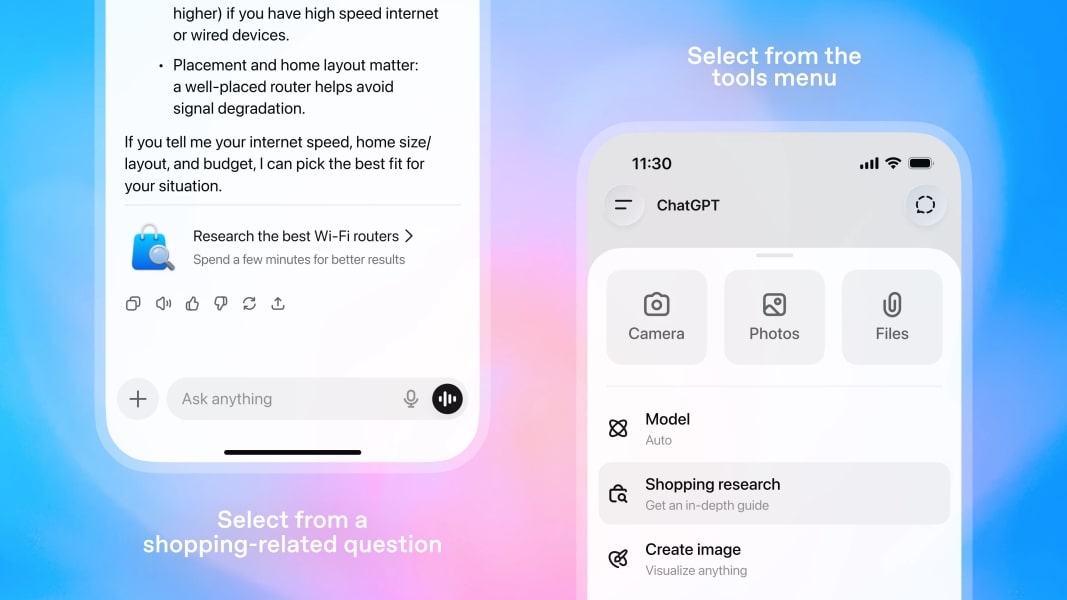
- Start with a shopping question
When ChatGPT detects a shopping-related request, it will offer the option to begin shopping research. You can also select the tool manually from the (+) menu.
- Describe what you need
A visual interface opens where you explain what you’re looking for. ChatGPT may ask about:
Budget
Who the product is for
Key features that matter most
With memory enabled, ChatGPT tailors results further (e.g., factoring in your interest in gaming when recommending a laptop).
- Guide the research
As ChatGPT pulls real-time product details from the internet, you can steer results by marking items as “Not interested” or “More like this.” The process adapts to your ongoing feedback.
- Receive a personalized buyer’s guide
Within minutes, you’ll get a clear summary highlighting:
Top product recommendations
Key differences and trade-offs
Relevant specs and pricing
Cited, reliable retail sources
How shopping research works behind the scenes
Shopping research in ChatGPT is powered by a version of GPT-5 mini, trained with reinforcement learning specifically for shopping tasks. It was taught to read trusted websites, cite accurate sources, and synthesize details across multiple pages to deliver high-quality product research.
The model’s design supports dynamic, real-time refinement based on user constraints, resulting in responses that are both comprehensive and personalized.
Model accuracy performance
In internal evaluations measuring whether recommended products meet user requirements (such as specs, price, or material), the shopping research model outperforms other GPT-5 variants:
- GPT-5-Thinking-mini (base): 37%
- GPT-5-Thinking: 56%
- ChatGPT Search: 64%
- Shopping research model: 52% (specialized for product discovery
Transparency, trust, and limitations
According to OpenAi’s blog post, ChatGPT does not share user chats with retailers. All shopping research results come from publicly available retailer sites, and low-quality or spam sources are avoided. Merchants may request to be allowlisted to appear in results.
However, the system is not flawless. While accuracy is improved, shopping research in ChatGPT may still make occasional mistakes regarding price or availability, so visiting the merchant site remains the best way to confirm details.
Just the start
Shopping research marks a major step toward simplifying how people find products online. The experience will continue to evolve as ChatGPT expands into more categories, learns user preferences better, and introduces more intuitive comparison and discovery features.