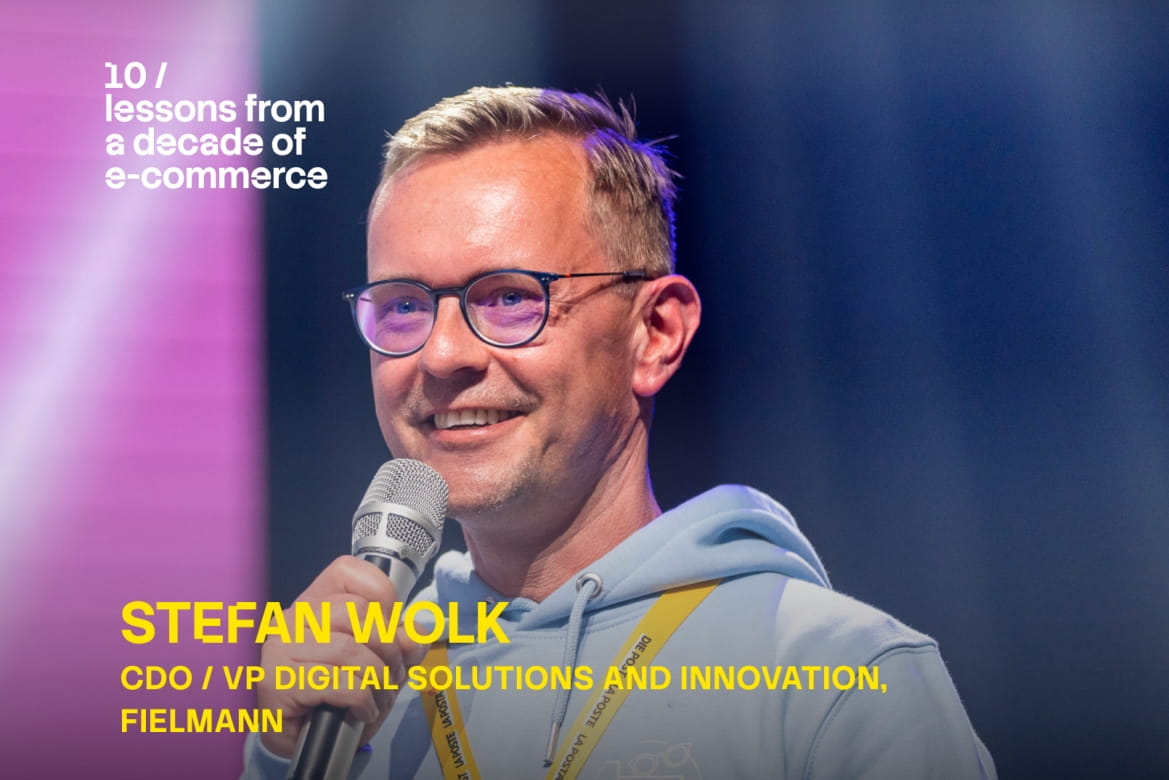
“Sustainable success is built on people and customers – in that order, and closely connected”: 10 lessons from Stefan Wolk, CDO / VP Digital Solutions and Innovation at Fielmann Group AG
Written by
Editorial TeamPublished on
Discover 10 valuable e-commerce lessons from Stefan Wolk, CDO / VP Digital Solutions and Innovation at Fielmann Group AG, as he shares his insights on the future of online retail to mark the 10th anniversary of the E-commerce Berlin Expo. [EXCLUSIVE INTERVIEW SERIES]
The E-commerce Berlin Expo celebrated its 10th anniversary in 2026. To mark this milestone, we interviewed some of the world’s most influential leaders about the future of online retail, asking them to share their 10 valuable lessons in e-commerce. Their insights were featured in our special album, showcasing the most powerful voices in online retail, which we decided to share with you on E-commerce Germany News.
This time, we’re featuring an exclusive interview with Stefan Wolk, CDO / VP Digital Solutions and Innovation at Fielmann Group AG. See what e-commerce lessons he shared with us below!
THE CUSTOMER MUST BE THE ANCHOR POINT FOR EVERY DECISION
What first drew you to this industry?
STEFAN: I have always been fascinated by innovation and digital topics. While still at university, I founded my first company – a small online marketing agency. Very early on, I experienced how exciting it is to work with customers and help them respond to changing expectations. After internships and my start at OTTO in 2003, right in the middle of a rapidly growing e-commerce environment, I realized that the digital revolution was exactly my terrain. What has driven me ever since is the desire to make things simpler, more intuitive, and more relevant. I truly enjoy improving customer experiences and developing digital solutions that create real value. This combination of creativity, technology, and impact drew me into the industry – and continues to inspire me today.
Which early failure taught you something that still guides you today?
STEFAN: Early on, I learned the hard way that what works in theory can fail quickly when it meets real customers. In my early entrepreneurial years, I once focused too heavily on optimizing channels and campaigns, assuming that performance marketing alone would compensate for an offering that was not yet strong enough in terms of value and customer experience. The initial results looked promising, but retention and genuine satisfaction were not where they needed to be. That experience taught me a lesson that still guides me today: if the customer value is not right, scaling simply amplifies the wrong thing. Since then, I have seen technology and marketing as accelerators – but never as substitutes for relevance, trust, and a strong end-to-end experience. The customer must remain the anchor point for every decision, especially when things move fast.
Quote / Stefan Wolk, CDO / VP Digital Solutions and Innovation at Fielmann Group AGI believe leadership is less about having all the answers and more about creating clarity, focus, and the conditions for learning.
When you think of the past decade of e-commerce, what do you miss – and what are you glad we left behind?
STEFAN: Whenever something truly new emerges, it brings uncertainty, but also enormous room for creativity and experimentation. In the early days of e-commerce, that pioneering spirit was everywhere: boldness, speed, trial and error, and sometimes chaos. Today, e-commerce has become much more grown-up. Processes are professionalized, standards established, and many things are more predictable. That is necessary and right – and I am glad we left behind the idea that growth at any cost is always the answer. Still, I sometimes miss the raw pioneer energy of exploring completely uncharted territory together. At the same time, AI is bringing back that same mix of uncertainty and excitement – just on a much more advanced level.
What is the single most important business lesson you have learned throughout your career?
STEFAN: The single most important lesson is that sustainable success is built on people and customers – in that order, and closely connected. Strategies, tools, and structures matter, but they only work if you have a culture that learns fast, takes ownership, and stays close to real customer needs. Looking back, many turning points in my career came from encounters with people who challenged my thinking and raised the bar. Great teams do not just execute plans; they question assumptions, simplify complexity, and turn uncertainty into progress. That is why I believe leadership is less about having all the answers and more about creating clarity, focus, and the conditions for learning. When you get the people and the customer perspective right, the business results follow far more reliably.
How would you define success in e-commerce today, and how has your view of it changed over time?
STEFAN: Today, I define success in e-commerce as creating customer value that is both measurable and sustainable: strong trust, high repeat usage, and profitable growth – not just traffic or short-term conversion. Success means being relevant in customers’ everyday lives, reducing friction, and delivering a consistent experience across channels. Over time, my perspective has shifted from winning the next sprint to building long-term loyalty and resilience. Ten years ago, many companies optimized for speed and scale above all else; today, success also requires operational excellence, responsible data usage, and a clear value proposition. AI and automation will raise expectations even further, making personalization and service quality decisive differentiators. In short, success is not a moment – it is the ability to keep earning the customer’s choice again and again.
Quote / Stefan Wolk, CDO / VP Digital Solutions and Innovation at Fielmann Group AGThe combination of pragmatic execution and long-term courage is what makes innovation work in a large organization.
INNOVATION IS NOT A SIDE PROJECT
What do you see as the biggest opportunity in e-commerce today?
STEFAN: The biggest opportunity lies in rethinking retail through the customer’s lens and using technology to remove friction at scale. Customer focus is the key to sustainable success: when needs change, the offering must evolve with them. AI, data, and automation can help organizations become faster and more precise, but they are always a means to an end. What truly matters is understanding what customers need and how you can make their lives a little easier. That is why “Der Kunde bist Du” (“The customer is you”) is not just a principle at Fielmann, but a powerful mindset for any organization. Those who genuinely embrace this perspective will make better decisions and build stronger businesses for the future.
What’s the most counterintuitive or unconventional thing your company does today that actually works?
STEFAN: One unconventional approach that works well is treating innovation not as a side project, but as a structured part of value creation while deliberately keeping it close to real operations. Instead of waiting for perfect concepts, we consistently apply MVP logic: small, testable steps that generate learning quickly and reduce risk. Another counterintuitive element is our venture-client mindset – rather than building everything ourselves from day one, we validate solutions early with external partners, learn fast, and scale what proves real value. This can feel too pragmatic for classic innovation thinking, but it delivers impact much faster. At the same time, we protect space for disruptive thinking, where core assumptions can be challenged. The combination of pragmatic execution and long-term courage is what makes innovation work in a large organization.
What guiding principle do you personally refuse to compromise on, no matter the trend or pressure?
STEFAN: The principle I refuse to compromise on is thinking from the customer backwards, even when internal pressure pushes for shortcuts. Trends come and go, but trust is hard to build and easy to lose. That means resisting the temptation to use technology as a shiny end in itself and focusing instead on real customer value. It also means being honest about what we know and what we do not, testing assumptions, and learning quickly without
Quote / Stefan Wolk, CDO / VP Digital Solutions and Innovation at Fielmann Group AGThat is your superpower: experimenting, learning, questioning, and rethinking – precisely where others say, “That won’t work.” Those who cultivate this mindset will actively shape the future of e-commerce and beyond.
THE NEXT DECADE WILL BELONG TO AI
Looking ahead, what will define the next decade of e-commerce, and how does thinking about the future make you feel – optimistic, excited, concerned, or something else?
STEFAN: The next decade will be defined by AI becoming deeply embedded in how we build, operate, and experience commerce – from personalization and service to forecasting, automation, and content creation. At the same time, the boundaries between channels will blur even further; customers will no longer distinguish between online and offline, but simply expect seamless experiences. New interfaces and technologies such as smart glasses, robotics, and ambient computing will reshape how products are discovered, purchased, and used. Trust, data responsibility, and sustainability will become even more critical as technological capabilities and expectations rise in parallel. Personally, I feel excited and optimistic about this future, while also being very aware of the responsibility that comes with shaping it. For organizations that stay curious, customer-centric, and willing to learn, the opportunities are immense.
If you could leave a message for future e-commerce leaders, what would it be?
STEFAN: In one sentence: have the courage to try things and take nothing for granted. I often see young talents in e-commerce doing things exactly as they learned them in training or at university. Yet we are facing a massive technological shift driven by AI, which will fundamentally change how work gets done across all functions. This transformation creates enormous opportunities, and for younger generations, it is often easier to embrace. That is your superpower: experimenting, learning, questioning, and rethinking – precisely where others say, “That won’t work.” Those who cultivate this mindset will actively shape the future of e-commerce and beyond.
STEFAN WOLK’S BIO
Stefan Wolk is the Chief Digital Officer and Vice President Digital Solutions & Innovation at Fielmann. For more than 25 years, he has helped shape the digital landscape of retail – from the early pioneering days of e-commerce to today’s data-driven and AI-powered transformation. At Fielmann, he is responsible for driving the company’s digital evolution, introducing new technologies, and creating innovative customer experiences across the omnichannel ecosystem.