Top 100 companies in Germany in 2026
Discover the top 100 companies in Germany for 2026. Explore leaders, innovative firms, and best of the best industries.
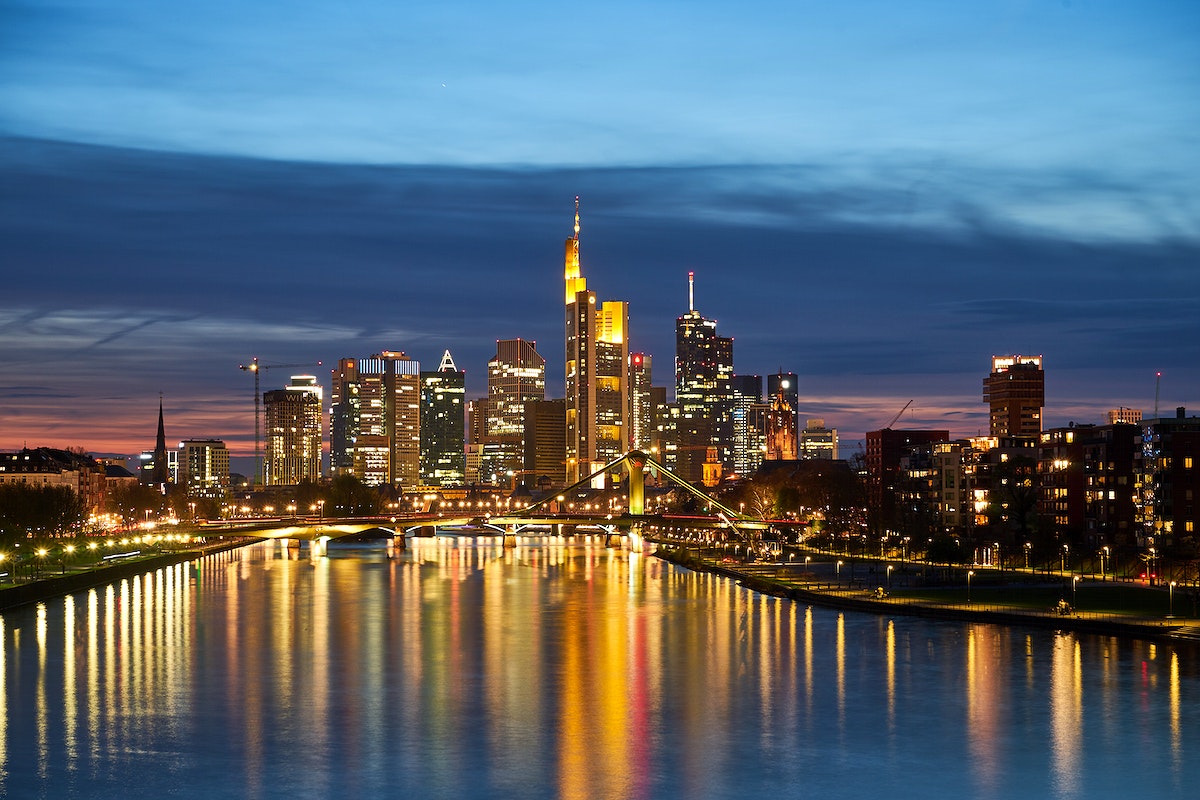
Many people associate Germany with their cars. Volkswagen and BMW are world-renowned brands and are usually related to high quality and reliability. But there’s more than that.
Today, we’re bringing you closer to not only 100 companies in Germany that you should know but also some key takeaways on the actual landscape – and what to do to become the new one on the list.
Company landscape in Germany 2026
The business landscape in Germany is influenced by market trends, global events, financial shifts, and emerging technologies. Some sectors are booming, while others are facing new challenges. But one thing is clear – staying competitive requires adaptability.
So, what factors are shaping the success (or struggles) of German companies this year?
Let’s break it down and see what 2026 has in store.
Financial metrics and market capitalization changes
Germany’s economic landscape showcases notable developments in financial performance and market capitalization across various sectors.
The KPMG Financial Performance Index (FPI) for German companies indicates a nuanced performance across sectors. The “Infrastructure and Real Estate” sector has demonstrated resilience, while sectors such as “Raw Materials and Natural Resources” have faced challenges due to global market dynamics.
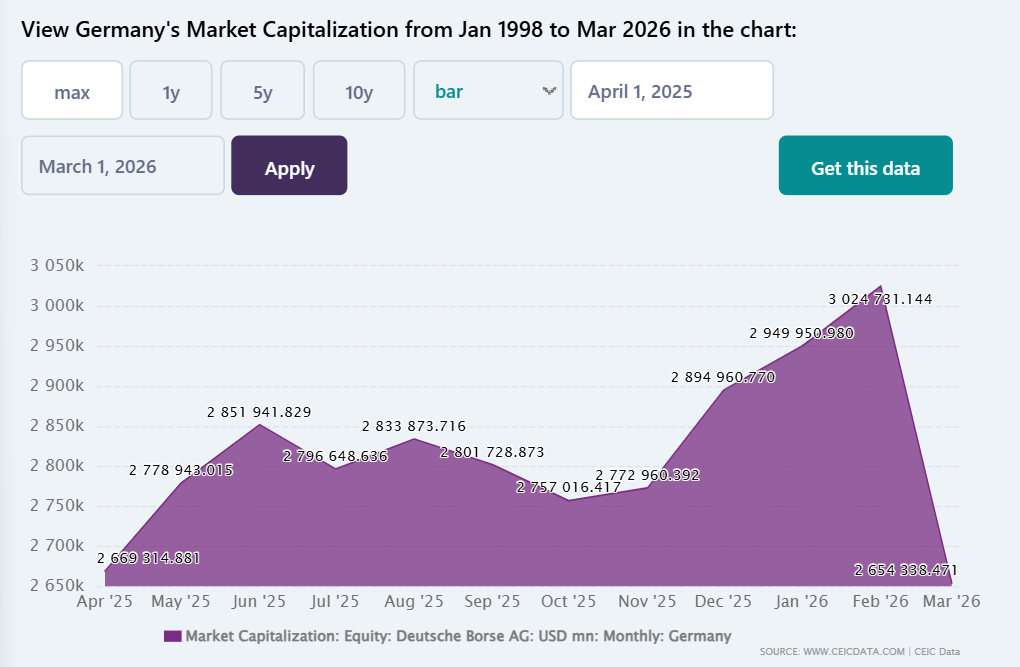
Germany’s market capitalization accounted for $2,654.338 bn in Mar 2026, and even more in February 2026 – an all-time high of $3,024.731 bn. Leading companies continue to play a pivotal role in this growth.
The impact of global events on German companies
The “Tariff War” and Export Realignment
One of the biggest global events impacting German companies (especially the DAX 40) is the escalation of trade barriers and tariffs.
- US trade policy and potential tariffs on European vehicles and machinery are forcing companies like Volkswagen, BMW, and Siemens to accelerate “localization”, shifting production directly into North American facilities to avoid import costs.
- While German manufacturing orders are stabilizing, mention the ongoing “bite” from Chinese competition. Top companies are no longer just exporting to China. They are now competing globally with Chinese OEMs who have cost-integrated supply chains, especially in the EV and green-tech sectors.
The Defense and Infrastructure “Fiscal Boost”
Also, a major shift in 2026 is the expansionary fiscal policy. After years of stagnation, German companies in the defense, aerospace, and construction sectors are seeing a massive surge.
- Germany’s defense spending is on track to reach significantly higher GDP percentages by 2029. This is a huge tailwind for companies like Rheinmetall, which have moved from the “fringes” to the “core” of Germany’s top-performing list.
- The amendment of the “debt brake” (Schuldenbremse) has allowed for increased infrastructure investment, benefiting industrial giants and engineering firms involved in rail and energy grid expansion.
The Energy Transition: From Crisis to Structural Cost
Moreover, the “energy crisis” has evolved into a “structural transition”
- The Green Subsidy Shield: We can see temporary industrial electricity prices (capped at around 5 cents per kWh for intensive sectors) and the €6.5 billion federal subsidy for grid charges. This is keeping energy-intensive giants (BASF, ThyssenKrupp, etc.) competitive against US and Asian rivals.
- Supply Chain Resilience: Top companies are “de-risking” by diversifying raw material suppliers for semiconductors and battery minerals to avoid the abrupt price spikes seen in previous years.
AI and Digitalization as an “Efficiency Shield”
Global events have made labor shortages more acute due to Germany’s aging population. German companies are using AI and automation (not just for innovation, but as a survival mechanism).
- Top manufacturers are integrating AI-driven automation into their core operations to protect profit margins despite higher wage demands (which are seeing significant increases in 2026).
- With the growth of AI-powered cyber threats globally, German organizations are now treating “Cyber Resilience” as a top-level business strategy rather than just an IT problem.
The German corporate landscape can be defined by a ‘Great Realignment’, balancing a pivot toward domestic defense and infrastructure investment with a defensive stance against rising global trade barriers and the structural costs of the energy transition.
Updated top categories and industry leaders
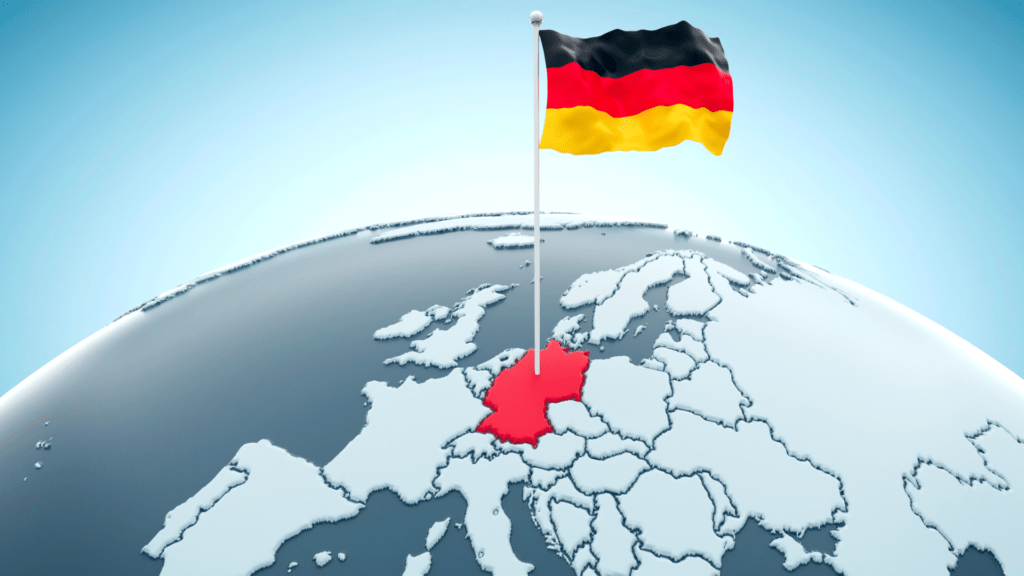
We are getting closer to presenting the ranking of the top 100 companies in Germany in 2026, which comes from CompaniesMarketcap.com and ranks German companies according to various criteria on an ongoing basis. This ranking is meticulously updated to reflect the most current data.
From year to year, we can see changes among the industry leaders. Traditional sectors like the automotive and chemical industries continue to hold strong positions, but digital and tech sectors are rising in prominence.
In ranking below, you can find the top 5 industries:
Automotive
- This dominant sector features 8 companies on the list, led by global giants like Volkswagen, Mercedes-Benz, and BMW.
- Organizations in this space focus on the manufacturing of passenger vehicles, heavy-duty trucks, and the specialized engineering of high-performance components.
- These manufacturers are essential to the national economy as they spearhead the transition to electric mobility and represent the “Made in Germany” brand on the global stage.
Energy
- There are 8 major power players in this group, including high-revenue entities such as Uniper, E.ON, and EnBW Energie.
- The industry encompasses the generation of electricity, natural gas distribution, and the rapid expansion of renewable energy infrastructure across Europe.
- Maintaining a stable energy sector is vital for national security, ensuring that both industrial factories and private households have reliable access to power at competitive prices.
Insurance & Finance
- A total of 7 financial powerhouses make the ranking, specifically featuring Allianz SE, Munich RE, and Talanx.
- Firms here specialize in global risk management, large-scale asset investment, and comprehensive banking services for international trade.
- This category provides the capital stability and risk mitigation required for all other industries to invest in long-term projects and survive economic volatility.
Healthcare & Life Sciences
- This broad category includes 7 top-tier organizations, most notably Drägerwerk, Fresenius, and Siemens Healthineers.
- Business activities range from advanced pharmaceutical research and biotechnology to the manufacturing of precision medical imaging equipment.
- The health sector is critical for societal well-being and longevity, while also serving as a high-tech engine for innovation and export-led growth.
Industrial Technology & Engineering
- There are 4 leaders represented here, including iconic names like Siemens, Schaeffler, and GEA Group.
- Enterprises in this field develop automation systems, industrial software, and the heavy machinery used in global manufacturing plants.
- These companies act as the “enablers” of modern civilization, providing the tools and technology that allow other businesses to digitize and automate their production lines.
The rest of the categories belong to, healthcare, biotechnology, energy, technology, telecommunications, logistics and transportation, food, and consumer goods.
And now, without further ado – let’s see who made our list.
Top 100 companies in Germany: List 2026
Now, let’s eventually check the whole TOP 100 companies in Germany list 2026.
The list is filtered by revenue.
| No. | Company Name | Revenue | Industry | Website |
| 1 | Volkswagen | $367.87 B | Automotive | https://www.volkswagen.de |
| 2 | Allianz SE | $159.29 B | Insurance & Finance | https://www.allianz.com |
| 3 | Mercedes-Benz | $154.61 B | Automotive | https://www.mercedes-benz.com |
| 4 | BMW | $153.70 B | Automotive | https://www.bmwgroup.com |
| 5 | Deutsche Telekom | $136.35 B | Telecommunications | https://www.telekom.com |
| 6 | DHL Group | $92.44 B | Logistics | https://www.dhl.com |
| 7 | Siemens | $91.84 B | Industrial Tech | https://www.siemens.com |
| 8 | E.ON | $90.16 B | Energy | https://www.eon.com |
| 9 | Uniper | $78.09 B | Energy | https://www.uniper.energy |
| 10 | BASF | $70.39 B | Chemicals | https://www.basf.com |
| 11 | Daimler Truck | $55.72 B | Automotive | https://www.daimlertruck.com |
| 12 | Bayer | $52.29 B | Pharma & Life Sciences | https://www.bayer.com |
| 13 | Traton | $51.28 B | Automotive | https://traton.com |
| 14 | Munich RE | $47.43 B | Insurance | https://www.munichre.com |
| 15 | Siemens Energy | $45.86 B | Energy Technology | https://www.siemens-energy.com |
| 16 | Lufthansa | $45.78 B | Airline | https://www.lufthansagroup.com |
| 17 | Hochtief | $44.11 B | Construction | https://www.hochtief.de |
| 18 | Porsche | $43.57 B | Automotive | https://www.porsche.com |
| 19 | SAP | $42.41 B | Software & IT | https://www.sap.com |
| 20 | EnBW Energie | $37.50 B | Energy | https://www.enbw.com |
| 21 | Thyssenkrupp | $37.04 B | Engineering | https://www.thyssenkrupp.com |
| 22 | Deutsche Bank | $36.93 B | Banking | https://www.db.com |
| 23 | Talanx | $30.25 B | Insurance | https://www.talanx.com |
| 24 | Adidas | $28.59 B | Apparel & Retail | https://www.adidas-group.com |
| 25 | Ceconomy | $28.14 B | Retail | https://www.ceconomy.de |
| 26 | TUI | $28.06 B | Travel & Tourism | https://www.tuigroup.com |
| 27 | Hannover Rück | $27.65 B | Insurance | https://www.hannover-re.com |
| 28 | Siemens Healthineers | $25.11 B | Healthcare Tech | https://www.siemens-healthineers.com |
| 29 | Fresenius | $24.46 B | Healthcare Services | https://www.fresenius.com |
| 30 | Schaeffler | $23.99 B | Industrial Supply | https://www.schaeffler.com |
| 31 | Merck KGaA | $23.78 B | Pharma & Chemicals | https://www.merckgroup.com |
| 32 | BayWa | $23.25 B | Agriculture | https://www.baywa.com |
| 33 | Continental | $22.67 B | Automotive Supply | https://www.continental.com |
| 34 | Fresenius Medical Care | $22.61 B | Healthcare Services | https://www.freseniusmedicalcare.com |
| 35 | Henkel | $22.47 B | Consumer Goods | https://www.henkel.com |
| 36 | Aurubis | $22.15 B | Metals & Mining | https://www.aurubis.com |
| 37 | HeidelbergCement | $21.75 B | Building Materials | https://www.heidelbergmaterials.com |
| 38 | Hapag-Lloyd | $21.65 B | Shipping | https://www.hapag-lloyd.com |
| 39 | Aumovio SE | $20.44 B | Logistics | https://www.aumovio.com |
| 40 | RWE | $20.12 B | Energy | https://www.rwe.com |
| 41 | Brenntag | $17.45 B | Chemicals | https://www.brenntag.com |
| 42 | Infineon | $17.18 B | Semiconductors | https://www.infineon.com |
| 43 | Evonik Industries | $15.95 B | Specialty Chemicals | https://corporate.evonik.com |
| 44 | Covestro | $14.68 B | Chemicals | https://www.covestro.com |
| 45 | Commerzbank | $14.60 B | Banking | https://www.commerzbank.de |
| 46 | Zalando | $14.28 B | E-commerce | https://corporate.zalando.com |
| 47 | KION Group | $12.40 B | Logistics | https://www.kiongroup.com |
| 48 | Rheinmetall | $11.46 B | Defense | https://www.rheinmetall.com |
| 49 | Salzgitter | $10.23 B | Steel | https://www.salzgitter-ag.com |
| 50 | Südzucker | $9.76 B | Food | https://www.suedzucker.com |
| 51 | Nordex | $9.02 B | Renewable Energy | https://www.nordex-online.com |
| 52 | HELLA | $8.89 B | Automotive Supply | https://www.hella.com |
| 53 | AUTO1 | $8.68 B | E-commerce | https://www.auto1-group.com |
| 54 | Knorr-Bremse | $8.66 B | Manufacturing | https://www.knorr-bremse.com |
| 55 | PUMA | $8.47 B | Apparel | https://about.puma.com |
| 56 | HelloFresh | $8.01 B | Food Delivery | https://www.hellofreshgroup.com |
| 57 | Deutsche Börse | $7.97 B | Financial Services | https://www.deutsche-boerse.com |
| 58 | Beiersdorf | $7.35 B | Personal Care | https://www.beiersdorf.com |
| 59 | Bechtle | $7.08 B | IT Services | https://www.bechtle.com |
| 60 | Klöckner & Co | $7.11 B | Metals | https://www.kloeckner.com |
| 61 | Hornbach Holding | $7.22 B | Retail | https://www.hornbach-holding.de |
| 62 | United Internet | $6.87 B | Internet/Telco | https://www.united-internet.de |
| 63 | Vonovia | $6.66 B | Real Estate | https://www.vonovia.de |
| 64 | W&W | $6.62 B | Financial Services | https://www.ww-ag.com |
| 65 | Lanxess | $6.57 B | Chemicals | https://lanxess.com |
| 66 | MVV Energie | $6.45 B | Energy | https://www.mvv.de |
| 67 | Hornbach Baumarkt | $6.42 B | Retail | https://www.hornbach.de |
| 68 | GEA Group | $6.34 B | Industrial Tech | https://www.gea.com |
| 69 | Wacker Chemie | $6.31 B | Chemicals | https://www.wacker.com |
| 70 | Bilfinger | $6.26 B | Industrial Services | https://www.bilfinger.com |
| 71 | Krones | $6.17 B | Machinery | https://www.krones.com |
| 72 | Jungheinrich | $5.82 B | Logistics | https://www.jungheinrich.com |
| 73 | Nürnberger Vers. | $5.58 B | Insurance | https://www.nuernberger.de |
| 74 | DWS Group | $5.56 B | Asset Management | https://www.dws.com |
| 75 | Mutares | $5.42 B | Private Equity | https://mutares.de |
| 76 | Douglas Group | $5.06 B | Retail | https://corporate.douglas.de |
| 77 | MTU Aero Engines | $5.05 B | Aerospace | https://www.mtu.de |
| 78 | Sixt | $4.95 B | Transportation | https://www.sixt.com |
| 79 | Fraport | $4.92 B | Transportation | https://www.fraport.com |
| 80 | HUGO BOSS | $4.92 B | Apparel | https://group.hugoboss.com |
| 81 | 1&1 | $4.54 B | Telecommunications | https://www.1und1.de |
| 82 | Dürr | $4.37 B | Manufacturing | https://www.durr.com |
| 83 | K+S | $4.19 B | Mining & Chemicals | https://www.kpluss.com |
| 84 | ProSiebenSat.1 | $4.18 B | Media | https://www.prosiebensat1.com |
| 85 | Sartorius | $4.03 B | Lab Technology | https://www.sartorius.com |
| 86 | Fuchs Petrolub | $3.98 B | Chemicals | https://www.fuchs.com |
| 87 | Drägerwerk | $3.69 B | Healthcare Tech | https://www.draeger.com |
| 88 | BioNTech | $3.35 B | Biotechnology | https://www.biontech.com |
| 89 | Symrise | $3.32 B | Chemicals | https://www.symrise.com |
| 90 | CTS Eventim | $3.29 B | Media/Ent. | https://www.eventim.de |
| 91 | KSB SE | $3.08 B | Machinery | https://www.ksb.com |
| 92 | Gelsenwasser | $3.07 B | Energy & Water | https://www.gelsenwasser.de |
| 93 | SYNLAB | $2.83 B | Healthcare Services | https://www.synlab.com |
| 94 | Freenet | $2.78 B | Telecommunications | https://www.freenet-group.de |
| 95 | Fielmann | $2.70 B | Retail (Optical) | https://www.fielmann-group.com |
| 96 | Hensoldt | $2.66 B | Defense Tech | https://www.hensoldt.net |
| 97 | Heidelberger Druck. | $2.61 B | Manufacturing | https://www.heidelberg.com |
| 98 | Carl Zeiss Meditec | $2.50 B | Healthcare Tech | https://www.zeiss.de/meditec |
| 99 | Paul Hartmann | $2.50 B | Healthcare Supplies | https://www.hartmann.info |
| 100 | DMG Mori | $2.49 B | Manufacturing | https://www.dmgmori-ag.com |
Source (view date: 10.04.2026)
Final thoughts
As you can see in the table above, there are many successful companies that were born in the German market. All of them are creating power in the German economy and working hard to create a good reputation for German products.
Germany’s resilience in the face of global challenges, combined with its commitment to innovation, e-commerce possibilities, and responsibility for sustainability, points to a promising future for companies that operate in the country.
Looking for more inspiration or information about the German market?