Cross-border friction: what nobody tells you about selling outside the EU
Selling outside the EU? Discover common cross-border e-commerce challenges, from shipping and customs to returns, and see how to avoid costly mistakes.

Online retail is booming in the European third countries of Switzerland, the UK, and Norway. High per capita income, brand loyalty, and excellent infrastructure make these markets attractive. And expansion looks easy on paper: same products, nearby markets and strong purchasing power. But then the first 500 orders hit, and margins start leaking in places no one tracked. Cross-border expansion doesn’t fail at strategy level. It fails in operations that look “minor” on paper.
Where cross-border breaks in reality
Take a look below at hidden operational risks when expanding to non-EU Europe – here’s where teams lose money, margin, and reputation.
Delivery doesn’t fail, it slows silently
Companies experiencing rapid growth and high employee turnover often feel compelled to rely on courier services for their entire supply chain. Their inefficient process leads to delivery times up to two weeks. And, since courier services aren’t flexible with last mile carriers the costs per package are disproportionately high. Customers waiting up to two weeks for their package will also mean more support tickets since they might contact your customer support asking about the delivery. Considering that there is a relatively high possibility that a package gets lost in the courier services process, you are busy investigating and reclaiming cases that are lost or late.
Customs doesn’t block, it complicates pricing
Thanks to special regulations between the EU and non-EU countries, taxes are often not levied. Nevertheless, you need customs clearance for each package, which leads to high costs. After waiting up to two weeks for the ordered product, the customer might as well be shocked to pay customs and taxes at their doorstep. When it comes to customer experience, not having paid for all costs in the online shop already is an unacceptable scenario that leads to unsatisfied clients who won’t buy again.
Returns don’t spike, they become expensive
Even though the return rate in Switzerland is significantly lower than in the UK, all customers expect an uncomplicated and domestic solution. Sending their returns to an address outside their country as well as delayed duty paybacks are certainly not up to date but still the rule with European third country deliveries.
What strong cross-border operations should look like
Strong cross-border operations are not just about entering new markets, they’re about operating seamlessly across them. At the core, effective cross-border operations rely on these pillars:
Cost transparency at checkout with DDP
To prevent your customers from having to pay customs duties or taxes at their doorstep, rely on DDP (delivered duty paid) shipments, where all costs are already covered in the online shop.
Local last-mile handoffs
The flexible choice of a regional CEP (courier, express, and parcel) provider, ensures the fastest and most affordable delivery. Your customers can then track the shipment status just like domestic shipments.
Domestic style returns in foreign markets
In the event of a return, any taxes and duties should automatically be refunded. A well-planned returns management system is worthwhile. To make the returns process as cost-efficient and straightforward as possible for customers, you need a domestic solution where returns are collected in the destination country and consolidated before being shipped back to the EU. If a package is lost by the courier service provider in the destination country, you need an efficient process to reclaim it.
Simple and cost-effective returns measures lead to an acceleration of the flow of goods, cost reductions, and a significant improvement in your customers’ buying experience.
Shorter delivery times and lower package price
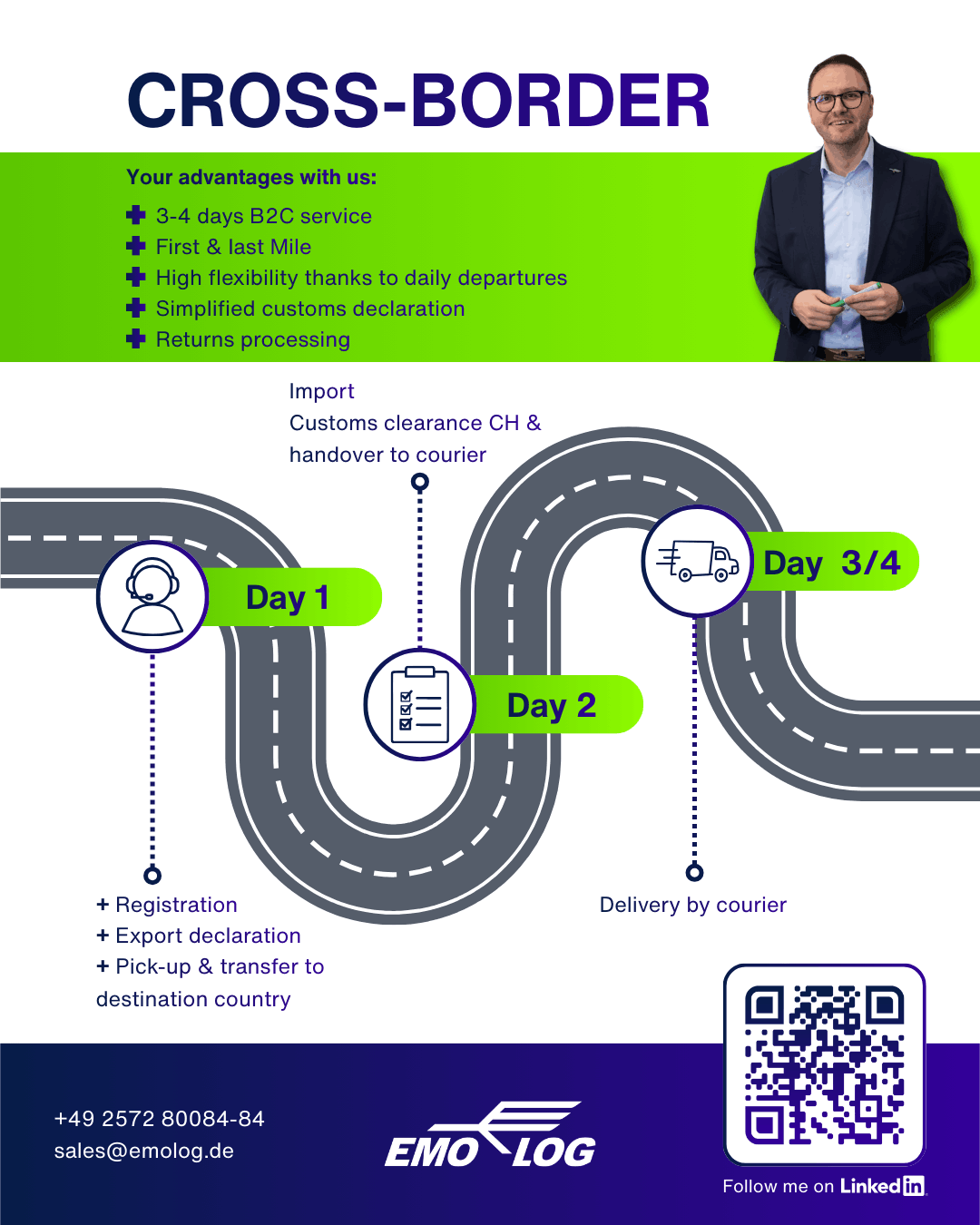
With cross-border, consolidating shipments is the cost-effective alternative right from the first parcel. Once the truck departs for the destination country, the right IT interfaces with foreign customs authorities mean it doesn’t have to wait at the border. Also, an in-house handling and AEO C-certified customs broker is prepared for each specific customs-related challenge and consolidates customs clearance for lower package prices.
Next level cross-border makes the difference
Some logistics providers build around these principles from day one. For example, setups that combine shipment consolidation, in-house customs handling, and local CEP handovers allow brands to operate in markets like Switzerland, the UK, or Norway as if they were domestic.
Ultimately, successful cross-border e-commerce comes down to eliminating hidden friction – whether in delivery times, cost transparency, or returns. The brands that get this right don’t just expand internationally; they create local-like experiences that customers trust.
This is the kind of approach leading logistics providers like EMO-LOG support – integrated, flexible, and built to simplify complexity as you scale.
Curious how your current setup compares? Talk to EMO-LOG and explore where you can remove friction in your cross-border operations.