7 Tools That Show E-Commerce Brands How AI Recommends Their Products

Your next customer might never visit Google. They’ll ask ChatGPT “what’s the best sustainable sneaker brand under €120?” and buy whatever lands in the first sentence of the answer. If your brand isn’t there, you’ve lost a sale you’ll never see in your analytics.
AI assistants (ChatGPT, Google’s AI Overviews and AI Mode, Perplexity, Gemini, Copilot) are reshaping product discovery for online retailers across Europe and beyond. The tricky part? Traditional SEO tools weren’t built to show you whether an AI model recommends your products or sends shoppers to a competitor instead.
That’s where AI visibility tools come in. They monitor how your brand appears in AI-generated answers: how often you’re mentioned, what competitors show up alongside you, which of your pages get cited, and where the gaps are.
Here are seven tools that help e-commerce teams track and improve their presence in AI-powered product recommendations.
1. Ahrefs Brand Radar
Best for: The broadest view of how AI talks about your brand across platforms, audiences, and markets
Ahrefs Brand Radar monitors your brand’s visibility across six AI platforms — ChatGPT, Perplexity, Gemini, Copilot, Google AI Overviews, and Google AI Mode — plus YouTube, TikTok, and Reddit. What sets it apart from every other tool on this list is scale: rather than relying on a small set of manually added prompts, Brand Radar draws from Ahrefs’ keyword database of over 110 billion keywords. It extracts real People Also Ask questions and runs them through AI platforms to see where your brand shows up.
For e-commerce teams, this means you can check whether AI assistants recommend your products when shoppers ask buying-intent questions — without having to guess which prompts to track. The tool shows four key metrics: mentions (how often your brand name appears), citations (which websites AI links to when discussing your category), impressions (mentions weighted by Google search volume), and AI Share of Voice (your brand’s share compared to competitors).
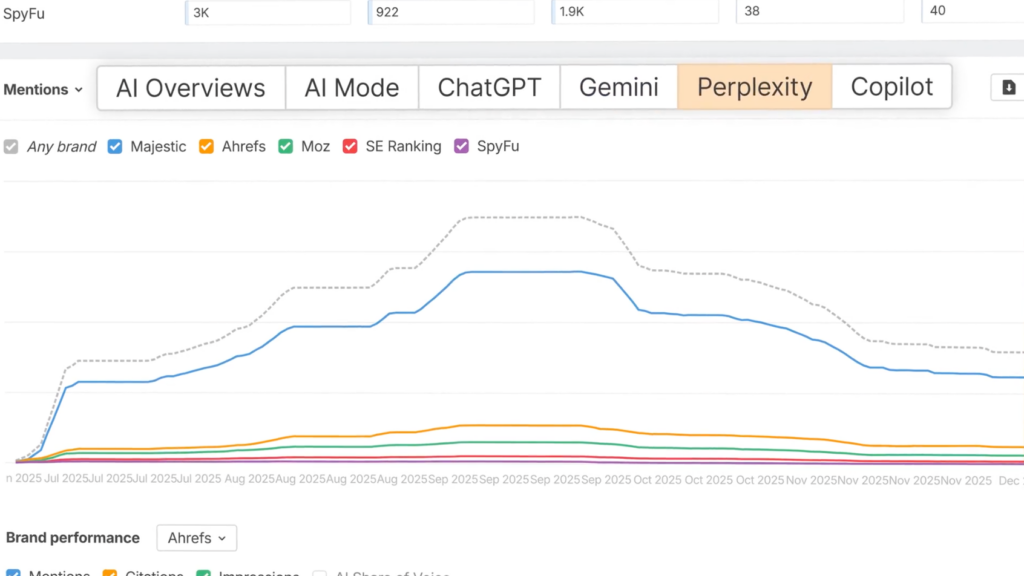
One feature that’s particularly useful for online retailers: you’re not limited to tracking your own brand. You can research any brand, product, or category and filter by market or niche. Want to see how your competitor’s products are positioned in AI answers for “best wireless headphones” in Germany specifically? You can do that. Want to find every prompt where a competitor is mentioned but you’re not? Brand Radar’s competitive filters make this straightforward.
The Cited Domains and Cited Pages reports add another layer. They show which websites and specific URLs AI models link to when discussing your product category. For an e-commerce brand, this is actionable intelligence: if a particular review site or comparison page keeps getting cited, that’s where you want your product featured.
Brand Radar also tracks how your visibility changes over time with historical trend data, something most newer AI monitoring tools can’t offer yet. And because it integrates with Ahrefs’ broader SEO toolkit — Site Explorer, Content Explorer, Keywords Explorer — you can connect AI visibility data to your existing backlink, content, and keyword strategies without switching between platforms.
Brand Radar AI indexes are available as add-ons to existing Ahrefs subscriptions, with individual platform indexes or a combined package. Some beta indexes (like TikTok and YouTube) are currently free for all paid subscribers.
2. Otterly.AI
Best for: Quick, visual monitoring of AI search visibility with a low barrier to entry
Otterly.AI focuses on automated brand monitoring across Google AI Overviews, ChatGPT, Perplexity, Google AI Mode, Gemini, and Copilot. The platform tracks brand mentions, website citations, and Share of Voice across these platforms and presents the data in clean, shareable dashboards.
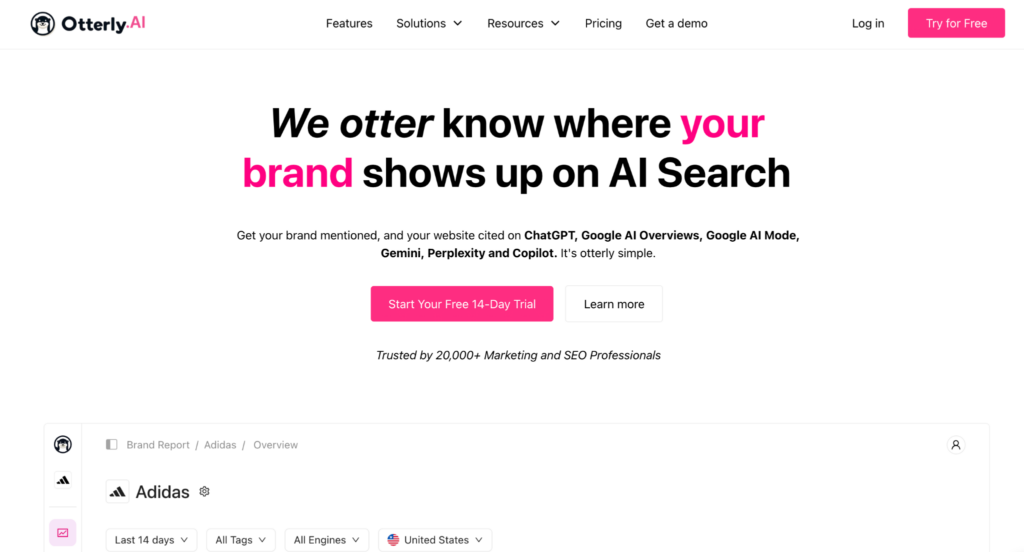
For e-commerce teams just getting started with AI visibility, Otterly offers a Lite tier at $29/month for 15 tracked prompts, making it one of the most accessible entry points. Higher tiers scale to 100 and 400+ prompts with competitive analysis features. The platform also offers a GEO audit that analyzes technical and content factors affecting your AI visibility — schema usage, content structure, crawl issues — and provides prioritized recommendations.
Otterly is prompt-based, meaning you decide which queries to track. This works well when you already know the exact buying questions your customers ask AI (“best CRM for Shopify stores,” for example), but it requires more manual setup and won’t catch queries you haven’t thought of.
3. Peec AI
Best for: European e-commerce brands that want competitive benchmarking with sentiment analysis
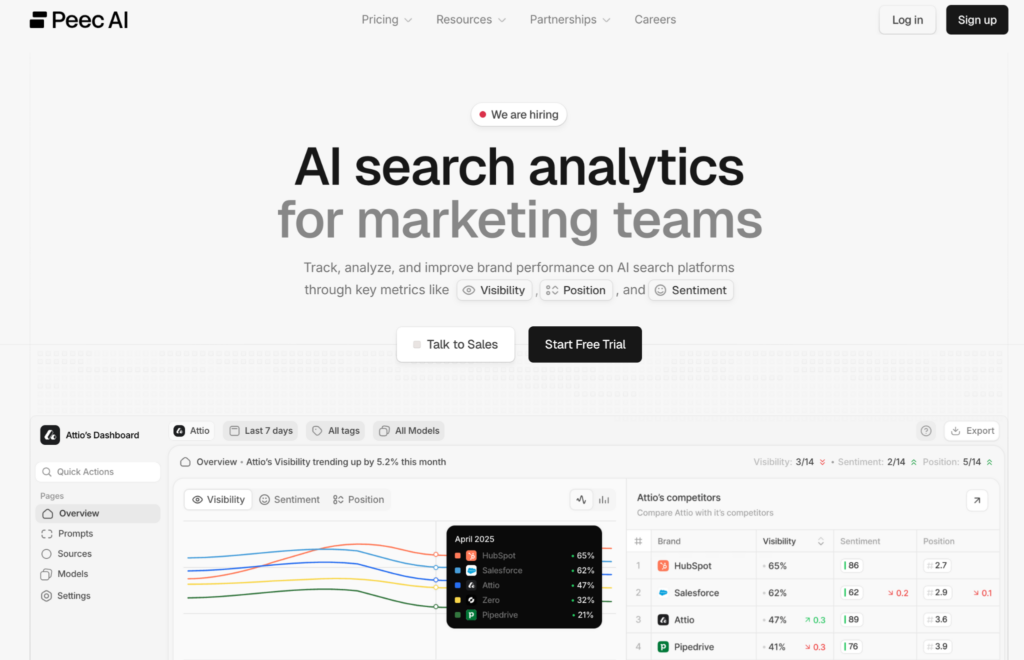
Peec AI is a European-founded AI visibility platform backed by €29M in funding, with a focus on competitive benchmarking across ChatGPT, Perplexity, Claude, and Gemini. Prompts are executed daily across selected AI models, giving you more frequent data updates than monthly-refresh tools.
The platform distinguishes between “used” (your content informed the AI’s answer) and “cited” (your URL is explicitly mentioned), which is a useful distinction for e-commerce brands trying to understand whether their product pages are actually driving AI recommendations or just providing background information. Peec also includes sentiment tracking, showing whether AI mentions your brand positively or negatively – important when AI assistants start qualifying recommendations with phrases like “good but expensive” or “reliable but limited selection.”
4. Semrush AI Toolkit
Best for: E-commerce teams already using Semrush for SEO who want AI visibility as an add-on
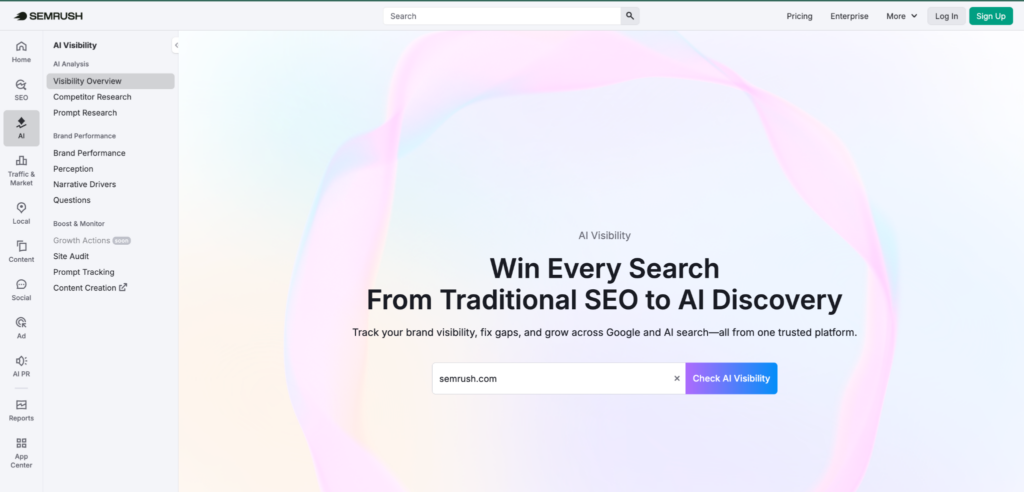
Semrush has added AI visibility features to its existing SEO platform, allowing you to track AI Overviews alongside traditional keyword rankings and competitor research. The AI Toolkit monitors how your brand appears in Google’s AI-generated results and surfaces basic AI-related insights within its familiar dashboard.
For e-commerce teams already paying for Semrush, this means you can start tracking some AI visibility data without adding another subscription. The integration with Semrush’s keyword, backlink, and advertising tools gives you a unified view of how your product pages perform across both traditional and AI-powered search.
That said, Semrush’s AI visibility coverage is still developing. It currently focuses more on Google AI Overviews than on standalone AI platforms like ChatGPT or Perplexity, so it’s best viewed as a complement to dedicated AI monitoring tools rather than a replacement. Plans that include the AI Toolkit start at $199/month.
5. SE Ranking AI Visibility
Best for: Cost-effective AI brand tracking tied directly to keyword-level SEO projects
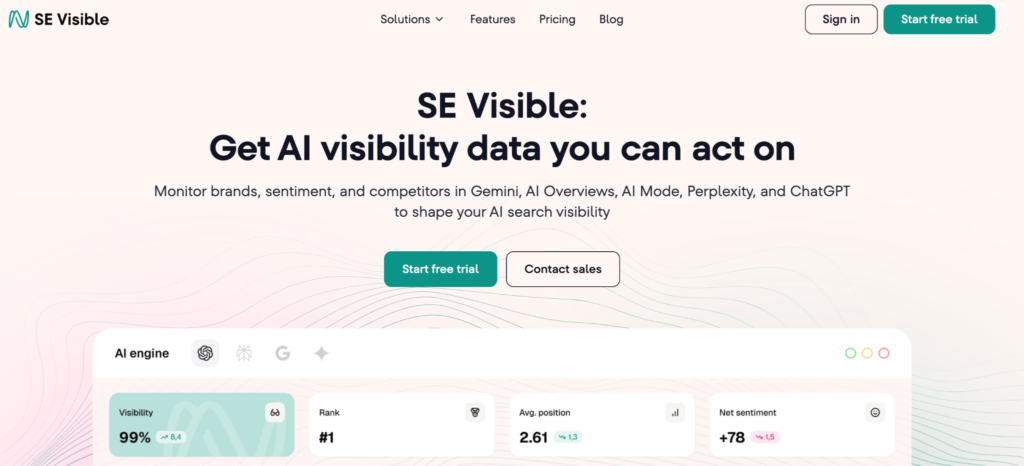
SE Ranking treats AI brand visibility as a core SEO function rather than a standalone add-on. The platform monitors brand mentions and link citations inside AI-generated responses and connects that data to your existing keyword tracking projects. Instead of generic prompt sampling, it ties AI visibility to real keywords you’re already ranking for.
For e-commerce brands running product-level SEO campaigns, this keyword-connected approach is practical. You can see not only whether AI mentions your brand for “best budget laptops” but also how that AI presence relates to your organic rankings and traffic for the same term. The Pro plan, which includes AI visibility features, starts at $119/month, making it one of the more affordable options for teams that need both traditional and AI search data in one place.
6. Profound
Best for: Enterprise e-commerce brands that need the deepest possible AI visibility data across the most platforms
Profound is an enterprise-grade AI visibility platform backed by a $35M Series B from Sequoia. It tracks brand presence across 10 AI platforms, including ChatGPT (with ChatGPT Shopping), Perplexity, Claude, Gemini, Copilot, Google AI Overviews, Grok, Meta AI, DeepSeek, and Amazon Rufus — that last one being particularly relevant for e-commerce brands selling on Amazon.
The platform goes beyond mention tracking with features like Conversation Explorer (see what users are asking AI in real time), AI crawler analytics (understand how AI systems access and interpret your product pages), and a URL watchlist that lets you track how often specific product pages get cited over time.
This depth comes at enterprise pricing: the Starter tier begins at $99/month (ChatGPT only, 50 prompts), Growth at $399/month (3 engines, 100 prompts), and Enterprise is custom-priced. For large e-commerce operations with significant AI-driven discovery, the breadth of platform coverage and the ChatGPT Shopping tracking may justify the investment.
7. Brand24
Best for: E-commerce teams that want AI brand monitoring layered onto broader social and web listening
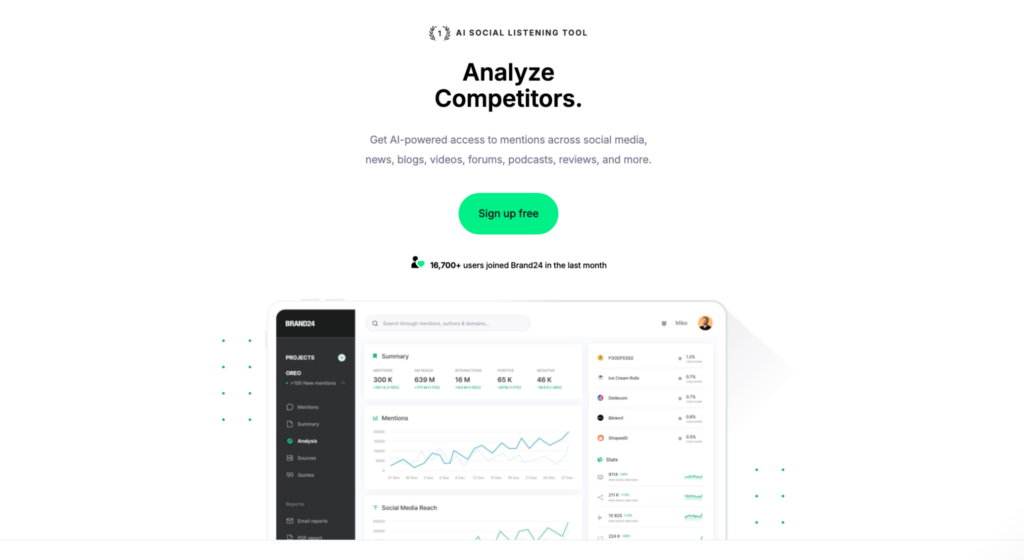
Brand24 is primarily a brand monitoring platform that tracks mentions across 25 million+ online sources, including social media, blogs, forums, news, and review sites. In 2026, it has added the ability to detect brand mentions generated or referenced in AI-driven summaries and conversational answers.
For e-commerce brands that already use Brand24 for social listening or reputation management, the AI tracking layer is a natural extension — you get AI-influenced mention alerts alongside your existing monitoring workflows. The platform’s strength is speed and volume: it’s fast at catching when and where your brand gets picked up, including in sources that AI models frequently pull from.
However, Brand24 is not a dedicated AI visibility tool. It doesn’t offer prompt-level analysis, competitive share of voice in AI answers, or citation tracking at the level of purpose-built platforms. Think of it as a useful early warning system rather than a deep AI analytics tool. Plans with the AI monitoring features start at approximately $199/month.
How to pick the right tool for your store
The choice depends on where you are in your AI visibility journey and what you need most:
- For the broadest brand-level intelligence: Ahrefs Brand Radar gives you the widest lens — six AI platforms plus YouTube, TikTok, and Reddit, powered by real search data rather than manually chosen prompts. It’s the strongest starting point if you want to understand the full picture of how AI talks about your brand and your competitors before drilling into specific queries.
- For prompt-level monitoring on a budget: Otterly.AI and SE Ranking offer accessible entry points for teams that want to track specific buying queries without a large investment.
- For enterprise depth: Profound’s coverage of 10 AI platforms — including ChatGPT Shopping and Amazon Rufus — is unmatched for large e-commerce operations.
- For adding AI data to an existing SEO workflow: Semrush and SE Ranking integrate AI visibility into platforms you may already use.
The one thing all these tools agree on: if you’re not monitoring how AI assistants recommend products in your category, you’re flying blind in the channel that’s growing fastest. AI-driven product discovery isn’t a future trend for e-commerce. It’s already here, and the brands that track it first will be the ones AI keeps recommending.