AI in Ecommerce: How to Use It for Growing Visibility

Here’s the uncomfortable truth for ecommerce brands: the way people find products online has fundamentally changed, and most businesses haven’t caught up yet.
AI is no longer just a back-office tool for automating emails or generating product descriptions. It’s now the front door to product discovery. Google’s AI Overviews have crossed 2 billion monthly users across 200+ countries. ChatGPT handles over 1 billion searches per week. And according to Adobe, traffic from generative AI sources surged 1,200% between July 2024 and February 2025.

For ecommerce specifically, 91% of product queries now trigger AI-generated results. That’s not a future scenario—it’s today’s reality. And it has massive implications for how you think about visibility, content strategy, and where your next customer comes from.
This guide breaks down exactly how AI is reshaping ecommerce visibility, what’s working right now, and what you should be doing about it—whether you’re selling in the DACH region or globally.
The Visibility Shift: What’s Actually Happening
Let’s start with what the data tells us, because the numbers are striking.
When AI Overviews appear in Google search results, click-through rates for the #1 organic result drop by 34.5%. Some sites report traffic declines of 20–40% since the rollout. And here’s what makes it worse for ecommerce: 80% of sources cited in AI Overviews don’t even rank organically for that query. Holding a top-three position in Google gives you just an 8% chance of being cited in the AI Overview.

In other words, the old playbook—rank on page one, get clicks, make sales—is breaking down. AI is creating a new layer of search results that sits above the traditional ones, and it pulls from different sources with different criteria.
At the same time, a new opportunity is emerging. AI-referred visitors convert at 23× higher rates than standard organic search visitors. B2B SaaS companies report 6× to 27× higher conversion rates from AI traffic. The visitors that AI platforms send to your site are fewer in number but dramatically more qualified—they’ve already been filtered through a conversational intent layer.
So the question isn’t whether AI matters for ecommerce visibility. It’s how you position your brand to win in this new landscape.
Generative Engine Optimization (GEO): The New SEO
Traditional SEO optimizes for search engine algorithms. GEO—Generative Engine Optimization—optimizes for AI answer engines. It’s the practice of structuring your content so that AI systems like Google’s AI Overviews, ChatGPT, Perplexity, and other large language models cite, reference, and recommend your brand.
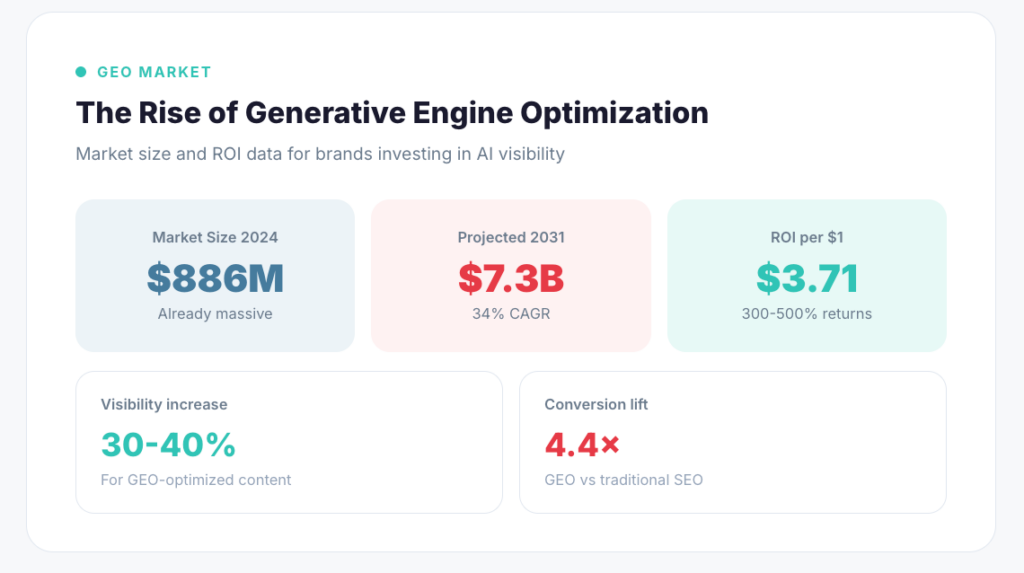
The GEO market is already worth $886 million and is projected to reach $7.3 billion by 2031, growing at a 34% CAGR. Companies investing in AEO optimization are seeing 30–40% visibility increases in AI search results, with ROI of $3.71 for every $1 invested. Early adopters report 300–500% returns within 6–12 months.
This isn’t a niche tactic anymore. It’s becoming the most important visibility strategy for ecommerce brands that want to stay relevant as search evolves.
How GEO differs from traditional SEO
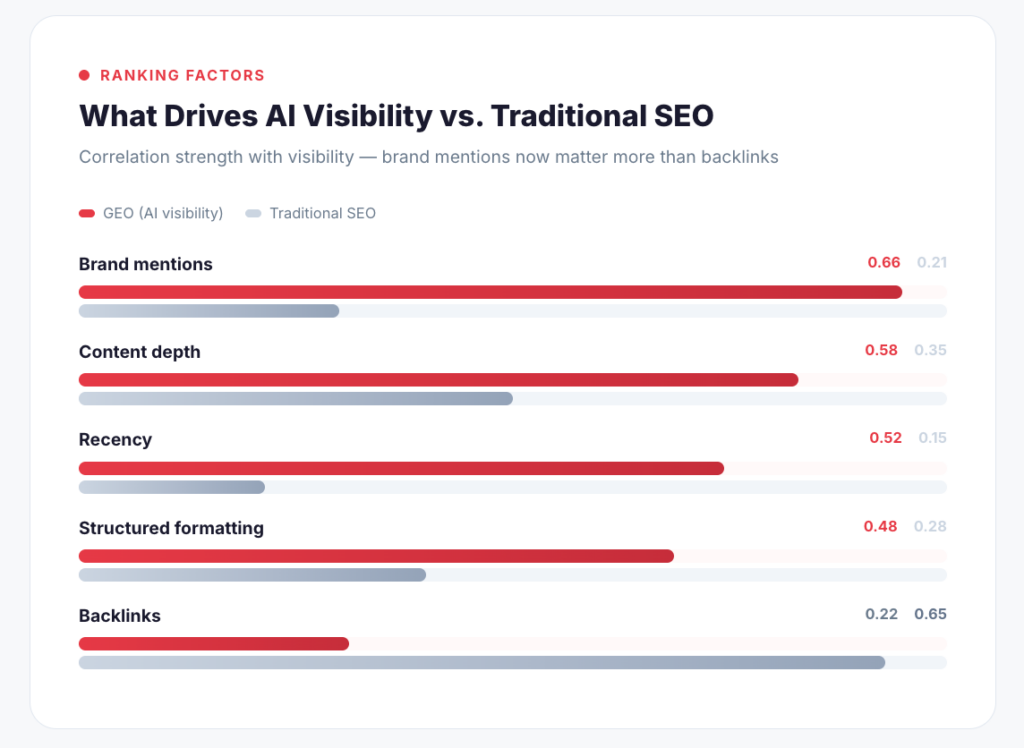
The ranking factors are different. For traditional SEO, backlinks, domain authority, and keyword density matter most. For GEO, what matters is content depth and readability, brand mentions across the web, factual accuracy and recency of content, structured formatting (Q&A, headings, lists), and page load speed.
One study found that branded web mentions have the strongest correlation (0.664) with AI Overview appearances—much stronger than backlinks (0.218). That’s a fundamental shift. Your off-site reputation now matters more than your link profile for AI visibility.
Content recency is also critical. Research shows that 85% of AI Overview citations were published in the last two years, and 50% of Perplexity citations are from 2025 alone. If your product pages and blog content haven’t been updated recently, AI systems are likely passing you over for fresher sources.
Seven Practical Strategies for Growing Ecommerce Visibility with AI
1. Structure content for AI consumption
AI systems prefer content that’s easy to parse and extract. This means using clear headings and subheadings that match the questions buyers ask, Q&A formatting (FAQ sections perform exceptionally well), ordered and unordered lists (78% of AI Overviews use list-based formatting), comparison tables for product categories, and concise factual statements (AI-cited articles cover 62% more facts than non-cited ones).
For ecommerce, this translates to building out rich product comparison guides, detailed FAQ sections on product pages, and buying guides that directly answer the questions your customers type into AI assistants.
2. Invest in content depth over keyword density
Articles over 2,900 words average 5.1 AI citations, while those under 800 words get just 3.2. For ecommerce, this doesn’t mean making every product page 3,000 words long. It means creating comprehensive category-level content—buying guides, trend analyses, and educational articles—that AI systems recognize as authoritative.
An electronics retailer publishing an in-depth comparison of the top wireless headphones in 2025 will earn AI citations. A product page with a 100-word description won’t. The content strategy has shifted from targeting individual keywords to building topical authority that AI systems trust. Leverage AI training videos and other educational content formats to deepen your topical coverage and provide the kind of multi-format material that AI systems increasingly cite.
3. Build brand mentions beyond your own site
Since branded mentions are the strongest predictor of AI Overview visibility, your off-site strategy matters more than ever. This means getting your products and brand mentioned in industry publications, review sites, and expert roundups. It means engaging with forums and communities where your products are discussed. It means building genuine relationships with content creators and influencers who reference your brand naturally.
For brands operating in the German market, this is particularly relevant. Micro-influencers and niche content creators convert better here than large-scale sponsorships, and their mentions carry weight with AI systems that scan the web for brand signals.
4. Optimize your technical foundation for AI crawling
AI systems need to be able to access and understand your content efficiently. This means implementing schema markup and structured data on all product pages, ensuring fast page load speeds (faster content is more likely to be cited by AI), using clean HTML (Google’s John Mueller confirmed you don’t need special Markdown or JSON versions for AI—clean HTML works), and keeping your sitemap updated and your robots.txt configured to allow AI crawlers.
For businesses running on platforms that power broader digital infrastructure—whether that’s a standard ecommerce deployment or an OpenClaw deployment service architecture—the technical foundation needs to be AI-crawler-friendly from the ground up.
5. Track your AI visibility separately
Only 22% of marketers currently track how visible their brand is in AI-generated results. That’s a dangerous blind spot. You need to measure AI referral traffic in GA4 (look for traffic from chatgpt.com, perplexity.ai, and other AI sources), track which pages are being cited in AI Overviews, and monitor your brand’s presence across AI platforms.
Tools like Semrush’s AI Visibility Toolkit, Ahrefs’ Brand Radar, and purpose-built platforms are emerging as an AI overviews tracker for ecommerce brands. An important next step in your AI visibility strategy is implementing dedicated tracking before competitors do.
6. Leverage AI for content production (smartly)
Here’s where AI cuts both ways. You can use AI tools to scale your content production—generating product descriptions, blog drafts, and marketing copy faster than ever. AI-written pages now appear in 17% of top search results. But there’s a catch: 93% of marketers edit AI content before publishing, and Google has shown it can penalize unedited AI content as spam.
The winning approach is to use AI as a first-draft tool and invest human expertise in editing, fact-checking, and adding original insights. For German-language content, this is especially important: 90% of Germans are online, but they prefer buying in their native language, and AI-generated German text still requires careful human review for nuance and cultural accuracy.
Whether you’re exploring tools like ChatGPT, Gemini, or looking for an alternative to ChatGPT that better fits your workflow, the principle is the same: AI accelerates production, but human oversight ensures quality.
7. Prepare for visual and multi-channel AI search
AI search isn’t just text-based. YouTube appears in 2% of AI Overview citations. Pinterest and visual search platforms are increasingly important for ecommerce product discovery. And AI Overviews for product queries already feature shopping links—72% of ecommerce-related AI Overviews include direct product links.
This means your product images need proper alt text and metadata, your video content should target the questions buyers ask, and your presence across platforms (not just your website) contributes to AI visibility.
The DACH Angle: What German Ecommerce Brands Should Know
The German market has its own dynamics that intersect with AI visibility in important ways.
Germany’s digital advertising market is growing at 10% in 2025, with 67.8 million Germans active on social media. But search advertising is growing at just 8%, while paid social and online video see double-digit growth. This suggests that German consumers are already shifting how they discover products—moving from traditional search toward more content-rich, AI-enhanced discovery channels.
Google.de still dominates search in Germany, and AI Overviews are active across the DACH region. But German consumers are also privacy-conscious, with strict data protection expectations. AI visibility strategies need to respect this—building trust through transparent, accurate content rather than aggressive tracking or data collection.
For any brand handling complex cross-border operations—whether that involves logistics, regulatory compliance, or setting up kiosk solutions for physical retail integration—the AI visibility layer adds another dimension to consider in your market entry strategy.
The mobile angle is also critical. Over 66% of German online shoppers make purchases on their phones, yet many advertisers still prioritize desktop. AI search is inherently mobile-first—AI Overviews and chatbot interfaces are designed for small screens. German ecommerce brands that optimize for mobile-first AI experiences will have a significant edge.
The Numbers That Matter: An AI Visibility Cheat Sheet
Here’s a quick reference of the data points that should inform your AI ecommerce strategy:
91% of ecommerce product queries now trigger AI-generated results. AI Overviews reduce organic CTR by 34.5% for top results. AI-referred visitors convert 23× higher than organic search visitors. 80% of AI Overview citations don’t rank in Google’s top 10 organically. 85% of AI Overview citations were published in the last two years. Content over 2,900 words averages 5.1 AI citations (vs. 3.2 for under 800 words). Brand mentions are the strongest predictor of AI Overview appearance (0.664 correlation). The GEO market is growing at 34% CAGR, projected to reach $7.3 billion by 2031. Only 22% of marketers currently track AI visibility. 58% of consumers now rely on AI platforms for product recommendations.
What to Do Next
AI isn’t replacing traditional ecommerce visibility—it’s adding a new layer on top of it. Google still sends 345× more traffic than ChatGPT, Gemini, and Perplexity combined. Traditional organic search still accounts for 25% of all website traffic, while AI referral traffic accounts for just 1.08%.
But the trajectory is unmistakable. AI referral traffic grew 527% year-over-year. AI Overviews increased their presence among domain keyword rankings by 155% across 2025. And the visitors AI sends are converting at dramatically higher rates than traditional search traffic.
The brands that start optimizing for AI visibility now—structuring content for AI consumption, building brand mentions, tracking AI-specific metrics, and investing in comprehensive, factual, up-to-date content—will be positioned to capture a disproportionate share of this rapidly growing channel.
Those who wait will find themselves fighting uphill against competitors who got there first.
The shift is already here. The question is whether your ecommerce brand is ready to be seen in it.