AI video generation for e-commerce: Inside SenseTime’s Seko, China’s automated video factory
Discover how Chinese sellers cut production costs to 10% and turn scripts into finished e-commerce ads in days, not months. Bonus: Want to see models like this live in China? Learn more about the trip with E-commerce Berlin Expo and Expanding Together at the end of article.
Written by Zheng Xu
At a glance: This case study is based on Zheng Xu’s, an International Expansion Architect with 18 years of Germany-China experience, meeting with a Chinese company called SenseTime. It examines how the firm’s Seko platform is changing video production for e-commerce brands.
Instead of relying on traditional studios, actors and lengthy production schedules, Seko uses a multi-agent AI system to support the entire creative process, from script analysis and shot planning to video generation, multilingual dialogue and detailed editing.
The article looks at how this technology can be used to produce product advertisements, branded microdramas, virtual lookbooks and multiple creative variations for social media campaigns. It also explores what China’s increasingly automated approach to content production could mean for European e-commerce companies.
While many Western brands still book studios, hire actors and wait weeks for a single product commercial, Chinese sellers are already operating on a different clock. During my recent visit to China, I took a close look at one of the platforms driving this shift: Seko, built by AI company SenseTime. What I found is a case study in how AI video generation for e-commerce is rewriting the economics of content production and a preview of what is likely heading to Europe next.
The problem Seko set out to solve
Every e-commerce marketer knows the bottleneck: high-quality video converts, but it is expensive and slow to produce.Traditional production means hiring actors, renting cameras, lighting and studios, and paying editors, and in a market where trending products change in days, waiting months for a commercial means missing the trend entirely.
Seko attacks this bottleneck directly. The platform functions as an automated, high-volume video factory producing hyper-targeted social media video ads. In practice, it lets an e-commerce seller operate as a “one-person film crew,” handling everything from script to final execution.
How the platform works: a case study in AI video generation for e-commerce
Seko is a hierarchical, multi-agent AI system that breaks a massive creative workflow into interconnected tasks. Rather than treating a complex product ad, or a 100-episode series, as one giant video file, it processes content step by step:
1. Script processing and shot breakdown. The seller inputs text descriptions, product features or marketing copy. Seko’s Agent Core System reads the narrative, then automatically slices it into logical scenes and granular shot lists.
2. Long-context, cross-episode management. Unlike standard AI video generators restricted to single clips, Seko tracks consistency across up to 100 episodes. Character faces, environments, outfits and props are stored in memory, so styling can adapt to different scenes while the core identity stays intact.
3. Rendering via the LightX2V engine. Generation runs on SenseTime’s open-source LightX2V inference framework – a real-time, high-throughput model designed to reduce token costs and wait times. Creators can generate single-episode blocks up to three minutes long.
4. Audio, dialogue and lip-sync. Integrated dubbing tools match the script, and a dedicated feature called SekoTalk executes multi-person lip-syncing so character lip movements align naturally with the audio across multiple languages.
5. Multi-character micro-editing. If a scene isn’t perfect, creators don’t re-roll the whole video. They can pinpoint individual shots to change background details, adjust expressions or fine-tune multi-character interactions.
SenseTime often pairs Seko with a companion tool, SenseAvatar, which handles 24/7 digital live-stream shopping hosts – the video content engine on one side, the always-on presenter on the other.
What e-commerce brands actually do with it
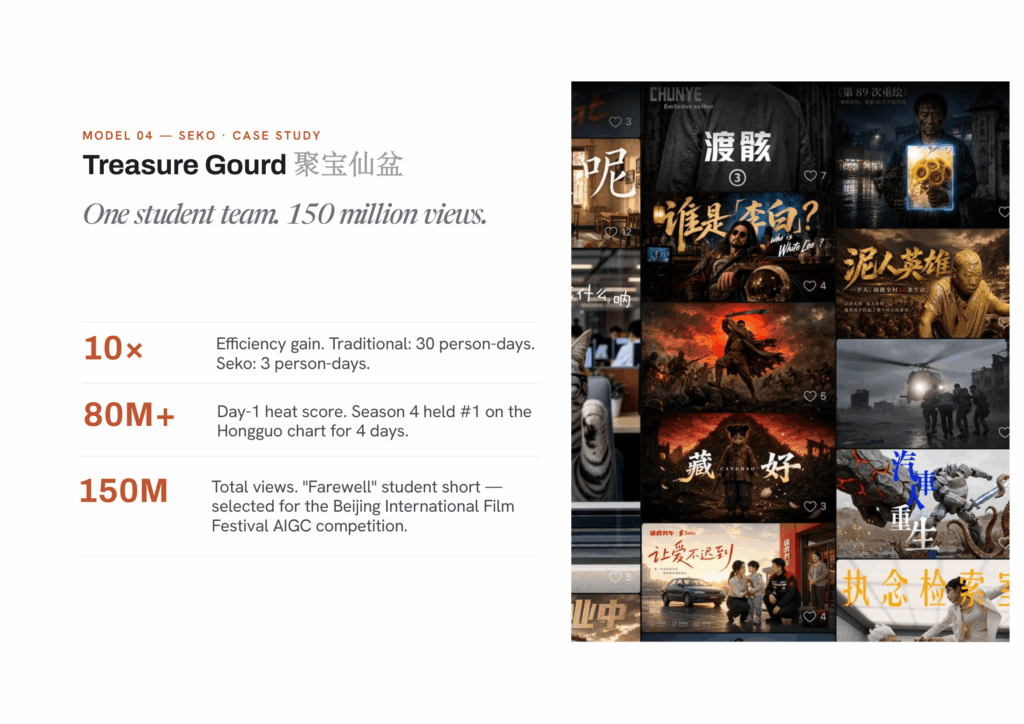
The most striking commercial trend I observed is the rise of branded “microdramas”: one-to-three-minute, highly dramatic episodic videos popular on platforms like TikTok and Kuaishou, in which a product is woven into a short, addictive fictional narrative. Because Seko maintains continuity across 100-episode arcs, brands can feature their inventory across weeks of content without character or prop distortion. Think a skincare product resolving a wedding-day crisis, or a travel bag surviving a chaotic airport mix-up.
Beyond microdramas, the platform’s practical applications map neatly onto a modern marketing pipeline. Fashion brands generate virtual lookbooks, using the LightX2V engine to showcase 50 different outfits in exotic locations within weeks instead of months. Others convert customer reviews into “problem-solution” motion comics for Instagram, Pinterest and TikTok.
SekoTalk turns one master product video into multilingual versions with naturally synced lips, removing the need to hire voice actors for each market. And because paid ad algorithms fatigue quickly, sellers use micro-editing to swap backgrounds, characters or ending hooks and A/B test dozens of creatives simultaneously to see which visual styles drive the highest click-through and purchase rates.
The numbers behind the model
The case for AI video generation for e-commerce becomes concrete in the figures. According to figures presented by SenseTime, Seko may reduce certain video-production costs to approximately 10% of a comparable traditional live-action production. Production timelines shrink from months to weeks, or even days, so campaigns launch while consumer demand is at its peak.
Scale changes too. SenseTime positions the system as a way for small teams to produce and test a significantly larger number of short-form video assets. Finally, by using AI-generated characters and SekoTalk’s lip-syncing, brands own 100% of their digital ambassadors: no ongoing royalties, no contract negotiations, no risk of a real-life influencer controversy damaging the brand.
Why this matters for Western e-commerce
For European sellers, Seko is less a product recommendation than a signal. The combination of automated video ads generated from product text, virtual brand ambassadors, serialized microdrama marketing and continuous scene-and-product swapping represents a model of content production that is already operational in China and that Western competitors will increasingly meet in their own ad auctions. Understanding how AI video generation for e-commerce works in practice, not just in theory, is becoming a competitive necessity.
See China’s e-commerce models live, not in a slide deck
In an innovative, ever-changing environment like e-commerce, knowing about the trends emerging in China is no longer enough. The real advantage is seeing these systems in person, talking to the teams, and hearing how they think, rather than only reading reports and case studies.
That is why E-commerce Berlin Expo and Expanding Together are organising the E-Commerce Networking Trip: seven days total, visiting Beijing, Shanghai and Hangzhou in November 2026, bringing Europe’s e-commerce community into direct contact with the people building China’s innovative online retail solutions.
If you’d like to see Chinese e-commerce models live with your own eyes, come with us to China and gain your competitive advantage. What we can offer you:
- No factory tourism or generic show sessions – instead, closed-door conversations with operational decision-makers, exclusive networking sessions with potential partners, and a fully tailored programme built around who is in the room;
- All networking sessions run in German and English, with professional interpreters throughout;
- Plenty of inspiration from seeing models two to three years ahead of Europe, live and in context;
- A concrete action plan for your business for the 30–90 days after you land back in Europe.
Source
This case study is based on information shared during Zheng Xu’s meeting with SenseTime. The results and descriptions reflect the information presented during that exchange.
About the author

Zheng Xu is an International Expansion Architect with 18 years of Germany–China experience, architecting strategic relationships across cultural boundaries – systematically, authentically, and with long-term impact.
Frequently Asked Questions
Q: What is AI video generation for e-commerce?
A: AI video generation for e-commerce uses artificial intelligence to create or modify product videos, advertisements and social media content. Depending on the system, AI may assist with scripts, storyboards, visual generation, dialogue, digital presenters, translation, lip-sync and editing.
Q: What is a branded microdrama?
A: A branded microdrama is a short, episodic story in which a product is included as part of the narrative. Instead of presenting a conventional product advertisement, the brand uses characters, conflict and recurring episodes to maintain the audience’s attention.
Q: How can e-commerce brands use AI-generated video?
A: Potential applications include product demonstrations, social media advertisements, virtual lookbooks, multilingual campaign versions, review-based stories, branded microdramas and multiple creative variations for advertising tests.
Q: Can AI video generation reduce e-commerce production costs?
A: AI can reduce the need for some traditional production activities, such as repeated studio shoots, physical locations and separate versions for every language.
Q: Does AI-generated video replace actors and creative teams?
A: Not necessarily. It can automate parts of production and reduce dependence on physical shoots, but brands still need people to develop the concept, check product accuracy, maintain brand standards, review outputs and decide which content should be published.