Discount strategy in e-commerce: why vouchers can become a serious growth lever
Does your voucher win new orders or just give away margin? Discover how to build a discount strategy in e-commerce that gives every code a clear job, protects your profits and proves real results. Read the full article before your next campaign. (Ad)

Author: Nicola Sonnleitner, Managing Director of 45Nord and founder of Rabatt-Coupon.com
A voucher can help an undecided shopper complete an order. It can also reduce the margin on a purchase that would have happened anyway. Both outcomes look like a successful redemption in a campaign dashboard. Understanding the difference is what turns discounting into a useful e-commerce strategy.
For online retailers, a sound discount strategy connects a relevant incentive with a specific customer need while keeping the economics under control. That means deciding who should receive an offer, what behaviour it should encourage and how its effect will be measured before the code goes live. A higher redemption count alone does not answer any of those questions.
As Nicola Sonnleitner, Managing Director of 45Nord and founder of Rabatt-Coupon.com, I work in this field through a platform focused on vouchers and promotional offers. The wider question for retailers is how those incentives can lower purchase barriers and support sales without necessarily weakening brand value. In this article, I explore practical decisions retailers can apply to their own shops.
At a glance
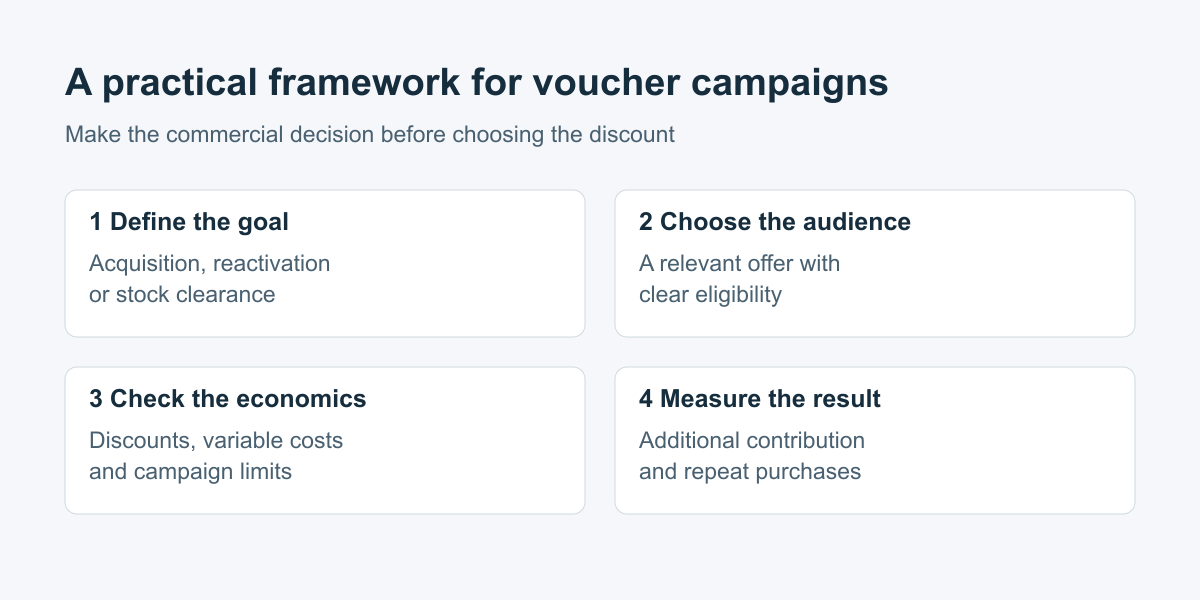
- Give each voucher campaign one job – acquisition, reactivation or stock clearance – and set the audience, limits and success measure before the code goes live.
- Check the real cost: when an order leaves €30 in contribution, a €10 discount needs 50 percent more identical orders to earn the same total.
- Keep offers easy to find, understand and redeem, and keep partner and coupon-site listings accurate.
- Measure additional orders, not just redemptions – ideally against a group that did not receive the offer.
Understand the hesitation before offering a discount
Price is one possible reason for hesitation, but it is not the only one. A shopper might be uncertain about delivery, returns, product suitability or the reliability of an unfamiliar retailer. Offering a code before understanding the obstacle can spend margin without resolving the problem. A delivery question needs a clear delivery promise; an unclear size guide needs better product information.
Start with the evidence available in the shop. Review customer service questions, search terms, checkout errors and feedback from people who did not complete their purchase. Combine those observations with funnel data. A drop at the payment step suggests a different investigation from a drop immediately after shipping costs appear.
Where price is the relevant barrier, an incentive can give the customer a reason to act. A small first-order offer may make trying an unfamiliar retailer feel less costly. A category-specific voucher may help a customer consider a new range. These are hypotheses to test, rather than outcomes that a discount can guarantee.
Give each promotion one clear job
A campaign intended to acquire new customers needs different rules from one intended to clear seasonal stock. Treating both as a generic percentage discount makes evaluation harder and can spread the incentive across customers or products that did not need it.
Write a short campaign brief before selecting the discount. Identify the eligible audience, the desired action, the products covered, the expiry date and the spending limit. Specify what would count as success and what result would cause the team to stop the campaign. This gives marketing, finance and customer service a shared reference.
For acquisition, the useful outcome may be additional first purchases that leave enough contribution to justify the acquisition cost. For reactivation, it may be profitable orders from customers who have not purchased for a defined period. For stock clearance, releasing cash and storage space may matter alongside margin. The right measure follows the commercial objective.
Keep the offer easy to understand. A minimum spend, product exclusion or customer restriction may be commercially necessary, but the customer should discover it before attempting redemption. An attractive headline followed by unexpected conditions creates avoidable disappointment at the moment the promotion is supposed to build confidence.
Protect the economics: what a discount really costs
Revenue after a promotion is not the same as profit from a promotion. Discounts interact with product costs, fulfilment, payment charges, commissions and returns. A useful campaign calculation includes the variable costs that change when another order is placed, as well as the cost of delivering the incentive.
Consider a simplified illustration, with all figures excluding tax. A retailer sells a basket for €100 and incurs €70 in variable costs, leaving €30 in contribution. A €10 discount reduces contribution to €20 if those costs stay unchanged. The retailer would need 50 percent more identical orders to generate the same total contribution. This is an illustrative calculation, not a forecast or a result from a real campaign.
The example explains why a higher conversion rate can still produce a disappointing commercial result. Equally, a lower contribution on a genuinely additional first purchase may be acceptable if subsequent purchases justify it. That future value should be measured over time, rather than assumed when approving the offer.
Set practical safeguards around the campaign. These might include a maximum number of redemptions, restrictions on stacking offers and exclusions for products with insufficient margin. Test combinations with free shipping and automatic discounts. An individually affordable offer can become expensive when several benefits apply to the same basket.
Coupon sites and checkout: make discovery useful rather than distracting
A promotion needs to reach the people it is intended to help. Email, paid campaigns, on-site messaging and coupon platforms can each play a role, but they reach customers in different contexts. Someone reading a product guide has a different immediate need from someone checking whether a code exists before paying.
Coupon platforms, such as my German couponing website Rabatt-Coupon, are one route through which shoppers discover offers. For a retailer considering this type of distribution, the practical questions are whether the offer is described accurately, whether its conditions remain current and whether results can be evaluated against the campaign objective.
Give distribution partners consistent information: the exact code, eligible products, start and end dates, exclusions and the destination page. Assign responsibility for correcting an inaccurate listing or removing an expired offer. A customer who finds a code outside the shop still experiences its failure as part of the retailer’s buying journey.
At the same time, avoid creating unnecessary reasons to leave checkout. Baymard Institute’s research on checkout forms describes users leaving a checkout to search for a code after encountering a coupon field. Its guidance supports reducing the prominence of that field, for example by placing it behind an expandable link. That finding concerns checkout usability; it does not show that every coupon campaign increases sales.
Make redemption straightforward
The moment of redemption should confirm the promise made by the campaign. Show clearly that the code has been accepted, what saving it creates and what the customer will pay. Do not make customers infer the result from a changed total or wonder whether another action is required.
When a code cannot be used, explain the actual reason. An expired offer, an unmet minimum spend and an excluded product require different responses. A specific message lets the customer understand the situation without repeatedly entering the same code or contacting support for an explanation the checkout could have provided.
Test the complete path on mobile as well as desktop. Include a valid basket, an ineligible basket, an expired code and a basket that qualifies for another promotion. Check what happens when an item is removed after the discount applies. These small tests often reveal inconsistencies that a successful single redemption would miss.
Also prepare customer service for the campaign. Give the team the same eligibility rules and a clear process for handling mistakes. If the promotion appears across several channels, make sure staff can identify the offer from the information a customer is likely to provide, rather than relying on an internal campaign name.
Measure your discount strategy: separate attributed orders from additional orders
An order carrying a code is easy to count. Whether the code caused that order is harder to establish. Some customers would have bought at the full price, while others may have purchased later or through a different channel. Crediting every redemption as additional growth can therefore overstate the value of the campaign.
Where feasible, compare randomly assigned eligible groups, with one receiving the offer and another not receiving it. Keep other campaign conditions as similar as possible. Define the measurement period and primary outcome in advance, and allow enough time to observe returns and cancellations. Very small samples should not support sweeping conclusions.
If a controlled test is impractical, compare results cautiously with an appropriate baseline. Account for changes in season, traffic sources, product availability and other marketing activity. A strong sales week during a major seasonal event is not automatically evidence that the voucher produced the improvement.
Review several measures together: conversion, average basket value, contribution after discounts, returns and subsequent purchases. Separate new and existing customers. An offer that looks weak across the whole audience may be useful for a specific group, while a strong overall redemption rate may conceal discounts given mostly to already loyal buyers.
Protect brand value through consistency
A promotion is also a message about how a retailer treats its customers. Clear eligibility, an honest deadline and a saving that appears as promised can support trust. Repeated deadline extensions or confusing exclusions can undermine it, even when the nominal discount is generous.
Avoid making promotional urgency a permanent feature of the shop. If customers repeatedly see an offer extended, they may become less confident that its stated end date means anything. A defined campaign calendar helps teams coordinate activity and prevents separate departments from unintentionally creating a continuous sale.
Different customer needs may also call for different benefits. Some shoppers may value delivery convenience, access to a relevant bundle or a service benefit more than a larger percentage reduction. Test those alternatives where they fit the product and economics, rather than assuming the deepest discount is always the strongest proposition.
Keep the experience coherent across channels. An offer advertised by a partner should not lead to a landing page that contradicts its conditions. Customers should recognise the promotion and understand how to use it without having to reconstruct the campaign from several different messages.
Build learning into your e-commerce discount strategy
After the campaign ends, bring marketing, finance and customer service together for a short review. Compare the original objective with the outcome, including contribution and customer feedback. Record which assumptions held up, which problems appeared and what the team would change before repeating the offer.
Maintain a simple campaign record so that the next promotion starts with evidence. Include audience rules, offer mechanics, distribution channels, costs, test design and results. Without that record, teams can repeat an attractive headline while forgetting the restrictions or operational work that made the previous campaign viable.
In e-commerce, vouchers can become a serious growth lever when they help the right customers make a purchase that serves both sides. Their value comes from relevance, reliable execution and disciplined measurement. Retailers that connect those elements can judge when an incentive earns its place in the customer journey and when a different improvement would do more.
Frequently asked questions about discount strategy in e-commerce
Q: What is a discount strategy in e-commerce?
A: It is a plan for when, to whom and how an online shop offers price incentives such as voucher codes. A good one gives each promotion a single goal – for example acquiring new customers, reactivating lapsed ones or clearing stock – and defines the audience, limits and success measure before the offer goes live.
Q: Do discount codes increase e-commerce sales?
A: They can, but a redemption alone does not prove it. Some customers would have bought at full price anyway. The most reliable way to measure the effect is to compare a randomly selected group that receives the offer with one that does not, looking at contribution, returns and repeat purchases as well as conversion.
Q: How many extra orders does a discount need to break even?
A: Divide the discount by the contribution that remains after it. If an order leaves €30 in contribution and a €10 discount reduces that to €20, the retailer needs 50 percent more identical orders to earn the same total contribution.
Q: Should retailers list vouchers on coupon websites?
A: Coupon websites are one route through which shoppers discover offers. They work best when partners receive accurate details – the exact code, eligible products, dates and exclusions – and someone is responsible for correcting listings and removing expired offers.
Q: How can online shops offer discounts without damaging their brand?
A: Keep conditions clear, honour stated deadlines rather than repeatedly extending them, and plan a campaign calendar so promotions do not turn into a permanent sale. Non-price benefits such as delivery convenience or a relevant bundle can sometimes work better than a deeper discount.
About the author

Nicola Sonnleitner is Managing Director of 45Nord and founder of Rabatt-Coupon.com, a German website featuring voucher codes and promotional offers from online retailers.