Amazon’s Global Standing: Market Strongholds and Competitive Edge
Amazon is the world’s largest marketplace, but 80% of its GMV comes from just five countries. Outside them, rivals set the rules. Here’s where Amazon dominates, where it doesn’t, and why based on data from ECDB. (Ad)

Amazon is the world’s largest e-commerce marketplace, but for how long? ECDB took a deeper look at the company’s profile. It revealed that Amazon is entrenched in its core markets, while outside of them, its competitors rule the game.
Even so, Amazon adapts to new market realities and leads on several important KPIs. This insight breaks down Amazon’s standing market by market.
Readers who want to dig deeper can download ECDB’s latest Amazon Marketplace Report 2026.
Amazon Rules in North America, Western Europe and Australia
Amazon remains the number one e-commerce marketplace worldwide, with a GMV of US$846.1 billion in 2025. Asian marketplaces fill most of the rest of the global top 10, though.

Amazon’s standing is firmest in North America, Western Europe and Australia. Outside of those regions, other players set the terms.

In Latin America, MercadoLibre takes the lead. Elsewhere, PDD Holdings, Alibaba, and Sea Ltd. with Shopee dominate the e-commerce landscape. In India, Walmart competes for the first spot through Flipkart.
Europe splits into Amazon-led markets and markets where competitors hold a firmer grip. The reasons come down to timing and structure. In Poland and the Netherlands, Amazon arrived late and earlier rivals had already built their base, Allegro in one case and Bol in the other. Elsewhere, geography gets in the way. Greece is mountainous and spread across islands, which makes next-day delivery and the rest of the Amazon service model harder to run.
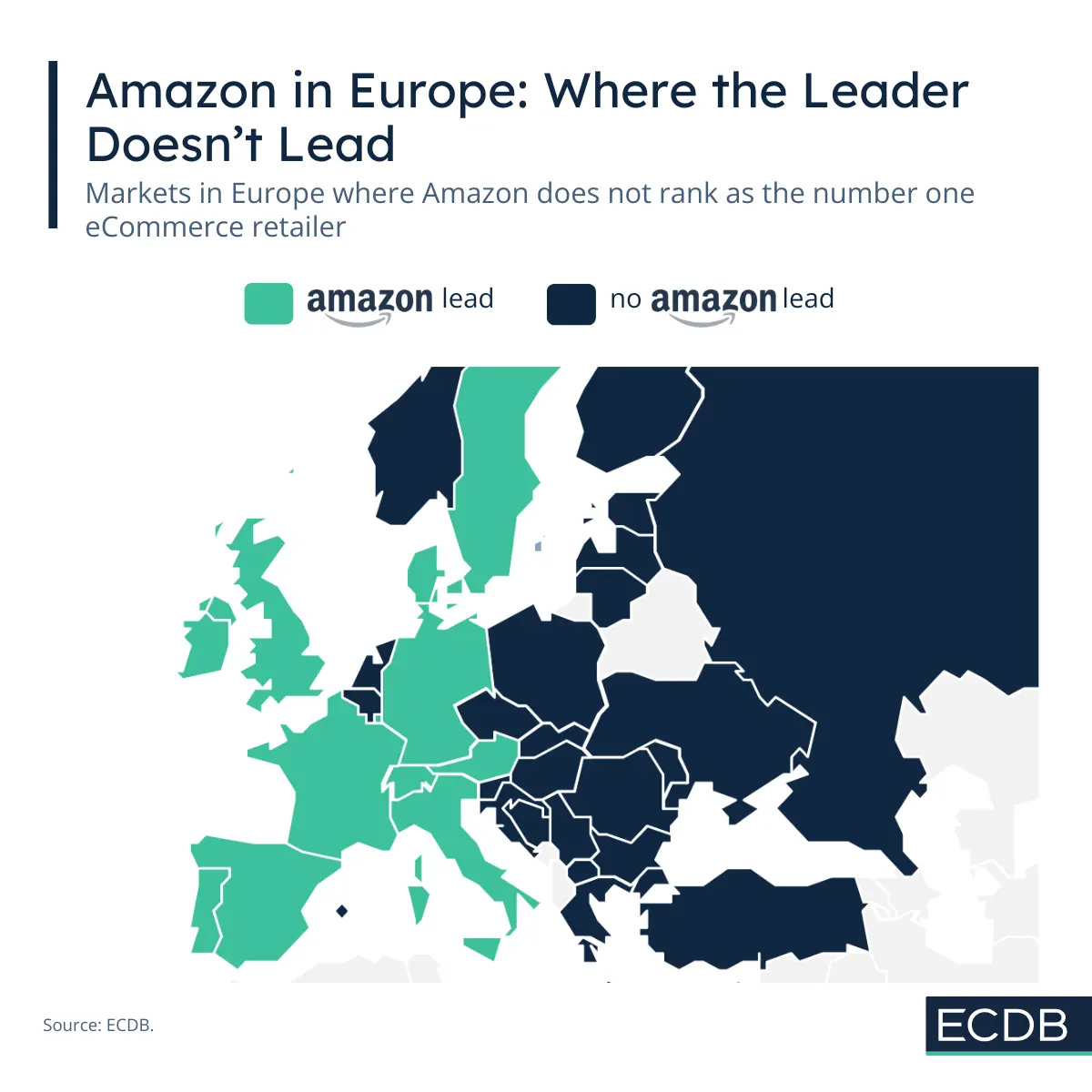
In its key markets, Amazon dominates the competition. That dominance rests on a narrow base. Amazon’s GMV is concentrated in one domain in particular.
Amazon Is Highly Concentrated Around One Market in Particular
Amazon.com generates more than half of Amazon’s product sales, with US$441 billion. Most of that comes from US shoppers, which makes the US by far Amazon’s most important market.
Five markets generate 80% of the platform’s total GMV. These five core markets are where Amazon’s advantage compounds.
- 51% of Amazon’s GMV are generated in the US
- The UK follows further behind with 10%
- Germany is Amazon’s third-most relevant market with 8%
- Japan follows closely with 7%
- Canada comes in fifth with 4% of Amazon’s GMV
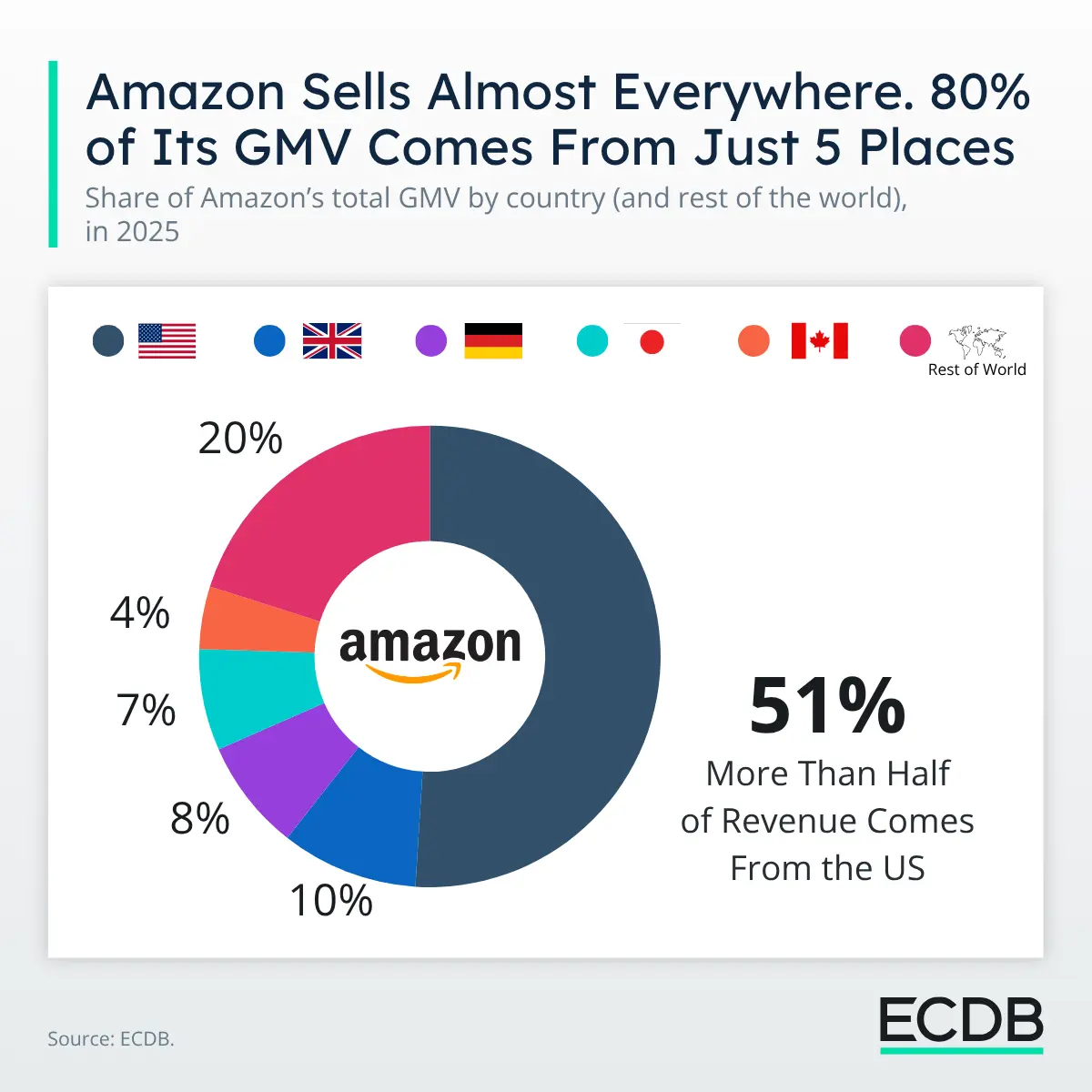
The markets outside the US contribute smaller percentages, but Amazon’s role in them is far from arbitrary. The top five are where Amazon’s logistics network is most developed, Prime membership is most entrenched, and brand loyalty runs deep. That makes direct competition extremely difficult.
The “Amazonification” of markets is real, too . It describes how consumer expectations change because of the fast delivery, vast product offering, and service available on the platform. That shift puts pressure on existing retailers and new entrants alike, and it is most visible where Amazon has the strongest foothold.
Amazon’s transactional KPIs point the same way. It outperforms its competitors on several of them, above all on purchase frequency.
Amazon’s Competitive Advantage Is Its High Purchase Frequency
The average Amazon customer places 19 orders per year. No other major retailer comes close to that frequency, and it says more about Amazon’s business model than almost any other metric available.
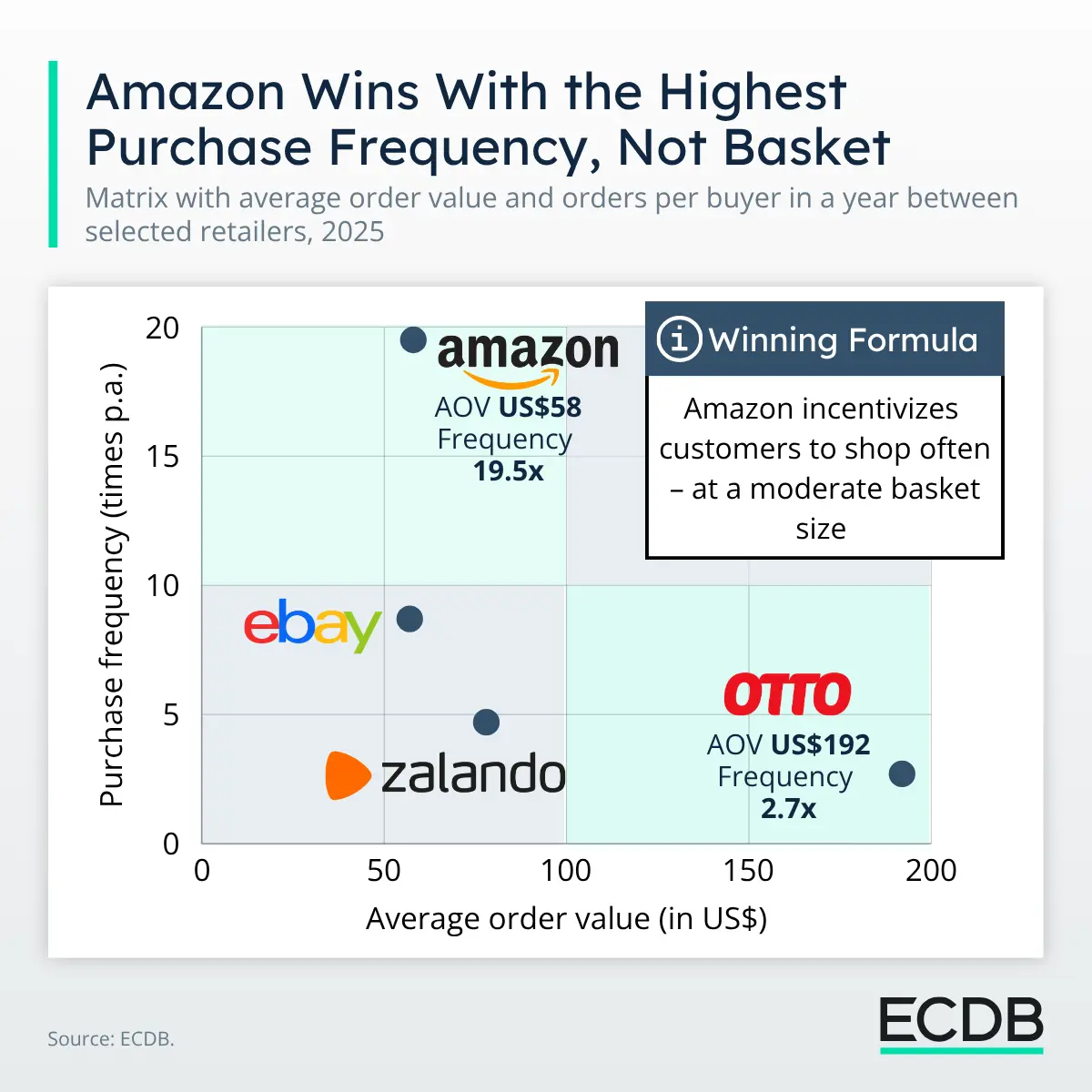
What makes that number more interesting is what it is paired with. Amazon’s average basket size sits at a relatively modest US$58. Put the two together and a clear pattern emerges: Amazon customers place small orders constantly, treating the retailer like a default habit for everyday shopping.
Fast delivery times remove the friction that normally makes people batch purchases together to justify shipping costs or wait times. Prime membership adds a psychological push in the same direction, since subscribers already feel they are paying for the benefit and want to use it.
Recurring discount events give customers fresh reasons to come back throughout the year rather than stock up once. Prime Day is the most obvious example, and if it has ever nudged you into ordering something you did not plan to buy that week, you are proof of exactly how well the model works.
Amazon Appeals to Broad Segments, Skews Younger and More Affluent Than Walmart
Across two dimensions, age and income, amazon.com and walmart.com are both fairly balanced. Of the two, Amazon is more evenly distributed, which speaks to its broad appeal across the general consumer base.
Shoppers earning more than US$100,000 a year account for the largest GMV share at amazon.com, at 38.9%.
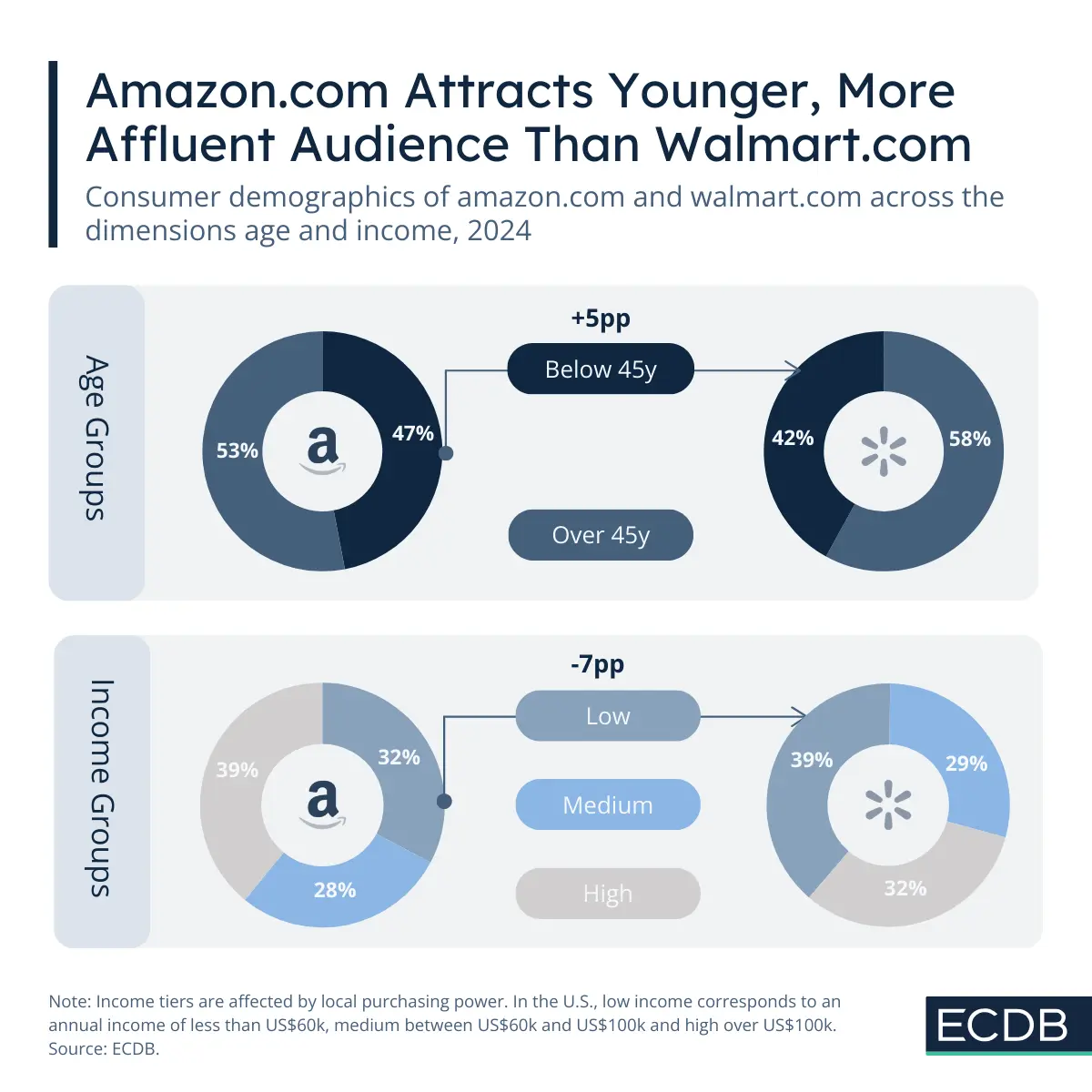
Amazon.com generally speaks to all age groups, but younger users are better represented than older ones. Amazon.com’s largest age group are online shoppers between 35 and 44, who generate 19.7% of GMV. Users aged 45 to 54 follow shortly behind.
Prime is designed to appeal most to shoppers with a steady income and frequent purchasing habits. Those groups are more likely to fall in the middle age brackets. Younger consumers may not see enough value in paying for the subscription. Older shoppers may not use the full range of benefits, or might prefer the in-store experience.
Going With the Times: Amazon’s Third-Party Share Is Growing
Third-party (3P) sellers are now the driving force behind Amazon’s marketplace. The trend is accelerating globally, and Amazon’s business model shift hints at a wider development in digital retail. In 2025, third-party sellers generated 67.1% of the platform’s GMV.
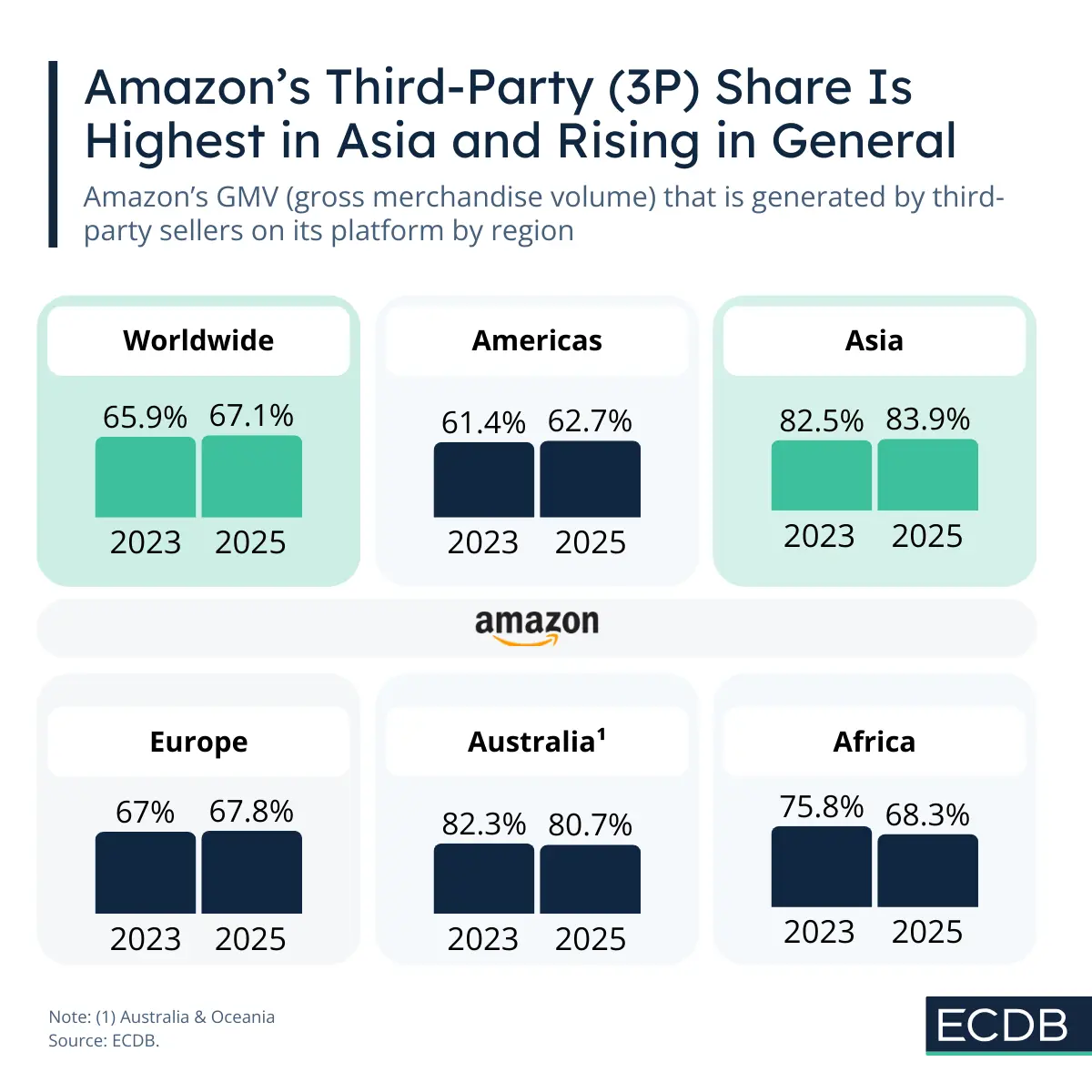
In practical terms, more than two-thirds of all sales on Amazon come from external sellers. These include small businesses, brands, and international merchants who use Amazon’s infrastructure to reach customers worldwide.
Asia stands out as the region where third-party sellers dominate most. There, external sellers generate 83.9% of Amazon’s GMV.
This reflects a broader trend across Asian e-commerce, where marketplace platforms have long been the standard. Consumers are accustomed to buying from thousands of independent sellers on a single platform, which makes the 3P model particularly successful in the region.
In Europe, third-party sellers generated 67.8% of Amazon’s GMV in 2025. That share reinforces how far Europe has moved toward platform-based commerce. The marketplace model is spreading globally on the back of clear advantages. It scales easily. It lowers risk for companies that avoid the cost of buying and storing goods. It widens selection for customers. And it opens access for smaller businesses, who can reach global audiences with relatively low barriers to entry.
Wrap-Up: Amazon’s Lead Rests on Concentration, Frequency and Third-Party Sellers
Amazon has been going with the times. Most influential in its top 5 markets, the platform has set the standard for fast delivery and wide-ranging services. Where Amazon leads, competing platforms have a hard time reaching the top, as Amazon usually dominates where it operates.
Amazon’s KPIs mirror the habits of its affluent, broadly distributed customer base. Prime membership and next-day delivery encourage shoppers to buy small baskets often.
The world is moving toward the 3P model in e-commerce, and Amazon is shifting in the same direction. This enables more product variety and lower overhead, with a wealth on data ready to use for costumer behavior analysis.
But Amazon does not dominate everywhere and among the global top 10 marketplaces, Amazon’s lead is narrowing year by year. How well it defends its core five while rivals keep growing outside of them will shape Amazon’s position in the years ahead.