Cross-border e-commerce study: How sellers can efficiently utilise the potential of international trade
Selling abroad is now routine for German companies, but 59% say it keeps getting costlier. The cross-border e-commerce study explains why marketplaces are becoming the shortcut. (Ad)
For German companies, selling across national borders is no longer a test run, but everyday business. This is shown by the current cross border e-commerce study “Cross-Border E-Commerce – International Sales via Digital Channels” by ibi research at the University of Regensburg, for which German companies from trade, industry, construction and services were surveyed between May and July 2026. A key finding: 63 percent now actively sell domestically or internationally – in 2022 this figure was 51 percent. 84 percent actively sell domestically or internationally, or at least accept orders from abroad. In 2022 this figure was still at 51 percent. The increase of 33 percentage points shows that the leap into the unknown, which many companies used to fear, has long since been completed for most.
In addition, the cross border e-commerce study delivers a second, equally clear result: 59 percent of respondents say that expansion abroad is becoming increasingly expensive and complex. Growth is there – but it costs valuable resources. This leads to the real challenge of the next phase of cross-border e-commerce: Success will not depend on the number of countries entered, but on who can actually manage the operational effort per market.
The study provides an obvious answer to this problem: Marketplaces provide precisely the technical infrastructure that sellers would otherwise have to painstakingly build themselves. In doing so, they reduce precisely the effort that, according to the survey, is becoming the limiting factor.
MARKETPLACES LIKE Kaufland Global Marketplace: A response to the cross-border e-commerce study results
Kaufland Global Marketplace is the all-in-one solution behind the international Kaufland marketplaces and was once again awarded the E-Commerce Germany Award this year as the best internationalisation solution. With just one registration, sellers can sell a wide product portfolio in 6,400 categories in up to nine European countries. In Germany, France, Italy, Poland, Austria, the Czech Republic and Slovakia, the Kaufland marketplaces have already established themselves as top marketplaces and significant players. They record up to 46 million visitors per month. Kaufland.nl in the Netherlands launched in September 2026, and Kaufland.es in Spain, the fifth largest e-commerce market in Europe, will follow in late summer of this year. This makes Kaufland Global Marketplace the largest marketplace network in Europe, through which sellers can reach a potential of 220 million online customers. Around 15,000 sellers are already selling over 45 million products via the generalist marketplaces.
Kaufland Global Marketplace goes far beyond simply being a sales platform. The aim: To enable sellers of all sizes to build and expand their international business faster and more resource-efficiently than they could on their own – with transparent fees and individual support. An alternative to global e-commerce giants, from Europe – for Europe.
A detailed look at the cross-border e-commerce study results shows how well this partnership-based approach, focused on joint growth, works in practice: The advantages that sellers want from marketplaces for their internationalisation line up almost exactly with the offer of Kaufland Global Marketplace.
The study results in detail: Five advantages that marketplaces offer for international expansion
1. Speed
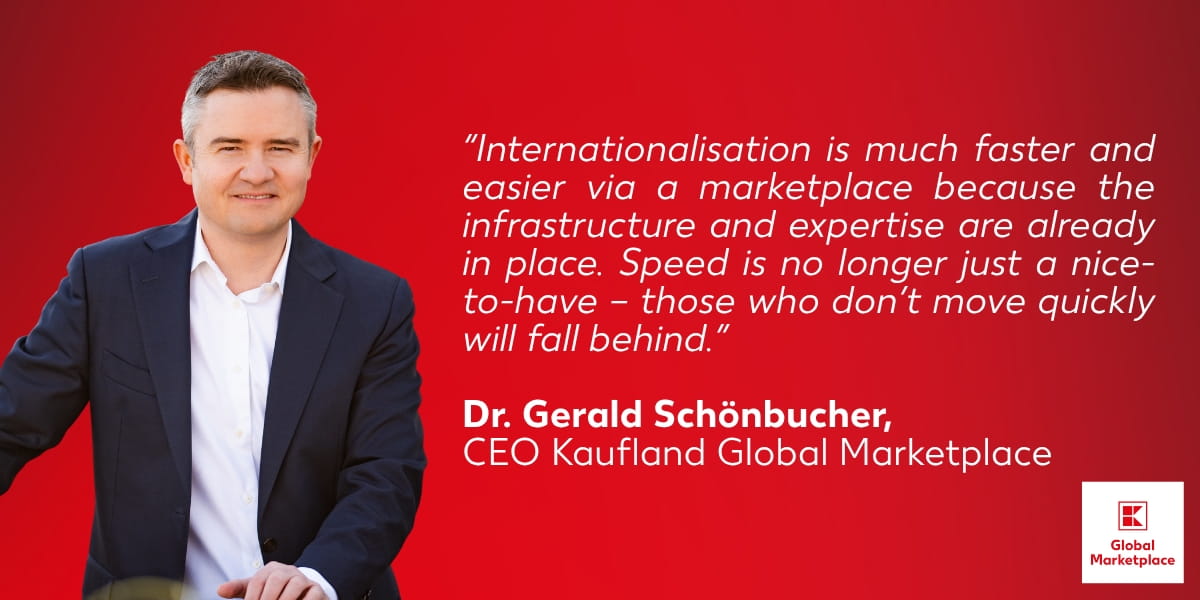
The results of the ibi research’s cross border e-commerce study confirm the statement: While the path from planning to go-live for an individual online shop takes an average of 70 days for the respondents, it only took 60 days via a marketplace. At Kaufland Global Marketplace, market entry into new countries is significantly faster: Once a seller is active on one of the marketplaces, an additional country can be activated in about 30 minutes. Inventories and offers can be transferred with just a few clicks.
2. Easy selling
2.1 Support with legal requirements
Specifically, companies cite the necessary bureaucracy as the main obstacle to internationalisation: 77 percent of all respondents see the review and implementation of legal and regulatory requirements as significantly more challenging than in domestic business. For companies that are not yet active abroad, the figure is as high as 85 percent. Tax and customs regulations as well as national product requirements are considered the biggest stumbling blocks – this also includes Extended Producer Responsibility (EPR), which is mentioned in the study as one of the biggest compliance challenges. This is exactly where Kaufland Global Marketplace comes in, taking over the Extended Producer Responsibility registration for sellers.
2.2 One-Portal Solution
The desire for simplification becomes even clearer in light of the question of a centralised management solution. 61 percent of companies state that a one-portal solution with a central backend, through which offers, orders and processes for multiple countries can be managed simultaneously, would strongly or very strongly influence their decision to expand into multiple countries at the same time. Only 15 percent see hardly any effect from it.
This is a clear signal, especially for an industry that has spent years building its own isolated solutions for each country in order to cope with the respective regulatory requirements: A central system beats many individual solutions.
Kaufland Global Marketplace answers this wish with a networked multi-marketplace technology and a comprehensive range of additional services:
- Control from one portal: Sellers seamlessly manage all offers, orders, product data and after-sales processes for all Kaufland marketplaces from a single Seller Portal
- Automated translation of product data and legal texts – free of charge and without any additional manual effort for sellers
- Extended Producer Responsibility Service by Kaufland: The marketplace assumes Extended Producer Responsibility
- Multilingual ticketing system and 1st level customer support in the respective national language
- Relevant payment methods in local currency, including support with payment processing
- Personal Seller Support in various languages, by phone and e-mail
- Option to link your own online shop
- Automated optimisation functions for performance improvements
- Self-services: Experience in Seller University and webinars
- Cooperations: Advantages with external partners for other services
2.3. Technical connection
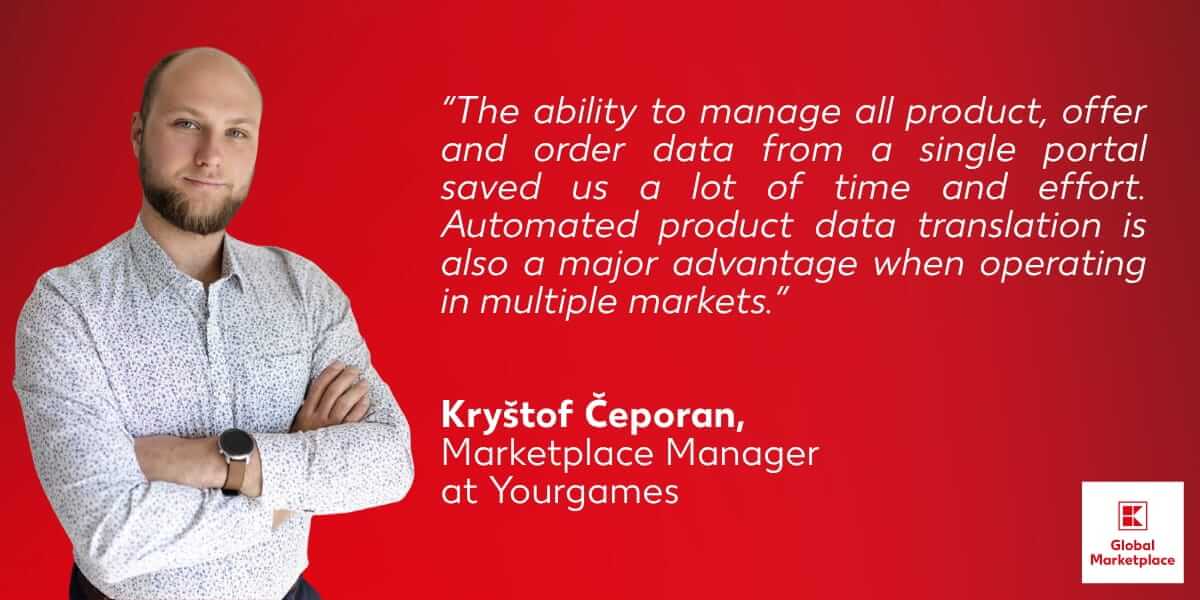
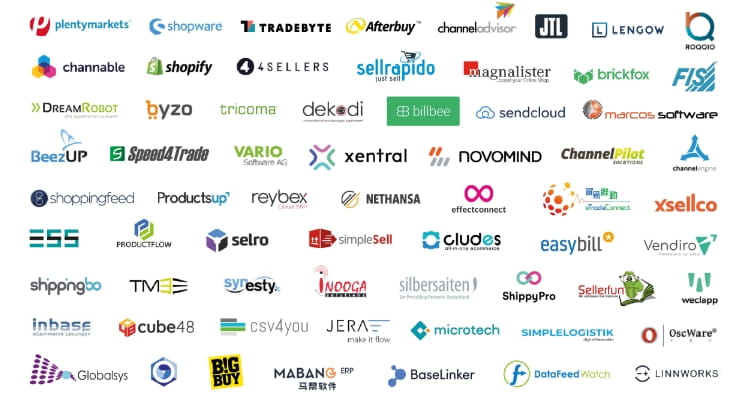
One reason why companies hesitate to open up new sales channels or countries, according to the study, is a fear of the effort needed for integration: Technical connectivity and a lack of resources or expertise to build a technical infrastructure repeatedly emerge as mentioned hurdles. Kaufland Global Marketplace offers various options for transferring data to the system: Manually, via CSV file upload, via a proprietary API connection or via interfaces from external software partners such as Base, ChannelEngine, JTL, 4Sellers or ESS. Over 170 warehouse resource management, shop and software systems can be seamlessly integrated, so sellers do not have to rebuild their entire IT landscape for an additional country.
2.4 AI support
The use of AI provides another building block for reducing operational complexity. On the Kaufland marketplaces, it acts as a virtual assistant: On request, it takes over time-consuming tasks such as price adjustments, optimising delivery times or product titles.
The AI assistant “Ailora” proceeds in four steps:
- Lead – identifies where support is needed
- Optimise – optimises untapped potential
- Recommend – suggests specific measures, such as a suitable Sponsored Product Ads campaign
- Automate – automatically implements actions after confirmation by the seller.
This transforms AI from a mere recommender into an active team member that saves resources and creates space for strategic decisions – a consistent further development of precisely the “one backend, many markets” logic that 61 percent of sellers explicitly mentioned a wish for in the study. The purpose is not only to bundle the operational complexity of multi-marketplace sales, but also increasingly to automate the associated decisions.
3. Brand awareness
Besides easy control and support with legal issues, the study cites the familiarity of a platform as another reason for using marketplaces (57 percent). Kaufland has a structural advantage that pure marketplaces cannot offer: brand awareness of up to 99 percent in the marketplace countries, supported by around 1,600 brick-and-mortar retail stores. Like its independent sister division Lidl, Kaufland belongs to the Schwarz Group, which, with 604,000 employees in 34 countries, is one of the largest retail companies worldwide. Customer loyalty programs such as the Kaufland Card XTRA and the Kaufland app further strengthen this link between brick-and-mortar and digital retail.
What does this mean concretely for sellers? Less effort on their part for brand building and resources for promoting their own online shop – an advantage that is particularly important when entering new markets with low risk.
4. Reach
Another advantage of international expansion: Marketplaces offer enormous reach. Through the Kaufland marketplaces, sellers can potentially reach 220 million online customers. In combination with the aforementioned brand awareness, this makes it possible to gain customers who would only be reachable with considerable effort – or not at all – via their own online shop.
However, reach alone does not make a seller successful on a marketplace: The crucial thing is to use it strategically and to prominently place one’s own offers. Kaufland Global Marketplace offers numerous marketing tools precisely for this purpose:
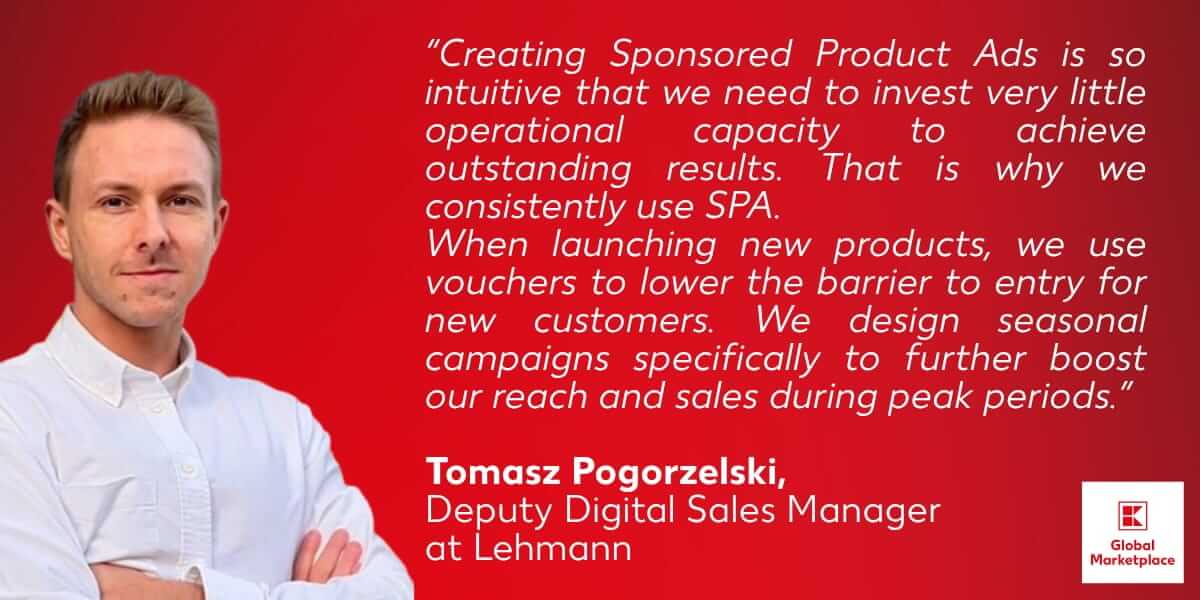
- Sponsored Product/Brand Ads: Prominent placement in search results or on product details pages; best practices show up to 170 percent more traffic.
- Vouchers: Individual discounts increase visibility and the chances of winning the BuyBox; sellers who use vouchers increase their sales per item by an average of 16 percent.
- Seasonal campaigns: Free participation in high-reach marketing events such as Black Week, advertised via newsletter, social media and the Kaufland homepage.
- External multi-channel promotion: Promotion on Google Shopping and other price comparison platforms is included.
5. Logistics
The study also paints a pragmatic picture regarding shipping, fulfilment and warehousing. When choosing a logistics partner, the price (85 percent) as well as reliability and delivery speed (84 percent) are the primary factors. Sustainability criteria such as CO₂ reporting or certificates play a negligible role, accounting for only one to four percent. It is also noteworthy that so far only about one-fifth of companies use a fulfilment service provider at all; half say they have sufficient internal capacity and want to retain full control over warehousing and shipping.
For marketplaces, this means that additional services in the logistics sector must offer a clear, measurable advantage over in-house handling, instead of creating additional complexity. Kaufland Global Marketplace therefore relies on an open technical connection rather than a forced solution; the partner network includes numerous logistics providers that support sellers in international fulfilment. In addition, German sellers can use international shipping labels at attractive rates. With Kaufland Shipment Solutions (KSS), sellers create shipping and return labels for their orders and ship packages from the German warehouse to all Kaufland Marketplace countries – cost-effectively, reliably and with a delivery time of two to four days to the end customer. Easy handling, immediate access to shipping and return labels and qualified Seller Support for delivery inquiries complete the offer.
Conclusion of the ibi cross border e-commerce study
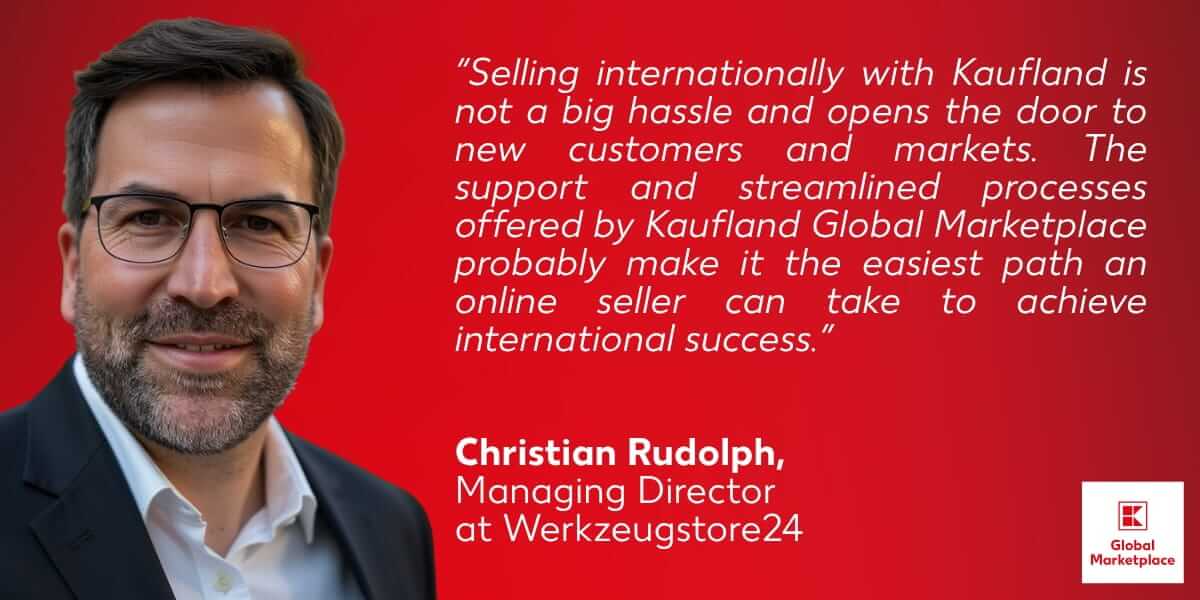
The conclusion of the ibi research cross border e-commerce study is unequivocal: By 2026, success will no longer be a question of team size, but of the right platform strategy. Those who make their existing product range accessible to new customers via the appropriate marketplaces can grow – without having to proportionally increase the number of employees or resources – simply and quickly.
These are exactly the two words that come to mind when you think about an expansion with Kaufland Global Marketplace.
The study provides a useful compass for companies on their way to international expansion. Kaufland Global Marketplace, winner of the Best Global Expansion Solution Award from E-Commerce Germany News, demonstrates how concretely its central demands can already be implemented today: As an alternative to global e-commerce platforms, the all-in-one solution offers exactly what makes international growth easier for sellers and brands: a fast path to new target groups that can be easily convinced thanks to the high brand awareness, additional marketplace services and support in logistics.
Bio
Kaufland Global Marketplace is the all-in-one solution that gives online sellers and brands of all sizes the opportunity to sell internationally with minimal effort across more than 6,400 categories. A single registration opens access to nine seamlessly connected marketplaces and potentially 220 million customers. Combining technical excellence, strong brand awareness, and comprehensive marketplace services – including automated translation of product data, customer tickets, and legal texts, payment processing support, and a personal seller support – Kaufland Global Marketplace is the strong European alternative to global e-commerce giants, giving sellers the ideal infrastructure to grow across Europe quickly and easily.