Behind the Click Podcast with Dr. Oliver Dlugosch: Why the same operational problems keep showing up in every company, and how AI can finally fix them
Written by
Editorial TeamPublished on
Dr. Oliver Dlugosch, CCO & Co-Founder of GeneralMind, explains how AI and LLMs can automate supply chain work, and shares his lessons from founding twice.
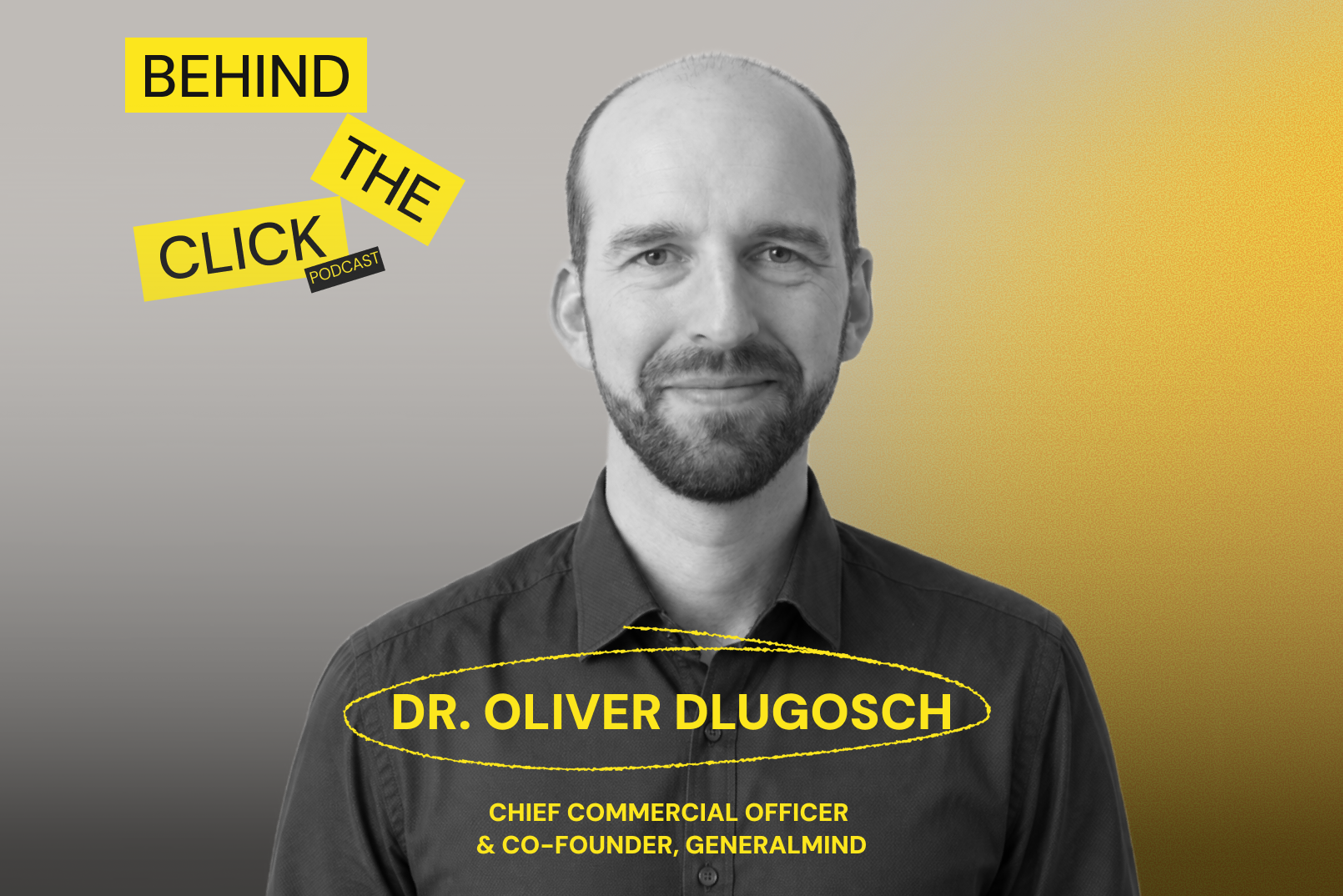
A 100-year-old corporation and a small startup can look completely different from the outside. Behind the scenes, says Dr. Oliver Dlugosch, they often struggle with the same things. As Co-founder and CCO of GeneralMind, he explains why supply chain operations still depend on so much manual work, and what LLMs can change.
Supply chain automation rarely makes headlines, yet it decides whether goods arrive on time, invoices are booked correctly and seasonal products reach the shelves at all. For Dr. Oliver Dlugosch, this unglamorous layer of business is where AI can make the biggest practical difference.
In the newest episode of Behind the Click, hosted by Janine Heinrich, Dlugosch talked about building and integrating more than 300 e-commerce businesses at Razor Group, the pain that led to GeneralMind, and how AI is changing the daily work of operations teams. He also shared candid lessons on founding a company twice.
From physics and consulting to founding Razor Group
Dlugosch’s career did not start in e-commerce. He trained as a physicist, moved into consulting and then took an operational role at Fortuna Sulov, if only for a year. That role showed him his skills were useful not just for strategic projects but for everyday operations.
In 2020, his old schoolmate Tushar called with an idea for Razor Group. Dlugosch tried to find the flaw in the plan and could not find one that made it structurally impossible. Challenging, yes, but feasible. He had no family or children at the time, and his reasoning was simple: if not now, when?
He is candid that entrepreneurship is the hardest of his three fields. Physics came naturally, and consulting was a logical extension of it. Entrepreneurship, he says, is immediate and direct, with very little buffer for mistakes.
The founder story fits the picture. On Razor’s first operational day, he slept on an air mattress in the basement office because he had nowhere to stay in Berlin.
Buying, integrating and standardizing 300 businesses
Razor Group acquired more than 300 small e-commerce businesses, many of them built on Amazon’s FBA program, each selling a few hundred products a day. Dlugosch explains that this shared foundation made the whole model possible, because Amazon already handles much of the distribution and customer acquisition.
Razor then consolidated operations. It worked with fewer, larger suppliers, used bigger logistics providers for better shipping rates, and centralized warehousing, content creation and advertising. The original founders left after a handover period of four to six weeks, and from then on everything was run by Razor. This made it an integrated company rather than a holding umbrella.
The first 10 to 20 acquisitions were new territory. After about six months, onboarding turned into a standardized process, like a conveyor belt, with defined sequences and checkpoints that no longer needed founder attention.
One early decision made this scale possible. Only about four months after founding, and before any revenue, Razor set up a full ERP system. Dlugosch describes an ERP as the backbone of a business, bringing together the movement of goods with invoices and payments. Others called the timing crazy, but he believes that without it the company would have been “dead by 2021”, overwhelmed by complexity that Excel files could not handle.
The problem behind GeneralMind
Razor’s supply chain still needed 150 to 200 people, despite the expensive ERP. Most of them were not managers or strategists. They worked in operational procurement, import logistics, warehouse management, order management and accounting. They answered supplier questions, chased logistics companies and customs, and prepared documents.
The team assumed this was a Razor-specific problem. It was not.
Manual processes also carry real risk. Dlugosch gives the example of a highly seasonal product such as Halloween merchandise. One missed email can mean missing the vessel from Shanghai to Hamburg, and the whole shipment then has to be stored for a year. A single overlooked message can cost millions.
When large language models became available, the team saw a way out of these repetitive tasks. That is what GeneralMind does today: it helps large companies bring AI into their operations exactly where it is needed.
What LLMs can do in supply chain operations
Dlugosch says GeneralMind focuses on anything connected to the movement of goods or money. A typical example is sending an order to a supplier. It sounds trivial, but someone has to confirm it was received, collect the supplier’s answer and record the result.
LLMs can now interpret incoming emails, extract data from PDFs and Excel files, validate that data and write it into the ERP. The ERP stays the system of record, the single source of truth on the status of the supply chain.
His example of work no human should do manually is extracting data from a document and checking it against another system. Taking a PDF and matching it against the ERP is something machines can now do.
Will AI take the jobs?
Dlugosch expected strong resistance from employees, but says it rarely happens. He gives several reasons:
- Many companies have trouble finding people willing to do tasks like comparing PDFs against ERP entries.
- Some customers have teams close to retirement, such as accountants who know how to book technical invoices correctly. Those companies risk losing that knowledge, and AI can help preserve it.
- Operators are often relieved. Instead of digging through hundreds of emails in Outlook, they can focus on the critical cases.
He does not claim that no one will lose a job. In his view, that is the path technology takes, and a business under heavy cost pressure that cannot stay competitive may face a worse outcome. The host agreed that leaders face a real balancing act between the human impact and the bottom line.
His central point is that AI is far from being left alone. It handles the clear cases and frees people for the difficult ones. People still need to own, review and question the process. Twenty or thirty years of experience are not best used extracting a purchase order number from a PDF.
Lessons from founding twice
The core team behind Razor Group is largely the same one now building GeneralMind, which is unusual given how often founder breakups sink companies. Dlugosch credits three things:
- Complementary skills: each founder does something well that the others cannot.
- Trust: shared history means the team skips the phase of the first disappointment, when someone says they will do X and does not. It makes them faster.
- Shared pain: GeneralMind is a natural next step because the founders are solving the problems they lived through at Razor.
Two or three additional founders who were not at Razor have since joined and brought new capabilities.
Razor also changed how he thinks about strategy. He once believed a startup needed white papers and a fully worked-out plan. Reality taught him that operations beat visionary talk. Good metrics, controlled processes and solid numbers matter most, though he values Tushar’s vision as guidance for the team.
If he were to build a supply chain today, he says it would look completely different, with room for AI advances built into the architecture from the start.
An office-first culture in the age of AI
GeneralMind hires many young, AI-native people, and Dlugosch says he learns from them, for example how to review documents in two minutes instead of five hours. Meeting summaries, email drafts and data collection are increasingly handled by AI.
He does not think hiring can be fully automated. The company still meets almost every new hire in person at least once, because it is a people business. It is also office-first, with no structural home-office policy. He believes a young, fast-changing company needs people to overhear conversations and react to change together, which is hard to replicate on Zoom. He admits a handful of candidates declined because of this, but says resistance has been limited.
Advice for businesses and founders
For businesses: Get started with AI. Open it up to your teams. Beyond operational tasks, Dlugosch encourages companies to apply AI to their core competency, the specialist knowledge that only they have, whether that is how tires or microphones are made. That is where AI can strengthen a competitive advantage.
For aspiring founders: Just start. He believes entrepreneurship is open to far more people than assume it is. Setting up a company in Germany can cost as little as a notary appointment, and AI makes building a website or outbound sales easier than ever. Expect to fail, and get market feedback early instead of pivoting endlessly before selling anything. In his view, it may be the best time ever to start a business.
From the host: Accept that things will go slower than planned and learn to relinquish control over what you cannot influence. Hustle, but do not overwork, because tired founders make bad decisions. Sometimes the best move is to take a nap.
Watch the full episode
How did Razor Group survive its rapid growth? Where exactly does AI help in supply chains, and where does it not? What does a founder team need to stay together through two companies? For the full answers and Dlugosch’s perspective in his own voice, watch the complete episode of Behind the Click on YouTube.
You can also listen to the episode on Spotify and Apple Podcasts.
FAQ: AI in supply chain operations
Q: What is GeneralMind?
A: GeneralMind helps large companies use AI and LLMs to automate manual white-collar work in supply chain operations, especially tasks tied to the movement of goods and money flows.
Q: What tasks can LLMs automate in the supply chain?
A: According to Dr. Oliver Dlugosch, LLMs can read supplier emails, extract data from PDFs and Excel files, validate it and write it into the ERP system. This covers order confirmations, tracking and document checks.
Q: What is an ERP system?
A: An ERP (enterprise resource planning) system is the backbone of a business. It combines goods movements with financial processes such as invoices and payments, and it can also cover HR and other functions.
Q: Does AI replace supply chain employees?
A: Dlugosch says employee resistance is rare. Many companies struggle to hire for repetitive tasks or face retiring teams. He acknowledges some people will be let go, but says AI mostly handles clear cases and frees people for critical ones. Humans still need to guide and monitor the process.
Q: What is Razor Group?
A: Razor Group acquired and consolidated more than 300 small e-commerce businesses, many selling through Amazon FBA. It integrated their suppliers, logistics, warehousing, content and advertising into one company.
Q: What is Dlugosch’s advice for starting a business?
A: Start early, do not overthink, expect to fail, and learn from customers and the market instead of endlessly refining ideas.