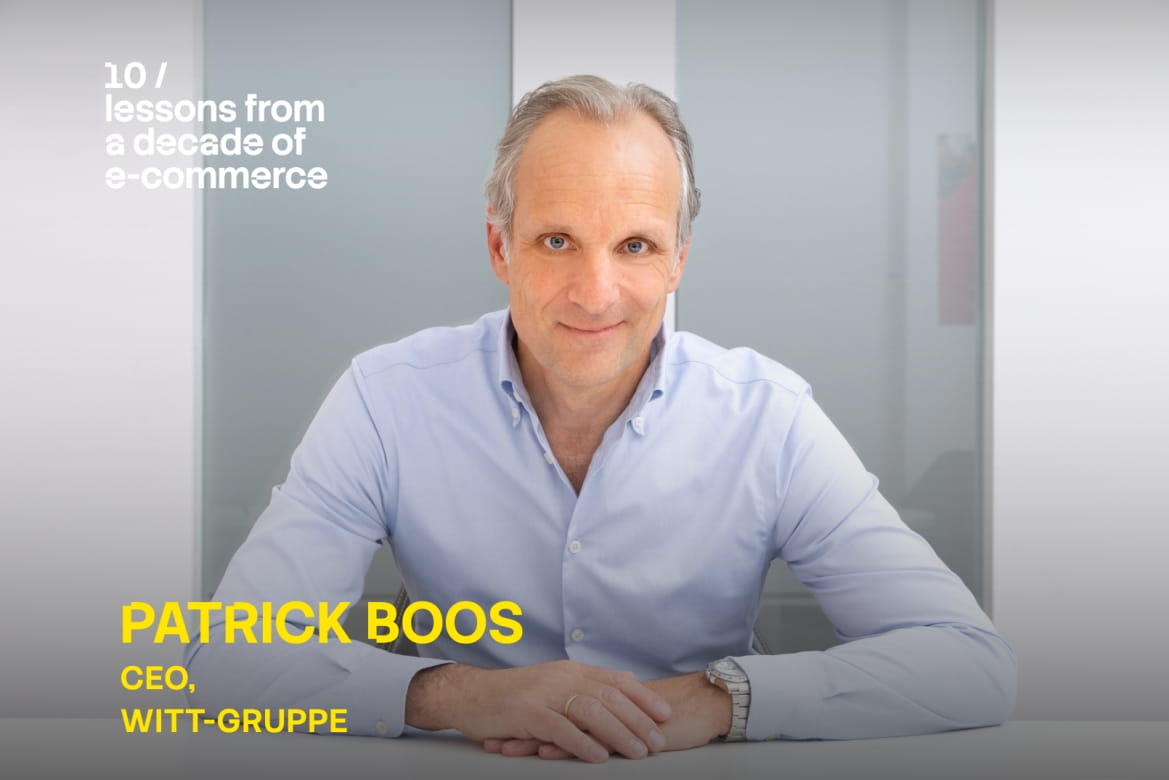
“I believe that maximizing lifetime value hinges on earning and protecting trust. This means refusing to treat the customer as a metric to be exploited”: 10 lessons from Patrick Boos, CEO of Witt-Gruppe
Written by
Editorial TeamPublished on
Discover 10 valuable e-commerce lessons from Patrick Boos, CEO of Witt-Gruppe, as he shares his insights on the future of online retail to mark the 10th anniversary of the E-commerce Berlin Expo. [EXCLUSIVE INTERVIEW SERIES]
The E-commerce Berlin Expo celebrated its 10th anniversary in 2026. To mark this milestone, we interviewed some of the world’s most influential leaders about the future of online retail, asking them to share their 10 valuable lessons in e-commerce. Their insights were featured in our special album, showcasing the most powerful voices in online retail, which we decided to share with you on E-commerce Germany News.
This time, we’re featuring an exclusive interview with Patrick Boos, CEO of Witt-Gruppe. See what e-commerce lessons he shared with us below!
BUILD FOR CUSTOMER’S PAIN POINTS, NOT YOUR OWN ASSUMPTIONS
What first drew you to this industry?
PATRICK: E-commerce first captivated me in the late 1990s, when the concept of borderless trade was revolutionary – not normal. My fascination lay in the unprecedented ability of an individual, like a German seller, to directly transact with a buyer in the United States. This democratizing power drove me to work for eBay. While the industry has since matured into a highly sophisticated global utility, the pace of continued operational and technical innovation keeps me deeply engaged and driven today.
Quote / Patrick Boos, CEO of Witt-GruppeWe used to chase traffic; now we chase relationships and retention, which is a much healthier way to build a business.
Which early failure taught you something that still guides you today?
PATRICK: Early in my career, I was convinced a product I personally loved – a technically sophisticated but niche item – had to become a massive hit. The failure was that I was selling to my own preference, not the market’s need; the product had a great feature set, but the customer didn’t care enough to pay a premium. That failure taught me the critical lesson that I am not the customer. My guiding principle today is to rigorously validate every significant decision, from product roadmap to site design, through continuous voice-of-customer feedback and data. It ensures we build for their actual pain points and desires, not our own assumptions.
When you think of the past decade of e-commerce, what do you miss – and what are you glad we left behind?
PATRICK: What I miss is the “Golden Era” of organic reach. I miss the arbitrage opportunity of the mid-2010s. There was a specific window where Facebook and Instagram CPMs were incredibly low, and organic reach was actually viable for brands without a massive paid budget. You could launch a D2C brand and scale it to seven figures purely on the back of great creativity and cheap traffic. What I’m glad we left behind is the “Spray and Pray” attribution. I am incredibly glad we left behind the lack of data sophistication. Ten years ago, attribution was a black box, and decisions were often made on vanity metrics or gut feelings. We’ve moved away from generic “growth hacking” tactics toward rigorous data modeling, customer lifetime value analysis, and profitability. We used to chase traffic; now we chase relationships and retention, which is a much healthier way to build a business.
Quote / Patrick Boos, CEO of Witt-GruppeI have seen brilliant strategic roadmaps fail simply because the team lacked the trust or agility to execute them, while I've seen “average” strategies win because the team was relentlessly aligned.
What is the single most important business lesson you have learned throughout your career?
PATRICK: The most enduring lesson I have learned is that while strategy defines the destination, culture determines the velocity at which you travel. I have seen brilliant strategic roadmaps fail simply because the team lacked the trust or agility to execute them, while I’ve seen “average” strategies win because the team was relentlessly aligned. In a fast-moving industry like e-commerce, your ability to pivot is entirely dependent on a culture of ownership and psychological safety. I now view culture not as a “soft” HR concept, but as the hard operating system that dictates a company’s efficiency. Ultimately, if your people do not believe in the mission, the best strategy in the world is just a document on a screen.
Success is built on resilience
How would you define success in e-commerce today, and how has your view of it changed over time?
PATRICK: Today, I define e-commerce success by contribution margin and customer lifetime value, rather than just top-line revenue. Early in my career, especially in start-ups, I was focused on “growth at all costs” – if our sales were doubling, I assumed we were winning. My view has shifted because the market reality has changed: capital is no longer cheap, and paid acquisition is no longer efficient. I realized that anyone can buy revenue if they spend enough on ads, but that doesn’t build a sustainable company. Now, success to me looks like resilience: Can we acquire a customer profitably on the first order? And, is our product good enough that customers return without us paying for them again? If we are growing revenue but our unit economics are negative, that isn’t success – that is just efficiently burning cash.
What do you see as the biggest opportunity in e-commerce today?
PATRICK: Not surprisingly, the biggest opportunity in e-commerce today is leveraging Generative AI to fundamentally transform the entire value chain, acting as a direct lever for both top-line revenue growth and bottom-line cost reduction. For instance, as a group of fashion brands, we see incredible potential in content creation: Generative AI will allow us to create thousands of personalized product descriptions, ad copy, and even virtual try-on images at scale, ensuring every customer sees the most relevant version of the product. With respect to the bottom line, as an example, I would name customer service: Advanced conversational AI agents can resolve high shares of customer inquiries (order tracking, returns, sizing) instantly and accurately, dramatically lowering the cost-to-serve while simultaneously improving customer satisfaction and reducing agent burnout.
What’s the most counterintuitive or unconventional thing your company does today that actually works?
PATRICK: The most unconventional thing we at Witt-Gruppe do is generate almost 80% of our revenue through printed catalogs in a digitally obsessed world. While every competitor views print as obsolete, our highly curated catalog remains the primary discovery channel for our core target of women aged 50 and over. This counterintuitive strategy works because the physical medium provides an uninterrupted, emotionally engaging browsing experience that digital channels often fail to replicate for this demographic. We treat the catalog as our most profitable storefront, which then drives high-intent traffic directly to our e-commerce platform, leading to strong conversion and high average order values.
algorithmic competition is coming
What guiding principle do you personally refuse to compromise on, no matter the trend or pressure?
PATRICK: The guiding principle I would never compromise on is transparency and ethical alignment with the customer. This is at the core of Witt-Gruppe but also within the entire Otto Group. In an industry prone to short-term tactics – like manipulative dark patterns, unclear pricing, or aggressive data collection – I believe that maximizing lifetime value hinges on earning and protecting trust. This means refusing to treat the customer as a metric to be exploited. While a quick win might come from obscuring a fee or making a cancellation difficult, I adhere to the principle that a business built on mutual respect and clarity will always achieve superior long-term retention and organic brand advocacy. Our corporate values must guarantee the customer always feels respected, not tricked.
Looking ahead, what will define the next decade of e-commerce, and how does thinking about the future make you feel – optimistic, excited, concerned, or something else?
PATRICK: The next decade will be defined by algorithmic competition, where AI-driven hyper-efficiency in logistics and pricing sets the new performance floor. I approach this future feeling excited but sober: the glass is half full, but what’s in it is harder to acquire. Direct-to-consumer (D2C) brands like us will find it significantly harder to compete on price against the massive, vertically integrated supply chains of platforms like Amazon or Chinese giants like Temu and SHEIN. Success will thus shift from optimization to differentiation, forcing D2C players to double down on community, ethical sourcing, and uniquely valuable brand experiences that algorithms cannot commoditize.
If you could leave a message for future e-commerce leaders, what would it be?
PATRICK: The message is simple: Gross revenue is a vanity metric; Gross margin is oxygen. Refuse to be seduced by the chasing of top-line GMV without a ruthless focus on the profitability of every single transaction. Your long-term success will not be defined by how much you sell, but by the health of your unit economics – specifically, ensuring your customer lifetime value is multiples of your customer acquisition cost. Do not grow at a loss; build a business that is engineered for profit from the very first sale, because in the future, only efficiency will be defensible.
PATRICK’S BIO
Patrick Boos has been the CEO of Witt-Gruppe since 2022 and has more than 20 years of leadership experience in the fields of technology, media, and e-commerce. Previously, he held leading positions at companies such as eBay, Axel Springer, and Accenture. In addition, he is involved as an investor, manager, and supporter of start-ups.