Behind the Click Podcast with Dr. Lara Day: Why live shopping formats like eBay Live may bring the human touch back to e-commerce
Written by
Editorial TeamPublished on
Can the thrill of an auction room really work on a phone screen? Dr. Lara Day, Head of eBay Live Germany, thinks so and she explains why human interaction may be e-commerce’s next big advantage in the age of AI.
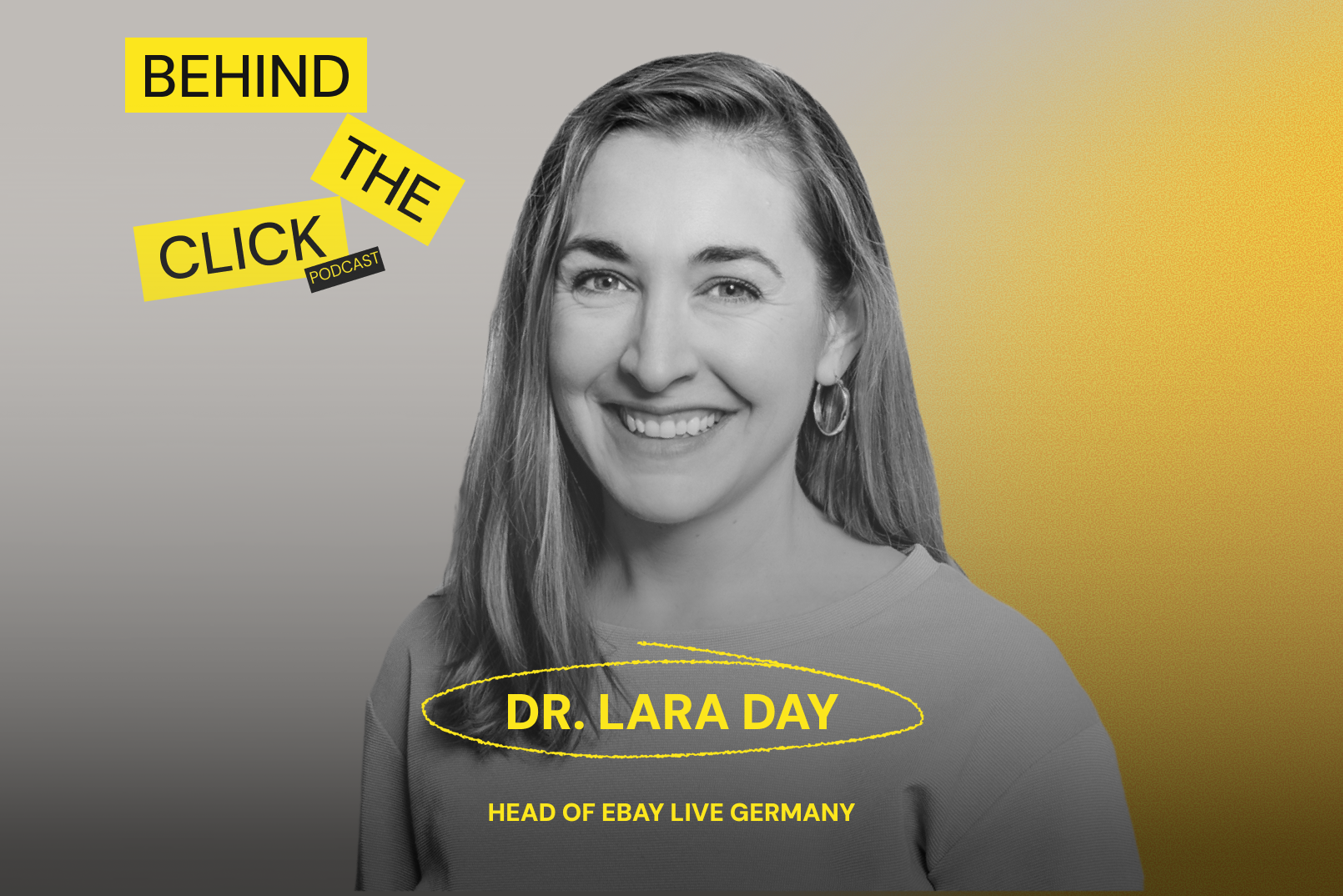
Live shopping is often discussed as another e-commerce format. For Dr. Lara Day, Head of eBay Live Germany, however, there is much more behind it: expertise, storytelling, community, and the kind of human interaction that increasingly disappears from highly optimized digital shopping journeys.
In the newest episode of Behind the Click, hosted by Janine Vanessa Heinrich, Dr. Lara Day discussed what live commerce can bring back to online shopping, how German consumers are responding to the format, and why connecting buyers directly with knowledgeable sellers could become increasingly important.
But her perspective on live shopping did not begin with e-commerce.
From art and collectibles to live commerce
Before leading eBay Live Germany, our guest worked in the art and luxury collectibles industry after completing a PhD in art and architectural history. At first glance, it might look like an unusual route into live commerce. During the conversation, however, she explained why the different stages of her career are more closely connected than they might seem.
A recurring theme is the relationship between people, objects, expertise, and stories.
Dr. Lara Day talked about the passion found within collecting communities and how deeply people can immerse themselves in areas ranging from fashion and ceramics to trading cards. For her, expertise changes the way an object is perceived: understanding how something was made, where it came from, or why particular details matter can create an entirely different level of appreciation.
That idea also helps explain what attracted her to live commerce.
Traditional auction houses have long combined an object with a story, an expert and an audience. Live shopping takes some elements of that experience and brings them onto a digital platform, where potential buyers can see products more closely, hear the story behind them and ask questions immediately.
And, as our interviewee explained in the episode, that changes the experience considerably.
Bringing the auction-room feeling online
Traditional auctions rely heavily on atmosphere. There is a room full of people, an auctioneer responding to what is happening around them, and the tension of several buyers competing for the same item.
Can that feeling really translate to a phone screen?
Day argues that it can, although the interaction looks slightly different online.
On live streams, much of it happens through the chat. Regular viewers recognize each other, sellers greet returning customers, people request products, react to auctions and celebrate when another member of the community wins something.
For her, that social element is one of the most important parts of the experience:
“It feels like people are in the same room even though it’s a virtual space.”
This is also what separates live commerce from a standard product page. Customers are not simply receiving information. They can react, ask questions and influence what happens during the stream.
Does live shopping only work for collectibles?
Collectibles may be a natural starting point because strong communities already exist around them, but Dr. Lara Day does not believe live commerce needs to remain limited to that space.
One of its strengths, she explained, is the ability to sell products that require more explanation.
For second-hand goods, sellers can show scratches, marks and other details directly to potential buyers. With new products, they can demonstrate features, answer questions and help customers understand how something works.
Our guest described this as a way to make the research phase of a purchase more immediate. Instead of searching across multiple sources, the buyer can ask follow-up questions directly while seeing the product in action.
Her view of what makes the format work is relatively straightforward:
“The driving force really is this expertise and the willingness to engage with the people who are in your show.”
During the full episode, Day and Heinrich explored what this could mean for categories well beyond collectibles, including products consumers typically spend a long time researching before making a decision.
Do sellers need a perfect studio?
From the seller’s point of view, live commerce can initially seem intimidating.
Going in front of a camera, speaking to an audience you cannot physically see and simultaneously presenting products and following a chat is not necessarily something every seller will immediately feel comfortable doing.
But Dr. Lara Day emphasized that the format does not have to look like a television production.
It is not necessarily about perfect lighting, a highly scripted show or a professional studio. Some sellers create polished productions, while others simply use a phone and walk through their warehouse, reacting to whatever interests viewers along the way.
The common denominator is authenticity and expertise.
The conversation also revealed that there is no single formula for a successful live stream. Some sellers carefully prepare a sequence of products. Others let the audience guide them and even leave the stream briefly to find something viewers have specifically requested.
How to start with live commerce formats like EBAY LIVE?
Our guest also shared practical advice for companies considering trying the format, including why testing, consistency and finding your own style matter:
- The first step, she explained, is simple: sellers reach out, go through onboarding and do a couple of test streams with the eBay team to make sure the technical basics work. After that, it’s about testing and learning to find your sweet spots, whether that’s the inventory, the pace or the time of day.
- Her advice is to try it, but to try it consistently for a while. One stream might go brilliantly or feel uncomfortable, and different people need different amounts of time to settle in. Consistency also helps build an audience: according to Day, eBay has seen that sellers who stream regularly on the same days build their community faster, because viewers know when to find them.
- Finally, she stressed the importance of knowing yourself. Some sellers can manage the chat, the products and the packing all at once, while others work better with someone monitoring the chat for them.
Is Germany ready for ebay live and live commerce?
Another major part of the episode focused on Germany.
Dr. Lara Day explained that the live commerce market here is still developing. Consumers are becoming more familiar with the format, but there is still an educational element involved.
Interestingly, she noted that the concept can sound more complicated when it is described than when someone actually experiences it. Once people see that they can watch the product, talk to the seller and ask questions directly, the format becomes much easier to understand.
At the same time, adoption cannot simply be copied from one country to another.
Heinrich and Day discussed how shopping habits and expectations differ between Germany, the UK, the US and other markets, as well as why certain product communities may adopt live commerce more quickly than the general population.
The question is therefore not only whether live shopping will grow in Europe, but what its European and German versions will eventually look like.
Human commerce in the age of AI
The conversation became particularly interesting when it turned to the future of e-commerce and AI.
Dr. Lara Day sees clear benefits in using AI to simplify operational tasks for sellers. If technology can automatically create listings or remove manual work, she sees that as a positive development.
But she also believes live commerce offers something automation cannot replicate in the same way.
As more transactions become frictionless and almost invisible, live shopping deliberately reintroduces interaction. Buyers spend time with a seller, hear the story behind a product and become more involved in the purchase itself.
This does not mean every purchase needs to become a live experience. Day instead suggests that the format may be especially relevant for products people genuinely care about and want to understand more deeply.
That idea became particularly tangible when she talked about vintage and pre-owned goods. Through a live stream, buyers can see the condition of an item, understand its history and inspect details that would be difficult to communicate through a few static images.
So, where does live shopping go from here?
Our guest is clearly enthusiastic about the possibilities, but the episode does not present live commerce as a finished model.
There are still questions around cross-border selling, shipping, local consumer preferences and the right formats for different product categories. Sellers themselves are also learning what resonates with their audiences.
That experimentation is part of the process.
And for sellers who are interested but still uncertain whether live commerce is for them, her message is uncomplicated: just try it.
WATCH THE FULL EPISODE WITH DR. Lara DAY
What makes Day believe so strongly in the format? Which types of sellers can benefit most? How can businesses encourage viewers to stay engaged? And how could live commerce develop as it expands across borders and into entirely new product categories?
For the full answers, examples and Dr. Lara Day’s perspective in her own voice and with all the nuance that can’t fit on a page, watch the complete episode of Behind the Click:
You can also listen to the episode on Spotify and Apple Podcasts.
FAQ: eBay Live
Q: What is eBay Live?
A: eBay Live is a live shopping format on eBay where sellers present products in real-time video streams. Buyers can watch the stream, ask questions in the chat and purchase items during the show.
Q: How does eBay Live work?
A: Sellers go live and show their products on camera, often telling the story behind each item or demonstrating how it works. Viewers interact through the chat, request products they want to see and can take part in auctions as they happen.
Q: What products are sold on eBay Live?
A: Collectibles such as trading cards are a natural fit because strong communities already exist around them. According to Dr. Lara Day, the format also works well for second-hand and vintage goods, where sellers can show condition details directly, and for new products that benefit from a live demonstration.
Q: Is eBay Live available in Germany?
A: Yes. eBay Live is active in Germany, where Dr. Lara Day leads the format. The German live commerce market is still developing, but she notes that once people experience a stream, the concept quickly becomes easy to understand.
Q: Do you need a professional studio to sell on eBay Live?
A: No. Some sellers create polished productions, while others simply use a phone and walk through their warehouse. Dr. Lara Day emphasizes that authenticity and expertise matter more than perfect lighting or a scripted show.
Q: What makes a successful eBay Live stream?
A: There is no single formula. Some sellers carefully plan a sequence of products, while others let the audience guide the show. The common factors, according to Dr. Lara Day, are expertise and a genuine willingness to engage with viewers, along with testing, consistency and finding your own style.