BEHIND THE CLICK PODCAST WITH MIA-MALIKA LANGE, ON How to Market a Complex Product
Written by
Editorial TeamPublished on
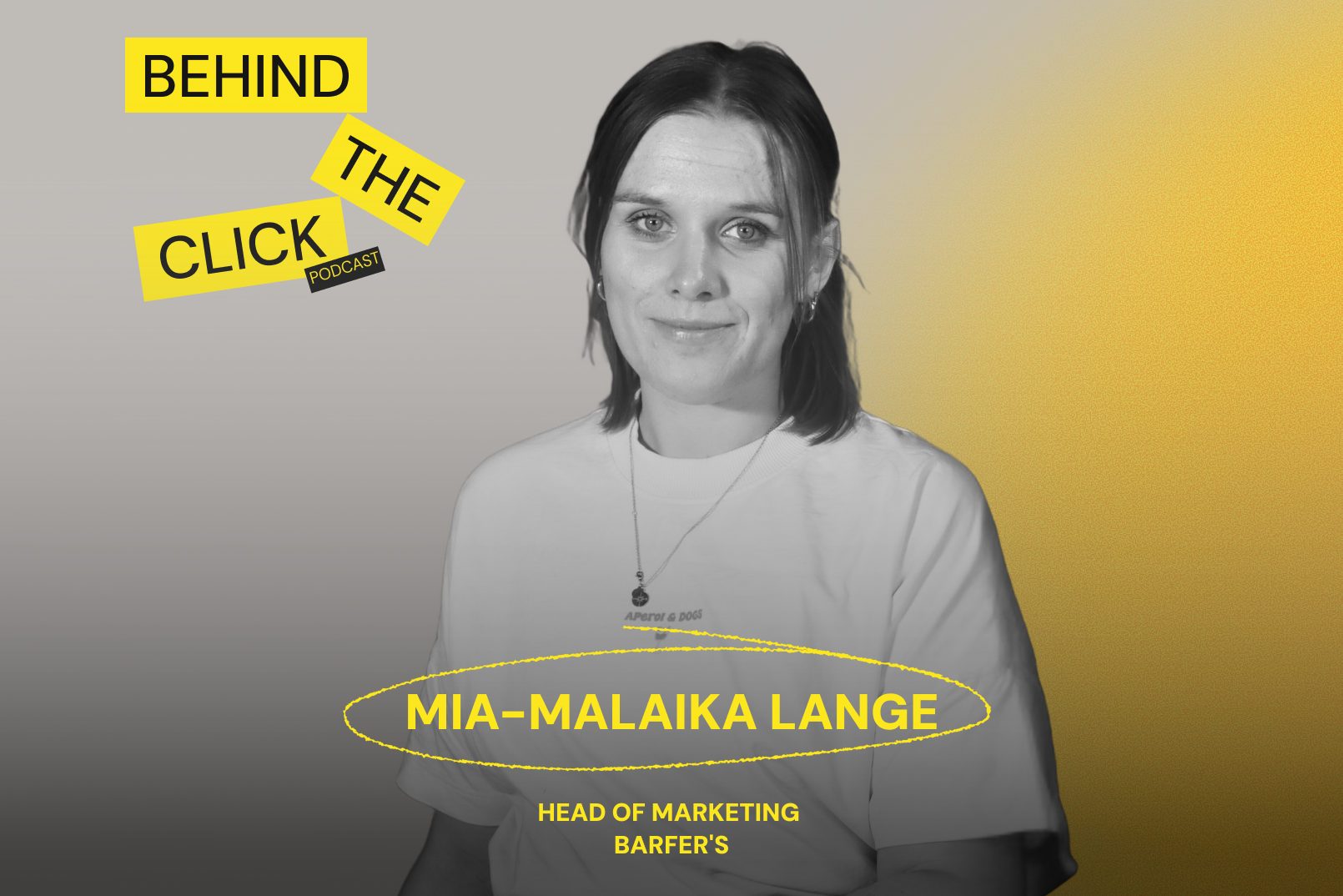
Discover how Mia-Malaika Lange, Head of Marketing at BARFER’S, explains why simplifying a complex product starts with understanding both the product and the consumer, how familiar content formats can do the explaining for you, and how to build a team that embraces testing and honest feedback, in the latest Behind the Click Podcast episode.
How do you convince someone to buy a product they don’t understand?
That was the question at the heart of the latest episode of Behind the Click, hosted by Janine Heinrich. This time, Janine was joined by Mia-Malaika Lange, Head of Marketing at BARFER’S, for a conversation that moved from raw dog food and protein powder to TikTok cat communities, Pinterest experiments, dog festivals and the culture it takes to run a team that is happy when a test fails.
And one idea kept resurfacing throughout the conversation:
Quote / Mia-Malika LangePeople do not change their dog's food because they don't understand it.
Never change a running system
Mia explained that many pet owners follow a “never change a running system” approach. Feeding is a daily habit. You know exactly how much you need, you don’t have to weigh anything, and the dog eats it. Changing that routine creates friction, and there is always one lingering doubt: will my dog actually eat the new food, and is it really better?
The core challenge is that owners cannot feel what their pet feels. If you eat more protein, you may notice that you feel stronger. With a pet, you have to be told what to look for. Some changes, such as shiny fur or healthier skin, take time and never happen overnight. Others can show up quickly, and part of the job is pointing customers towards the signs that are worth watching.
Solution seekers and customers who don’t know they have a problem
Host Janine described a model she once used at work: some people have a problem and know they need a solution, some have a problem but are not looking for one, and some don’t know they have a problem at all. According to Mia, all three groups exist in pet food.
There are solution seekers, often owners of pets with allergies. Mia noted that pets probably always had allergies, but owners are simply more aware of them now. As pets increasingly become the new kids at home, especially for double-income couples without children, owners watch for changes in fur and skin much more closely.
Then there are owners whose pet has no visible problem. BARFER’S does not want to frighten them by suggesting their pet might develop an allergy. Instead, communication has to make people aware of something that may already be there. Mia compared it to eating fast food: occasionally it is fine, but if it is all you eat, you may eventually stop feeling great.
Education and persuasion come hand in hand
Asked where education ends and persuasion begins, Mia said the two go together: persuasion can happen through education. She turned the question around and asked Janine if she had ever checked the ingredients of her dog’s food. Janine admitted she had not looked closely, because the vet had recommended the brand. She does read the ingredients of her own food, but with her dog, the expert had spoken.
She also described how hard it is to find reliable information on how much food a dog needs, or what mix of protein and grains is right. She even considered cooking for her dog, but gave up when she couldn’t work out portion sizes.
For Mia, this is a complexity game, and complexity can be reduced in two ways: through education and through the product itself.
- BARF (a raw feeding approach) started in the 1990s and is essentially meal prepping for your pet: you take the meat, bones and everything else, and prepare food every other week.
- Many owners see that as a huge barrier. BARFER’S therefore launched a complete mix that is produced for you. You defrost it and feed it, with no recipe and no prepping.
Some complexity remains, in the defrosting process and in the changeover from the old food, and this is where communication has to step in.
Fighting the curse of knowledge
Simplification, Mia said, starts within the team. BARFER’S has certified BARF nutrition experts who fact-check everything, but experts can get lost in the curse of knowledge and go far too deep. She recalled social content she was immediately sure would fail, because nobody without a BARF degree would understand it. Someone who wants to change their pet’s nutrition does not want to take a course first.
The team therefore works in three steps:
- Someone on the team creates the content.
- The nutrition experts check that it is correct.
- A team member who is a real pet owner, but not deep into the topic, checks that a customer can actually understand it.
Over time, even Mia has become one of the experts after three and a half years, which makes it harder to challenge messages. Her answer is to ask new team members, who bring a fresh view, and to run small tests with colleagues outside the marketing team: do you understand this content piece, or are we losing you?
Simplify complex products by borrowing formats people already understand
Mia’s academic background helped here. Having studied sociology, she draws on Niklas Luhmann’s systems theory, which says that complexity can be reduced by using patterns that are already familiar. In marketing, that means borrowing formats that already exist on the web and work for other creators.
The best example is the meal prep video, a huge format on TikTok. It starts with stacked boxes, everyone knows how it works, and it can then dive into the recipes. BARFER’S uses the same hook and explains how meal prepping for a pet works. Funnily, this took the team back to the basics of BARF, while the product that is eventually sold is the complete mix that needs no prepping. The video helps to explain what is inside.
The second important point: you don’t go deeper with every content piece. Stay at a certain level of depth, repeat yourself, and break the topic down through different formats.
From cute dogs to expert content on TikTok
BARFER’S began on TikTok with cute dog content. It was easy to produce, since many team members have pets. But those videos could not differentiate the brand from dog influencers or private users, and they explained nothing about the product.
What worked was a niche of explanation content, which did two things:
- It positioned BARFER’S as the BARF expert, which matters in a category where pet food is always a trust game.
- It created hook-worthy content with a decent thumb-stop ratio, using formats such as “what I eat in a day” and meal prep, and then explained the product.
The team also tapped into the cat community on TikTok, which Mia said is stronger than the dog community. Because BARF for cats was not yet big, BARFER’S was one of the first to launch a cat complete mix in the raw segment. That led to some viral hits.
A culture of testing: data, fixed frames and permission to fail
To make this work, Mia relies on several things:
- Data literacy: everyone on the team has access to the BI tool and can pull the data they need for their own hypothesis.
- Hypotheses and fixed test frames: the team works with OKRs on a quarterly basis. A test gets a defined time frame of about three months to set up, run and evaluate.
- A real feeling that failure is okay: a failed test is a learning, and the team knows for the future what does not work.
- Ownership: team members decide for themselves what they test. Ideas can come from other teams or from Mia, but the team has the final say, which creates buy-in.
What failed, what worked
Pinterest organic (failed). The assumption was that people who scroll for recipes might also scroll for recipes for their pet. But the static recipe content stayed on the complex side of the product, with no chance to explain that BARFER’S does it for you. Showing the finished product, on the other hand, felt like an ad played out organically. The test took at least one OKR cycle. Because the frame had been fixed in advance, stopping was fine for everyone, including the manager who loves Pinterest and was invested in it.
TikTok (worked). BARFER’S tested it organically, with no active campaigns, while promoting products for cats. The post-purchase survey then showed new customers referring to TikTok. That validated the hypothesis and led to campaigns on the platform.
A dog festival (worked). The team went offline, sold products in person and handed out voucher codes, and sales from the festival then came in online. Mia highlighted the direct contact with consumers, learning about their problems and their thoughts on raw feeding. With nutritionists on site and enthusiastic marketers in front of them, the team could build the kind of trust that sits between an online ad and a vet. And to Mia’s surprise, every dog ate the dog ice cream on the spot.
Understand the product, understand the consumer, then simplify
Asked for the first step for a marketer with a complex product, Mia’s answer was that there is really only one, and it has two parts:
- Understand your product to the core. You should not sell something you don’t understand yourself.
- Understand your consumer to the core. That includes their daily habits, such as when they feed their pet, and the barriers that could stop them from buying. As Mia put it, as someone who sells frozen goods, solutions sometimes come with barriers too.
If you have someone on your team who understands both, she said, keep them. Only after that comes the third step: reducing the complexity.
The market ahead
Looking forward, Mia believes the pet market is already changing drastically. New players are coming in, and it is no longer just raw: cooked food and kibble are growing too. Pet supplements are also growing strongly, and she joked that she has yet to see a big online store for fish supplements.
The recurring message across the episode is consistent: know your product, know your customer, and only then make the complex thing simple.
FAQ: Marketing complex products
How do you market a complex product?
Start by understanding the product and the consumer to the core, including their habits and the barriers that could stop them from buying. Only then reduce the complexity, for example by using content formats people already know.
What is the curse of knowledge in marketing?
It happens when experts know so much that they explain things too deeply. At BARFER’S, nutrition experts check the facts, and a team member who is not deep into the topic checks that customers can understand the content.
Why did BARFER’S launch a complete mix?
BARF means meal prepping your pet’s food, which many owners see as a huge barrier. The complete mix is produced for the customer, who only has to defrost and feed it.
How does BARFER’S use TikTok?
The team moved from cute dog videos to explanation content, such as meal prep and “what I eat in a day” formats, and tapped into the cat community. A post-purchase survey showed new customers coming from TikTok.
Watch the full episode with Mia-Malaika Lange
The full conversation goes much deeper into complexity reduction, content formats, team culture, testing and the future of pet food. To hear Mia explain it in her own words, watch the complete episode of Behind the Click:
You can also listen to the episode on Spotify and Apple Podcasts.