“Don’t confuse activity with progress”: 10 lessons from Dorit Posdorf, Chief Digital Officer of Maniko Nails
Written by
Editorial TeamPublished on
Discover 10 valuable e-commerce lessons from Dorit Posdorf, Chief Digital Officer of Maniko Nails, as she shares her insights on the future of online retail to mark the 10th anniversary of the E-commerce Berlin Expo. [EXCLUSIVE INTERVIEW SERIES]
The E-commerce Berlin Expo celebrated its 10th anniversary in 2026. To mark this milestone, we interviewed some of the world’s most influential leaders about the future of online retail, asking them to share their 10 valuable lessons in e-commerce. Their insights were featured in our special album, showcasing the most powerful voices in online retail, which we decided to share with you on E-commerce Germany News.
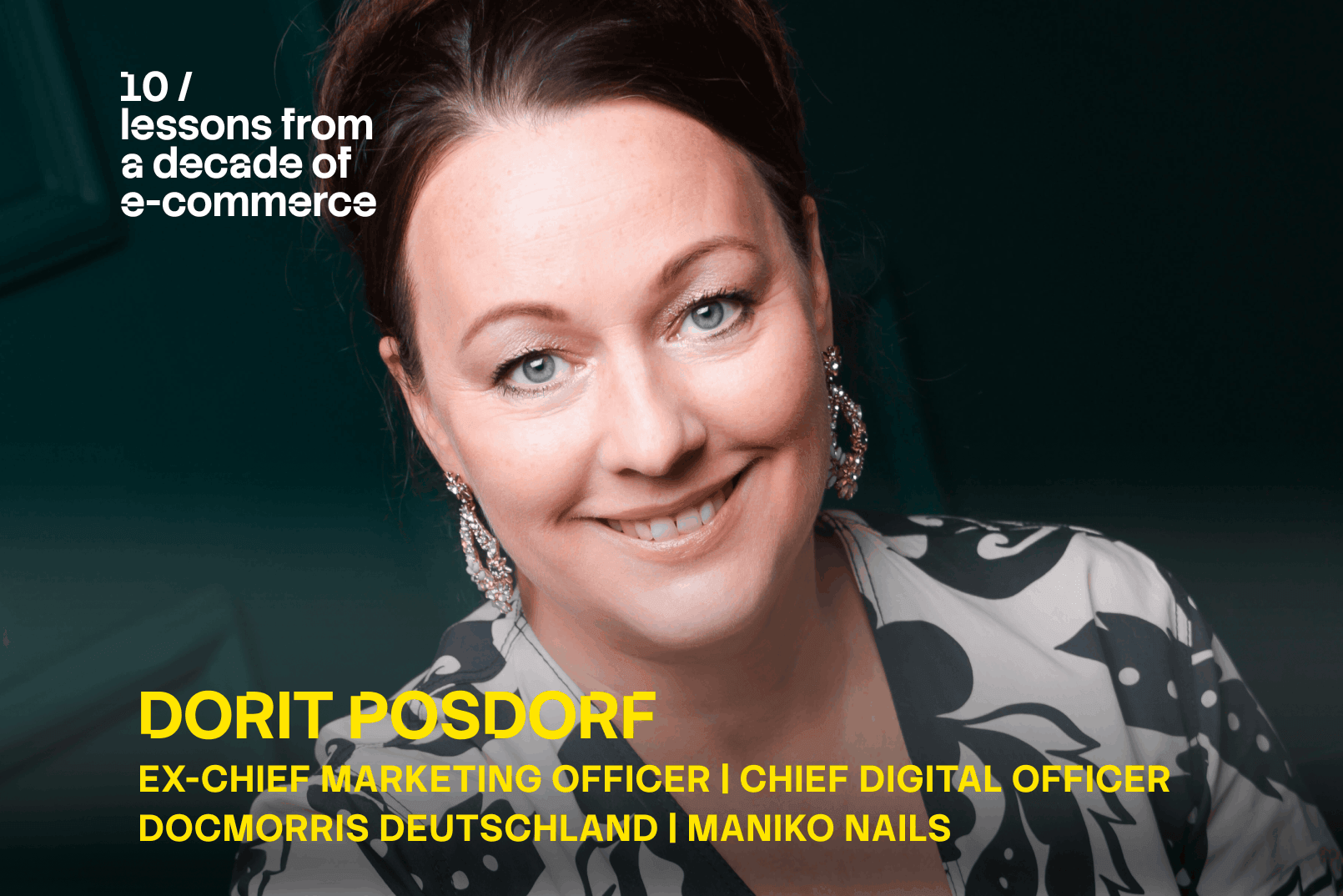
This time, we’re featuring an exclusive interview with Dorit Posdorf, Chief Digital Officer of Maniko Nails. See what e-commerce lessons she shared with us below!
The interview took part at the end of 2025, while Dorit Posdorf was Chief Marketing Officer of DocMorris Deutschland
Take good care of your data
What first drew you to this industry?
DORIT: What drew me to e-commerce was the clarity with which customer behavior and business outcomes connect. Already during my years in consulting, I saw how digital models allow you to test ideas quickly and base decisions on real data rather than assumptions.
When I moved into operational roles, I appreciated that improvements in product, pricing, or user experience could be measured almost immediately and that this transparency drives better decisions. I was also interested in how technology reshapes established markets, not as a buzzword, but as a practical lever to simplify processes for customers.
Over time, the combination of problem-solving, measurable impact, and continuous iteration became the kind of work environment in which I felt most at home. Ultimately, e-commerce attracted me because it’s one of the few industries where curiosity, creativity, and analytical rigor have equally strong seats at the table.
Which early failure taught you something that still guides you today?
DORIT: One learning that still guides me today is how easy you can get lost in measurement if lots of data is available. And that data can also hamper decision-making processes. In one of my first digital projects, we had dozens of KPIs and even more interpretations of what “success” actually meant. Because we hadn’t aligned upfront on the few metrics that truly mattered, every review turned into a debate about definitions rather than decisions. The initiative itself wasn’t unsuccessful, but the lack of clarity cost us time, focus, and credibility.
Since then, I’ve learned that in e-commerce, where everything can be measured, you must be very selective about what should be measured. Today, I insist on defining success criteria, data sources, and thresholds before a project even starts. Clear gateways to success avoid endless reinterpretation afterwards and give teams the confidence to move forward with discipline rather than noise.
Quote / Dorit Posdorf, Chief Digital Officer of Maniko NailsIn e-commerce, it’s easy to get distracted by new channels, new tools, and constant market noise, but without a clear focus, even strong teams dilute their energy.
When you think of the past decade of e-commerce, what do you miss – and what are you glad we left behind?
DORIT: What I sometimes miss from the earlier years of e-commerce is the greater sense of control in day-to-day decision-making. Testing was simpler because there was less fragmentation in channels, fewer data-privacy constraints, and no AI systems influencing outcomes in ways that are not always fully transparent. You could run a test, see the effect, and understand quite clearly why something worked. Today, parts of the decision process are delegated to algorithms, which brings efficiency but also creates distance, and, at times, the feeling of giving up control.
What I’m glad we left behind, though, is the belief that growth automatically solves structural problems. Too many businesses relied on ever-increasing marketing budgets without building the operational discipline needed to scale sustainably. Today, with better tools, better data, and a more mature understanding of unit economics, the industry has moved away from “growth at any price.” The shift toward profitability, customer lifetime value, and operational excellence creates healthier businesses and ultimately better customer experiences.
What is the single most important business lesson you have learned throughout your career?
DORIT: The most important lesson I’ve learned is that focus creates impact. Across different roles and business models, the moments when we delivered the strongest results were always the ones in which we committed to a small number of priorities, aligned the entire organization behind them, and protected teams from unnecessary complexity. In e-commerce, it’s easy to get distracted by new channels, new tools, and constant market noise, but without a clear focus, even strong teams dilute their energy.
I’ve seen repeatedly that disciplined prioritization is key to success: fewer initiatives, executed well, move the business further than broad but shallow activity. This applies to strategy, to teams, and to personal leadership. Whenever I’m unsure, I return to the same question: what truly shifts the outcome for customers and for the business? Everything else is secondary.
Steadiness is the key
How would you define success in e-commerce today, and how has your view of it changed over time?
DORIT: Today, I define success in e-commerce as the ability to create sustainable customer value while running a business with healthy economics. It’s no longer enough to grow fast or launch new features. Success means understanding who your core customers are, what problem you truly solve for them, and how you do that efficiently at scale.
Earlier in my career, I was more focused on growth metrics: traffic, conversion, top-line acceleration. Over time, especially through roles where I owned full P&L responsibility, my view shifted toward long-term contribution margins, retention quality, and operational excellence. Sustainable success now comes from disciplined prioritization, strong cross-functional execution, and a clear understanding of lifetime value. It’s less about chasing every opportunity and more about mastering the few that really matter.
Quote / Dorit Posdorf, Chief Digital Officer of Maniko NailsThe principle I refuse to compromise on is steadiness. What I mean by that is maintaining consistency in goals and decisions, even when the environment becomes noisy.
What do you see as the biggest opportunity in e-commerce today?
DORIT: The biggest opportunity in e-commerce today comes from using AI to rethink how we operate, not by personalizing everything to the extreme, but by improving the quality and efficiency of the core levers we already have. AI allows us to create and adapt content for channels in a way that is faster, more relevant, and significantly more cost-effective. It also helps us understand customer intent with greater precision, which means we can design journeys that feel more intuitive without pretending that every individual needs a completely unique experience.
Beyond this, AI opens the door to entirely new business models that go beyond the traditional “sell a product online” logic. In many categories, including health, beauty, home services, and more, digital services, automated guidance, and intelligent decision-support can create value long before a transaction happens. Companies that use AI to build these kinds of service-led ecosystems will have a much stronger and more defensible position in the market.
To me, the real opportunity lies in expanding what e-commerce can be, not just optimizing what it already is.
What’s the most counterintuitive or unconventional thing your company does today that actually works?
DORIT: A development that I consider a game-changer is shifting the digital presence toward a true service ecosystem rather than treating it only as a conventional online shop. The focus is still on short-term transactions but equally now also on guiding customers through their journeys with clearer processes, better information, and digital services that address real needs. This approach changes how one has to prioritize product, content, and commercial decisions: instead of optimizing for individual transactions only, the design and the experience need to be in a manner that customers feel supported throughout their interaction. This shift requires disciplined product thinking and close collaboration across tech, commercial, and marketing teams, but it consistently leads to higher satisfaction and stronger long-term engagement. By improving the underlying processes rather than relying on temporary levers, one creates a more stable and scalable foundation for growth.
STAY CURIOUS AND DISCIPLINED
What guiding principle do you personally refuse to compromise on, no matter the trend or pressure?
DORIT: The principle I refuse to compromise on is steadiness. What I mean by that is maintaining consistency in goals and decisions, even when the environment becomes noisy. E-commerce is full of shifting priorities, new tools, and constant pressure to react quickly. But teams need reliability to do their best work. For me, that means setting a clear direction and then sticking to it long enough for the organization to execute with confidence. I try to avoid the pattern of changing course every time a new trend appears or a number fluctuates.
Steadiness doesn’t mean ignoring new information; it means integrating it thoughtfully rather than impulsively. Especially in a world where automation and AI accelerate the pace of change, this kind of calm, consistent decision-making becomes even more important. It allows teams to move with purpose and to recalibrate with peace. Like this, you build a culture where people know what they can rely on and where they feel confident and empowered to do their job.
And that is what you need in the end: an empowered team!
Looking ahead, what will define the next decade of e-commerce, and how does thinking about the future make you feel – optimistic, excited, concerned, or something else?
DORIT: I believe the next decade of e-commerce will be shaped by a move toward (self-) service-driven digital ecosystems, supported by AI that streamlines decisions, content creation, and customer journeys. Efficiency and operational discipline will matter just as much as experience, because the businesses that master both will define the competitive landscape.
Thinking about the future makes me cautiously optimistic, but not without concerns. The increasing consolidation of platforms and the decline of pluralistic market environments will challenge us far beyond operational questions. A diverse media and commerce landscape is essential for a healthy democratic society because it allows different voices, business models, and perspectives to coexist. As the industry evolves, we need to ensure that innovation doesn’t come at the expense of diversity and that technology strengthens choice rather than narrowing it.
If you could leave a message for future e-commerce leaders, what would it be?
DORIT: My message would be: stay curious and stay disciplined. E-commerce will continue to evolve quickly, and technology will open new possibilities at a pace that can feel overwhelming. The best leaders will be those who explore these opportunities without losing sight of the fundamentals: clean processes, sound economics, and a clear understanding of the problem they are solving for customers.
Don’t confuse activity with progress. Build organizations that think calmly, execute reliably, and resist the urge to change direction with every new trend. And remember that leadership in this industry comes with societal responsibility. The strength of our democracy depends on diverse media and commerce ecosystems that allow different voices and business models to exist. Future leaders should actively support this diversity, because innovation means little if it narrows choice instead of expanding it.
DORIT’S BIO
Dorit Posdorf is a seasoned strategist and digital transformation expert. With over ten years of experience, she has previously heldcommercial leadership roles at Flaconi, Outfittery, and ProSiebenSat.1, where she focused on digital commerce and marketing strategies. Dorit is passionate about integrating technology into the fashion and healthcare sectors, emphasizing the importance of human-machine collaboration in driving innovation. She holds a degree in economics from Cologne and has a proven track record of successfully transforming businesses, including significant contributions to the digitalization of the healthcare system in Germany.
See Dorit’s LinkedIn profile here.