Case study from Chinese e-commerce: How Youzan uses AI to turn one-time buyers into repeat customers
Discover how Youzan uses unified customer data and AI to turn one-time buyers into loyal repeat customers across stores and e-commerce platforms in China. Bonus: Want to see models like this live in China? Learn more about the trip with E-commerce Berlin Expo and Expanding Together at the end of article.

Written by Zheng Xu
What if you could stop paying for influencers and ads again and again, and let an AI system turn first-time buyers into repeat customers instead? That is not a hypothetical. It is the working model behind Youzan, a Chinese e-commerce SaaS solution for vendors. This case study breaks down how one of its clients called Zhou Hei Ya, a snack brand with more than 3,000 offline shops and a presence on 22 e-commerce platforms, made it work by finally recognizing the same customer across every channel.
The mechanics are worth studying closely because the problem Youzan solves is one most Western retailers still live with every day.
What is Youzan?
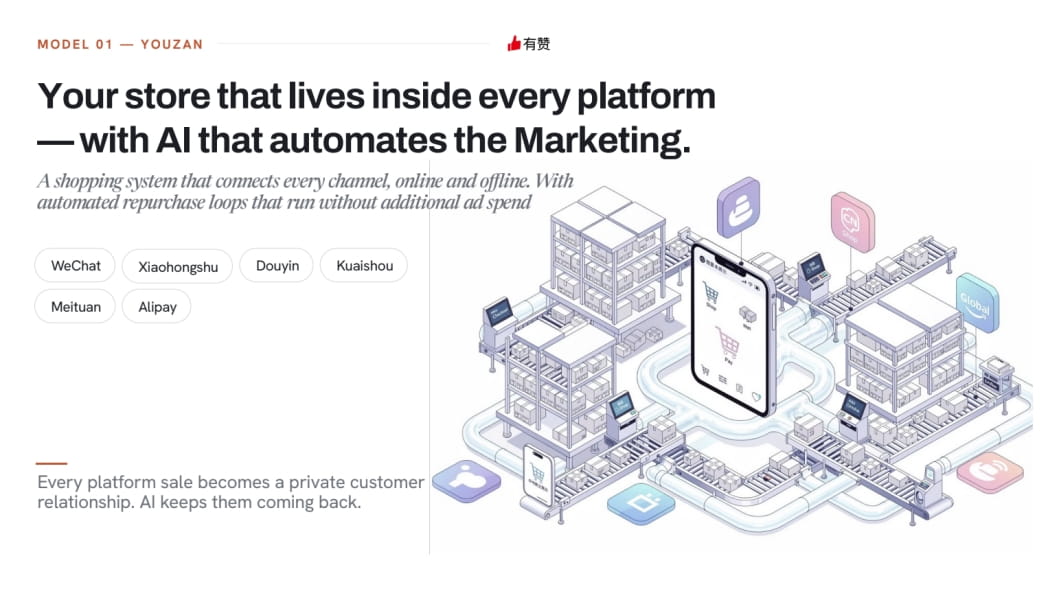
The simplest way to describe Youzan: think of a Shopify-like system that lives inside all the sales channels at once. The company, based in Hangzhou, China, started online and later expanded into offline retail. Today it uses AI to help brands optimize every channel, manage customer engagement, and run the marketing for each funnel.
To understand why such a system exists at all, you need one piece of context about Chinese e-commerce. China doesn’t have 3 or 5 e-commerce platforms, there are more than 20, because there is no clear line between social media and shopping apps. Every platform is its own ecosystem, built around the same loop: discover, engage, buy. You can imagine how hard it is for a brand that wants access to potential customers across all of them.
Youzan’s answer is one platform and one set of data. On top of that, it designed a system that turns sales on each platform into a private customer relationship – what in China is called the brand-owned private domain – and then lets AI keep bringing those customers back.

The client: 3,000 offline shops, 22 e-commerce platforms, one marketing headache
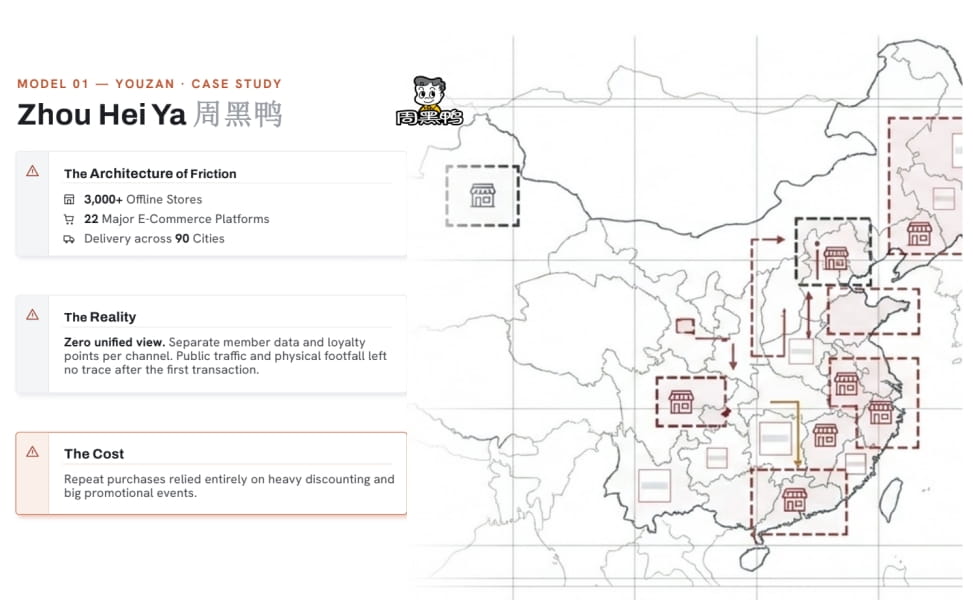
The case that illustrates this best is a very Chinese brand you have probably never heard of: Zhou Hei Ya, a maker of duck snacks, spicy, salty, sweet, that Chinese consumers love. The brand runs more than 3,000 offline shops across the country, operates on 22 major e-commerce platforms, and delivers from its own factories to more than 90 cities in China.
Anyone with CRM experience who has worked on a marketing team for a company like that knows the headache. With zero unified view, you can’t track your customers. You spend heavily on paid ads and influencers to promote the product and after one purchase, especially a physical in-store transaction, the customer is simply gone. There is no system to follow them, and that costs a lot, because every repeat purchase ends up relying on discounts or big promotional events.
The same person could buy in a shop in Shanghai, then on Taobao, then on Xiaohongshu and look like three different strangers. This was the reality for Zhou Hei Ya before they met Youzan.
Step 1 integration: one database, one customer
Youzan’s starting point was blunt: this brand already had a huge database and enormous traffic touchpoints – it just couldn’t use them. So the first step was to integrate the physical stores, rebuild the system, and implement it across all the platforms.
The result is one database in which all customer data is united. Whether a customer buys in the Shanghai shop, on Taobao, or on Xiaohongshu, the database represents them as one client. Everything that follows in this Chinese AI e-commerce model depends on that single move.
Step 2 pulling customers into the private domain
Once the data is unified, every action can be turned toward one goal: attracting those customers into the brand’s own private domain.
Why does this matter? Because inside the private domain, the AI can send activities, run promotions, and chat with customers without re-spending on ads and without paying influencers to bring the same people back into the store.
Step 3 AI marketing that recognizes the customer everywhere
At this point Youzan can read customer behavior across all platforms and every store, then automatically trigger the right action for each segment:
- a new buyer gets a 7-day automated coupon push to secure the second purchase,
- a dormant user receives a 30-day reactivation discount to halt churn,
- a high-value member gets exclusive access and product priority.
No campaign team manually decides who gets what. The system makes the decision itself based on data.
The results: one database, all sales channels integrated, the same customer.
What happens when one database lets every channel recognize the same customer? For Zhou Hei Ya the numbers speak clearly:
- +479% private domain repurchase rate,
- +210% dormant user reactivation rate,
- +32% member annual spend per customer,
- 15% of total brand revenue now comes from the private domain after two years.
That last figure deserves a pause. Fifteen percent of total revenue, on a base of 3,000 offline stores and 22 online platforms, is huge and it saves the money that would otherwise go into ads and influencer promotions again and again.
The takeaway for Western e-commerce
Western retailers may not have 22 platforms to reconcile but they have the same underlying problem: the customer who buys through three different channels looks like three different strangers and isn’t recognized as the same buyer.
The Youzan case doesn’t work because of any single clever AI feature, it works because everything is built on one move: recognizing that those three strangers are one person. Once that unified view exists, the AI layer on top almost writes itself, deciding who gets a second-purchase nudge, who needs reactivating, and who deserves VIP treatment, all without a campaign team guessing.
The lesson isn’t “buy a special AI e-commerce solution”. It’s that most Western brands are trying to automate retention on top of fragmented data, and no amount of AI can recognize a customer it can’t see. Unify the customer first; the repeat-purchase economics that let Zhou Hei Ya stop re-buying the same customers through ads and influencers only become possible after that.
See it live: where models like this are being built
It is, of course, important to know about the trends and innovative concepts happening in China. But real power comes from access – seeing these systems yourself, talking with the teams, and hearing what they’re thinking, instead of simply reading reports and case studies. Marketplaces like Shein were the first wave. The next one is being built right now, by people most European companies have never met.
That is why E-commerce Berlin Expo and Expanding Together are organizing the E-Commerce Networking Trip: seven days in Beijing, Shanghai, and Hangzhou (Youzan’s home city) in November 2026, bringing Europe’s e-commerce community into direct contact with the people building China’s next wave.
If Chinese AI e-commerce models like Youzan’s are something you would rather see live and in context than in a slide deck, this is something you could consider.
What you can expect at the trip:
- no factory tourism and generic show sessions – instead closed-door conversations with operational decision-makers, exclusive networking sessions with potential partners, and a fully tailored programme built around who’s in the room,
- all networking sessions run in German and English with professional interpreters throughout,
- a lot of inspiration from seeing models 2-3 years ahead of Europe, live and in context,
- a concrete action plan for your business for the 30-90 days after you land back in Europe.
Are you interested in joining us?
About the author

Zheng Xu is an International Expansion Architect with 18 years of Germany-China experience, architecting strategic relationships across cultural boundaries systematically, authentically, and with long-term impact.