How Community, Content & AI Search Are Driving Conversion at Sallys Shop
Boosting conversions with AI-powered search: See how Sallys Shop used community language, guided discovery, and personalised search to achieve a 70.8% search-to-click rate and increase search-driven conversions by 30.8%. (Ad)

Case study
You watch a baking video. Sally makes it look effortless – the round ceramic pan, the vanilla extract, the piping bag. You think: I want that. So you open her shop, ready to recreate the recipe yourself.
That’s the power of content-driven commerce. Inspiration turns directly into action.
But when a brand grows to offer hundreds of products, ingredients, tools, and recipes, the shopping experience needs to scale with it – staying simple and intuitive even as the catalogue expands. For Sallys Shop, the baking and lifestyle brand built around Sally Özcan’s 2.19 million YouTube subscribers and 1.3 million Instagram followers, that became the defining challenge of growth.
Together with Doofinder, they optimised exactly that.
The result: a 70.8% search-to-click rate – roughly double the average of similar search platforms – alongside a +29.5% month-on-month lift in average order value and a +30.8% improvement in search-driven conversion.
Here’s how they did it.
Sallys Shop Is Not a Typical Online Store
Most e-commerce brands start with a product catalogue and build an audience. Sallys Shop did it the other way around.
Sally Özcan spent years creating content – 4,000+ recipes, 9 books, videos watched by millions – before the shop became a serious revenue channel. The community came first. The commerce followed.
That’s a powerful foundation, but it creates a structural tension: content builds desire, but desire alone doesn’t convert.
When a viewer finishes watching a birthday cake tutorial and clicks through to the shop, they arrive with inspiration, not a shopping list. They don’t necessarily know the product name, the category, or even what they need. They just know they want to bake that cake.
If the shop can’t bridge that gap – turning vague intent into a confident purchase – the moment is lost.
The Three Problems That Blocked Conversion
When Sallys Shop started working with Doofinder in 2023, three friction points stood out:
1. The inspiration-to-purchase gap. The jump from YouTube to the shop created an orientation break. Users arrived engaged but immediately faced a large, unfamiliar product catalogue with no clear path forward.
2. Decision fatigue from a large assortment. With hundreds of baking tools, ingredients, tableware, kitchen machines, and lifestyle products, too much choice became an obstacle. Users couldn’t find what they were looking for — or weren’t sure what they were looking for in the first place.
3. The gap between customer language and catalogue. Shoppers often searched using the language they were familiar with from Sally’s content and community. For example, many users searched for “Sallys Lieblingstasse” after seeing Sally use her favourite mug in videos and social media content. However, the actual product was listed as “Bauchtasse”, a German term for a belly-shaped mug.
The insight the team landed on was clear: the customer journey was breaking at the moment of decision.
The fix wasn’t more products or more content. It was smarter search.
Search as a Strategic Growth Lever
Rather than treating search as a utility feature, Sallys Shop repositioned it as the core connector between inspiration and purchase. Doofinder was implemented not just to return results, but to actively guide users through the decision-making process.
The integration was plug-and-play – no dedicated development resources required – and was designed to fit seamlessly into the Sallys brand experience on Shopify.
Here’s what that looked like in practice across six key features:
Guided Search: Reducing Cognitive Load
When a user searches for “Torte” (cake), they don’t want 127 results dumped in front of them. They want to be asked: What kind? A decorating set? A cake board? A mould?
Doofinder’s Guided Search presents visual category filters at the top of results – Sets, Modelling Clay, Nozzles, Cake Boards – before users even scroll. Fewer searches, fewer doubts, more confident decisions.
Synonym Understanding: Speaking the Community’s Language
Sally’s community has its own vocabulary. “Lieblingstasse,” “Bauchtasse,” “Belly Mug” – three names for the same product, all used by real customers. A traditional search engine trained on product catalogue terms would fail all three.
Doofinder’s synonym engine learns how the community actually speaks and maps informal or community-specific terms directly to products. The search adapts to the user, not the other way around.
AI Personalisation: The YouTube Effect in the Shop
YouTube gets better the more you use it. Every video watched, every like, every skip trains the recommendation engine. Doofinder brings the same logic to product search: the more a user interacts, the more relevant the results become.
This personalisation layer means repeat visitors see a search experience that feels tailor-made – exactly the continuity of experience that builds loyalty.
Multi-Indexing: Where Recipes Meet Products
One of Sallys Shop’s strongest assets is its recipe library. Multi-indexing allows that content to live alongside products in the same search experience. A user searching for “Brot” (bread) might see bread-baking recipes, bread-baking mixes, and loaf tins – all in one unified result.
Context drives decisions. When inspiration and purchase options appear together, the conversion path shortens dramatically.
Custom Results and Banners: Search as a Marketing Channel
When a user searches “Pfanne” (pan), they see not just product results but a targeted banner promoting a current campaign. Search results can be deliberately shaped to direct purchase intent toward strategic priorities – new arrivals, seasonal items, higher-margin products – without disrupting the user experience.
Analytics: Search as a Real-Time Intelligence Layer
Perhaps the most underrated aspect of the Doofinder integration is what it reveals about customer intent. The search analytics dashboard shows in real time:
- What users are searching for (top terms, volume, CTR)
- What they can’t find (zero-result searches)
- What they click after searching (clicked results by product)
- What they compare or ignore
For Sallys Shop, this data became a strategic asset. Search terms like “emaille” (enamel, searched 745 times with 69.9% CTR) revealed product demand that could inform sourcing decisions, recipe content prioritisation, and campaign planning. The shop doesn’t just sell to its community – it now listens to it at scale.
The Results
The impact of repositioning search as a core part of the customer journey – not a secondary feature – was significant.
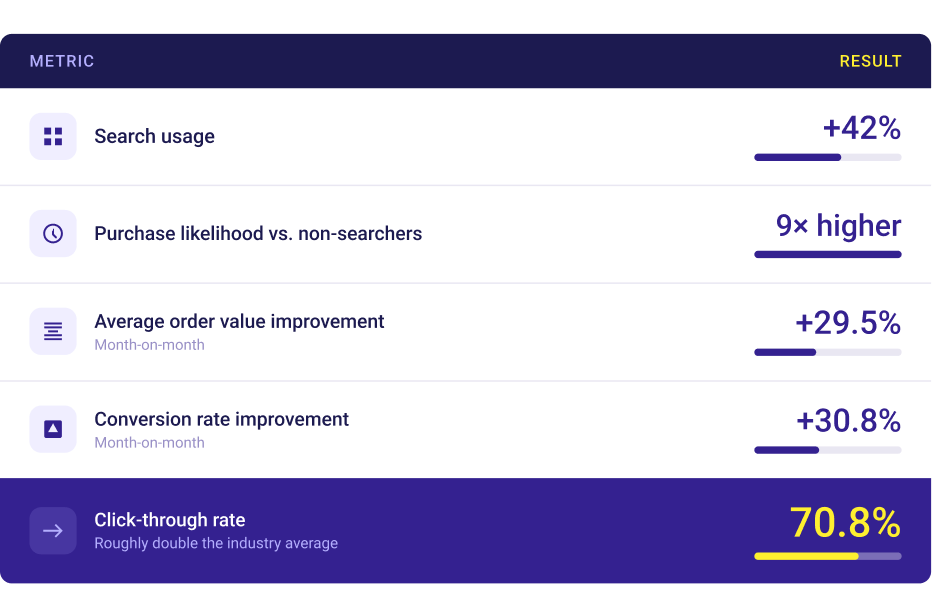
Customers who use search are nine times more likely to complete a purchase. That single figure captures what the whole strategy is built around: getting people into the search bar isn’t a vanity metric. It’s the single highest-leverage moment in the journey.
👉 Try Doofinder free for your shop
What’s Next: The Doofinder AI Assistant
The Sallys Shop case study demonstrates what AI-powered product search can do. But search is only one half of the discovery challenge. The other half is the conversation that happens before a user knows what to search for.
That’s where Doofinder’s newly launched AI Assistant comes in.
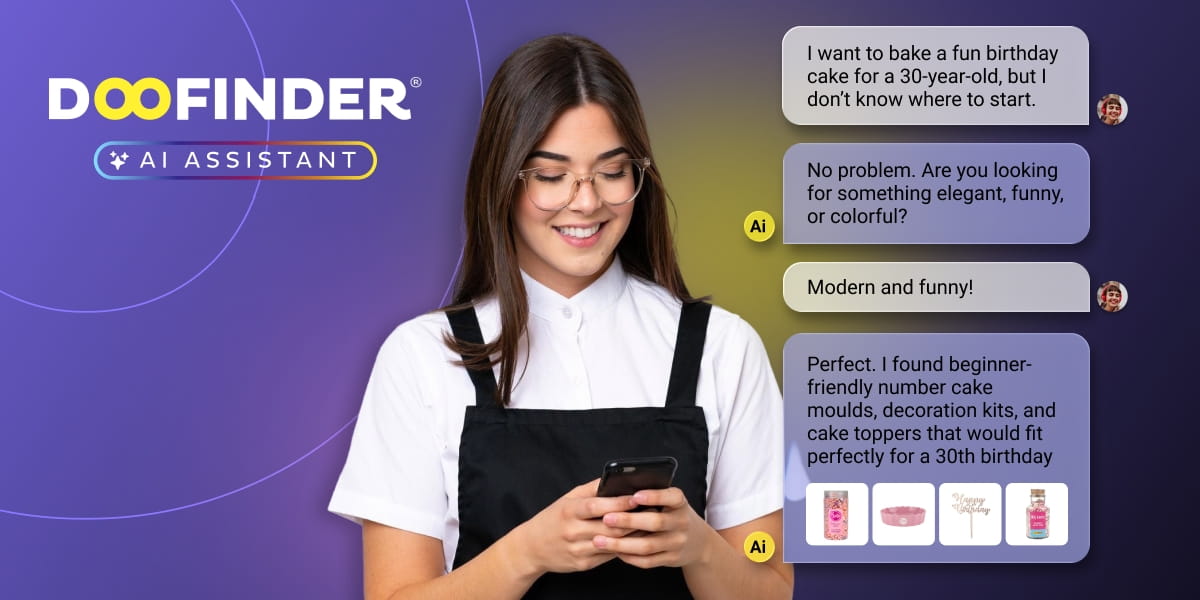
Traditional search requires users to already have a term in mind. But what happens when a customer thinks: “I want to bake a fun birthday cake for a 30-year-old — where do I even start?”
The AI Assistant handles exactly this. Instead of typing “birthday cake mould,” a user can simply describe what they’re looking for in natural language — the way they’d ask a knowledgeable shop assistant. The AI responds conversationally, clarifies what they need, and surfaces the right products from the shop’s own catalogue.
Key capabilities of the Doofinder AI Assistant:
- Conversational experience: Users describe their need; the assistant asks clarifying questions and narrows down recommendations step by step.
- Human-like interactions: The exchange feels like chatting with someone who knows the shop — not like using a search bar.
- Contextual product comparison: The assistant can surface multiple options and explain the differences, helping users make a confident choice.
- Shop-only knowledge: The assistant draws exclusively on the shop’s product data and catalogue — no hallucinated results, no external distractions.
The shift this represents is fundamental. Search has always assumed the user knows what they’re looking for. The AI Assistant removes that assumption entirely. It represents the natural next chapter for content-driven brands: a discovery experience as rich and personal as the content ecosystem that surrounds them.
👉 Try the Doofinder AI Assistant
Key Takeaways for E-Commerce Brands in 2026
The Sallys Shop story isn’t really about baking. It’s about what happens when a brand stops treating search as a checkbox and starts treating it as the connective tissue between content and commerce.
Content creates the intent. Search has to close it. Sallys Shop had 2.19 million YouTube subscribers and still struggled to convert. The audience was there. The desire was there. What was missing was a search experience capable of meeting users at the moment of decision.
Your customers don’t speak catalogue. They say “Bauchtasse” when they mean “Belly Mug.” Search that understands this converts. Search that doesn’t, loses trust.
Search data is product strategy. What people search for, what they click, and what returns zero results is one of the most valuable signals a brand can have — feeding directly into content, assortment, and campaign decisions.
The next frontier is conversation. Search still assumes the user knows what to type. Doofinder’s AI Assistant removes that assumption — letting shoppers describe what they need naturally and get a relevant answer from the shop’s own catalogue. Conversational commerce isn’t a future concept. For brands with the right infrastructure, it’s available now.
Doofinder is an AI-powered search and discovery platform used by over 15,000 shops worldwide, including 4,000+ in the DACH region. It integrates with Shopify, WooCommerce, Magento, and more — with no development resources required.