Best inventory management companies for German e-commerce
Find leading inventory management companies for German e-commerce. Optimize your stock management and elevate your online business with trusted providers.

You’ve nailed your product. Your marketing is working. Orders are coming in. And then — a customer buys something you don’t actually have in stock. Or worse: you’ve been sitting on six months of unsold inventory, tying up cash that should be funding your next campaign.
Poor inventory management is one of the most expensive operational problems in German e-commerce — and one of the most fixable. This guide walks through the best inventory management companies and tools available to DACH-based online retailers in 2025, with a practical framework for choosing the right one for your stage of growth.
Why Inventory Management Is a Make-or-Break Issue in DACH
Germany’s e-commerce market is one of the most competitive in Europe — and one of the most operationally demanding. Shoppers expect fast delivery, accurate stock information, and seamless returns. Marketplaces like Amazon, Zalando, and Otto penalise sellers for stockouts and inaccurate listings. And the multichannel reality — where a single SKU needs to be tracked across a webshop, two marketplaces, and a physical store — creates a complexity that spreadsheets simply cannot handle at scale.
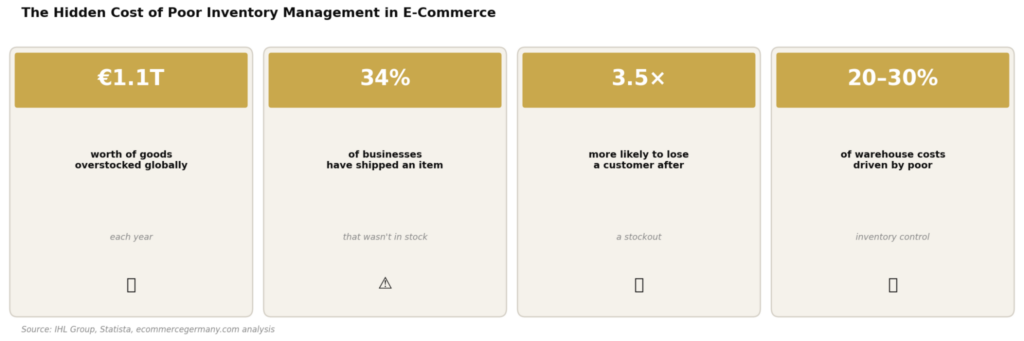
The numbers are stark. Globally, overstocking and stockouts combined cost retailers over €1 trillion per year. In Germany specifically, where e-commerce fulfilment expectations are among Europe’s highest, the operational margin for error is thin. A single high-volume day — Black Friday, Amazon Prime Day, or a viral product moment — can expose inventory blind spots that quietly exist year-round.
The good news: a modern inventory management system (IMS) eliminates most of these problems. The challenge is choosing the right one for your specific operation when the question shifts from configuration to software migration — weighing feature gaps, data ownership and platform stability against the cost of switching.
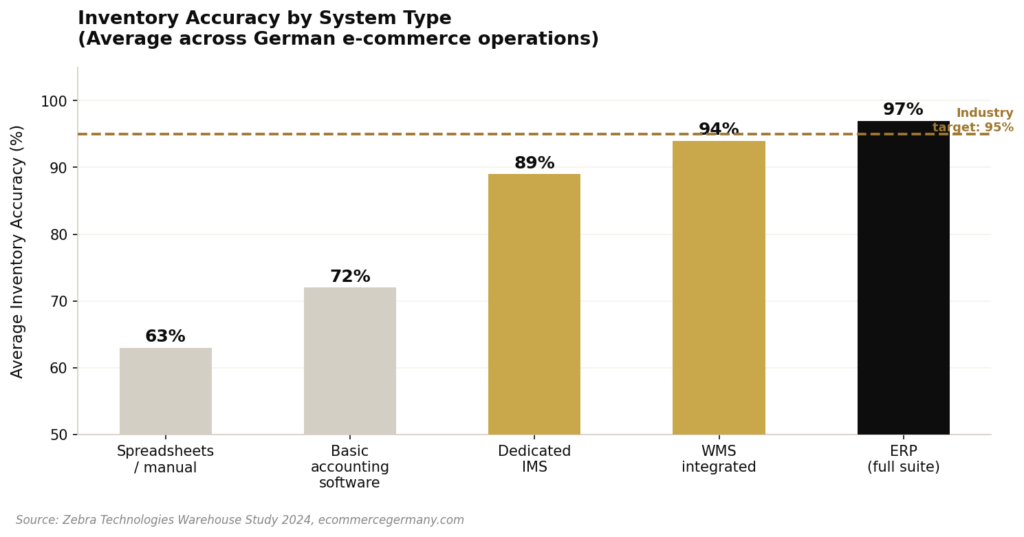
The data tells a clear story. Retailers relying on spreadsheets or basic accounting software average 63–72% inventory accuracy — meaning roughly 1 in 3 stock decisions is based on incorrect information. Dedicated IMS platforms push that to 89–97%. That gap is the difference between profitable scaling and operational fire-fighting.
What to Look for in an IMS for the German Market
Not all inventory management systems are created equal — and the German market has specific requirements that many international tools underestimate.
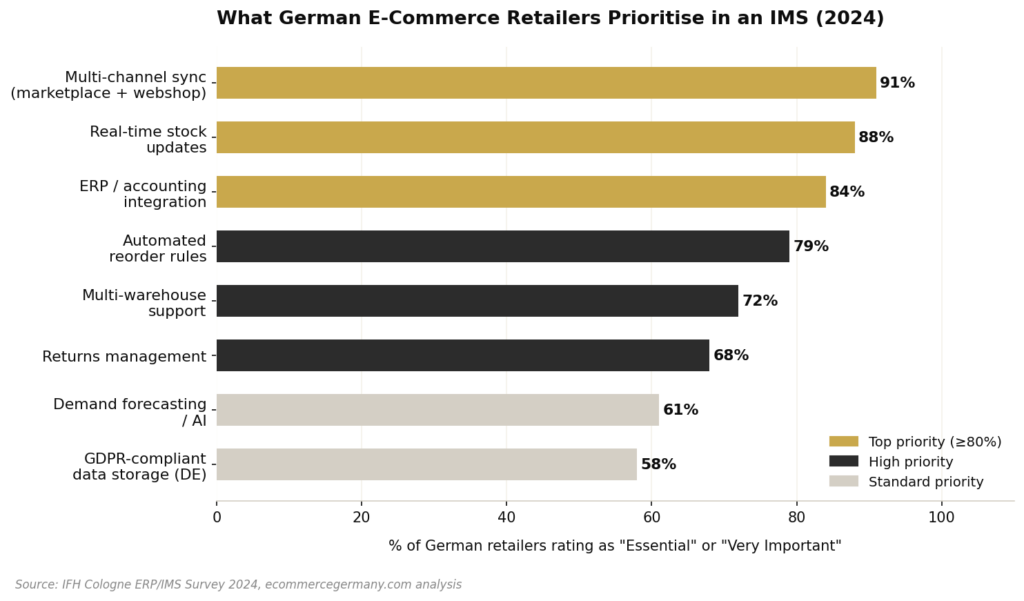
Multi-channel synchronisation is the top priority by a significant margin. German online retailers rarely sell through a single channel — the typical mid-market operation runs a Shopware or Shopify webshop alongside Amazon.de, Zalando, and Otto simultaneously. Stock updates need to propagate across all channels in near real-time to prevent overselling, which on marketplaces carries the additional penalty of account suspension risk.
ERP and accounting integration matters more in Germany than in most other markets. German accounting requirements — GoBD compliance, VAT specifics, and the dominance of tools like DATEV and Lexware — mean that an IMS which doesn’t integrate cleanly with German-market accounting software creates more work than it saves. For a deeper look at why ERP integration is critical in DACH, see this analysis of bridging e-commerce with ERP scaling.
GDPR-compliant data storage — specifically, the option to store data on EU-based servers — is a practical requirement for German retailers, not just a compliance checkbox. Many US-headquartered SaaS tools default to US data centres, which creates complications under Germany’s strict data sovereignty expectations. Always verify server location before signing a contract.
Returns management integration is non-negotiable in a market where return rates in fashion exceed 40%. An IMS that can’t efficiently process returns back into available stock is an IMS that will create permanent inventory distortion over time.
The IMS Integration Ecosystem
Before choosing a tool, it helps to understand the full ecosystem it needs to connect with. A modern German e-commerce operation isn’t just a webshop and a warehouse — it’s a network of interconnected systems, each of which needs accurate inventory data to function.
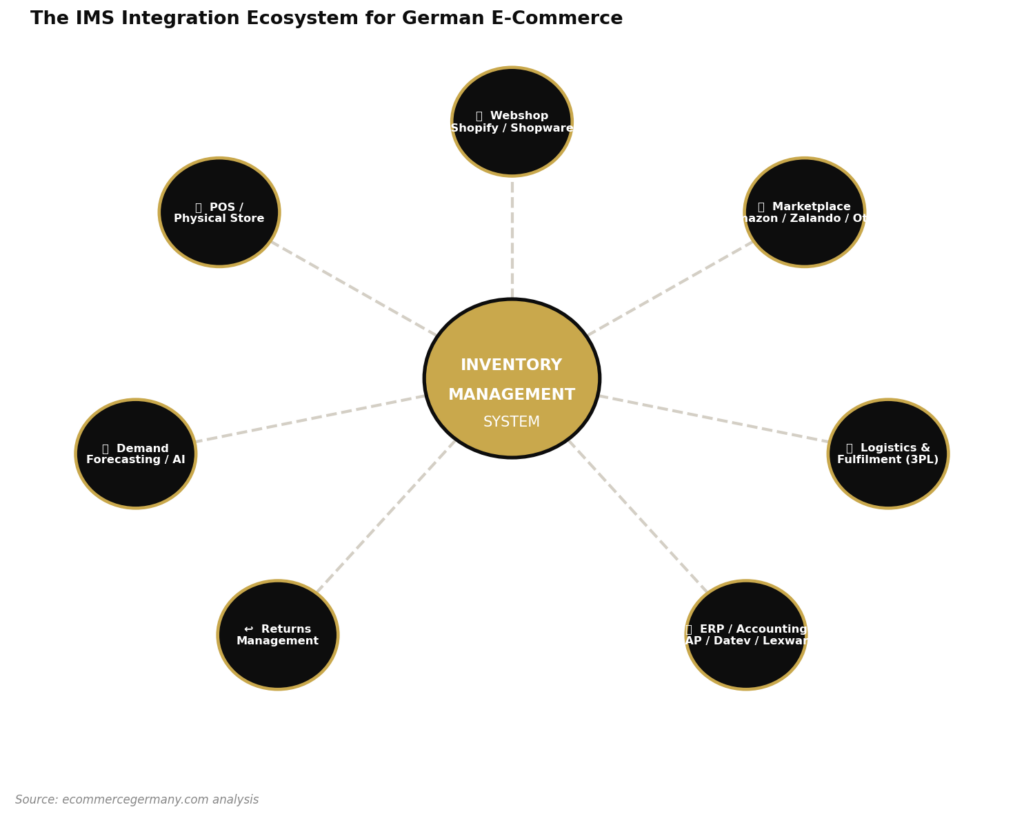
The IMS sits at the centre of this web, synchronising stock data bidirectionally with every connected system. When a marketplace order is placed, stock is decremented. When a return is processed, stock is reinstated. When a reorder threshold is hit, a purchase order is triggered automatically. The quality of those integrations — not the feature list on the vendor’s website — is what determines whether an IMS actually works in practice.
For retailers building towards a full omnichannel operation, this integration architecture is foundational. A well-connected IMS makes omnichannel retail genuinely viable; a poorly integrated one creates data silos that undermine the entire strategy.
Top Inventory Management Companies for German E-Commerce

🥇 Linnworks — Best for High-Volume Multichannel Retailers
Best for: Mid-market and enterprise retailers selling across 5+ channels
Pricing: From ~€449/month
German language support: Yes
Key integrations: Amazon, Otto, Zalando, Shopware, Shopify, DHL, DPD, GLS
Linnworks is widely regarded as one of the most powerful multichannel inventory and order management platforms available to European retailers. Its core strength is real-time inventory sync across unlimited sales channels — when an item sells on Amazon.de, Zalando, and your Shopware webshop simultaneously, Linnworks reconciles the stock positions in seconds.
For German retailers, Linnworks offers particularly strong marketplace integrations with Otto and Kaufland — two platforms that many international IMS vendors treat as afterthoughts. Its warehouse management module handles multi-location stock with pick/pack/ship workflows, making it viable for operations with their own fulfilment infrastructure.
The price point puts it firmly in mid-market territory, but for retailers processing more than 500 orders per day across multiple channels, the ROI is typically realised within the first quarter of use.
🥈 Brightpearl — Best for Omnichannel Retail Operations
Best for: Retailers with physical stores + online channels
Pricing: Quote-based (typically €800–€2,000+/month)
Key integrations: Magento, Shopify, Amazon, EPOS systems, Sage, Xero (and Xero alternatives)
Brightpearl positions itself as a “retail operating system” rather than a pure IMS — and for German retailers managing both online and physical retail, that distinction matters. Its real-time inventory sits alongside order management, CRM, accounting, and reporting in a single platform, eliminating the integration overhead that plagues multi-tool setups.
Where Brightpearl particularly excels is in handling the complexity of omnichannel fulfilment — click and collect, ship from store, endless aisle — which requires inventory visibility across every location simultaneously. For German retailers expanding from pure-play e-commerce into physical retail, or vice versa, it’s one of the most complete solutions available.
🥉 Odoo Inventory — Best Value for Growing SMEs
Best for: SMEs wanting modular ERP with inventory as a starting point
Pricing: From €7.25/user/month (Community free)
German language support: Yes
Key integrations: Native Odoo ERP suite, WooCommerce, Shopify, DHL
Odoo’s open-source heritage makes it uniquely flexible for German retailers who want to start with inventory management and gradually expand into a full ERP without switching platforms. The inventory module integrates natively with Odoo’s accounting, purchasing, CRM, and manufacturing modules — making it one of the most cost-effective paths to a complete operational stack.
The Community edition is free and covers the basics well. The Enterprise edition adds barcode scanning, multi-step routes, and advanced reporting. For retailers working with a German IT partner, Odoo’s German-market customisations — including DATEV export and GoBD-compliant audit trails — are well-developed. See how the right IT partner can transform operational outcomes in our overview of choosing tech support for e-commerce.
Zoho Inventory — Best for Early-Stage and Budget-Conscious Retailers
Best for: Startups and early-stage SMEs with limited budgets
Pricing: Free tier available; paid from €59/month
Key integrations: Amazon, eBay, Shopify, Etsy, DHL
Zoho Inventory is consistently one of the top-rated entry-level IMS tools for German e-commerce operations. Its free tier supports up to 50 orders per month — sufficient for retailers just starting to outgrow spreadsheet tracking — and its paid tiers scale affordably.
The platform’s German marketplace integrations (Amazon.de, eBay Germany) are solid, and its user interface is genuinely accessible for non-technical teams. What it lacks in advanced warehouse management features, it compensates for with ease of implementation and a clean learning curve.
SAP Inventory Management — Best for Enterprise and Manufacturing-Adjacent Operations
Best for: Large enterprises, brands with complex supply chains or manufacturing
Pricing: Enterprise (contact SAP)
Key integrations: Full SAP ecosystem, EDI, custom integrations
For German enterprises already running SAP ERP — a significant proportion of large-scale DACH retailers — SAP’s inventory management module is the natural choice. Its strength is depth of supply chain integration: demand-driven replenishment, multi-plant inventory visibility, and real-time financial reconciliation with SAP Finance.
SAP is not appropriate for SMEs — the implementation cost and complexity put it firmly in enterprise territory. But for brands with complex supply chain challenges — seasonal peaks, multi-country operations, or manufacturing integration — no other platform offers comparable depth.
Microsoft Dynamics 365 Supply Chain — Best for Microsoft-Stack Operations
Best for: Enterprises with existing Microsoft infrastructure
Pricing: From €95/user/month
Key integrations: Full Microsoft 365 ecosystem, Azure, Power BI
Microsoft Dynamics 365 Supply Chain Management is a strong choice for German enterprises already invested in the Microsoft ecosystem. Its integration with Power BI enables sophisticated inventory analytics and demand forecasting dashboards that are far beyond what standalone IMS tools offer. Azure-hosted deployment satisfies EU data residency requirements.
For retailers looking to leverage AI-driven demand forecasting — one of the fastest-growing IMS capabilities — Dynamics 365’s Copilot integration is one of the most mature implementations currently available, connecting inventory predictions directly to purchasing workflows.
Körber WMS (formerly HighJump) — Best for Complex Warehouse Operations
Best for: Operations with large, multi-zone warehouses
Pricing: Enterprise (contact Körber)
Key integrations: SAP, Oracle, major carriers, automation hardware
Körber’s Warehouse Management System is the specialist choice for German retailers whose primary bottleneck is warehouse operation rather than multichannel inventory sync. Its strength is in physical warehouse optimisation — slotting, wave picking, automation hardware integration, and real-time labour management.
For retailers operating their own large fulfilment centre, or considering outsourcing to a fulfilment partner that uses Körber infrastructure, understanding this tool’s capabilities is important. Several major German 3PL providers run Körber as their warehouse operating system.
inFlow Inventory — Best for B2B and Wholesale Operations
Best for: B2B retailers, wholesalers, and businesses managing purchase orders heavily
Pricing: From €89/month
Key integrations: Shopify, WooCommerce, QuickBooks
inFlow’s standout feature for German B2B e-commerce operators is its purchase order management workflow — far more sophisticated than most IMS tools at this price point. For companies running data-driven B2B e-commerce strategies, the ability to manage supplier lead times, minimum order quantities, and automated reorder triggers within the same platform as inventory tracking is genuinely valuable.
How to Choose: The Selection Matrix
The right IMS is not the one with the most features — it’s the one that fits your current operation and can scale with your next phase of growth. Use this matrix as a starting point.
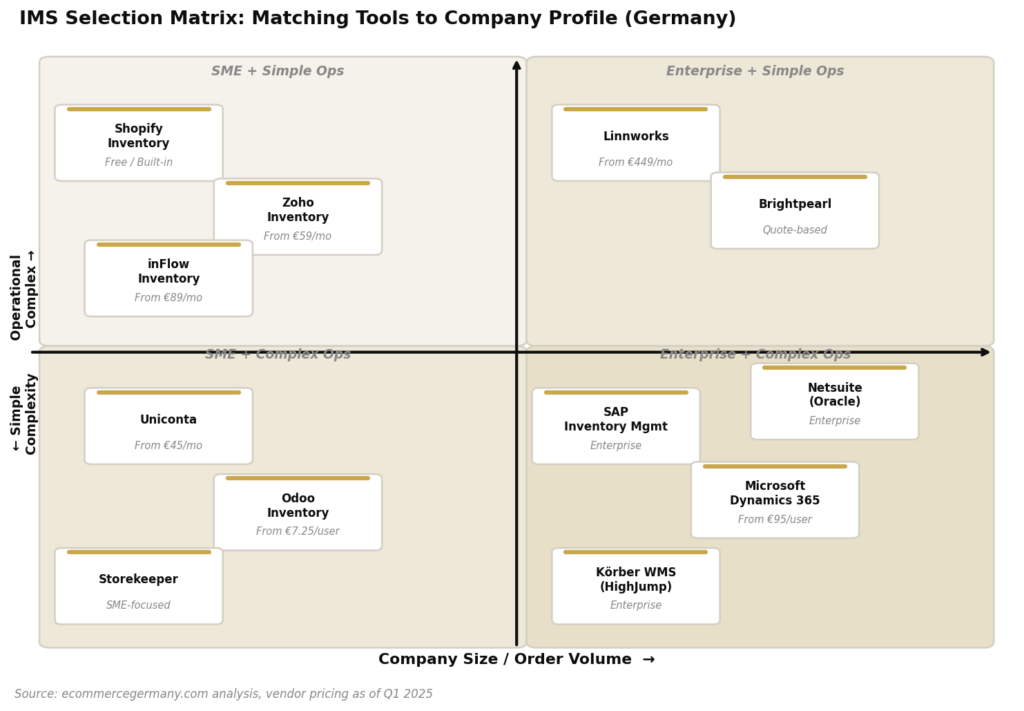
| Company Stage | Ops Complexity | Recommended Approach |
| Startup / early SME | Simple (1–2 channels) | Zoho Inventory, Shopify native, inFlow |
| Growing SME | Moderate (3–5 channels) | Odoo, Linnworks entry tier |
| Scaling retailer | High (multichannel + warehouse) | Linnworks, Brightpearl |
| Enterprise | Complex (multi-country, ERP-connected) | SAP, MS Dynamics 365, Körber |
Three questions to ask every vendor before signing:
- Do you have native integrations with Otto.de, Kaufland, and Zalando? — The absence of these is a significant red flag for any IMS targeting German retailers.
- Where is my data stored, and are you GoBD-compliant? — Non-negotiable for GDPR and German accounting compliance.
- What does a standard implementation take in weeks, and who provides post-go-live support in German? — Support quality in the German language degrades sharply for non-European vendors.
Implementation: What German Retailers Get Wrong
Choosing the right IMS is only half the battle. Implementation is where most projects stumble — and the DACH market has a few specific failure patterns worth anticipating.
- Starting with dirty data. Migrating inaccurate inventory data from spreadsheets into a new system doesn’t fix the inaccuracies; it just automates them. Before any IMS go-live, invest in a physical stock count and SKU rationalisation. The time cost is real; the alternative is worse.
- Underestimating channel integration complexity. Amazon’s inventory API behaves differently from Otto’s, which behaves differently from Zalando’s. A vendor who shows you a clean demo with three channels in sync may not have told you that those three channels required six weeks of custom integration work. Ask for customer references specifically from retailers with your channel mix.
- Skipping the 3PL conversation. If you work with a third-party fulfilment provider — or plan to — their WMS must connect cleanly with your IMS. Many smaller 3PLs in Germany still operate on proprietary systems with limited API connectivity. The 5 e-commerce fulfilment strategies for 2025 are all predicated on this integration working. Validate the 3PL integration before selecting your IMS, not after.
- Treating the IMS as a one-department tool. The best implementations involve finance, operations, customer service, and marketing from day one — because inventory data feeds reporting, CRM, and demand planning, not just the warehouse team. The cloud-native ERP approach for e-commerce makes cross-departmental data sharing significantly easier and is increasingly the architecture of choice for scaling German retailers.
Conclusion
Inventory management is not a glamorous topic. It doesn’t generate social media buzz or drive viral growth. But in the operational reality of German e-commerce, it’s the difference between a business that scales efficiently and one that grows into chaos. The tools exist. The integrations are proven. The only question is how long you’ll wait before using them.