How to Sell on TikTok Shop: A 2026 Guide for European Sellers
Learn how to sell on TikTok Shop in 2026, from seller setup and fees to fulfilment, content strategy, and choosing TikTok over Amazon or eBay.
TikTok Shop went live in Germany in spring 2025 and crossed €1 billion in European gross merchandise value within twelve months. The platform now sits alongside Amazon, eBay, and Kaufland as a legitimate marketplace for European sellers, with one critical difference. TikTok Shop merges product discovery, content, and checkout into a single feed, which changes what selling looks like at the operational level.
This guide covers the practical mechanics of selling on TikTok Shop in Europe in 2026. Registration, fees, fulfilment, content strategy, and the recurring mistakes that cost sellers their accounts in the first 90 days.
What TikTok Shop is for sellers
TikTok Shop is a marketplace inside the TikTok app. Sellers list products, the platform surfaces them inside live streams, short-form videos, and a dedicated Shop tab, and buyers check out inside the app. Payments process through TikTok, fulfilment runs through the seller’s own logistics or TikTok’s partner network, and the platform takes a commission per sale.
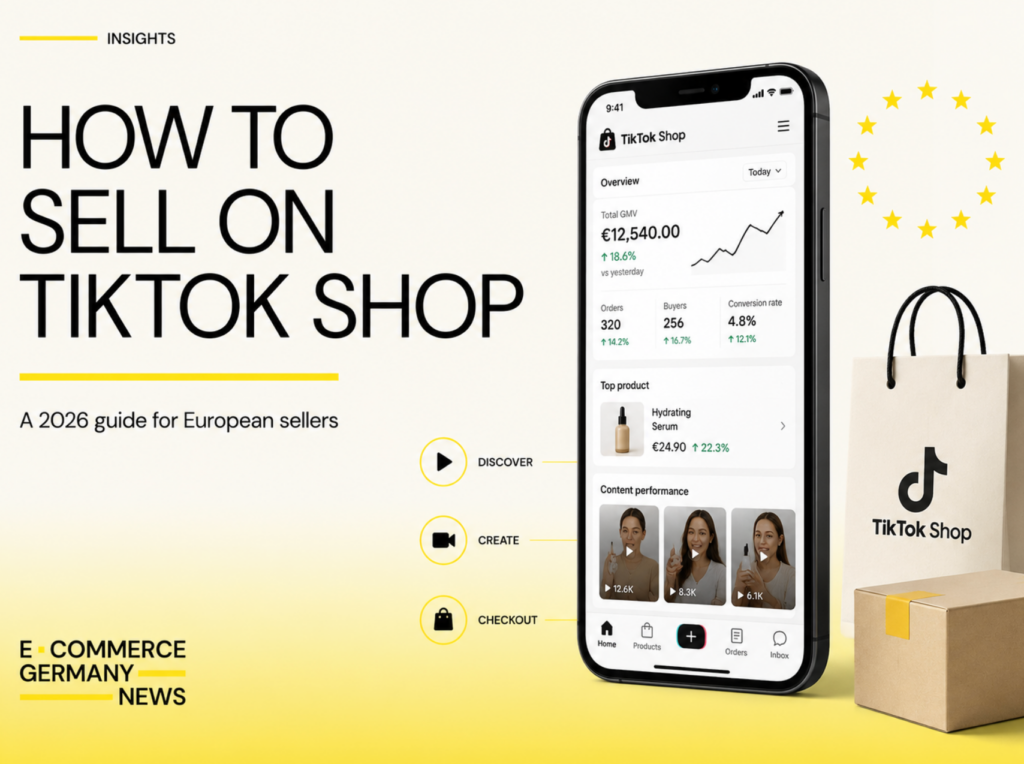
The core difference from Amazon or eBay is the discovery layer. On Amazon, buyers arrive with intent. They know what they want and they search. On TikTok Shop, buyers discover products they did not know existed, often in the middle of watching unrelated content. This shifts the seller’s job from optimizing for keywords to producing content that triggers impulse purchases. Sellers who treat TikTok Shop like Amazon fail. Sellers who treat it like a media business with a checkout button succeed.
For broader context on where TikTok fits in the European marketplace landscape, our review of the 20 best online marketplaces in Germany covers the players TikTok competes with, and the overview of Amazon in Germany provides the baseline most sellers benchmark against.
Who can sell on TikTok Shop in Europe
TikTok Shop accepts registered businesses based in the country they want to sell in. For Germany, sellers need a registered German business entity, a German VAT ID, a German bank account, and a German business address. Sole proprietors and limited companies both qualify. Individual hobby sellers do not.
Cross-border sellers from outside the EU can list products on TikTok Shop Germany through the platform’s cross-border program, which handles VAT collection and import compliance. EU sellers from other member states can also sell into Germany, with VAT obligations following standard distance-selling rules under OSS.
Category restrictions apply. TikTok Shop currently does not allow alcohol, tobacco, weapons, prescription medications, financial services, or live animals. Restricted categories include cosmetics, food supplements, and electronics, where sellers must submit additional certification before listing.
Step-by-step registration
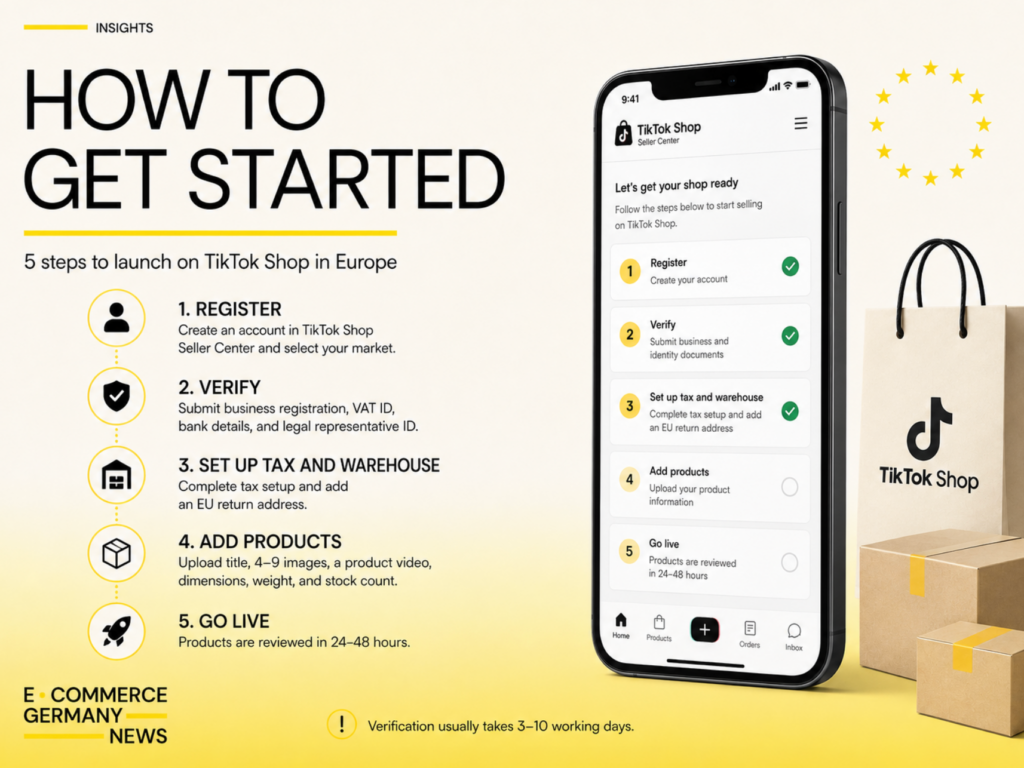
- The registration flow takes between 3 and 10 working days for most sellers, depending on category and document verification speed.
- Open the TikTok Shop Seller Center at seller-de.tiktok.com and select Germany as your operating market. Submit the business registration documents, which include the Handelsregisterauszug for limited companies or the Gewerbeanmeldung for sole proprietors. Add the VAT ID, IBAN, and business address. Upload the legal representative’s ID document, which must match the name on the business registration.
- Once business verification clears, complete tax setup inside the Seller Center. TikTok Shop collects German VAT on behalf of non-EU sellers under the Import One Stop Shop, but EU-resident sellers handle their own VAT registration and reporting. The platform issues monthly invoices and transaction reports that integrate with most accounting software.
- Set up the warehouse address next. This is the return address that appears on every product page, and it must be a real address inside the EU. PO boxes and forwarder addresses get accounts flagged. The address also drives shipping rate calculations, so a Berlin warehouse generates different delivery estimates than a Hamburg warehouse for the same product.
- Finally, add the first product. TikTok Shop requires a product title, four to nine images, a video demonstration, dimensions, weight, and a stocked inventory count. The product goes through a 24 to 48 hour review before going live.
For sellers handling fulfilment logistics, our list of fulfilment centres and logistics operators in Germany covers the partners that integrate cleanly with TikTok Shop’s pickup APIs.
Fees and payouts
TikTok Shop charges a commission per completed sale, with rates that vary by category. As of 2026, beauty and personal care sit at 5 percent, fashion at 6 percent, electronics at 3 percent, and home goods at 4 percent. The commission applies to the product price plus shipping fees charged to the buyer. Refunded orders return the commission.
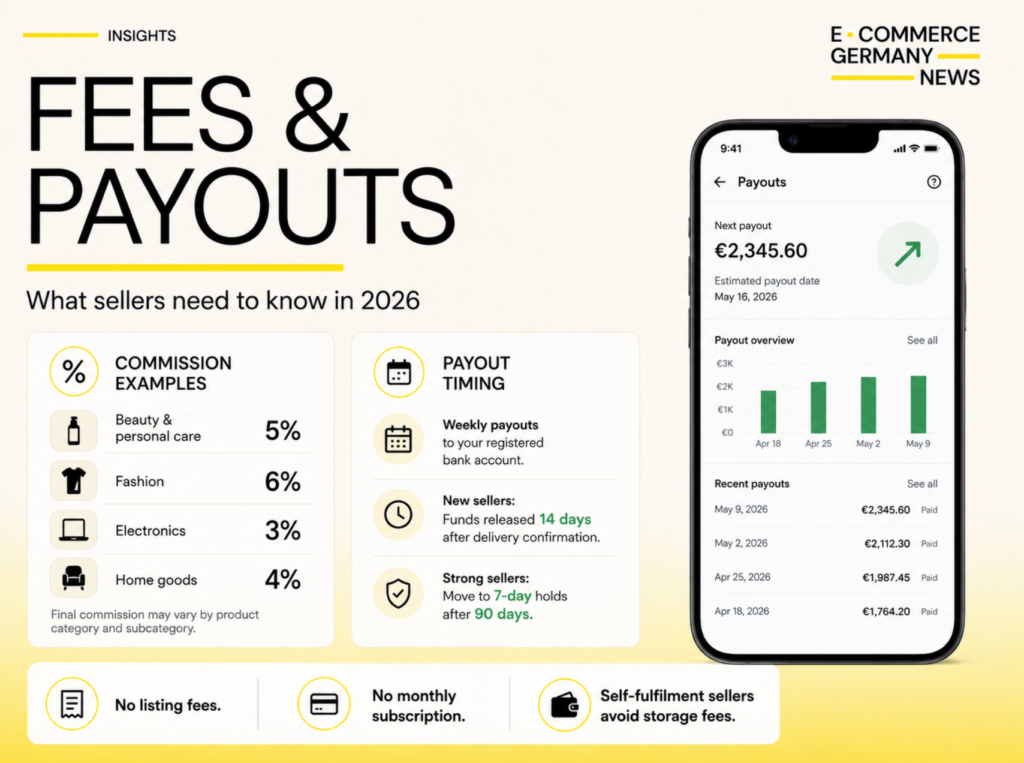
Payouts process weekly, with funds released 14 days after order delivery confirmation. The 14-day hold protects buyers during the return window and only applies to the first batch of payouts for new sellers. Established sellers with strong dispute histories move to 7-day holds after 90 days.
TikTok Shop does not charge listing fees, monthly subscriptions, or storage fees for sellers using their own warehouses. Sellers using TikTok’s fulfilment partners pay separate logistics fees on top of the commission. For comparison with other marketplaces, our breakdown of top KPIs for measuring profitability on Amazon covers the same margin math sellers should apply to TikTok Shop.
Fulfilment options
Sellers choose between three fulfilment models on TikTok Shop.
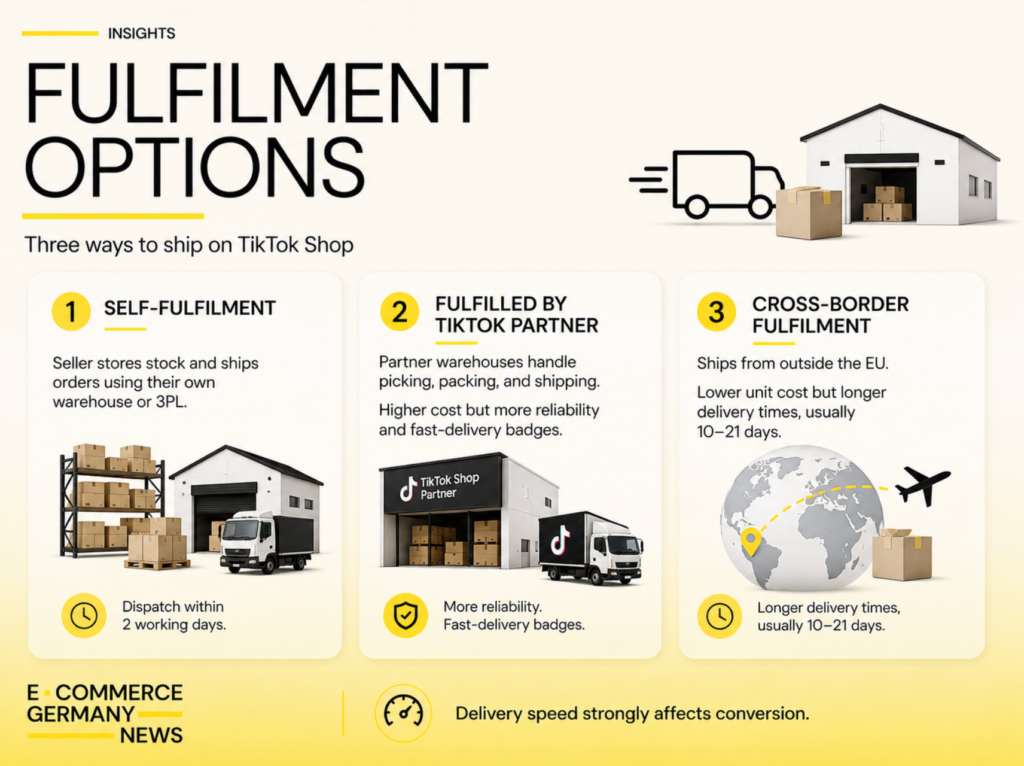
Self-fulfilment is the most common. The seller stocks inventory at their own warehouse or 3PL, receives orders through the TikTok Shop Seller Center, prints labels using integrated carriers like DHL, DPD, or GLS, and ships directly to buyers. SLAs require dispatch within 2 working days, and missed SLAs trigger account warnings. Three warnings in 30 days suspends listings.
Fulfilled by TikTok runs through partner warehouses. Sellers ship inventory in bulk to the partner warehouse, and TikTok handles picking, packing, and shipping per order. This model carries higher per-order costs but eliminates SLA risk and qualifies sellers for the platform’s fast delivery badges, which improve conversion.
Cross-border fulfilment ships from outside the EU. This model has the lowest per-unit cost but the longest delivery times, typically 10 to 21 days. Conversion rates drop sharply on listings with delivery estimates over 7 days, which means cross-border sellers compete mainly on price.
For the wider context on how packages move through the European fulfilment system, a package’s journey from the moment of purchase covers the operational layer, and why euro containers matter for fulfilment centres explains the inventory handling assumptions German 3PLs make.
Content is the channel
TikTok Shop conversion is driven by content, not search. Every product page benefits from organic exposure inside the For You feed when sellers or affiliates post videos featuring the product. Sellers who post 4 to 6 videos per week on the product see 5 to 8 times the conversion of sellers who upload product pages and wait.
Three content formats produce most of the volume.
Live streams are the highest-converting format. Sellers run 1 to 4 hour streams demonstrating products, answering questions, and triggering time-limited promotions. Top-performing streams convert 2 to 4 percent of viewers into buyers, which is roughly 10 times standard ecommerce conversion. Live commerce works because the seller can address objections in real time and the urgency layer compresses the buying decision into seconds.
Short-form video is the discovery layer. 15 to 60 second clips showing the product in use, the unboxing experience, or a problem-solution demonstration. These videos appear in the For You feed and drive Shop tab visits. The platform’s algorithm prioritizes videos with strong watch-through rates, which favors product demos over polished advertising.
Affiliate content extends reach. Sellers invite TikTok creators to promote products in exchange for a percentage of each sale, typically 10 to 20 percent. Creators receive trackable affiliate links, and TikTok handles the attribution. Affiliate programs scale faster than self-produced content because creators bring their own audiences.
The content strategy connects directly to the broader question of how to enhance content operations for hybrid ecommerce teams, because most sellers underestimate the production volume required to keep a TikTok Shop account growing.
What German buyers expect
German ecommerce buyers carry different expectations than US or UK buyers, and TikTok Shop sellers who fail to adapt see returns climb past 30 percent.
German buyers expect a complete legal imprint on every product page. The Telemediengesetz, which we covered here, requires every commercial listing to display the seller’s full company name, registered address, tax ID, and contact information. Missing imprints get accounts suspended.
Payment preferences skew toward PayPal, Klarna, and SEPA direct debit. Credit card share is lower than in most other European markets, and our overview of payment methods in German ecommerce breaks down the volumes. Sellers who fail to offer Klarna lose roughly 20 percent of potential buyers at checkout.
Return rates run higher in Germany than in most other European markets, particularly in fashion. Buyers order multiple sizes, keep one, and return the rest under the 14-day right of withdrawal. Sellers pricing fashion items for TikTok Shop should bake a 30 to 40 percent return rate into the margin model.
GDPR compliance is non-negotiable. Buyers expect cookie consent, clear privacy policies, and data deletion rights. GDPR data privacy in Germany covers the operational checklist sellers should apply to their TikTok Shop presence.
Quiet hours apply to seller communications too. Buyers do not expect calls or messages outside business hours, and aggressive follow-up tactics trigger complaints. Ruhezeit rules cover the cultural expectations sellers should respect.
Common mistakes that cost sellers their accounts
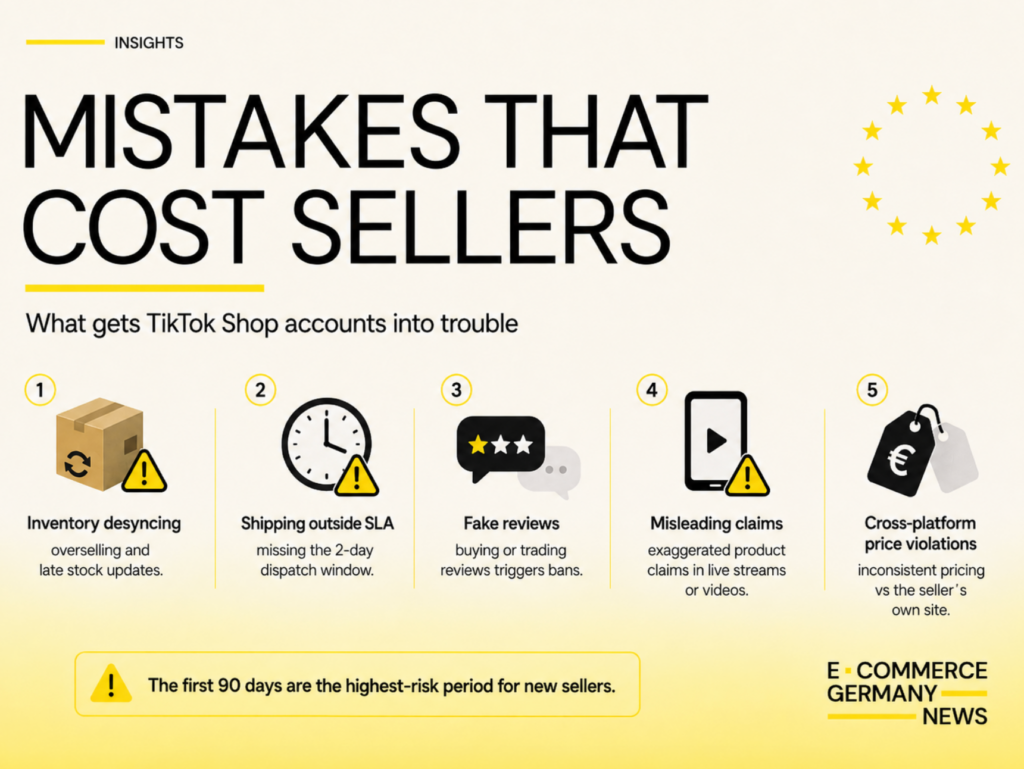
Five recurring mistakes show up in account suspensions across the first 90 days.
- Inventory desyncing is the top cause. Sellers list a product, sell out, and fail to update inventory in time. The platform charges the seller for cancellations, applies SLA penalties, and pushes the listing down in the algorithm. Sellers should integrate inventory feeds with the TikTok Shop API instead of updating manually.
- Shipping outside SLA is the second. Sellers underestimate dispatch capacity and miss the 2-day dispatch window. Three misses in 30 days suspends listings. The fix is honest capacity planning, not aspirational promises.
- Fake reviews are the third. Buying or trading reviews triggers automatic detection and a permanent account ban. The platform monitors review timing, geographic clustering, and account age. Organic review velocity from real buyers is the only sustainable path.
- Misleading claims are the fourth. Live streams compress claims into seconds, and sellers occasionally promise effects or compatibility that the product cannot deliver. Buyers report the discrepancy, the platform reviews the recorded stream, and the seller loses the listing. The fix is scripts that stay within what the product label allows.
- Cross-platform price violations are the fifth. TikTok Shop requires price parity with the seller’s own ecommerce site for the same SKU. Sellers running aggressive discounts on Shopify and full price on TikTok lose the listing. The platform crawls seller websites to enforce this.
For more on how to avoid the structural mistakes that kill ecommerce businesses, our piece on why most AI projects in ecommerce fail covers a parallel pattern of execution failure.
How TikTok Shop compares to Amazon and eBay
Each platform suits a different seller profile, and the best choice depends on how people discover your product. Amazon works best when buyers already know what they want. eBay works best for long-tail demand, refurbished stock, collectibles, and harder-to-find items. TikTok Shop works best when content can create demand before the buyer starts searching.
Amazon is the volume engine
Buyers arrive with high intent, conversion is strong, and the infrastructure is mature, but margins can compress under referral fees, FBA costs, Sponsored Ads, and Buy Box competition. Amazon says most referral fees sit between 8% and 15% depending on category, while FBA adds fulfillment and storage costs on top. That is why the platform often rewards sellers with strong keyword strategy, operational discipline, and enough margin to survive paid visibility. Our breakdown of what stands behind Amazon.de’s success in Germany covers why the platform dominates and what that means for sellers building elsewhere.
eBay is the long-tail marketplace
It suits sellers with niche inventory, refurbished goods, used products, collectibles, spare parts, or products where buyers compare condition and price more carefully. Selling on eBay Germany covers the operational mechanics, but the bigger strategic point is simple: eBay is often less about viral demand and more about availability, trust, item condition, and price. eBay’s own fee structure depends on listing format, category, optional upgrades, seller conduct, and final sale value.
TikTok Shop is the discovery channel
TikTok Shop launched as a way to bring ecommerce into the content feed, with shoppable videos, live shopping, product links, affiliate content, and in-app checkout.
Buyers do not always arrive with a clear plan to buy products directly. Instead, short videos, quick demos, creator recommendations, and live sessions turn passive attention into demand. That makes TikTok Shop especially useful for visual products, impulse-friendly items, creator-led brands, and products that need demonstration. TikTok describes the platform as a discovery-based ecommerce ecosystem that connects sellers, creators, and communities.
For a small business, the appeal is obvious: you can set up a shop, upload your products, promote your products through content, and let creators showcase and sell products directly on TikTok. The operational side still matters. A TikTok seller needs to verify documents, add tax and business information where required, build a product listing, manage shipping times, and use TikTok Seller Center as the dashboard for products, orders, promotions, analytics, and customer service. Official TikTok materials say sellers may need to upload identity or business documents, verify your documents, provide tax information, and complete compliance review before items appear.
The strategic question, which we cover in depth in our TikTok ecommerce strategy framework, is which channel your product fits. Some products work everywhere. Most products work on one or two platforms. TikTok Shop is the right call when discovery beats search, content can explain the product quickly, and TikTok’s audience is likely to react to the format.
| Platform | Best fit | How buyers discover products | Seller strengths needed | Main advantage | Main challenge |
| Amazon | Branded products, replenishable goods, high-intent categories, products with search demand | Search, category ranking, Sponsored Ads, recommendations | Keyword visibility, pricing discipline, inventory control, review generation, fulfillment setup | High purchase intent and mature fulfillment options | Margin pressure from fees, ads, FBA costs, and Buy Box competition |
| eBay | Refurbished goods, collectibles, used items, parts, niche products, long-tail inventory | Search, filters, condition-based comparison, saved searches | Accurate listings, strong product photos, clear condition notes, reliable shipping | Works well for hard-to-find or price-sensitive inventory | Less useful for trend-led products that need visual storytelling |
| TikTok Shop | Visual products, demo-friendly items, creator-led brands, impulse buys, beauty, fashion, gadgets, home products | Short videos, live sessions, creators, product links, For You discovery, in-app checkout | Creating engaging content, creator partnerships, fast testing, strong hooks, reliable fulfillment | Can create demand for items on TikTok before buyers search elsewhere | Lower predictability, content workload, creator dependency, trend volatility |
To learn how to sell on TikTok Shop, start with the product-market fit rather than the setup process. Yes, you can start selling on TikTok through TikTok Seller Center, and you can use an existing TikTok account or connect an official TikTok account to strengthen brand presence. But the bigger question is whether your product can hold attention in a TikTok video. If it needs a long technical explanation, Amazon or eBay may be stronger. If it can go viral through a visual before-and-after, a creator demo, or a live shopping pitch, TikTok Shop has a clearer role.
There are also different routes into the ecosystem. A brand can become a TikTok Shop seller and sell products directly on TikTok. A creator can become an affiliate and earn from products for a commission. Brands and creators can work together, with creators to showcase and sell products through shoppable content. That model is central to social commerce because it brings entertainment, recommendation, and checkout into one shopping experience.
TikTok Shop is not a shortcut around ecommerce basics. You still need real products, clear product photos, accurate descriptions, reliable shipping, and customer support. You may need to provide your business name, business documents, tax information, and, in the US, details such as an EIN depending on your business setup. If you want to access TikTok Shop, the platform may also ask you to verify identity or company information before you can start selling.
So the decision is not “Amazon vs eBay vs TikTok Shop” in the abstract. It is search demand vs long-tail demand vs content-led demand. Amazon helps you capture buyers who already want a product. eBay helps you match specific inventory with specific buyers. TikTok Shop helps you grow your business with TikTok when your product and seller story can turn attention into GMV. For seller growth, TikTok Shop can be one of the fastest-growing opportunities, but only when the content format fits the product.
Bottom line
TikTok Shop is a viable channel for European sellers in 2026, with low setup friction, fair commission rates, and a discovery layer no other marketplace offers. The platform rewards content production, fast fulfilment, and honest claims, and it penalizes sellers who treat it like Amazon.
The first 90 days are the riskiest. Sellers who survive the SLA learning curve, build a content rhythm, and respect German buyer expectations move from listing live to consistent weekly volume by month three. Beyond that, the ceiling is mostly a function of how much video the seller can produce and how well the products convert in 30-second formats. Sellers who want a head start on the visual playbook can review the best ways to boost ecommerce store traffic without buying ads, which applies cleanly to TikTok content production.
For sellers deciding if TikTok Shop is the right investment versus expanding on existing channels, our analysis of European ecommerce growth across markets covers the broader demand patterns, and the TikTok ecommerce strategy guide walks through the channel-fit decision in detail.
FAQ
Below are a few frequently asked questions you can add near the end of the article.
Can you sell on TikTok Shop without a big following?
Yes, in many cases you can sell on TikTok Shop without having a large audience first. TikTok’s own seller materials say an Official Account can connect to TikTok Shop for self-selling with no minimum follower requirement, while affiliate and marketing account access may have separate requirements depending on the account type and use case.
That means your follower count matters less at the beginning than product fit, strong content, and reliable operations. A new seller on TikTok can still test short videos, add a shop tab on your profile, and use product content to reach potential customers through TikTok’s discovery feed.
How much does it cost to sell on TikTok Shop?
TikTok Shop does not charge every seller the same way in every market, so check your local Seller Center before you price your products. In the US, TikTok’s seller registration page promotes $0 setup fees, but sellers still need to account for marketplace costs, fulfillment, returns, discounts, ads, affiliate commissions, and other operating costs.
The practical point: selling fees are only one part of the margin. If you want to increase your sales, leave room for creator commission, shipping support, product samples, and promotional campaigns.
Do I need to be an influencer to sell on TikTok Shop?
No. You do not need to be an influencer to sell your own products through TikTok Shop. Sellers can use their own brand account, while creators can join affiliate routes and promote products for commission when they meet TikTok’s eligibility rules. TikTok’s creator eligibility materials also describe follower-related limits and pilot access for some creators.
The advantage is that TikTok Shop gives brands and creators to showcase products in a more native way. A creator can explain, test, style, compare, or demonstrate a product, while the seller handles the product, listing, stock, and fulfillment.
Can TikTok Shop help small sellers grow?
Yes, but it works best when the product suits video. TikTok Shop describes itself as a discovery-based ecommerce ecosystem, so the platform can help small sellers reach shoppers who were not actively searching for their product.
To build a stronger business with TikTok Shop, focus on repeatable product demos, creator partnerships, fast answers to comments, and content that shows the product in real use. The goal is not only to boost your sales once. The goal is to find a content format that you can repeat without burning out.
Can you sell digital products on TikTok Shop?
Usually, be careful. TikTok Shop’s US prohibited products policy says digital products and virtual products are prohibited unless TikTok approves them under the Virtual Goods category.
So before you list templates, ebooks, downloads, courses, software files, or similar items, check the rules in your market. TikTok Shop is much more straightforward for physical products that can ship, track, and move through standard return flows.
How do creators make money from TikTok Shop?
Creators can earn through affiliate links when shoppers buy through qualifying product links. TikTok’s materials say creators can share showcase or campaign links and earn commission from eligible purchases tracked through TikTok Shop.
For sellers, this creates a useful growth loop. Instead of producing every video alone, you can work with creators who already know how to present products, answer objections, and make items feel relevant to their audience.