Marketing in Europe in 2026: What’s new and what hasn’t changed? [McKinsey Report]
Marketing in Europe is shifting, as always. See what’s new, what hasn’t changed, and where to focus next, based on the McKinsey report on marketing in 2026.
![Marketing in Europe in 2026: What's new and what hasn't changed? [McKinsey Report]](https://ecommercegermany.com/wp-content/uploads/2026/01/windows-w79mIrYKcK4-unsplash-scaled.jpg)
Marketing in Europe is walking into 2026 with a mix of confidence and nerves. On paper, the mood looks upbeat. In real life, there is more budget intention, more pressure to prove impact, and a sharper push toward brand trust and creative that stands out.
Marketing in 2026 also looks more demanding because audiences are tired, channels are noisy, and tracking is harder than it used to be.
The good news is that this McKinsey report doesn’t pretend any of this is easy. It calls out what’s changing, what’s stuck, and where teams are placing their bets next.
Background + marketing areas where you should act now
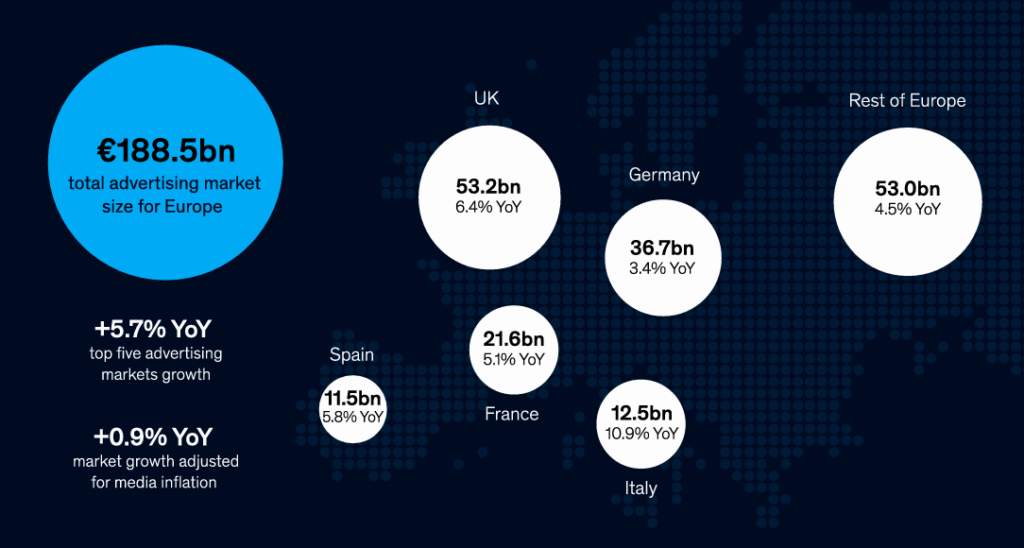
Europe’s advertising market is expected to reach €188.5 billion in 2025. The top five markets are forecast to grow +5.1% year over year, and it’s Germany, UK, Spain, France, and Italy. Yet, the real growth is close to flat, because media inflation eats a lot of the nominal gain.
Source: State of Marketing Europe 2026, McKinsey & Company report
This is the background stress behind marketing in 2026. You can spend more and still feel like you’re running to stand still. CPMs rise. Competition rises. Your “good enough” creative stops working. That pushes teams toward better differentiation, smarter channel choices, and measurement that can defend decisions.
Okay, but even if you would like to start and put more into your budget, where do you begin?
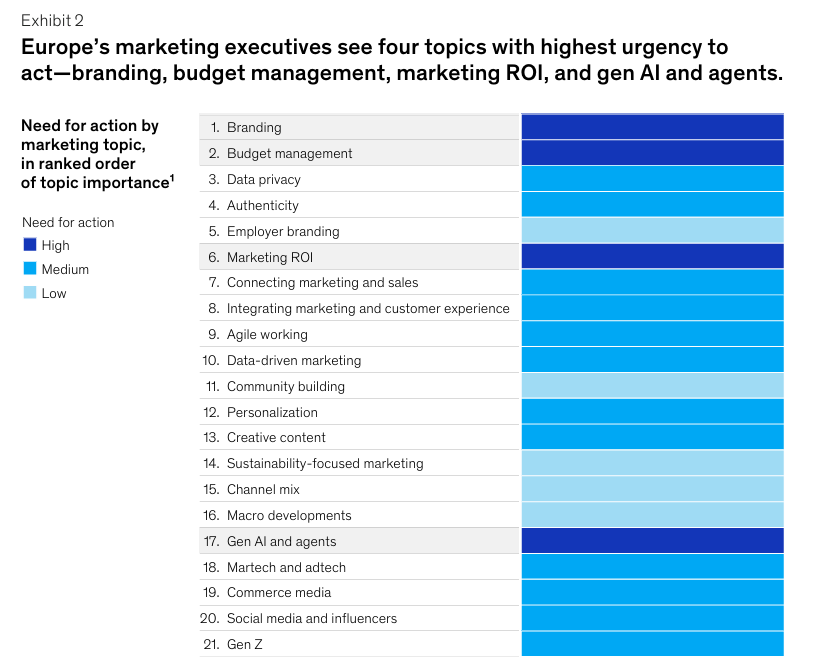
Well, the report calls out four areas with the highest urgency to act:
- branding,
- budget management,
- marketing ROI,
- and gen AI and agents.
Source: State of Marketing Europe 2026, McKinsey & Company report
Branding is being treated like a serious growth lever again. Budget management signals tighter scrutiny. ROI is the proof layer. Gen AI shows that leaders think automation and productivity gains will matter, even if many teams are still early.
If you’ve felt pulled in two directions, this is why. You’re asked to build long-term trust while also proving short-term impact. The report doesn’t say “pick one.” It implies marketing teams need a plan that can handle both without collapsing into chaos.
Where the money is moving in 2026 plans
Paid media takes a bigger share, while martech, labor, and agencies lose a bit. It reads like a practical move. Paid media is easier to scale up or down quickly. Tools and teams are harder to resize in a tight economy.
Source: State of Marketing Europe 2026, McKinsey & Company report
This is not a return to “spray and pray.” It’s more like: buy reach when you need it, then tighten efficiency in how you plan, target, and create. If your pain point is “we can’t do more with the same team,” this explains why the system is leaning toward paid media. It’s seen as a faster lever, even if it comes with risks.
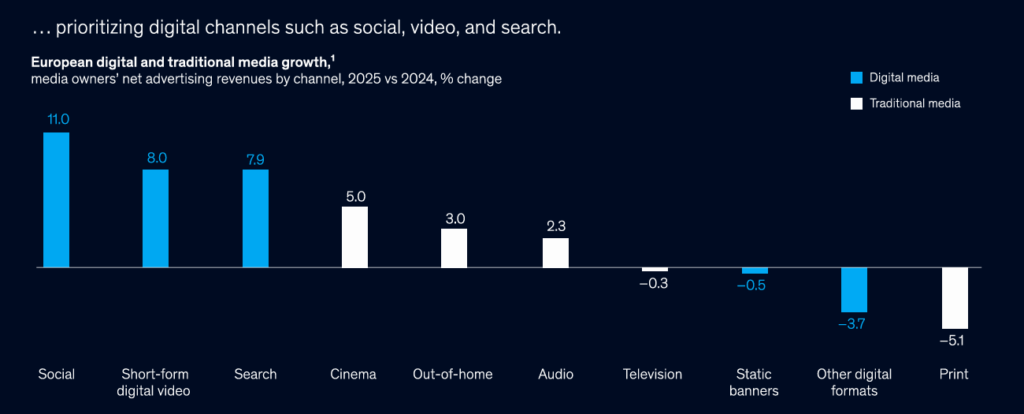
The expected growth is led by social (+11.0%), followed by short-form video (+8.0%), and search (+7.9%). This is a clean planning signal for marketing in Europe: marketers are following attention patterns. Social and short-form video also push brands to communicate fast and clearly. If you can’t earn attention in two seconds, you don’t get the next five.
Source: State of Marketing Europe 2026, McKinsey & Company report
Search staying strong fits the reality that many buying journeys still start with a question. Yet search is also evolving, and people are relying on tools to guide discovery.
The funnel conversation is shifting upward again
For years, many teams got stuck in last-click habits. Performance marketing became the default. Brand got squeezed. But that balance is changing, with more spend expected to move toward earlier stages of the funnel.
That’s a big deal for teams who feel stuck fighting over the same high-intent buyers. Because if you only compete at the bottom of the funnel, you end up bidding against everyone, with little room to stand out. Moving up-funnel is one way to create demand instead of only harvesting it.
Thus, leaders expect to increase budget share for upper funnel by +40.6%, with mid funnel +32.8%, and lower funnel +33.4%.
What that changes for your planning rhythm
This shift changes how you plan campaigns.
Upper funnel needs longer windows. It needs creative that can carry meaning without perfect targeting. It also requires measurement thinking that fits reality. You can’t judge everything by immediate conversion if you invest earlier in the journey.
It also nudges teams to connect brand and performance planning earlier. When those teams operate as separate worlds, you end up with mixed messages, duplicated work, and internal fights about attribution. A unified plan makes your story consistent across channels and helps you defend the budget as one system, not scattered tactics.
Differentiation is the new obsession
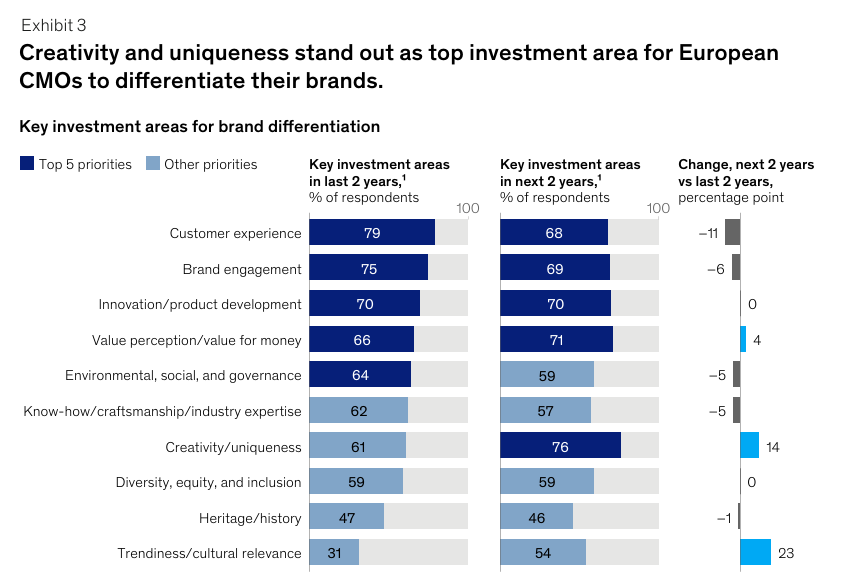
There is a shift from focusing on being “the newest and most trendy” to being “new and different to the brand”. That’s a meaningful change. Trendy campaigns can get attention. They can also dilute brand identity. Being “new and different to the brand” points to fresh work that still feels recognizably you.
Source: State of Marketing Europe 2026, McKinsey & Company report
This changes how you brief creative. You’re not only chasing what’s popular this month. You’re building memory structures. You’re trying to make people recognize you faster.
Authenticity isn’t going away, and people can smell fake fast
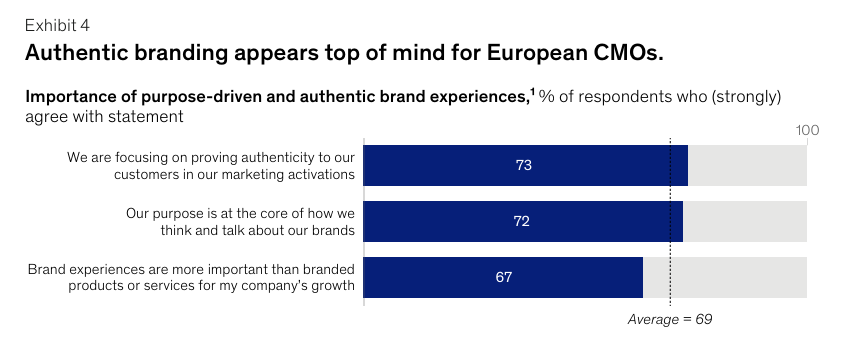
Authenticity is treated as a core theme. Audiences are tired of perfect claims and polished brand talk that does not match reality. For marketing in Europe, it connects directly to trust. If your message feels fake, you lose attention. If your experience doesn’t match your claims, you lose loyalty.
Authenticity is driven by:
- transparency,
- consistent customer experiences,
- and brand values aligned with customer values.
Source: State of Marketing Europe 2026, McKinsey & Company report
Transparency is about clear communication. Consistency is about delivering what you promised. Values alignment is about not saying one thing and doing another.
Interactive formats are shifting toward “real” and interactive
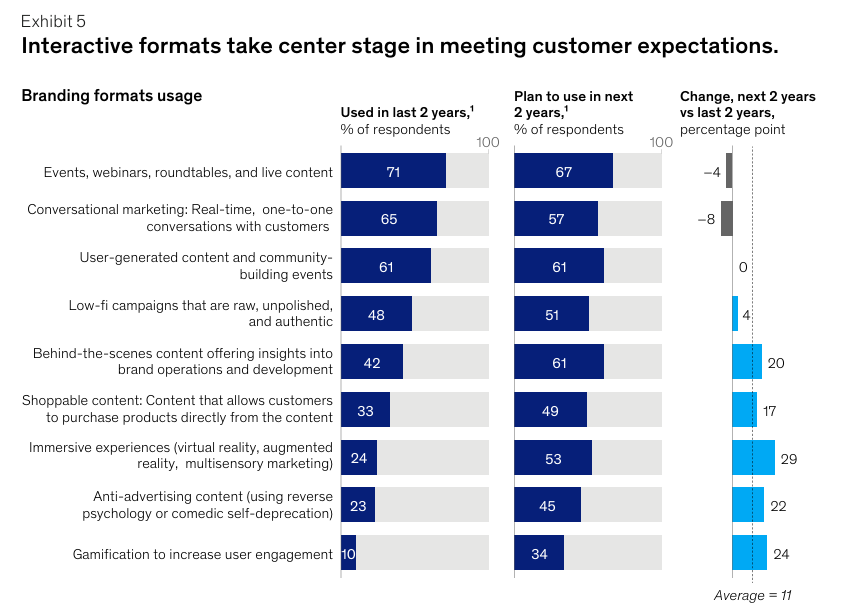
Well, people don’t only want to watch. They want to interact. For marketing in 2026, that can mean anything from quizzes and interactive tools to experiences that feel more personal and less like mass advertising.
And you can choose from many formats, like events, UGC, conversational real-time marketing, shoppable content, etc. Just look:
Source: State of Marketing Europe 2026, McKinsey & Company report
But… attention is the real bottleneck
Audiences are flooded, and performance suffers when everyone uses the same tactics. This is the quiet reason why strong offers can still underperform. There’s too much noise.
The average person is exposed to 4,000–10,000 ads daily. That makes attention a scarce resource. If your ad looks like every other ad, it disappears.
Plus, click-through rates can fall by more than 40% as brands increase digital targeting and personalization. That’s a warning. The fix is not always tighter targeting. Often it’s stronger creative, clearer value, and less generic messaging.
Marketing ROI is a priority, yet measurement coverage is still thin
This is where a lot of marketing teams feel the most pressure. Leaders want ROI. Teams measure what they can. Yet coverage is limited, and finance can sense the gap.
More than 90% can explain at least 10% of spend through MROI measurement. Only 3% can explain more than 50% of spend that way. That’s the measurement reality for marketing in Europe in 2026 planning.
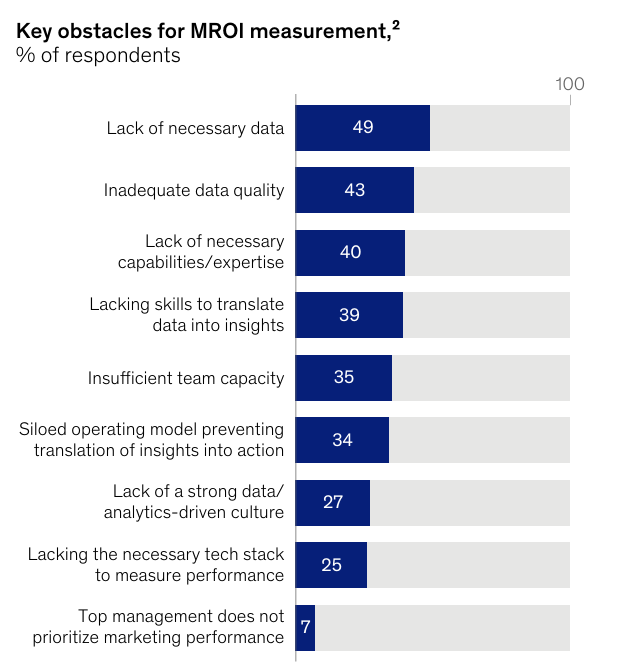
The biggest obstacles include lack of necessary data (49%), inadequate data quality (43%), lack of capabilities or expertise (40%), and lack of skills to translate data into insights (39%). These are not exciting problems. They still decide if your ROI program works.
Source: State of Marketing Europe 2026, McKinsey & Company report
And what’s matter: the most important ROI measurement area is marketing efficiency (68%). Other key priorities include full-funnel optimization (57%) and budget allocation across brands, categories, or markets (52%) (page 32). Leaders want decisions, not extra charts.
Marketing orgs are growing, but leadership structure still looks shaky
Marketing is expected to drive growth and prove ROI, yet a lot of companies still don’t give it clean authority lines to move fast and stay consistent. When that happens, marketing ends up doing two jobs at once. It has to build demand in the market and build confidence inside the company.
That tension often shows up in small, annoying ways. Teams spend time aligning on basics. Decisions take longer than they should. People argue about ownership of measurement.
McKinsey frames it as a structural issue. Marketing is becoming more central to growth, while the org setup still lags behind what the job requires.
A lot of companies still lack senior marketing leadership
One issue is that 38% of companies lack a dedicated marketing leader in the C-suite. That gap can create slow decision-making, unclear priorities, and messy measurement ownership. Not because people are incompetent. Because the org doesn’t have a clean “final call” function for marketing.
If you’ve ever tried to run cross-channel work across product, sales, and brand without a clear marketing leader at the top, you know what happens.
Plans become compromises. Strategy becomes a long deck that everyone edits. Campaigns ship late. Measurement becomes a shared responsibility, which often means it becomes nobody’s responsibility.
And in marketing in 2026, that kind of setup is expensive. It wastes time. It wastes budget. It also makes it harder to commit to longer-term plays like brand building, because nobody has the mandate to defend those investments.
Gen AI and agentic AI are the big “gap story” of 2026
And of course, the AI topic. Many teams got real efficiency gains thanks to it. Others are stuck in pilots that never scale. If your pain point is “we tried AI and it didn’t change anything,” you’re not alone.
AI outcomes depend on maturity, not intention. Teams that treat gen AI like a set of random tools get small wins. Teams that treat it like an operating upgrade get compounding gains.
Only 6% of surveyed CMOs count as gen AI leaders. Gen AI ranks 17th in importance for Europe’s CMOs overall, while gen AI leaders rank it 5th. That mismatch is the divide in one sentence.
This is also a useful lens for marketing in Europe teams that feel overwhelmed. If gen AI is still 17th for the average leader, you don’t need to rebuild everything tomorrow. Yet you also can’t ignore it, because the leaders are already treating it as top-tier priority. The gap is not about access to tools. It’s about how seriously teams take the operating change.
Efficiency gains are real for the teams doing it well
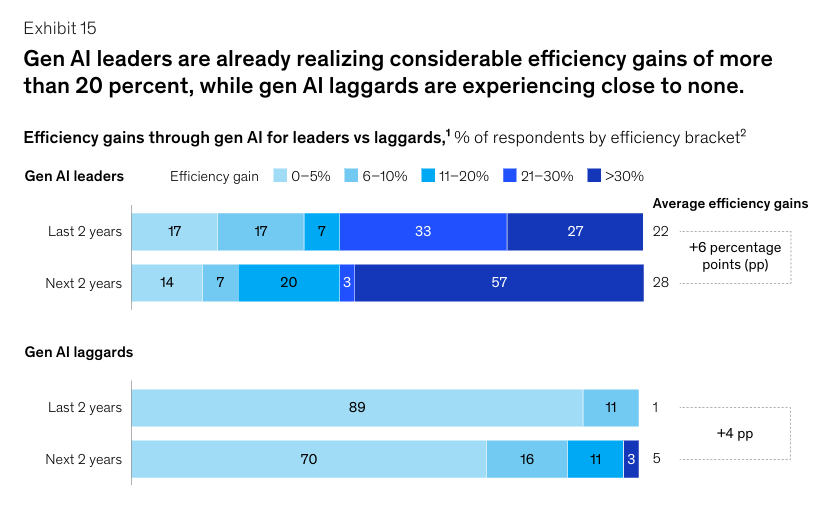
Companies with high gen AI maturity report average marketing efficiency gains of 22% in the past two years and project 28% in the next two years. That’s a meaningful lift. It’s the difference between shipping more campaigns with the same team or staying stuck in backlog land.
Further, leaders are shifting toward higher brackets, with 57% projecting more than 30% gains in the next two years. That’s a potential rewrite of how fast a marketing org can move.
Source: State of Marketing Europe 2026, McKinsey & Company report
If one team can spin up high-quality creative variations quickly, test faster, and optimize media with less manual work, they can out-iterate competitors. Not because they’re “better marketers” in a moral sense. Because their cycle time is shorter and their learning speed is higher.
What’s blocking progress depends on where you are
Even basics like technological infrastructure (81%) and adoption and scaling (65%) can block you. On the other hand, leaders cite harder problems like strategy (47%) and operating model (37%). Same tech, different stage, different headaches.
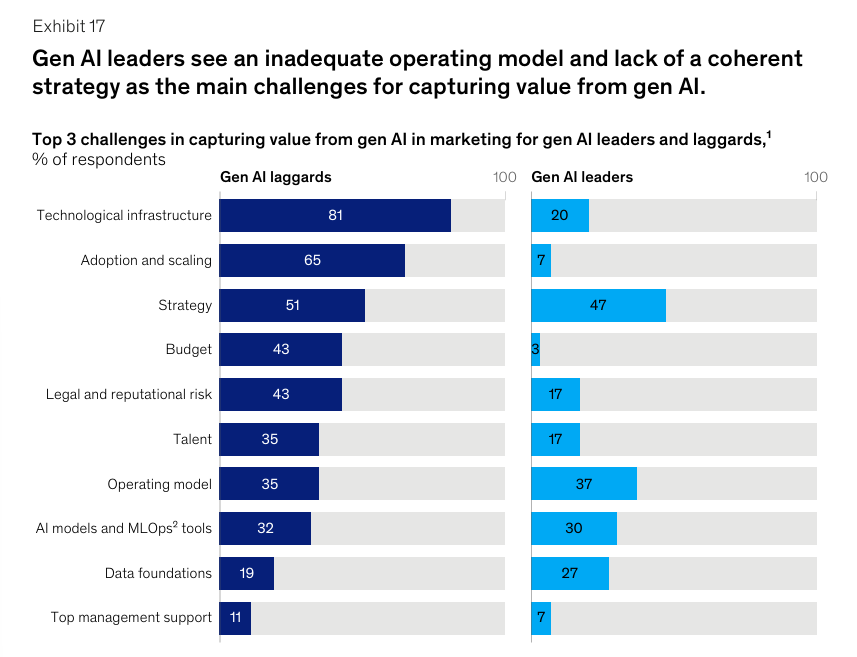
Source: State of Marketing Europe 2026, McKinsey & Company report
If you’re early, your problem is not “prompt skills.” Your problem is access, integration, governance, and adoption.
If you’re advanced, the problem becomes how to organize work around gen AI. Who owns it. How you measure it. How you prevent a mess of tools and inconsistent outputs.
Search and discovery are changing, and marketers can’t ignore it
Search and discovery are not stable anymore. We do see a shift driven by LLM-powered search experiences and answer-style discovery. That creates a new visibility game. Ranking still matters. Yet so does being the cited source, the trusted reference that the model pulls from.
This matters for marketing in 2026 because discovery is one of the few reliable demand drivers that doesn’t depend on renting attention forever. When search behavior shifts, your whole content and performance system gets affected. Your SEO strategy. Your paid search strategy. Your content strategy. Even your brand strategy, because trust signals matter more when answers are summarized for people.
SEO is evolving into GEO
Moreover, the classic SEO is moving toward generative engine optimization (GEO), tied to AI-generated summaries and recommendations. It also states that more than 50% of AI search users now rely on these tools to guide discovery and purchase decisions.
That one line should change how marketing in Europe teams think about content. You’re not only writing for Google rankings. You’re writing for answer extraction. That means clearer structure, clearer claims, stronger sourcing, and content that is easy for an AI system to interpret. It also pushes brands to publish content that feels credible and specific, because generic posts are less likely to be referenced in an answer.
For practical planning, GEO thinking changes the “what do we publish?” conversation. Instead of chasing broad keywords only, you focus on questions buyers actually ask. You build pages that answer them cleanly. You add proof points. You make content skimmable. You make it easy to cite.
Recap on what’s changed in marketing in 2026
Marketing in Europe is shifting back toward longer-term value, yet the demand for proof is stronger than ever.
Budgets are a real slice of the business, with marketing averaging 8.7% of revenue, so scrutiny is built in. Many companies still lack clean senior marketing leadership, with 38% missing a dedicated marketing leader in the C-suite, which can slow decisions and blur accountability.
Gen AI is where the gap is widening fast. Only 6% are gen AI leaders, yet those leaders are already reporting 22% efficiency gains and projecting 28% more, with 57% expecting more than 30% gains.
Search behavior is also shifting. GEO is becoming part of the job, and more than 50% of AI search users rely on AI tools for discovery and purchase decisions.
Last words
So, where does that leave you with marketing in Europe in 2026?
In a very real place. Budgets are moving, channels are loud, so “good enough” work gets ignored. Brand is back in the spotlight, yet it has to sit next to ROI without getting defensive. And AI is now a divider: some teams move faster every month, others keep testing tools without changing how they work.
If you want one simple takeaway, it’s this: pick a few priorities and make them stick.
Tighten what you measure. Make your creativity more distinctive. Keep your message honest and consistent.
Marketing in 2026 rewards teams that stay clear, stay focused, and keep shipping. Not perfect. Just better every cycle.