BEHIND THE CLICK PODCAST WITH ALEXANDER HOLZKNECHT: Why You Can’t Outperform a Bad Assortment
Written by
Editorial TeamPublished on
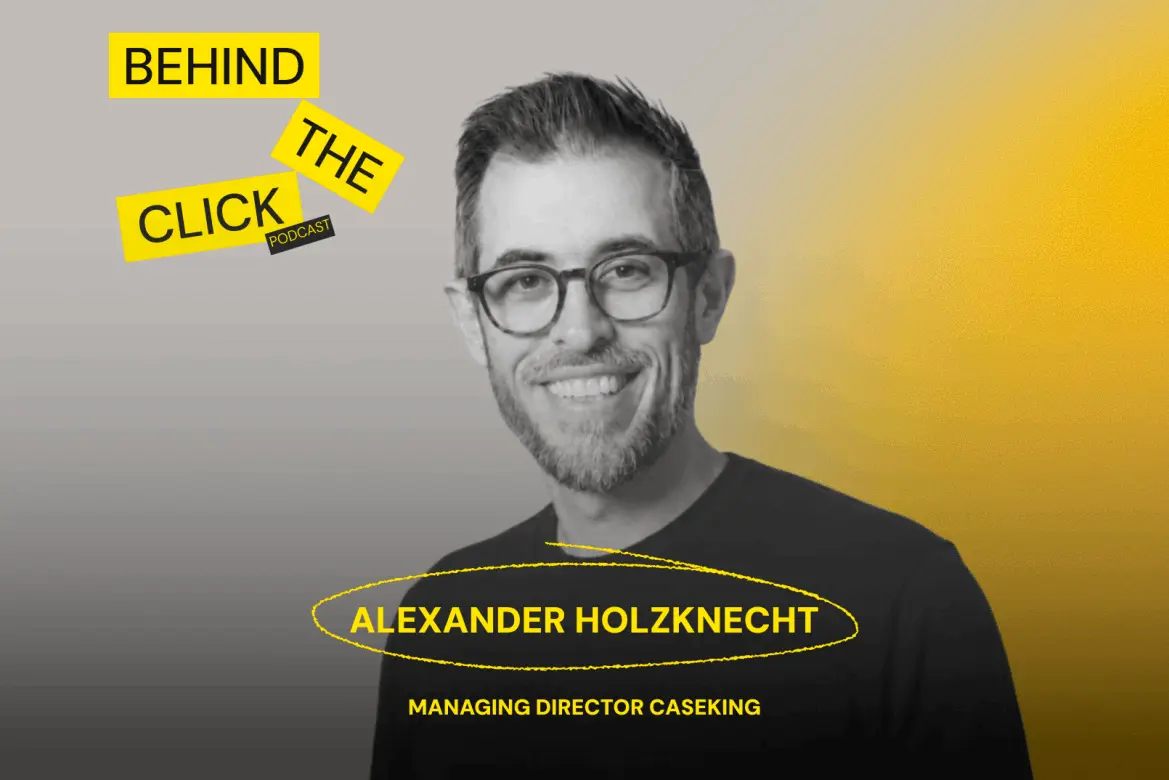
Discover how Alexander Holzknecht, General Manager of Caseking, explains why you can’t outperform a bad assortment and why human judgment and relationships still matter in an increasingly AI-driven e-commerce landscape in the latest Behind the Click Podcast episode.
What happens when you take a company with more than 20 years of history and try to make parts of it move with the speed of a startup?
That was one of the questions at the heart of the latest episode of Behind the Click, hosted by Janine Vanessa Heinrich. This time, Janine was joined by Alexander Holzknecht, General Manager of Caseking, for a conversation that moved from product assortment and customer behaviour to organizational transformation, AI and the human relationships that still underpin business.
And one idea kept resurfacing throughout the conversation:
You cannot outperform a bad assortment.
Great marketing cannot rescue the wrong product proposition
E-commerce conversations often gravitate toward performance marketing, UX, checkout optimization and conversion rates.
Our guest argued that companies sometimes focus so much on these levers that they overlook the thing everything else depends on: the product itself.
If the proposition is not compelling to the customer, pouring more money into marketing or optimizing individual steps in the funnel can get expensive quickly. Marketing, UX and other improvements matter, but they work as amplifiers. The product and assortment have to come first.
That becomes especially interesting in retail, where an assortment is not simply a collection of products.
Different products can play very different roles in the customer journey.
Drawing on his previous experience in FMCG, Alexander Holzknecht described how one group of products could attract shoppers with a strong deal, another could keep them browsing by offering something interesting to discover, while basic products such as pasta, rice or tomatoes could ultimately help create a basket large enough to justify checkout.
The same underlying dynamic, he said, could also be applied to gaming hardware today.
More choice does not automatically mean a better assortment
One of the episode’s most practical discussions focused on something many retailers find difficult: reducing choice.
Online shelf space might technically be almost unlimited, but our guest challenges the assumption that a specialist retailer therefore needs to offer everything within its niche.
For a specialist, expertise can also mean making a useful pre-selection for the customer. In his view, more curated assortment can make navigation easier and allow the business to work more intentionally with individual products and supplier partners.
A concrete example came from Caseking’s pre-built gaming PCs.
When Alexander Holzknecht joined the company, he found the existing configurations difficult to understand from the perspective of a customer who was informed, but not an expert on the subject. The team subsequently introduced the Kingforge lineup: a much cleaner range consisting of six pre-built gaming PC configurations, spanning roughly €1,000 to €6,000.
According to Holzknecht, sales of these ready-made systems tripled overnight.
The underlying products were not suddenly radically better. The major change was clarity: fewer options, clearer positioning and a proposition that became much easier to communicate through marketing.
It is a good illustration of one of the episode’s central themes: sometimes simplifying the choice can change much more than adding another layer of optimization.
From building businesses to transforming a 20-year-old company
The conversation then shifted from assortment to organization.
Alexander Holzknecht spoke about his experience building businesses from scratch. At Caseking, the challenge was different: helping an established organization adapt while preserving the successful foundation built over more than two decades. His approach brought back an idea he had worked with before: speedboats.
Instead of attempting to transform an entire complex organization at once, a company can isolate a particular problem or business area, give it greater autonomy and treat it more like a new venture.
That can make experimentation and faster iteration easier.
But there is a catch.
At some point, the speedboat has to reconnect with the larger organization. And according to Alexander, that is where much of the difficulty begins.
Creating a speedboat is easier than bringing it home
A separate team can move quickly because it operates differently from the core organization.
But when the project needs to be reintegrated, speed can disappear, stakeholders can resist the change, and existing responsibilities begin colliding with the new initiative.
What can improve the chances of success is preparing the wider organization early. The speedboat may operate with considerable autonomy, but people across the company should understand from the beginning what it is intended to become and why it exists.
From his experience, missing stakeholder buy-in is more often the reason these initiatives fail than simply integrating them too early.
And transformation requires more than giving someone permission to experiment.
Leaders also have to remove the blockers that appear along the way.
If a team receives a mandate to create something new but repeatedly runs into organizational barriers without support, the autonomy is largely theoretical. That is why Alexander emphasizes repeatedly explaining what the company is trying to achieve, why temporary friction is being created and where the organization ultimately wants to go.
AI should make people better, not replace the thinking
AI naturally entered the conversation too.
Alexander spoke positively about using it to improve efficiency, but his preferred workflow starts with human input.
His example was using AI to polish something that is already around 70% complete rather than asking AI to create 70% of the thinking and having a person simply refine the output afterwards.
For him, the important part is coming with the idea and the concept first, then treating AI as a sparring partner or a tool for improving the result.
The same philosophy appeared later when the conversation turned to AI in commerce.
Alexander expects AI to materially change shopping and described agentic commerce as potentially becoming a new form of product exploration. But in his view it doesn’t remove the importance of assortment itself.
The interface through which customers discover products may evolve dramatically. The underlying question remains: do you have the right products for the right customer?
The part of business AI still struggles to replace
Perhaps the most human part of the episode came when Janine and Alexander discussed relationships.
Companies can automate processes and reduce transaction costs, but our guest argued that some of the strongest foundations of business still come from sitting down with another person and understanding what they actually need.
That might mean speaking directly with an important supplier and asking where they are struggling, what their current priorities are and what kind of business relationship could create value for both sides.
AI can process standardized information extraordinarily efficiently. What Alexander finds harder to imagine it replacing in the near to medium term is the process of uncovering the motivations behind that information through genuine conversation.
His position is not anti-AI.
Quite the opposite: he believes companies should spend significant time figuring out how AI can make their operations more efficient.
The challenge is doing so without losing what makes the company unique or what allows it to stand out.
Speed is not the same as doing everything faster
Toward the end of the episode, Alexander also pushed back on another popular startup idea: “fail fast.”
In his opinion, for an established organization, simply doing more things more quickly is not necessarily progress.
Instead, he recommends first understanding responsibility areas and their interdependencies, identifying where faster independent decision-making is actually possible, and then working from a strong hypothesis.
His preference is not to experiment randomly and see what sticks, but to have a clear idea of what you believe could work and test it deliberately.
Moving faster does not necessarily require throwing away the fundamentals.
Whether the subject is product assortment, organizational transformation or AI, the recurring message is surprisingly consistent: understand what really drives the outcome first, and then use technology, marketing and organizational structures to amplify it.
As Alexander Holzknecht put it in his closing thought, businesses should keep their audience in mind and focus first on the weakest part of the system, because that is ultimately what limits performance.
Watch the full episode with Alexander Holzknecht
The full conversation went much deeper into product assortment, customer behaviour, Caseking’s transformation, speedboat teams, stakeholder buy-in, AI and the role of human relationships in an increasingly automated business environment.
To hear Alexander Holzknecht explain these ideas in full, in his own voice and with all the nuance that can’t fit on a page, watch the complete episode of Behind the Click:
You can also listen to the episode on Spotify and Apple Podcasts.