Top re-engagement strategies for online retailers in Germany
Explore re-engagement tactics for online retailers in Germany. Revitalize your customer base and maximize your sales with our strategic guide.
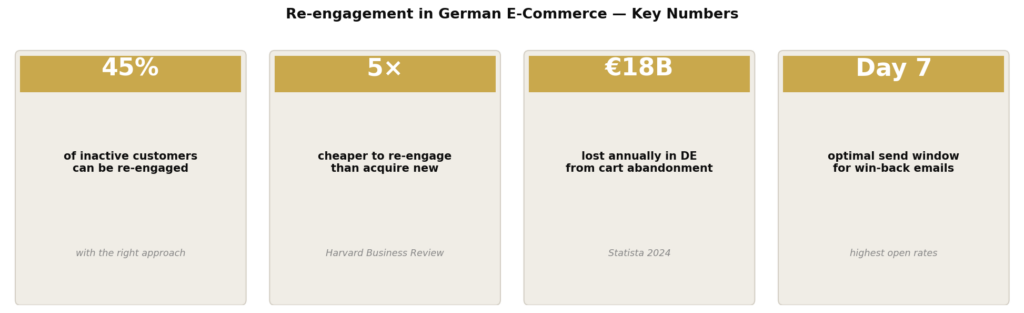
Up to 45% of inactive customers can be won back — if you reach them the right way, at the right time. For German online retailers, re-engagement is one of the highest-ROI marketing investments available. Here’s how to do it.
Why Re-engagement Matters More Than Acquisition
Acquiring a new customer in German e-commerce costs, on average, five times more than winning back a dormant one. Yet most online retailers in the DACH region still allocate the majority of their marketing budget to acquisition — chasing cold audiences via paid search and social ads — while neglecting the warm, already-converted customers sitting inactive in their CRM.
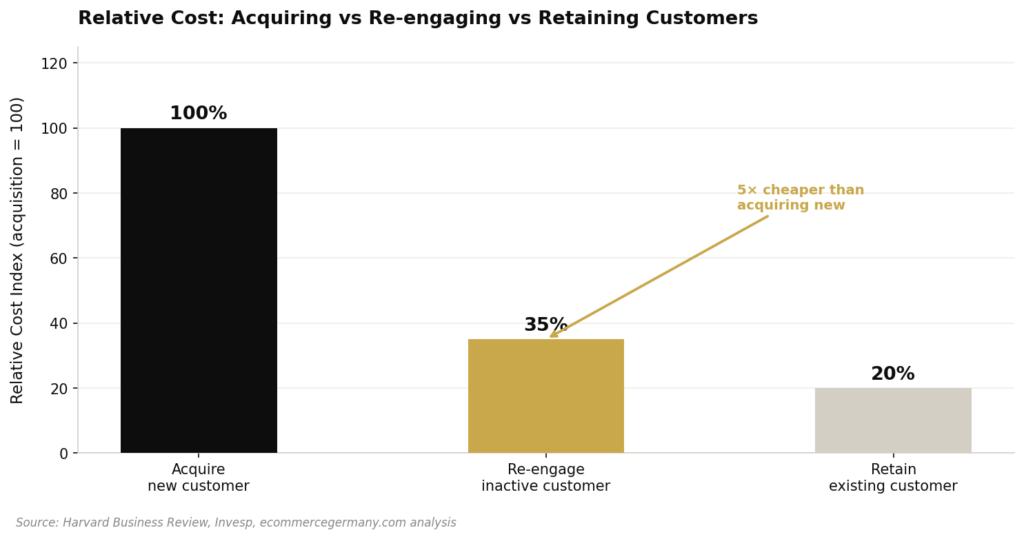
The numbers make a compelling case for shifting the balance. An inactive customer already knows your brand, has shared their data, and has previously trusted you enough to purchase. The barrier to re-conversion is significantly lower than it is for a cold prospect — particularly in Germany, where consumer trust and brand familiarity are unusually strong purchase drivers.
According to research from Harvard Business Review and Invesp, increasing customer retention rates by just 5% can boost profits by 25–95%. In a market like Germany — where e-commerce revenues faced headwinds in recent years — extracting more value from your existing customer base is not just smart, it’s essential.
Understanding the German Inactive Customer
Before building a re-engagement strategy, it helps to understand why German customers go inactive in the first place. The reasons differ meaningfully from other markets:
Price sensitivity and comparison shopping
German consumers are famously price-conscious. Many “inactive” customers haven’t left your brand — they’re simply waiting for a better deal, or have found a lower price on a marketplace. A well-timed offer can bring them straight back.
Trust erosion after a poor experience
Germany has one of the highest return rates in Europe, and a difficult return experience is one of the top reasons customers disengage. If a customer’s last interaction involved a return dispute or slow refund, their inactivity is a signal, not random drift. See our analysis of how returns policies drive loyalty and cut churn.
Inbox overload and generic communication
German consumers receive an average of 121 marketing emails per week. If your messaging is not personalised, relevant, and well-timed, it will be filtered, ignored, or — worst case — marked as spam, which can damage your sender reputation permanently.
Life stage changes
Customers who purchased baby products, furniture, or fashion may simply have moved past that life stage. Effective re-engagement acknowledges this rather than serving the same product categories they’ve outgrown.
The Customer Lifecycle: When Does Re-engagement Begin?
Not all inactive customers are the same. A customer who last purchased 35 days ago needs a very different message than one who last purchased 6 months ago. Mapping your customer base against lifecycle stages is the essential first step.
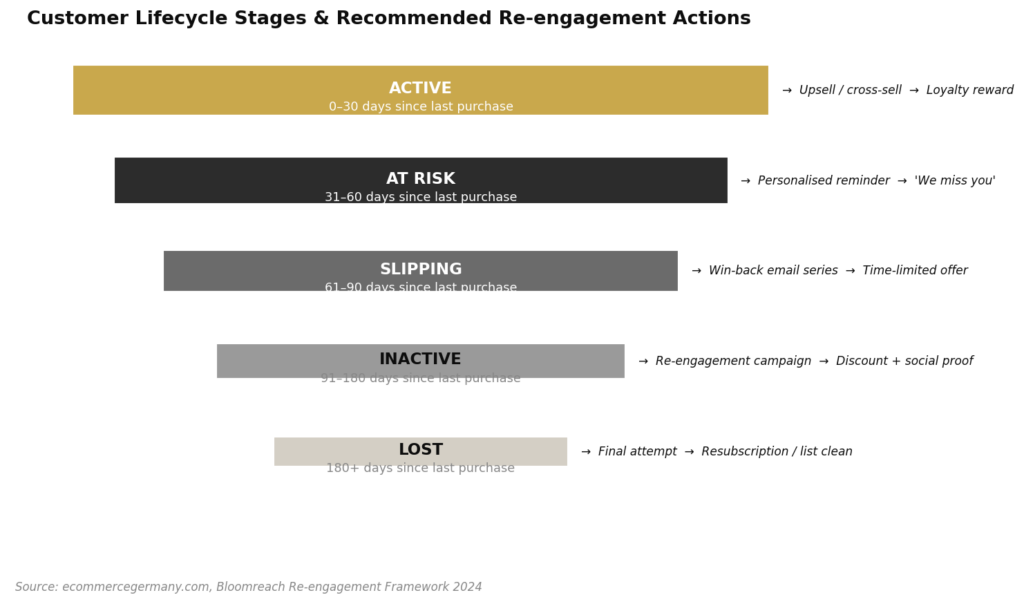
Most German retailers use a tiered model:
| Stage | Inactivity Window | Signal | Recommended Action |
| Active | 0–30 days | Normal purchase cycle | Upsell / cross-sell / loyalty |
| At Risk | 31–60 days | Starting to drift | Personalised “we miss you” |
| Slipping | 61–90 days | Clear engagement drop | Win-back series + time-limited offer |
| Inactive | 91–180 days | High churn probability | Re-engagement campaign + social proof |
| Lost | 180+ days | Very low purchase intent | Final attempt or list clean |
The key insight here is that earlier intervention is far more effective. A customer at “At Risk” stage can be recaptured with a simple personalised nudge. By the time they reach “Lost” status, recovery rates drop below 5% and aggressive re-engagement may actually harm your sender reputation.
Build automated triggers in your CRM or marketing automation platform that move customers into the correct segment as their inactivity window grows — and fire the appropriate campaign automatically. If you’re not yet using automation for this, our overview of AI automation in e-commerce is a useful starting point.
Top Re-engagement Strategies for German Retailers
1. The Personalised Win-Back Email Series
The most consistently effective re-engagement tool across DACH remains email — but generic newsletters don’t cut it. The key is a dedicated win-back sequence that differs structurally and tonally from your regular communication.
A high-performing German win-back series typically follows this arc:
Email 1 (Day 7 after trigger): “We noticed you’ve been away”
Acknowledge the absence without being passive-aggressive. Reference the customer’s last purchase or browsing category. Keep the tone warm and personal. No heavy discount yet — this is a relationship touch, not a panic offer.
Email 2 (Day 14): “Here’s what you’ve missed”
Curated new arrivals or restocks in their interest category. Include social proof — reviews, ratings, bestseller badges. A soft incentive (free shipping, gift wrapping) can work well here without training price-sensitivity.
Email 3 (Day 21): Time-limited offer
Now introduce the discount — but frame it as exclusive, not desperate. “A special offer, just for you” outperforms “20% off everything.” Make the deadline clear and credible (72 hours, not “limited time”).
Email 4 (Day 30): Final goodbye / preference update
The most underrated email in any win-back series. Acknowledge you’ll stop emailing if they don’t engage, and offer them a lower-frequency communication option. This email often generates the highest click rate of the series — customers who weren’t ready to purchase often opt into reduced frequency rather than full unsubscribe, keeping the relationship alive.
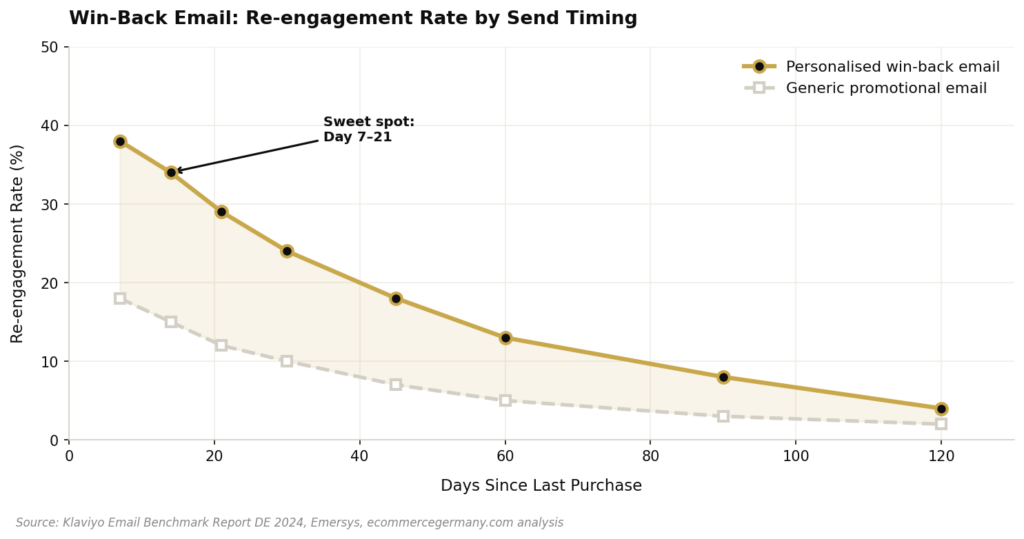
The data consistently shows that Days 7–21 are the sweet spot for win-back email performance. After 30 days, re-engagement rates drop sharply. After 90 days, email re-engagement alone rarely exceeds 5%. Don’t wait.
2. SMS and WhatsApp — Germany’s Underused Re-engagement Channel
WhatsApp has a 92% penetration rate in Germany, and it is the dominant messaging platform by a significant margin. Yet most German retailers have been slow to leverage WhatsApp for re-engagement, creating a real first-mover advantage for those who act now.
WhatsApp Business API allows retailers to send personalised, consent-based messages with far higher open rates than email (typically 35–45% open rate vs 18–28% for email). For re-engagement, this means:
- A single WhatsApp message referencing a customer’s abandoned cart can outperform a 3-email sequence
- Product restocks in previously browsed categories can trigger immediate re-visits
- Post-purchase follow-ups via WhatsApp build a direct channel that is genuinely difficult to replicate via email
Critical compliance note: WhatsApp Business messaging in Germany requires explicit opt-in consent that is separate from email consent. Do not attempt to message customers who have only provided email consent — this will violate both WhatsApp’s terms and GDPR, with significant legal exposure in Germany’s strictly-enforced regulatory environment.
See our in-depth guide to WhatsApp automation in e-commerce for implementation guidance.
3. Personalisation at Scale: Beyond “Hi [First Name]”
True personalisation in re-engagement goes well beyond inserting a customer’s first name in an email subject line. For German retailers with sufficient data depth, re-engagement messaging should reflect:
- Purchase history: Category affinity, average order value, preferred brands
- Browse behaviour: What they looked at but didn’t buy — high intent signals
- Seasonal patterns: Did they buy last year at Easter, Black Friday, Christmas?
- Return behaviour: If they have a history of returns in a specific category, don’t re-engage them with that category
- Device and channel preference: Desktop shoppers and mobile app users need different message formats
The infrastructure for this exists across most modern marketing platforms. The barrier is usually data quality rather than technology capability. Invest in valid, clean customer data as the foundation before optimising the messaging layer.
AI-powered personalisation is increasingly accessible for mid-market retailers too. Tools like Bloomreach, Emarsys, and Klaviyo all offer segment-level behavioural personalisation without requiring a data science team. Read our overview of AI-driven personalised shopping experiences for a practical assessment of the options available to DACH retailers.
4. Loyalty Programme Re-activation
If you run a loyalty or points programme, dormant members are a distinct and highly re-engageable segment. A “your points are expiring” notification is one of the most reliably high-performing re-engagement triggers in e-commerce — because it creates genuine urgency around something the customer has already earned.
Effective loyalty re-activation in the German market typically includes:
- Points expiry warning (60 days, 30 days, 7 days before expiry)
- “Double points” limited event to incentivise a first re-purchase
- Tier downgrade warning for customers at risk of losing status
- Personalised reward suggestion — not generic discounts, but rewards matched to purchase history
German consumers respond particularly well to value-based loyalty programmes (cashback, product rewards) over gamified point systems. Transparency about how points convert to value is essential — opacity in loyalty mechanics is a significant trust detractor in this market.
For retailers managing multiple reward types or re-engagement campaigns at scale, a voucher management system can make it easier to create, distribute and track personalised vouchers while keeping redemption rules consistent across different customer segments and channels.
And for a broader look at how post-purchase communication drives retention, see our guide to post-purchase strategies for customer retention.
5. Retargeting: Pairing Digital Ads with Email Re-engagement
Re-engagement email campaigns work significantly better when paired with coordinated paid retargeting. A customer who receives a win-back email and then sees a matching display or social ad experiences consistent brand reinforcement — the “ambient presence” effect that increases conversion probability.
The mechanics are straightforward using customer data platforms (CDPs) or email platform integrations with Meta and Google Ads:
- Build a suppression audience of your active customers (to avoid wasting paid spend on people who already buy)
- Build a re-engagement custom audience from your inactive segment
- Run lower-intensity creative — not acquisition ads with price-led messaging, but reminder-style creative that references the brand relationship
Keep retargeting frequency low (2–3 impressions per week maximum) for re-engagement campaigns. German consumers are more likely than average to use ad blockers and more sensitive to perceived surveillance-style advertising. Frequency capping and contextual targeting (rather than pure behavioural retargeting) perform better in this market.
6. Browse Abandonment and Cart Abandonment Flows
Cart abandonment is a specific and highly recoverable form of customer inactivity. In Germany, approximately €18 billion in potential e-commerce revenue is lost annually to cart abandonment — and the recovery rate through well-constructed abandonment flows can reach 15–20%.
Key elements of a high-performing German cart abandonment flow:
- First message within 1 hour of abandonment (while purchase intent is still warm)
- No immediate discount in message 1 — start with a simple “you left something behind” reminder with a prominent CTA back to the cart
- Social proof in message 2 — reviews of the abandoned product(s), stock availability warning if relevant
- Gentle incentive in message 3 — free shipping or a small voucher, positioned as helpful rather than desperate
- GDPR compliance: Abandonment emails in Germany require that the customer has already opted into marketing communications, or that you rely on the “soft opt-in” provision for existing customers — which has specific conditions. Always have this reviewed by legal counsel.
For conversion rate optimisation that reduces abandonment in the first place, see our guide to boosting conversion rates with inbound traffic.
7. Omnichannel Re-engagement: Connecting Online and Offline
For retailers with physical presence in Germany alongside their online channel, omnichannel re-engagement creates powerful additional touchpoints. Customers who are inactive online may still be visiting stores — and those interactions are opportunities to re-activate the digital relationship.
Practical approaches include:
- In-store QR codes that prompt loyalty programme login and trigger a digital re-engagement sequence
- Email capture at POS for customers who haven’t shopped online recently
- Online-exclusive re-engagement offers surfaced through in-store receipts or packaging inserts
The omnichannel opportunity is significant given that building an omnichannel ecosystem is increasingly critical for DACH retailers. Re-engagement is one of the clearest practical applications of that strategy.
Channel Guide: Which Channels Work Best in Germany?
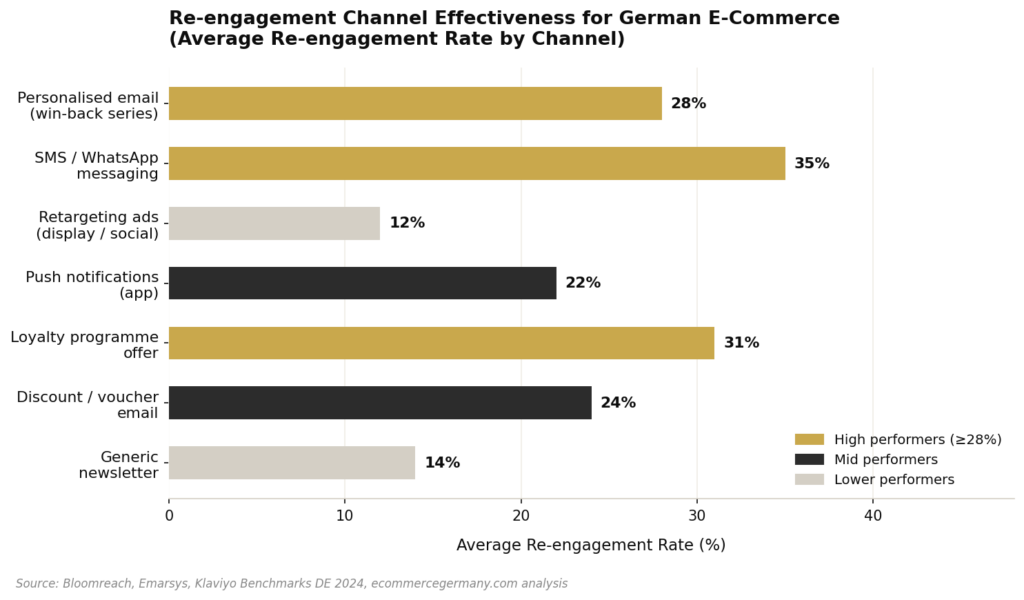
| Channel | Avg. Re-engagement Rate | Best Use Case | German Market Note |
| WhatsApp / SMS | 35% | Urgent triggers, cart recovery | High penetration; opt-in essential |
| Loyalty offer email | 31% | Points expiry, tier nudge | High trust; works well for value shoppers |
| Personalised win-back email | 28% | Dormant customers 7–30 days | Segment carefully; timing is critical |
| Push notification (app) | 22% | Recent installers, high-intent | Lower reach; higher relevance |
| Discount email | 24% | Price-sensitive segment | Risk of training discount dependency |
| Retargeting (display/social) | 12% | Supporting email sequences | Use for reinforcement, not standalone |
| Generic newsletter | 14% | Active subscribers only | Not a re-engagement tool |
The German Privacy Factor: GDPR and Re-engagement
Germany’s enforcement of GDPR is among the strictest in Europe. The Bundesdatenschutzbeauftragter (Federal Data Protection Commissioner) and state-level Landesdatenschutzbehörden are active and well-resourced, and fines for marketing compliance failures are substantial.
Key compliance requirements for re-engagement campaigns:
Consent must be current and documented
If a customer opted in to email marketing three years ago and has since made no contact with your brand, their consent may no longer be considered “freely given and informed” under strict GDPR interpretation. Review your consent records before launching any re-engagement campaign to dormant lists.
Unsubscribes must be honoured immediately
Any customer who has previously unsubscribed from marketing communication must never receive a re-engagement email — even if they later made a purchase. German courts have been unambiguous on this point.
The “soft opt-in” provision is narrowly interpreted
The EU’s e-Privacy Directive allows marketing to existing customers for similar products without fresh consent — but German courts apply this provision more narrowly than many retailers assume. Get legal advice before relying on soft opt-in for a large-scale re-engagement campaign.
For a full overview of the legal landscape, see our guide to regulatory and compliance issues in German e-commerce and our analysis of data privacy vs personalisation in DACH.
Measuring Re-engagement Success
Track these metrics at a campaign level, not just channel level:
- Re-engagement rate: % of targeted inactive customers who open/click at least one message
- Re-purchase rate: % of re-engaged customers who make a purchase within 90 days
- Revenue per re-engaged customer: Compare to new customer first-order value and lifetime value trajectory
- List health improvement: Reduction in hard bounces and spam complaints after cleaning
- Unsubscribe rate per campaign: A spike here signals messaging that is too aggressive or poorly targeted
The most important long-term metric is Customer Lifetime Value (CLV) delta — are customers who were re-engaged performing similarly to customers who never went inactive? If re-engaged customers churn again within 60 days, the campaign may be solving the symptom (inactivity) without addressing the cause (poor product-market fit, pricing, or experience quality).
Common Mistakes to Avoid
Starting with a discount
Immediately offering 20% off to a dormant customer trains them to go inactive and wait for a deal. Start with relevance and value; escalate to incentives only if needed.
Treating re-engagement as a one-time campaign
The most effective re-engagement is a continuous, automated process triggered by behaviour — not a quarterly “blast the inactive list” exercise.
Ignoring the reason for inactivity
If a cohort of customers went inactive after a specific product launch, a returns spike, or a price increase, their inactivity is telling you something important. Segment by inactivity trigger before writing a single email.
Sending to invalid or stale emails
German ISPs are aggressive about spam filtering. Sending to a list with high bounce and complaint rates will damage your deliverability for your entire customer base — including your active, engaged segment.
Not cleaning your list
Some customers will not come back. A segment that has been inactive for 12+ months, has received 3+ re-engagement attempts, and has never engaged should be removed from your active marketing list. A clean, engaged list is worth far more than a large, inactive one. Use the final “goodbye email” as a graceful exit — and honour those who don’t re-engage.
Over to you
Re-engagement is not a salvage operation — it’s a planned, data-driven growth lever. German retailers who invest in structured win-back flows, lifecycle-based segmentation, and compliant personalisation consistently outperform those who focus exclusively on acquisition. Start with your “At Risk” segment, send within Day 7, personalise beyond the first name — and measure everything.