Shopware Product Configurators: How Manufacturers and B2B Merchants Master Demanding Sales Processes
Written by
Editorial TeamPublished on
Discover how Shopware product configurators help B2B merchants automate complex sales, validate technical rules, and speed up quotes. (Ad)
Written by Jan Entzminger, CEO of blindwerk
Standard products are easy to sell, but complex B2B goods pose significant challenges for many online shops. While the B2C market often benefits from standard variants, industrial manufacturers and wholesalers frequently hit the limits of conventional e-commerce systems. Intelligent Shopware product configurators, however, bridge this gap by precisely and accurately mapping technical dependencies digitally. For companies looking to secure their competitiveness in the digital age, the use of such systems is virtually indispensable.
The B2B Complexity Gap: Why Traditional Systems Fail
Most e-commerce projects start with a basic model of variant management. This is typically done using simple dropdown menus or selection fields that allow users to choose from a static list of combinations. While this model works excellently for clothing, household goods, or simple consumer products, it creates insurmountable bottlenecks in the B2B environment. This is exactly where the limitations of many conventional approaches become apparent.
A powerful platform like Shopware, however, offers the necessary foundation through its modular architecture to overcome this complexity gap as well as the limitations of simple variant logic. As soon as products reach a certain level of technical depth, this architectural approach becomes crucial for the scalability of digital sales.
The Limits of Standard Variant Logic
With increasing technical complexity in product catalogs, classic variant management systems eventually reach a point where fundamental sources of error arise. These include:
- Administrative Burden: Product maintenance becomes a liability. When material costs fluctuate or technical specifications need to be updated, manual adjustment across thousands of potential variants is practically impossible. The lack of a centralized, logic-driven database leads to data silos. Consequently, information in the webshop often deviates from data in the ERP system, leading to a loss of trust.
- Combinatorial Explosion: In modern manufacturing, products often require the selection of motors, housings, power supplies, control units, and specific cooling systems. Each of these components is subject to strict compatibility rules. If a product has, for example, ten attributes with five options each, the mathematical number of potential combinations can reach the millions. Managing these possibilities as static database variants is inefficient and causes administrative overhead that makes scaling impossible.
- The Dilemma of Dependencies: Technical goods are based on complex, rarely linear dependencies. Selecting Component A might exclude Component B but mandate the inclusion of Component C. Attempting to map such rules in a standard CMS or via simple custom fields inevitably leads to complex, difficult-to-maintain database queries and gigantic variant sets. This negatively impacts the performance of the shop and leads to a poor user experience.
- The Cost of Inaccuracy: In manual or inadequate digital systems, customers regularly order configurations that are physically impossible to manufacture. This initiates an expensive cycle of technical review, time-consuming manual correspondence, and production delays. These inefficiencies drastically increase operating costs and significantly diminish the quality of the B2B customer experience.
From pump manufacturers, where incorrect material pairings immediately lead to chemical corrosion, to agricultural machinery producers that must automatically calculate axle loads – the need for intelligent logic engines is ubiquitous. These scenarios clearly show that without a viable configuration logic, a dangerous gap emerges between customer expectations and technical reality.
Redefining the Sales Cycle: Expectations for Digital B2B Sales
B2B buyers today expect the same digital self-service functions they know from B2C retail. If an e-commerce platform cannot adequately meet their growing needs, they inevitably revert to offline-oriented inquiries. This leads to inefficient “ping-pong” communication: customers formulate their requirements in unstructured emails, while sales teams attempt to calculate them in complex, often error-prone Excel spreadsheets. This manual process creates enormous friction, massively increases the risk of calculation errors during data transfer, and blocks valuable resources because generating a quote can take precious days.
This shift forces the sales team back into administrative tasks instead of focusing on high-value consulting and technical project management. A modern product configurator transforms this process: it turns a passive product display into an active consulting service that is available 24/7.
The Logic Engine: Requirements for Modern Configurators
A modern product configurator is more than just a mere visualization tool. Rather, it functions as an intelligent logic engine that completes the transition from displaying static data to real-time calculation of technical feasibility. To successfully map this process, a configurator solution must meet the following four core requirements:
- Rule-Based Configuration: The core of every configurator is the rule engine. The system must enforce constraints automatically and in milliseconds. If a user selects a specific high-voltage component, the system must immediately hide incompatible housings or actively inform the user about the incompatibility. It must also proactively suggest valid alternatives. This logic is calculated dynamically and must never rely on pre-calculated, static variants.
- Dynamic Real-Time Price Calculation: B2B transactions require absolute price transparency. The configurator must calculate the final price of the configuration based on selected components, quantities, and any discounts in real-time. This requires tight integration where price logic is provided via the ERP system, often supplemented by powerful middleware or direct system connections.
- Technical Plausibility Checks: This serves as an essential safety guardrail for the customer. The system must verify the technical integrity of the configuration before it enters the shopping cart. This ensures that every order reaching the production system is manufacturable. Technical clarifications after the order can thus be significantly reduced, which massively shortens production lead times.
- Automated Documentation and Technical Data: The output of a high-performance configurator goes far beyond a simple order line item. It generates the necessary technical documentation—bills of materials, data sheets, CAD files, or 3D previews—directly based on the final configuration. It thus builds the digital bridge between the webshop and production.
Shopware as an Orchestration Platform for High-End B2B Configurators
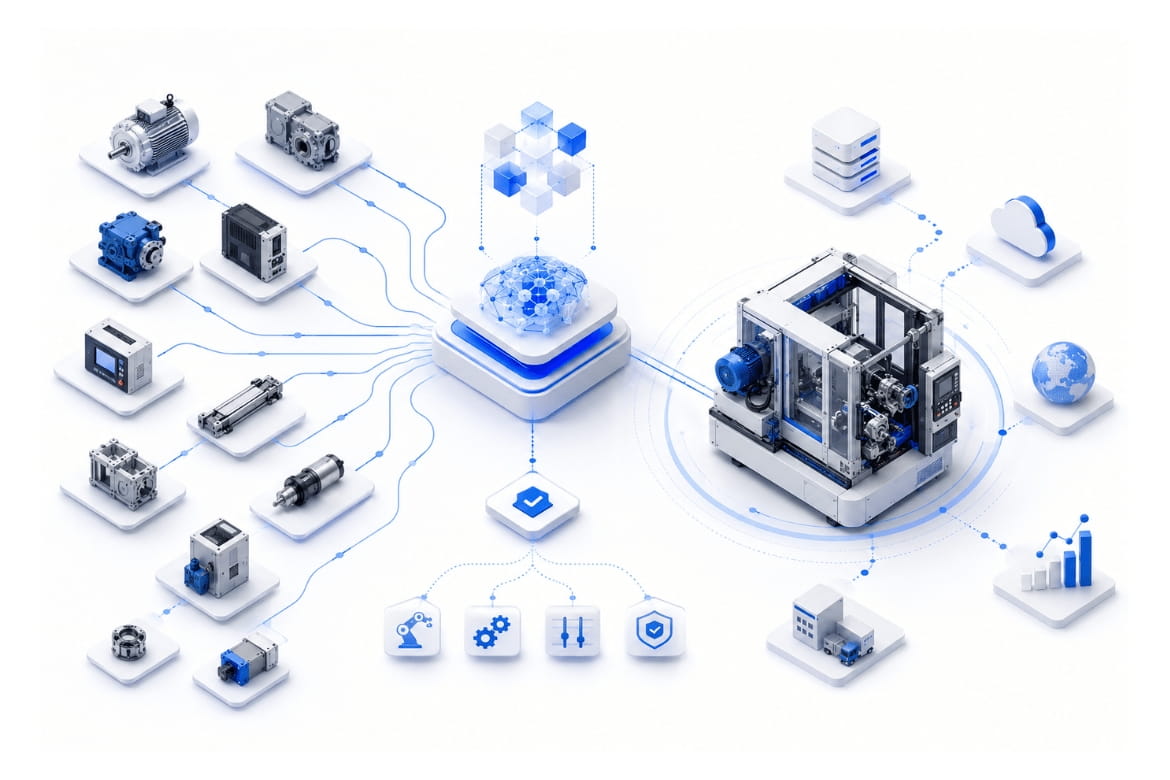
Shopware serves as an ideal orchestration platform for mapping variant-rich product configurators. Instead of forcing deep-seated logic into a monolithic system, Shopware acts as an intelligent link: it controls the checkout process and digital interaction while simultaneously serving as a central interface to seamlessly embed highly specialized configuration engines and professional applications into the e-commerce landscape. This modular architecture is the decisive lever for mapping B2B processes that previously failed due to rigid variant logic in a performant, scalable, and future-proof way.
The advantages of this architecture at a glance:
- Headless Architecture for Maximum Performance: The headless approach of Shopware is the most effective way to realize configurators with a high level of detail. By decoupling frontend and backend, companies can use modern JavaScript frameworks to create an extremely fast and highly interactive user interface. While the frontend shapes the user experience, demanding computational operations of the configuration engine can run in separate services, which sustainably protects the performance of the entire shop.
- API-First Integration as a Data Bridge: A configurator is only as precise as its data foundation. The open API structure of Shopware enables deep integration into existing IT landscapes and acts as a central hub:
- PIM Systems: Serve as a “Single Source of Truth” for complex product features, translations, and technical master data.
- CPQ Engines/ERP Systems: Deliver real-time prices, validation rules, and stock availability that flow directly into the configuration process.
- CRM Systems: Provide customer-specific pricing models or access rights based on individual framework agreements.
- B2B-Native Functions as a Foundation: Shopware natively supports sophisticated B2B scenarios such as individual customer pricing, diverse payment methods, and Request-for-Quote (RFQ) workflows. These functions form the stable foundation upon which the configurator logic sits. The need for costly individual development for basic e-commerce processes is significantly reduced, as companies can concentrate on differentiation through their specific configuration logic.
More information on developing custom product configurators for Shopware.
Strategic Implementation: The Knowledge Inventory as a Foundation
Technical realization is merely the crowning finale of a configurator project. The actual foundation – and simultaneously the most common stumbling block – is not the software architecture, but the structuring of the underlying expert knowledge. After all, a configurator can only act as intelligently as the rules upon which it is based.
Before development begins, a systematic knowledge inventory is therefore indispensable. It is about converting the often implicit knowledge from the minds of product managers and sales experts, as well as from unstructured Excel lists, into a precise digital logic. This step transforms experience into a usable data foundation. Only when this foundation is in place does a purely technical solution become a genuine, sales-supporting tool.
The Checklist Before Implementation
Leadership teams should mandatorily clarify the following points before beginning technical development:
- System Orchestration: Determine the “Source of Truth” for every data point. Does pricing originate from the ERP or the PIM? A clear system architecture prevents future synchronization conflicts.
- Logical Mapping of Constraints: Define precise physical and technical rules. Which dependencies exist? Which components are mutually exclusive? This documentation must exist in a standardized format before being converted into code.
- Data Quality Assessment: If the PIM system contains inconsistent or incomplete data, the configurator will fail. All attributes and compatibility rules must be correctly modeled in the master data source.
- Workflow Integration: Determine how configured data will flow into production – as a standard order or as a specialized production ticket in the ERP. Seamless mapping of the data flow from the webshop to the factory floor is critical.
ROI and Business Value: More Than Just Conversion Optimization
The introduction of a product configurator is often viewed as a purely digital efficiency project, but the business impact lies not solely in optimizing the conversion rate. For example, a packaging machine manufacturer can typically reduce its quotation time from three days to up to 20 minutes with a rule-based configurator—while simultaneously reducing the error rate in customer orders to nearly zero. Such jumps are not exceptions, but the logical consequence of a system that automates technical validation and pricing.
In detail:
- Data-Driven Insights: A digital configurator provides invaluable data on customer preferences. Analysis of the most frequently selected configurations provides direct impulses for product development. Insights regarding which combinations users attempt but cannot complete also flow into future product strategy, highlighting which functions are essential and which are not.
- Operational Efficiency and Scaling: By automating the configuration process, costs per order drop significantly. Manual technical checks and order-related clarifications are eliminated. Sales and service departments can scale without requiring additional personnel. While the system handles routine validations, employees can focus on complex project acquisition and deepening customer relationships.
- Increasing Customer Trust: Transparent, real-time prices and automated plausibility checks build trust. B2B buyers working under high time pressure receive a tool that allows them to configure a valid, accurately priced product within minutes—a clear competitive advantage over manual, days-long quotation processes.
Technological Outlook: Artificial Intelligence, Augmented Reality & Co.
The integration of AI will further advance configurator technology. AI-supported systems could provide intelligent recommendations and suggest components tailored to the customer’s specific industrial use case or environmental requirements. With the increasing maturity of Augmented Reality, the ability to visualize a custom-made machine directly in the customer’s facility will also become a standard expectation. These technologies will evolve the configurator from a mere selection instrument into a comprehensive consulting tool.
Furthermore, we are observing a trend toward so-called “Self-Healing Configurators.” These systems will utilize machine learning to monitor failed configuration attempts. If a specific component combination is frequently selected but leads to a dead end, the AI can alert product managers to potential gaps in the catalog. This creates a continuous improvement process that keeps the product portfolio aligned with market demand.
In a Nutshell: Shopware Product Configurators as a Strategic Must
Product configurators are no longer an optional feature, but a strategic necessity for manufacturers and B2B merchants. They form the core of digital transformation and bridge the gap between complex industrial product portfolios and the demand for a modern, efficient digital shopping experience.
Shopware offers the technical flexibility and modularity required to build these high-performance configurator systems. However, the success of such a project is ultimately decided by the quality of the data, the precision of the business logic, and the seamless integration into existing operational systems. Companies that invest the necessary time in modeling their product knowledge and aligning their internal processes will secure a sustainable competitive advantage in the increasingly digitalized B2B landscape.
About the Author
Jan Entzminger is the CEO of blindwerk, a digital agency operating in the DACH region that implements modern enterprise Shopware and B2B e-commerce solutions. As “digital architects,” the company specializes in agile project management and digital transformation, developing custom-fit IT infrastructures that consistently contribute to business success.