“The marginal cost approach always wins”: 10 lessons from Alexander Graf, Founder / Podcaster / Author at Spryker, Kassenzone, Energiezone
Written by
Editorial TeamPublished on
Discover 10 valuable e-commerce lessons from Alexander Graf, Founder / Podcaster / Author at Spryker, Kassenzone, Energiezone, as he shares his insights on the future of online retail to mark the 10th anniversary of the E-commerce Berlin Expo. [EXCLUSIVE INTERVIEW SERIES]
The E-commerce Berlin Expo celebrated its 10th anniversary in 2026. To mark this milestone, we interviewed some of the world’s most influential leaders about the future of online retail, asking them to share their 10 valuable lessons in e-commerce. Their insights were featured in our special album, showcasing the most powerful voices in online retail, which we decided to share with you on E-commerce Germany News.
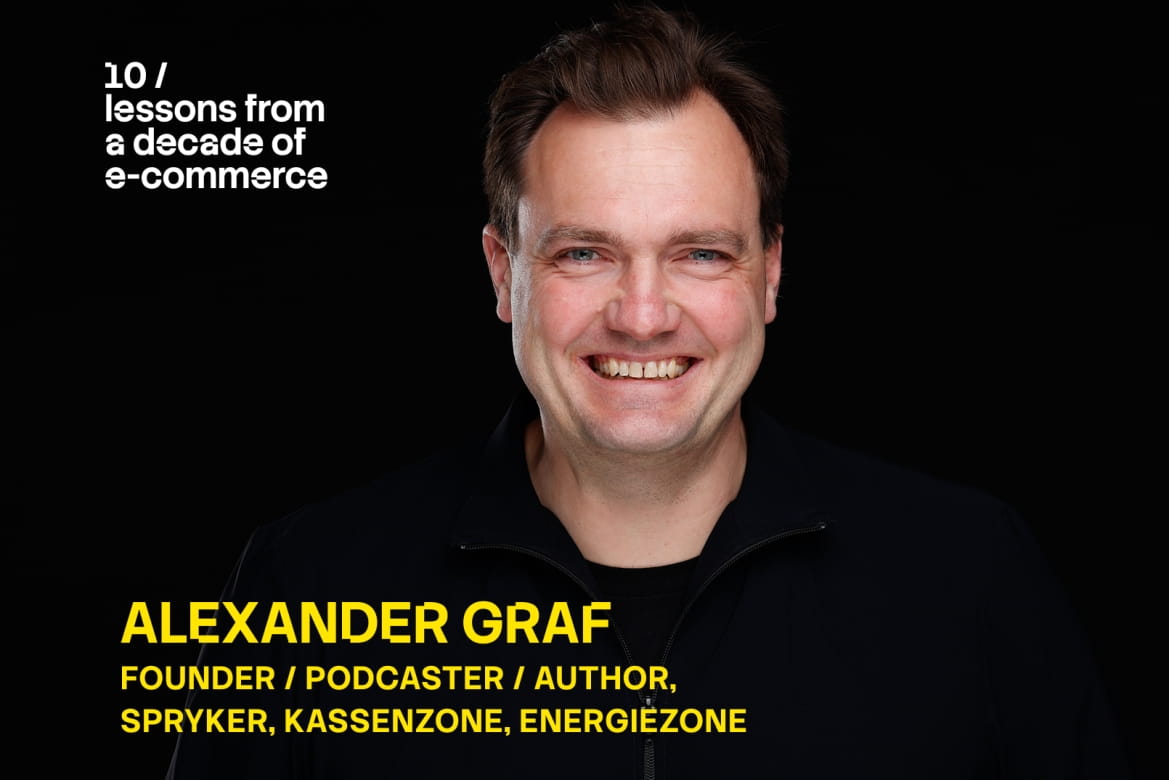
This time, we’re featuring an exclusive interview with Alexander Graf, Founder / Podcaster / Author at Spryker, Kassenzone, Energiezone. See what e-commerce lessons she shared with us below!
THE INDUSTRY BUILT FOR SPEED
What first drew you to this industry?
ALEXANDER: The speed. In traditional retail, cycles take years. In e-commerce, you spot a mistake in the morning and have it corrected by noon – or you’re out of business. This real-time Darwinism fascinated me.
Which early failure taught you something that still guides you today?
ALEXANDER: The belief that a “strong brand” can compensate for a lack of technological expertise. I’ve learned that no matter how great your logo is, if your tech architecture slows you down, the platform economy will eat you for breakfast.
Quote / Alexander Graf, Founder / Podcaster / Author at Spryker, Kassenzone, EnergiezoneThe marginal cost approach always wins. If your business model isn't designed to become cheaper than the competition (…) as it scales, then you're just a placeholder until someone comes along who can do the math.
When you think of the past decade of e-commerce, what do you miss – and what are you glad we left behind?
ALEXANDER: I miss the low CACs (customer acquisition costs) of Google/Facebook gold-rush era. I’m delighted that we’re leaving the fairy tale of the “omnichannel savior” behind us. The idea that brick-and-mortar stores could cross-subsidize online retail was an expensive illusion.
What is the single most important business lesson you have learned throughout your career?
ALEXANDER: The marginal cost approach always wins. If your business model isn’t designed to become cheaper than the competition (usually Amazon or Chinese apps) as it scales, then you’re just a placeholder until someone comes along who can do the math.
How would you define success in e-commerce today, and how has your view of it changed over time?
ALEXANDER: In the past, success meant sales growth and GMV at any cost. Today, success means adaptability. Success today goes to those who can change their strategy faster than SHEIN lists new products. Anyone who still thinks in terms of 5-year plans is planning their own demise. That is true for all industries.
Tech Pioneers Paradise
What do you see as the biggest opportunity in e-commerce today?
ALEXANDER: Breaking down entrenched B2B structures. While B2C is largely a done deal (Amazon and Temu dominate), B2B still relies on fax and Excel for ordering. Those who build frictionless, digital transaction models here will strike gold.
What’s the most counterintuitive or unconventional thing your company does today that actually works?
ALEXANDER: We often advise potential customers against purchasing technology. Many companies believe they have a software problem, but they actually have a business model problem. Telling them, “Save your money on IT, your model is obsolete,” paradoxically creates more trust than any sales pitch.
Quote / Alexander Graf, Founder / Podcaster / Author at Spryker, Kassenzone, EnergiezoneStop being retailers. Become technology companies that happen to sell goods.
What guiding principle do you personally refuse to compromise on, no matter the trend or pressure?
ALEXANDER: Own your tech IP. If technology is at the core of your business (and it is in e-commerce), you can’t outsource that core or squeeze it into standard templates. Compromising on your tech stack means compromising on your viability.
Looking ahead, what will define the next decade of e-commerce, and how does thinking about the future make you feel – optimistic, excited, concerned, or something else?
ALEXANDER: The next decade will be defined by “Made & Sold by China” and AI agents that shop for us. That makes me extremely excited because it completely reshuffles the deck. I’m only concerned for those who are still trying to optimize e-commerce from 2015. It will be a bloodbath for traditional middlemen, but paradise for tech pioneers.
If you could leave a message for future e-commerce leaders, what would it be?
ALEXANDER: Stop being retailers. Become technology companies that happen to sell goods. And above all, never underestimate the exponential speed of platforms. Don’t build anything that Amazon or Temu can copy more cheaply tomorrow.
ALEXANDER GRAF’S BIO
Alexander Graf (born in 1980) is a passionate e-commerce entrepreneur, serial founder, and retail and digital expert. As Co-Founder of Spryker, a software company for digital commerce, he is shaping the disruption of transactional business of all kinds. Spryker helps multinational players such as Toyota, Aldi, and Siemens Healthineers increase their sales with one of the most advanced commerce operating systems in the world. Whenever it comes to the digitalization of commerce, Alexander Graf is a sought-after expert as the host of the industry podcast “Kassenzone.”