The operational gap holding back German marketplace expansion
The Marketplace Seller Trends Report 2025 uncovers the structural problems behind German marketplace bottlenecks – from fragmented workflows to mounting manual tasks. Learn why even advanced sellers struggle to keep up with multichannel demands and what can be done to fix it. (Ad)

German marketplace sellers continue to scale across more channels. Most now sell on four or more marketplaces and feel constant pressure to keep descriptions, categories and prices aligned everywhere. The ambition is high but the operational structure underneath often relies on tools that cannot support this pace.
The Marketplace Seller Trends Report 2025 reveals the core issue. 62% of its respondents work with an integrator. More than half still use spreadsheets to run daily marketplace tasks. Instead of simplifying the workflow this combination creates extra steps. Teams jump between tools, repair data manually and hope each update reaches every marketplace on time.
Many sellers also work with external partners for content and pricing but internal files still sit at the center of their workflow. As soon as they add more marketplaces the workload becomes heavier and the process becomes harder to control.
This article looks at why these gaps exist and why they slow down even the most ambitious German sellers.
Why spreadsheets persist
Even with an integrator in place many still rely on spreadsheets to manage products and pricing. This is not a preference. It signals that the current setup does not cover the operational load required to sell across several marketplaces.
Four forces keep spreadsheets in play.
Legacy systems
Many German sellers use older ERP or PIM systems. These store core product data but cannot handle marketplace attributes or fast changing templates. When the integrator hits a limit teams fall back to Excel.
Gaps in marketplace coverage
Marketplaces update their rules at different times. Integrators catch most changes but not all. Sellers complete missing fields manually which brings spreadsheets back into the workflow.
External partners still use files
Many companies work with outsourced partners for content or pricing. These partners often request CSVs because the seller already uses them. The manual loop stays alive.
Internal pressure and habits
When a marketplace rejects a listing, teams need a fast fix. Excel feels immediate. It becomes the default tool even when the integrator can handle the task with the right setup.
The result is a hybrid system where spreadsheets close the gaps instead of addressing the root cause. The report confirms this. Sellers rely on spreadsheets not because they want to but because the workload forces them into it.
The real cost of manual work
The report quantifies the hidden cost of spreadsheet driven operations. Sellers spend 36% of the workweek on manual marketplace tasks. That equals almost two full days focused on updating listings, correcting content, repairing failed feeds and refreshing stock levels.
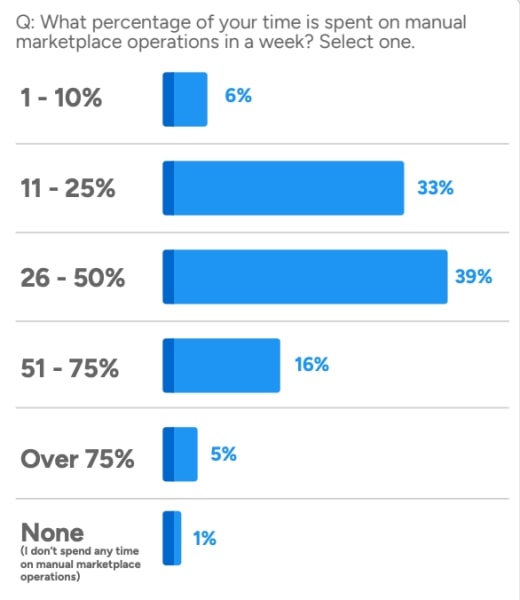
These tasks appear small on their own. The impact grows once a seller operates across several marketplaces. Each channel uses its own formatting rules. Each error requires a separate fix. The result is a continuous stream of repetitive work that slows down everything else.
Over one in five sellers spends half the week on these tasks. At that point marketplace management almost becomes the entire role.
The consequences show up quickly:
- Teams lose time they could use for content improvement or channel expansion.
- Updates reach marketplaces later than planned which weakens competitiveness.
- New products take longer to launch which delays revenue.
Manual work does not only reduce efficiency. It blocks scale. Every hour spent repairing data is an hour not spent on growth.
The 84,000-optimization problem
The report includes an example that captures the true size of multichannel selling.
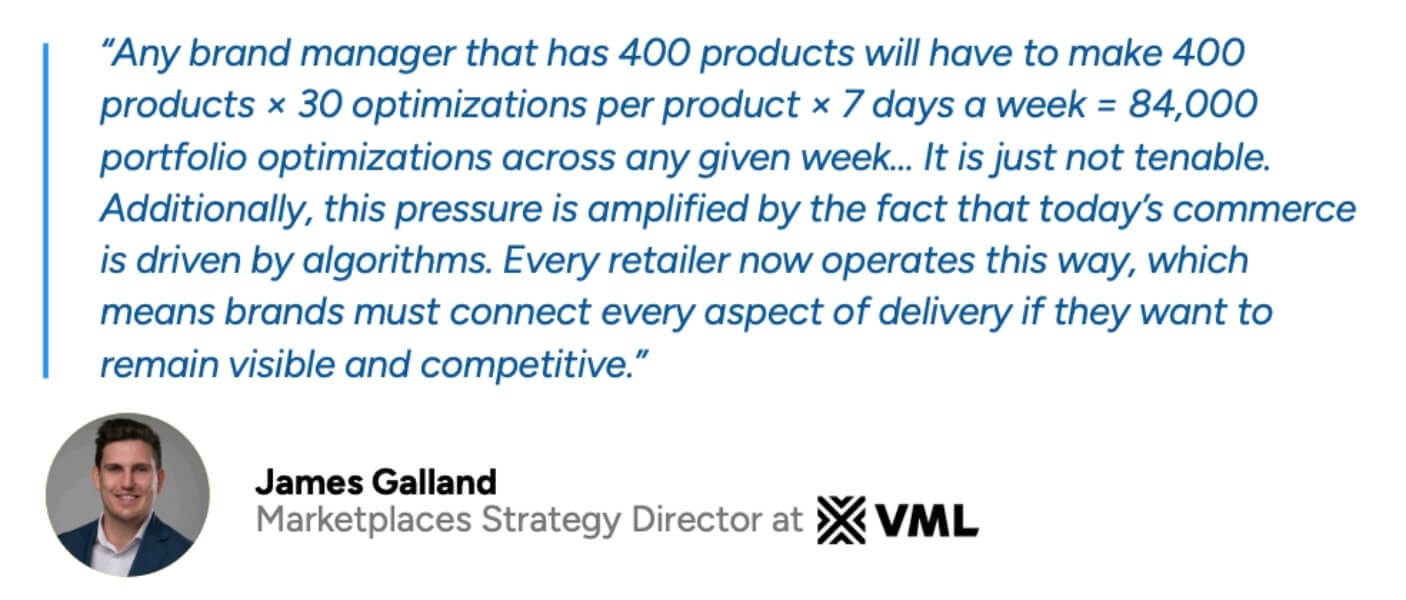
Let’s say that a seller with four hundred products performs thirty small optimizations per product each day across seven markets. This becomes 84,000 updates in one week.
It is easy to see why it’s not feasible with manual workflow.
Spreadsheets cannot support this volume. Each update requires a check and confirmation that it reached the correct marketplace. At scale even a short delay creates a backlog that teams cannot clear. Work shifts from improving performance to maintaining baseline accuracy.
More marketplaces mean more attributes and more checks. Even if the assortment stays the same the weekly workload grows. Sellers stay trapped in a cycle of updates because the tools cannot match the pace of multichannel selling.
Marketplace growth puts sellers in a constant cycle of updates. Spreadsheets may help at the moment but they cannot keep pace with the speed and frequency that multichannel selling now demands.
Spreadsheets create the inconsistencies that marketplaces penalize
Inconsistency is one of the most frequent and most damaging problems for sellers. Almost half of all respondents experience mismatched content across marketplaces.
This includes:
- titles that differ from channel to channel,
- outdated descriptions,
- missing attributes,
- incorrect pricing.
These issues often trace back to fragmented workflows where spreadsheets sit between systems.
A spreadsheet cannot keep every attribute aligned across multiple marketplaces without manual effort. When sellers update one file but forget another the marketplaces receive conflicting data. The report also notes that delayed or failed order syncs affect 43% of sellers.
Performance drops as soon as inconsistencies appear, and any gap reduces visibility and slows conversions.
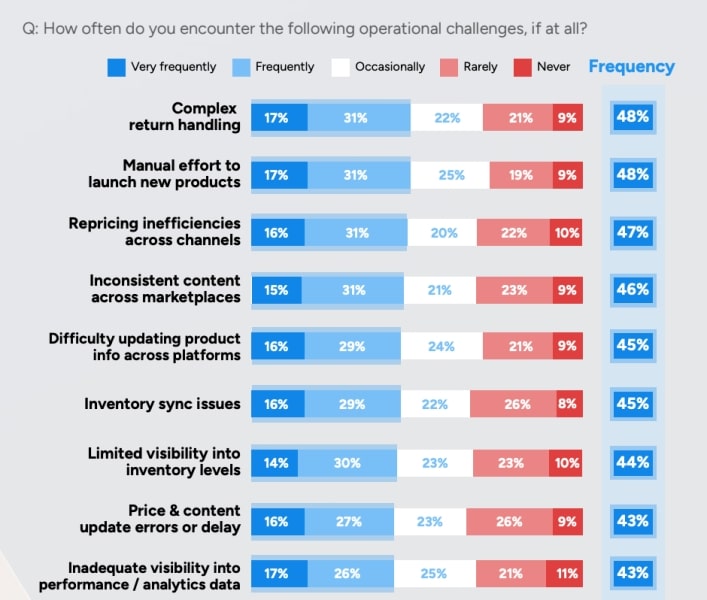
These failures often begin with mismatched stock levels caused by slow or manual updates.
Launching new products is another pressure point. A lot of sellers say that the process is heavily manual. Every marketplace has its own template so sellers copy fields from one sheet into another. Each copy introduces the chance for an error that marketplaces later flag.
The report shows how these inconsistencies influence performance. Marketplaces surface the most complete and reliable listings. Inaccurate or incomplete data hurts visibility and slows sales. As the number of marketplaces grows the risk multiplies.
This pattern repeats throughout the report. Spreadsheets help teams fix issues quickly but they also create the conditions that cause these issues in the first place.
The satisfaction illusion
The report uncovers a striking contradiction. 98% of sellers say they are satisfied with their current integrator. At the same time 66% plan to switch to a new provider within the next twelve months.
This gap between stated satisfaction and planned change suggests something deeper: that sellers are satisfied only with the parts that work. They still rely on spreadsheets for everything else. Over time workarounds become normal. Expectations shift. Teams forget that marketplace management was meant to be simpler. The report describes this as frustration that hides behind the appearance of satisfaction.
Spreadsheet use shows that the workflow is incomplete. It explains why so many sellers plan to switch providers despite reporting satisfaction.
The numbers point to some food for thought:
Sellers are not satisfied with the full experience. They are satisfied with the pieces that work.
The continued reliance on spreadsheets shows that the system underneath is incomplete.
And that is the real reason so many teams plan to make a change despite reporting satisfaction on the surface.
How ChannelEngine fits into the shift ahead
The report shows that respondents, including German sellers, struggle with the weight of multichannel operations.
Each marketplace introduces its own rules for
- listings,
- categories,
- SEO fields,
- seller settings,
- fee structures.
And spreadsheets sit between these differences because teams have no single place where all requirements align.
ChannelEngine solves this exact problem. It connects sellers to more than 1300 marketplaces through one environment and removes the need to manage separate rules in separate files. Product data, pricing, stock and orders move through one workflow, which reduces the number of exceptions that force teams back into spreadsheets.
Instead of adjusting each marketplace manually, teams work from a shared source of truth. ChannelEngine applies marketplace specific rules automatically. Updates travel across all channels at once and reach each marketplace almost in real time. The process replaces manual corrections with a predictable flow that scales as sellers grow.
ChannelEngine does not simplify marketplace selling by reducing complexity; it simplifies it by absorbing the differences between marketplaces into a single structure. That is the point where spreadsheets fall away and growth becomes easier to manage.
Conclusion
ChannelEngine’s Marketplace Seller Trends Report 2025 draws a clear line. Many, including German, sellers continue to grow across more marketplaces, yet still depend on workflows built for a much smaller operation.
Most already use an integrator. More than half still fall back on spreadsheets to keep listings aligned and updated. The result is a workload that grows faster than the systems designed to manage it.
This is a structural problem. When updates move through disconnected tools, the process becomes slower than the pace of marketplace change. Teams shift from improving performance to repairing issues created by manual steps.
The report signals the direction sellers want to move. They want fewer manual fixes and more stable flows. They also want marketplace requirements handled at the system level instead of through last-minute spreadsheets. Sellers who make that shift, unlock time for growth; but sellers who delay, remain stuck in the same cycle of corrections and exceptions.
The bottleneck is no longer hidden: the data shows exactly where it sits.
The next decision is how to build a workflow that matches the scale German sellers already operate at.