The rise of marketplace diversification: Why sellers are going multichannel in 2025
Discover why 2025 is the year of marketplace diversification. Learn how sellers are going multichannel to boost visibility, resilience, and growth. (Ad)

Shoppers no longer start their buying journey in one place. They jump through Amazon, from TikTok Shop to niche regional platforms. For brands and retailers, that shift is impossible to ignore: and it’s pushing sellers to expand their footprint faster than ever.
According to the Marketplace Seller Trends Report 2025 by ChannelEngine, sellers are now active on six marketplaces on average, and only 2% sell on a single marketplace. Just a few years ago, most brands considered Amazon their only viable channel. Today, diversification is simply a survival mission.
From single-channel dominance to a multichannel reality
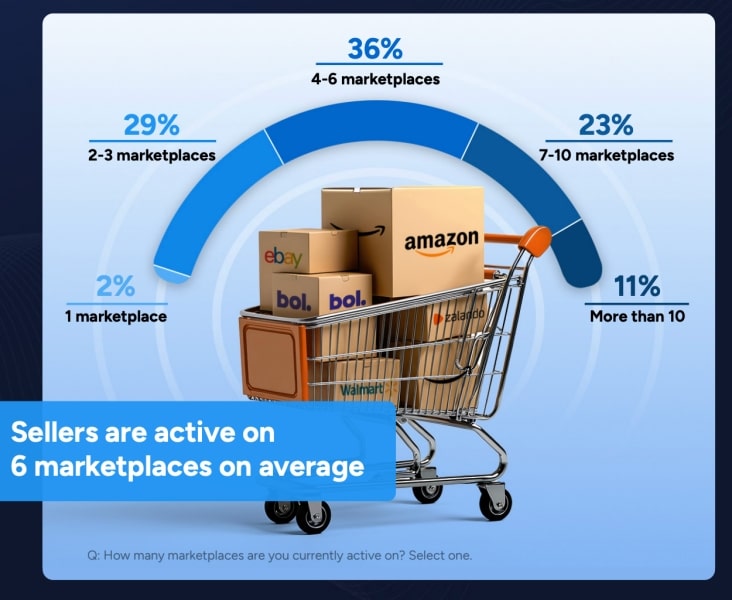
The report reveals that 34% of sellers are already present on seven or more marketplaces. That marks a decisive break from the “Amazon-first” mindset. While Amazon remains dominant across all surveyed regions, local platforms such as Otto in Germany and Bol in the Netherlands have taken strong market share.
Even newer entrants like TikTok Shop are gaining momentum, breaking into the top five marketplaces in the U.K. This shows a broader shift: discovery and conversion now happen across multiple ecosystems.
“A strong trend I’ve heard from Amazon sellers this year is the success they are finding on other marketplaces. Amazon is the leader. But those looking for a little extra are doing very well on TikTok Shop,”
Scott Needham, CEO and Founder at SmartScout
Why sellers are diversifying
1. Shoppers are multichannel by default
The ChannelEngine Shopping Behavior Report 2025 shows that 63% of consumers prefer marketplaces over brand sites, visiting an average of four marketplaces before making a purchase. Being absent from one can easily mean being invisible.
2. Algorithms drive visibility, not loyalty
Modern commerce runs on algorithms. Brand managers face an overwhelming number of optimizations to stay visible. Diversifying across multiple platforms helps brands reduce dependency on any single algorithm and maintain visibility.
3. Risk management and revenue resilience
Economic uncertainty and rising seller fees make overreliance risky. When one platform changes its policies or ad costs, sellers with multichannel setups can shift focus without losing sales momentum.
4. Marketplaces are evolving into brand-building channels
Once purely transactional, marketplaces now offer advanced storefronts, native ads, and analytics tools. Expanding to several marketplaces not only boosts sales but also strengthens brand visibility and customer engagement across audiences.
The hidden ROI of going multichannel
Diversification compounds returns across your entire commerce stack. Sellers using multiple marketplaces often see improved conversion rates on their brand sites, stronger ad efficiency (due to richer data), and faster sell-through of seasonal inventory.
Sellers expanding beyond three marketplaces are more likely to prioritize automation and reporting: two factors directly correlated with higher profitability.
In other words, the ROI of multichannel goes beyond sales. It’s about building operational agility that future-proofs your business against market shifts.
Europe’s multichannel momentum: local marketplaces take the lead
Across Europe, marketplace diversification is accelerating faster than anywhere else. Sellers no longer treat local platforms as optional add-ons, they’ve simply become essential growth engines. According to the Marketplace Seller Trends Report 2025, European sellers are active on an average of six marketplaces, with over one-third already on seven or more.
The shift is particularly visible in Germany, where Otto.de rivals Amazon as the go-to marketplace for domestic brands. In the Netherlands, Bol.com holds a similar position. These regional giants show that marketplace ecosystems are evolving around local regulations and consumer preference.
German sellers, for instance, are known for prioritizing automation, pricing control, and compliance. With 91% of surveyed companies rating automation as “business-critical,” Europe is setting the benchmark for how multichannel commerce operates at scale.
Platforms like ChannelEngine make this feasible, enabling brands to manage listings, inventory, and pricing across diverse European channels – from Otto and Kaufland to Allegro and Cdiscount – through a single connection.
The European experience highlights that diversification is all about adapting to localized ecosystems, where customer behavior and marketplace structure differ from country to country.
Sellers who master that complexity can scale across borders with far greater resilience.
“Amazon leads everywhere, but local players matter,” the report notes – and Europe proves it better than any other region.
The operational challenge behind diversification
Going multichannel comes at a price: complexity.
The report also highlights that 62% of sellers use integrators to manage listings and pricing. Yet, over half (52%) still rely on spreadsheets. Managing thousands of SKUs manually (from pricing updates to stock synchronization) drains productivity.
For one in five sellers, manual tasks take up over 50% of their week. This operational drag directly limits expansion.
The gap between ambition and capability explains why 98% of sellers say they’re satisfied with their integrator… yet two-thirds are ready to switch. Satisfaction doesn’t always mean efficiency; often, it means compromise.
These inefficiencies don’t just slow teams down. They actually shape what sellers can’t do. Every hour spent fixing listings or reconciling orders is an hour not spent on strategy, content, or expansion.
That’s why the real challenge isn’t the manual work itself, but the opportunity it steals.
If marketplace teams could reclaim the hours lost to manual operations, their top focus would be on improving product content (20%) and expanding to new marketplaces (19%): exactly the priorities identified for the year ahead.
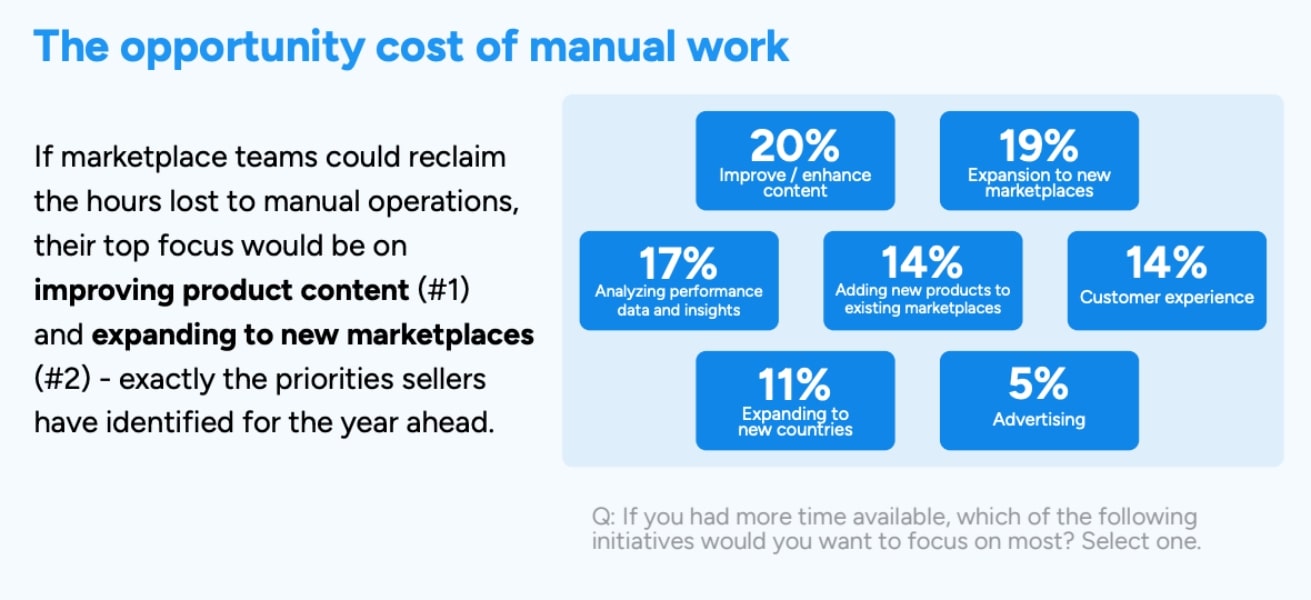
Automation doesn’t just speed up processes. It frees up strategic time for content optimization, analytics, and customer experience, which all are the areas that truly drive long-term growth.
The role of automation and integration
Diversification without automation is chaos. That’s why 91% of surveyed sellers describe automation as “very important” or “business-critical.”
AI-driven tools and smart integrators, such as ChannelEngine’s platform, make it possible to:
- Synchronize inventory and orders in real time
- Manage content and pricing centrally
- Expand to hundreds of marketplaces through one connection
As brands scale from three marketplaces to ten, automation becomes more than convenience: it’s the safeguard for profitability and brand control.
“Every retailer now operates through algorithms. Brands must connect every aspect of delivery if they want to remain visible and competitive,”
James Galland, Marketplace Strategy Director at VML
Multichannel IS the new foundation
The ChannelEngine’s Marketplace Seller Trends Report 2025 leaves little doubt: diversification is here to stay. Sellers are expanding faster, customers are discovering products in more places, and automation is bridging the gap between ambition and execution.
However, multichannel doesn’t mean being everywhere. The winning strategy is being intentional. Choose marketplaces that align with your target audience, pricing model, and operational strengths.
Key takeaways for 2026 and beyond
✅ Be where your customers are. Analyze buyer behavior and marketplace fit for your category.
✅ Automate before you expand. Manual processes are the biggest blockers to growth and profitability.
✅ Track performance marketplace-by-marketplace. Profit margins, not just sales volume, define success.✅ Think global early. With many sellers already expanding, 2026 may be the year to go cross-border.
Final word
Marketplace diversification in 2025 is a necessity. Consumers shop across platforms, compare constantly, and expect flawless experiences everywhere. Sellers who scale smartly, supported by automation and real-time integrations, will be the ones turning complexity into competitive advantage.
As the Marketplace Seller Trends Report 2025 makes clear, those who conquer marketplace complexity through automation will define the future of ecommerce: and lead the marketplace economy of tomorrow.