Top 20+ payment providers in the DACH region [2026 update]
Germany offers lots of different payment methods from online payment services, credit/debit cards and direct debits to prepaid cards. Here we have for you more than 20 payment providers in the DACH region
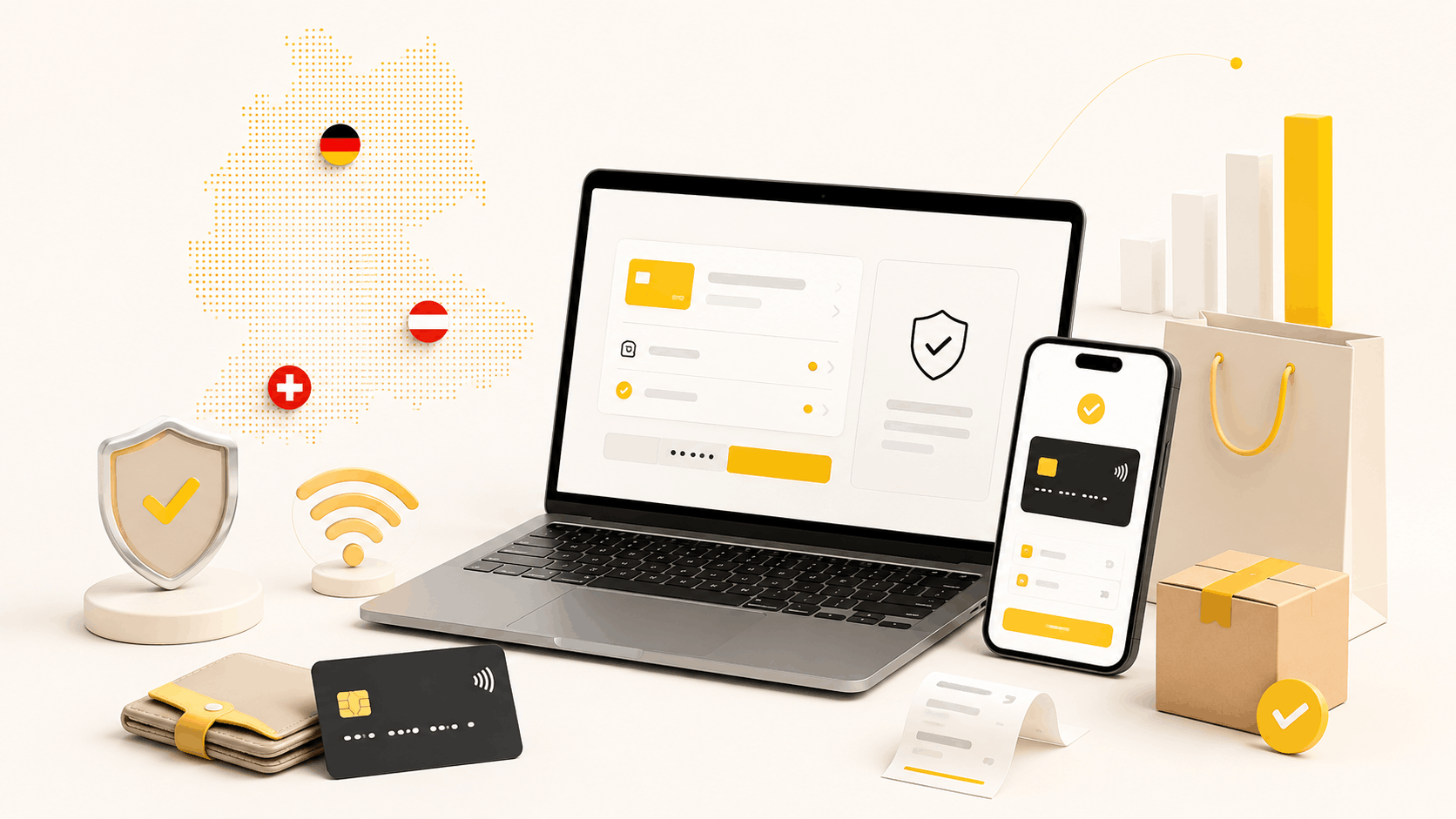
Payment localization in DACH is not optional.
Germany, Austria and Switzerland may sit in the same regional basket, but shoppers do not pay the same way across all three markets. German ecommerce still relies heavily on PayPal and invoice payments. Austria needs cards, PayPal, bank transfers, EPS and BNPL coverage. Switzerland requires special attention to TWINT, cards, invoice payments and local trust expectations.
That is why a “one checkout fits all” setup rarely works across DACH.
A checkout that converts well in Germany may look incomplete in Switzerland. A payment mix that works for Austrian shoppers may not be enough for German customers who expect invoice payments. And a global card-only setup will leave money on the table in all three markets.
Below, we compare the top payment providers in the DACH region, explain which payment methods matter in each country, and show how ecommerce brands can build a checkout that feels local enough to convert.
TL;DR: top payment providers in DACH in 2026
| Provider / method | Germany | Austria | Switzerland | Best for |
| PayPal | Very important | Very important | Important | Trust and fast checkout |
| Klarna | Important | Important | Relevant | BNPL, invoice, installments |
| Apple Pay | Growing | Growing | Relevant | Mobile checkout |
| Google Pay | Growing | Growing | Relevant | Mobile checkout |
| TWINT | Not relevant | Not relevant | Very important | Swiss ecommerce |
| Cards | Important | Very important | Very important | International checkout |
| SEPA direct debit | Important | Relevant | Less central | Subscriptions and repeat payments |
| EPS | Not relevant | Important | Not relevant | Austrian bank transfer |
| Wero | Emerging | Not core yet | Not core yet | Future European account-to-account payments |
| Adyen / Stripe / Mollie / Worldline | Important PSPs | Important PSPs | Important PSPs | Payment orchestration and multi-method checkout |
Payment methods vs payment providers
Before comparing the top payment providers in DACH, it helps to separate payment methods from payment providers.
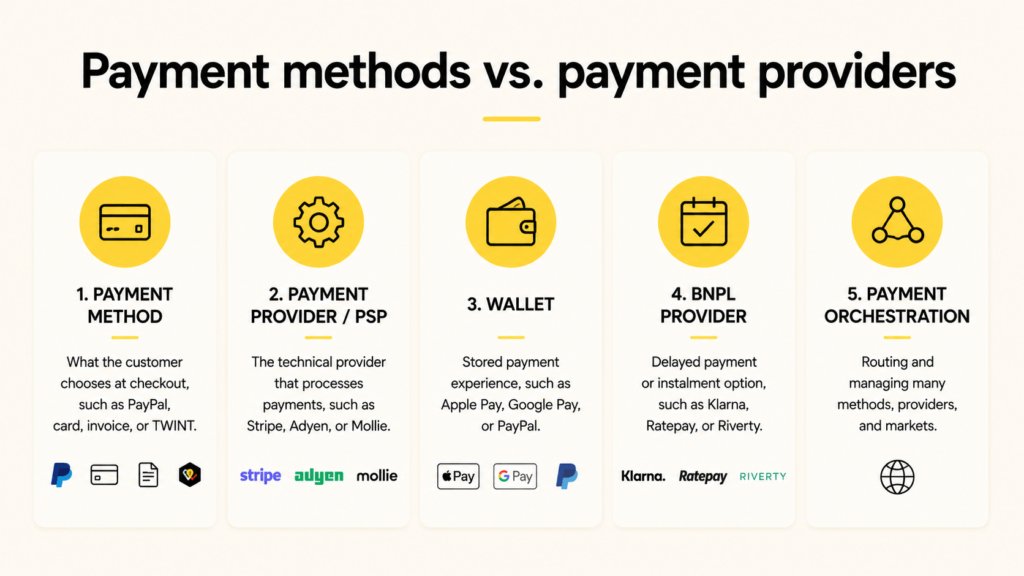
These terms often get mixed together, but they do not mean the same thing.
| Term | Example | What it means |
| Payment method | PayPal, card, invoice, TWINT | What the customer chooses at checkout |
| Payment provider / PSP | Stripe, Adyen, Mollie, Worldline | The technical provider that processes payments |
| Wallet | PayPal, Apple Pay, Google Pay, TWINT | A stored payment experience |
| BNPL provider | Klarna, Ratepay, Riverty | A delayed payment or installment option |
| Payment orchestration | PPRO, Computop, enterprise setups | Routing and managing many methods, providers and markets |
This difference matters because an ecommerce store does not simply “add a provider.” It designs a payment mix.
A small German webshop may use one PSP and still offer PayPal, cards, Klarna and SEPA. A larger cross-border retailer may use Adyen, Worldline, PPRO or Computop to manage dozens of local payment methods, currencies, fraud rules and refunds across markets.
The best payment setup is not the one with the most logos. It is the one that matches how customers want to pay.
DACH payment market in 2026: why one checkout does not fit all
DACH is not one payment market.
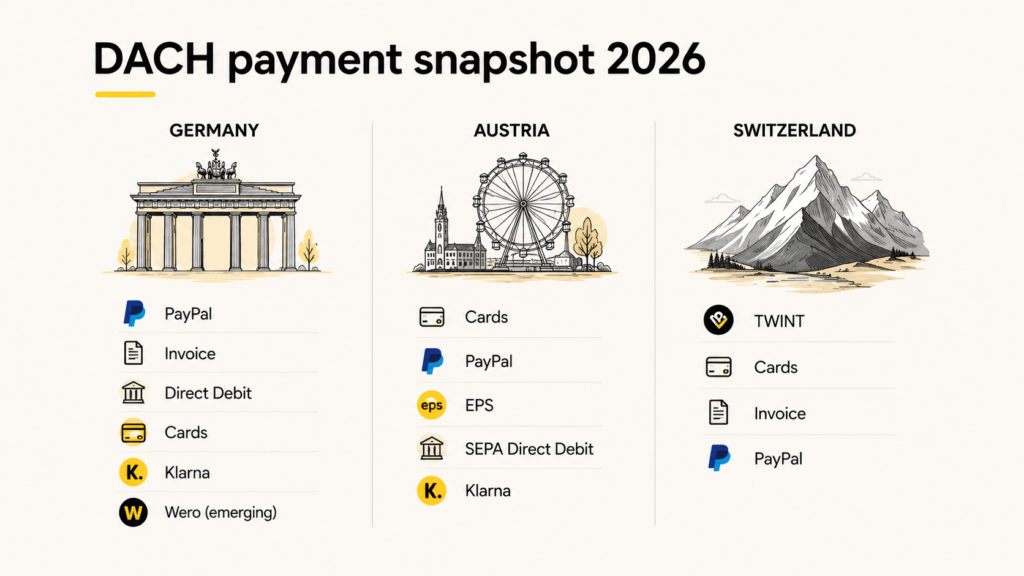
Germany, Austria and Switzerland share some ecommerce habits, but checkout expectations differ. Payment localization affects trust, conversion, refunds, fraud management and repeat purchase.
| Market | What matters most |
| Germany | PayPal, invoice, direct debit, cards, BNPL and Wero as an emerging option |
| Austria | Cards, PayPal, EPS / bank transfer, SEPA and Klarna / BNPL |
| Switzerland | TWINT, cards, invoice, PayPal and local trust |
| Cross-border DACH | PSP coverage, currency, fraud control, refunds and local payment mix |
For a broader view of the region, see our complete guide to understanding the DACH ecommerce market. Payments are one of the clearest examples of why DACH should not be treated as one generic German-speaking checkout.
Germany: PayPal and invoice still dominate
Germany is one of the most specific payment markets in Europe.
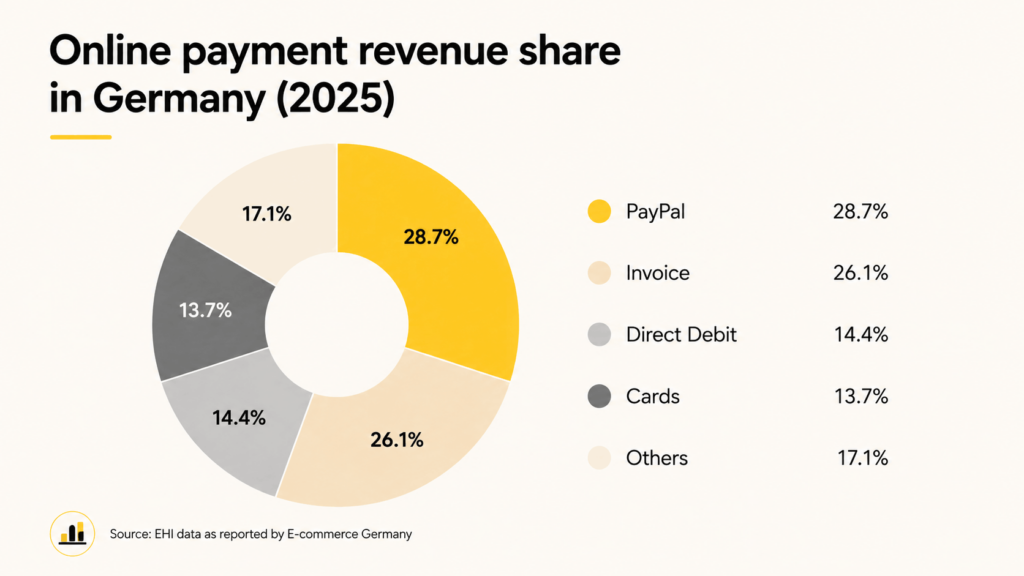
Cards matter, but they do not dominate ecommerce the way they do in some other countries. German shoppers still show strong trust in PayPal and invoice payments. According to EHI data covered by E-commerce Germany, PayPal remained the leading online payment method in Germany with a 28.7% share of online payment revenue, followed by invoice payment at 26.1%. Direct debit declined to 14.4%, while credit cards and international debit cards increased to 13.7%.
This makes Germany different from card-first markets.
A German ecommerce checkout should usually consider:
- PayPal,
- invoice payment,
- cards,
- direct debit,
- Klarna or another BNPL / invoice provider,
- Apple Pay and Google Pay for mobile checkout,
- Wero as an emerging account-to-account option.
Germany also shows a wider shift away from cash in physical retail and toward mobile and digital payments. We covered this in more detail in Mobile payment in Germany continues to grow.
What this means for merchants
A Germany-first ecommerce store should not rely only on cards and Apple Pay.
PayPal and invoice payment remain hard to ignore. Direct debit can still matter for subscriptions and repeat payments. Klarna, Ratepay or Riverty can help with pay-later expectations, but merchants need to watch risk, margin and category fit.
Wero is worth watching, but it is still emerging in ecommerce. It should not replace established methods yet.
Austria: cards, PayPal, EPS and BNPL
Austria is not just a smaller Germany.
Austrian shoppers use a mix of cards, e-wallets, bank transfers, EPS and BNPL. Cards are especially important, and PayPal remains highly relevant. EPS and bank-transfer-based payment options also matter because they connect checkout to local banking habits.
For Austria, the key payment mix often includes:
- cards,
- PayPal,
- EPS,
- SEPA direct debit,
- Klarna or another BNPL option,
- Apple Pay and Google Pay,
- bank transfer where relevant.
Austria is also highly cross-border. Many Austrian shoppers buy from German and international stores, which raises expectations around familiar payment methods and smooth refund handling.
For a broader country context, see our European ecommerce overview: Austria.
What this means for merchants
Austria needs flexibility.
If your store already sells in Germany, Austria may look like an easy next step, but payment behavior should still be checked separately. EPS, cards and PayPal should be treated seriously. Klarna or another BNPL option can support conversion, but it should not be the only local layer.
Austrian shoppers expect checkout to feel familiar, not simply translated.
Switzerland: TWINT changes the checkout logic
Switzerland is the most distinct DACH market from a payment perspective.
It uses Swiss francs, has its own consumer habits and sits outside the EU. That already makes checkout localization more complex. But payment behavior adds another layer: TWINT is a major part of Swiss digital payments.
TWINT should not be treated as a small extra option. For many Swiss shoppers, it is a familiar, trusted and everyday payment method.
A Switzerland-focused ecommerce checkout should usually consider:
- TWINT,
- cards,
- invoice payment,
- PayPal,
- CHF settlement,
- clear refund handling,
- local trust signals.
For more country-level context, see our European ecommerce overview: Switzerland.
What this means for merchants
A Switzerland checkout without TWINT may feel incomplete.
PayPal and cards are still useful, but they do not fully replace local payment behavior. Merchants also need to think about currency, customs, delivery costs and refunds. Payment is part of that trust equation.
If Switzerland is a serious market for your store, TWINT should be part of the conversation early.
Top payment providers in the DACH region
The best DACH payment setup is rarely built around one provider.
Some providers are payment methods. Some are wallets. Some are PSPs. Some help with invoice, BNPL or risk. Others help enterprise merchants route and manage many payment methods across markets.
Below is a practical list of top payment providers and payment options for ecommerce brands selling in DACH.
Global and cross-border payment providers
1. PayPal
PayPal remains one of the most important payment options in DACH, especially in Germany and Austria.
Its biggest strength is trust. Many shoppers already have an account, recognize the brand and feel comfortable using it for online purchases. In Germany, PayPal remains the leading online payment method by revenue share.
| Best for | DACH fit | Watch out |
| Fast checkout, trust, broad consumer adoption | Very strong in Germany and Austria, relevant in Switzerland | Fees, dependency and limited control over the checkout relationship |
PayPal is not enough as a full DACH payment strategy, but it is difficult to ignore.
2. Stripe
Stripe is a popular PSP for ecommerce companies, SaaS businesses and developer-led teams.
It supports cards, wallets and many payment methods. It is especially attractive for businesses that want fast integration, strong APIs and a flexible technical setup.
| Best for | DACH fit | Watch out |
| Developer-led ecommerce, SaaS, subscriptions, cross-border payments | Strong for international merchants selling into DACH | Local payment method coverage depends on setup and business model |
Stripe is useful for stores that want flexibility and speed, but merchants should still check whether their DACH payment mix includes the local methods customers expect.
3. Adyen
Adyen is a strong option for larger ecommerce companies, omnichannel retailers and enterprise merchants.
It supports many payment methods, markets and risk tools. For DACH, it can help retailers manage cards, wallets, local payment methods, fraud and reconciliation across several countries.
| Best for | DACH fit | Watch out |
| Larger retailers, enterprise ecommerce, omnichannel setups | Strong cross-border and enterprise fit | More complex than simple PSP setups |
Adyen is often a good fit when payments become operationally complex.
4. Worldline
Worldline is a major European payments player with strong relevance across DACH and wider Europe.
It offers acquiring, online payments, in-store payments and omnichannel payment services. This makes it useful for retailers that need both ecommerce and physical retail payment coverage.
| Best for | DACH fit | Watch out |
| European retail, omnichannel, acquiring and PSP coverage | Strong European and DACH relevance | Setup may be heavier than lightweight PSPs |
Worldline can be a strong fit for merchants that need local acquiring, in-store and online payment infrastructure, and a more enterprise-grade payment setup.
5. Mollie
Mollie is often attractive for small and mid-market ecommerce merchants that want an easier PSP setup.
It supports many European payment methods and can be simpler to implement than some enterprise payment platforms.
| Best for | DACH fit | Watch out |
| SMEs, mid-market ecommerce, simpler setup | Good for merchants that need European methods without heavy enterprise complexity | Less suited to very complex enterprise orchestration |
Mollie can work well for growing ecommerce teams that want a practical way to offer several payment methods without building a large payment stack.
6. Checkout.com
Checkout.com is a global payment provider used by ecommerce and digital businesses that need online payment processing, fraud tools and international reach.
| Best for | DACH fit | Watch out |
| Digital commerce, international payments, scaling businesses | Relevant for cross-border merchants | Local DACH method fit needs to be checked by market |
Checkout.com can be useful for merchants with cross-border needs, but DACH success still depends on whether local payment expectations are covered.
7. Amazon Pay
Amazon Pay lets customers pay with payment and address details already stored in their Amazon account.
This can reduce friction for customers who trust Amazon and want a fast checkout.
| Best for | DACH fit | Watch out |
| Fast checkout, Amazon account users, trust-based conversion | Relevant across DACH, especially for convenience-driven shoppers | Not a replacement for local payment methods |
Amazon Pay can help reduce checkout friction, but it should be one layer in the checkout, not the whole strategy.
BNPL and invoice payment providers
8. Klarna
Klarna is one of the most recognizable BNPL and pay-later providers in Europe.
In DACH, it is relevant because shoppers are familiar with invoice payments, installment options and delayed payment flows. Klarna can support conversion, especially in categories such as fashion, beauty, electronics and home goods.
| Best for | DACH fit | Watch out |
| BNPL, invoice, installments, conversion support | Strong in Germany and Austria, relevant in Switzerland | Fees, risk, regulation and margin impact |
Klarna works best when merchants understand the unit economics. Pay-later options can boost conversion, but they should not hide weak margins or excessive returns.
9. Ratepay
Ratepay focuses on invoice, installment and direct debit solutions, often with risk management.
It is especially relevant for merchants that want to offer payment methods German shoppers already trust, without taking all risk internally.
| Best for | DACH fit | Watch out |
| Invoice, installments, direct debit, risk-managed payments | Strong fit for Germany and Austria | Category and risk profile matter |
Ratepay can be useful for retailers that want to offer trusted local payment experiences while managing payment risk more carefully.
10. Riverty
Riverty offers payment, invoice, installment and receivables-related solutions.
It is relevant for merchants looking for pay-later and invoice payment infrastructure in Europe and DACH.
| Best for | DACH fit | Watch out |
| Invoice, installments, collections and risk handling | Relevant in DACH | Merchant fit varies by category and risk appetite |
Riverty may be especially relevant for retailers with larger baskets, invoice needs or post-payment process complexity.
11. PayPal Pay Later
PayPal Pay Later adds a pay-later layer to PayPal’s familiar checkout experience.
This can be useful because customers already trust PayPal, and pay-later options can reduce purchase hesitation for some categories.
| Best for | DACH fit | Watch out |
| Familiar pay-later flow within PayPal | Relevant where PayPal is strong | Still needs margin and return control |
PayPal Pay Later can work well as part of a broader checkout mix, but merchants should not assume every shopper wants BNPL.
Mobile wallets and local wallets
12. Apple Pay
Apple Pay supports fast mobile checkout and is increasingly important as mobile shopping grows.
It is not enough on its own in DACH, but it can reduce checkout friction for customers using Apple devices.
| Best for | DACH fit | Watch out |
| Mobile checkout, card-based wallet payments | Growing across DACH | Requires card/wallet readiness and good mobile UX |
Apple Pay is most useful when the rest of the mobile checkout is clean. A fast wallet button cannot fix a confusing checkout flow.
13. Google Pay
Google Pay serves a similar role for Android and Google users.
It helps customers pay quickly without entering card details manually.
| Best for | DACH fit | Watch out |
| Mobile checkout, Android users, stored card payments | Growing across DACH | Works best with mobile-first checkout design |
Google Pay should be part of a modern wallet setup, especially for stores with strong mobile traffic.
14. TWINT
TWINT is a must-consider payment option for Switzerland.
It is not relevant for Germany or Austria, but for Swiss ecommerce it can be one of the most important local methods. TWINT is familiar, trusted and widely used by Swiss consumers.
| Best for | DACH fit | Watch out |
| Swiss ecommerce, mobile payments, local trust | Very strong in Switzerland | Not useful outside Switzerland |
TWINT is the clearest example of why DACH checkout needs country-level planning. A global setup may miss the most important local method in Switzerland.
15. Wero
Wero is the European payment initiative designed to support account-to-account payments and compete with global payment brands.
It started with person-to-person payments and has been moving into ecommerce. In Germany, Wero is emerging as a payment option for online shopping, but broad ecommerce adoption is still developing.
| Best for | DACH fit | Watch out |
| Emerging European account-to-account payments | Emerging in Germany | Not yet a default must-have for every ecommerce store |
Wero should be watched closely, especially by merchants selling in Germany and wider Europe. But it should not replace proven payment methods yet.
Bank transfer and account-based payments
16. SEPA Direct Debit
SEPA Direct Debit remains relevant in Germany and Austria, especially for subscriptions, repeat payments and certain trusted customer relationships.
| Best for | DACH fit | Watch out |
| Subscriptions, repeat payments, account-based payment flows | Relevant in Germany and Austria | Risk, failed payments and mandate handling |
SEPA can be useful, but it requires proper retry logic, dunning flows and customer communication.
17. EPS
EPS is important for Austria.
It allows customers to pay through their bank and remains part of local payment behavior. For Austria-focused ecommerce, EPS should not be ignored.
| Best for | DACH fit | Watch out |
| Austrian bank-transfer-based checkout | Important in Austria | Not relevant for Germany or Switzerland |
EPS is a good example of a payment method that matters in one DACH country but not the others.
18. Sofort / Klarna Pay Now
Sofort, now associated with Klarna Pay Now, supports bank-transfer-based payment flows.
It can be relevant for customers who prefer direct bank payments rather than cards or wallets.
| Best for | DACH fit | Watch out |
| Bank-transfer-based ecommerce payments | Relevant in Germany and Austria | Adoption varies; not always enough as a primary method |
Sofort / Pay Now can be useful, but merchants should evaluate whether customers still prefer it over PayPal, cards, invoice or EPS in each market.
19. Open banking and account-to-account providers
Open banking and account-to-account payments are becoming more important in Europe.
They are not always customer-facing brands in the same way PayPal or Klarna are, but they can help merchants reduce payment costs, support instant transfers and build alternative checkout flows.
| Best for | DACH fit | Watch out |
| Account-to-account payments, lower-cost rails, future checkout models | Emerging across Europe | Customer adoption and UX still matter |
This area is important for 2026 and beyond, especially as Wero and other European account-to-account options develop.
Enterprise and payment orchestration options
20. Unzer
Unzer is a payment provider with relevance for DACH merchants, especially those looking for payment processing, risk tools and local payment coverage.
| Best for | DACH fit | Watch out |
| DACH ecommerce, local payment methods, payment processing | Strong regional relevance | Compare method coverage and pricing against merchant needs |
Unzer can fit merchants that want a provider with local market understanding.
21. Computop
Computop is a payment service provider with strong enterprise and omnichannel relevance.
It supports many payment methods and can be useful for merchants that need complex routing, reconciliation and international payment setups.
| Best for | DACH fit | Watch out |
| Enterprise ecommerce, omnichannel, payment orchestration | Strong DACH and international relevance | More complex than simple PSP setups |
Computop belongs in the conversation for retailers that treat payments as infrastructure, not just a checkout plugin.
22. Nexi / Nets
Nexi and Nets are relevant in European payments, especially for acquiring, processing and payment acceptance.
They can matter for DACH merchants with broader European operations or omnichannel payment needs.
| Best for | DACH fit | Watch out |
| European payment acceptance, acquiring and retail payments | Relevant across Europe | Fit depends on market, channel and merchant size |
For larger merchants, these providers may support more complex payment operations than a lightweight PSP.
23. PAYONE
PAYONE is a German payment provider relevant for merchants that need local payment processing and ecommerce payment solutions.
| Best for | DACH fit | Watch out |
| German ecommerce, local payment processing, multi-method checkout | Strong Germany fit | Compare flexibility and integrations |
PAYONE can be relevant for Germany-first merchants and retailers that want a provider with local market experience.
24. PPRO
PPRO focuses on local payment methods and payment infrastructure for global businesses.
It is especially relevant for companies that need to offer many local payment methods across markets.
| Best for | DACH fit | Watch out |
| Local payment method access, cross-border payment infrastructure | Useful for international merchants | Usually part of a broader payment stack |
PPRO can help merchants handle payment method complexity across markets, especially when one PSP does not cover everything.
Provider comparison table
| Provider | Type | Strongest DACH fit | Best for | Watch out |
| PayPal | Wallet / checkout | Germany, Austria | Trust, fast checkout | Fees and dependency |
| Klarna | BNPL / invoice | Germany, Austria | Pay later, installments | Regulation, risk and margins |
| TWINT | Swiss wallet | Switzerland | Swiss ecommerce | Not useful outside Switzerland |
| Stripe | PSP | Cross-border DACH | SaaS, ecommerce, developer-led teams | Local method coverage depends on setup |
| Adyen | PSP / enterprise | Cross-border DACH | Larger retailers, omnichannel | Enterprise complexity |
| Worldline | PSP / acquiring | DACH and Europe | Local acquiring and PSP coverage | Setup may be heavier |
| Mollie | PSP | SME / mid-market | Simple setup and local methods | Less enterprise-heavy |
| Ratepay | Invoice / BNPL | Germany, Austria | Invoice and risk-managed payments | Category and risk fit matter |
| Riverty | BNPL / invoice | DACH | Invoice, installments, risk handling | Merchant fit varies |
| Wero | Account-to-account | Emerging in Germany | Future European payment rail | Early ecommerce adoption |
Legacy or non-core payment options to review
Not every payment method from older DACH payment lists still deserves a main spot in a 2026 article.
Giropay
Giropay should no longer sit in the main list of active payment providers.
It was discontinued at the end of 2024, so merchants should treat it as a legacy payment method and review replacements.
Masterpass
Masterpass also looks like a legacy item rather than a modern DACH checkout priority.
A 2026 article should focus on active payment methods and providers that merchants can realistically use today.
Cash on delivery
Cash on delivery may still exist in certain niches, but it should not be treated as a top DACH payment provider.
It is better mentioned as a niche legacy or edge-case option.
Generic “credit cards” as a provider
Cards matter, but they are a payment method, not a provider.
In a modern article, cards should appear in checkout mix recommendations, while PSPs such as Stripe, Adyen, Worldline, Mollie or Checkout.com should appear as providers.
Which payment setup should merchants choose?
The right DACH checkout depends on your market, product category, average order value, risk level and business model.
| Merchant type | Recommended DACH checkout mix |
| Small DACH webshop | PayPal, cards, Klarna / invoice, Apple Pay / Google Pay, local method where relevant |
| Germany-first ecommerce store | PayPal, invoice, direct debit, cards, Klarna, Apple Pay / Google Pay, monitor Wero |
| Austria-focused store | Cards, PayPal, EPS, SEPA, Klarna / BNPL |
| Switzerland-focused store | TWINT, cards, invoice, PayPal, CHF settlement |
| Cross-border DACH retailer | PSP with local methods, fraud management, refund handling and multi-currency support |
| Subscription business | Cards, SEPA direct debit, PayPal, dunning and retry logic |
| Enterprise retailer | Adyen / Worldline / Computop / PPRO-style setup, routing, reconciliation and risk tools |
The core lesson is simple: payment setup should follow customer behavior, not internal convenience.
If Germany is your main market, PayPal and invoice payment matter. If Switzerland matters, TWINT needs attention. If Austria is your next step after Germany, EPS and cards need a closer look.
Payment trends in DACH for 2026
PayPal remains strong in Germany
PayPal is still one of the most important online payment methods in Germany.
Even as cards and wallets grow, PayPal keeps a strong trust advantage. Many shoppers already know it, use it and feel protected by it.
Invoice payments remain hard to ignore
Invoice payment is still highly relevant in Germany and across parts of DACH.
It supports trust because customers can receive goods before paying. For merchants, the challenge is risk management, fraud prevention and cash flow.
TWINT is essential in Switzerland
TWINT is not just a nice local add-on.
For Swiss ecommerce, it can be a core payment method. Stores that sell seriously into Switzerland should review TWINT early, not after launch.
Wero is emerging, but not yet a default must-have
Wero is one of the most important payment developments in Europe.
It matters because it points toward a stronger European account-to-account payment ecosystem. But ecommerce adoption is still developing. For now, merchants should monitor Wero and consider it where customer demand and PSP support make sense.
Mobile wallets are becoming more important for checkout UX
Apple Pay and Google Pay are increasingly relevant because more ecommerce journeys happen on mobile.
However, mobile wallets only help if the checkout is already clean. A messy mobile checkout with a wallet button is still a messy checkout.
BNPL remains useful, but needs control
Klarna, Ratepay, Riverty and PayPal Pay Later can support conversion, especially for higher-value or consideration-heavy purchases.
But BNPL is not free growth. Merchants need to monitor fees, returns, risk and customer behavior.
PSP choice is increasingly about orchestration
Payment providers are no longer just about “accepting cards.”
For larger merchants, PSP choice affects routing, fraud, refunds, reconciliation, local payment methods, multi-currency settlement and reporting.
This is why payment orchestration matters more as retailers expand across DACH.
For wider ecommerce trends across the region, see our guide to DACH trends for 2026.
Payment localization and customer trust
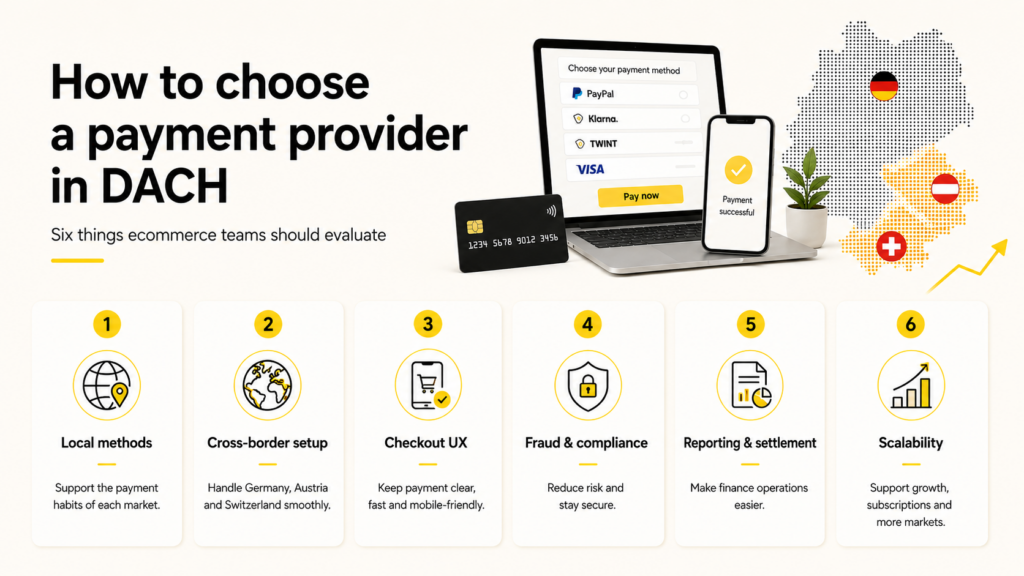
Payments are part of trust.
A customer may like your product, trust your brand and still leave checkout if the payment step feels wrong.
This is especially true in DACH, where customers often care about security, clarity and control. Privacy expectations also shape how customers react to payment data, personalization and checkout communication. We covered this wider topic in data privacy vs personalization in DACH online retail.
To build trust, ecommerce brands should make payment information clear before the final checkout step.
Customers should understand:
- which payment methods are available,
- when they will be charged,
- how refunds work,
- which currency they will pay in,
- what happens if payment fails,
- whether invoice or installment options are available,
- which provider handles the payment.
This is not only UX. It is conversion work.
FAQ: payment providers in DACH
What are the top payment providers in the DACH region?
Top payment providers and payment options in DACH include PayPal, Klarna, Stripe, Adyen, Worldline, Mollie, TWINT, Ratepay, Riverty, Amazon Pay, Apple Pay, Google Pay, SEPA Direct Debit, EPS, Wero, Computop, Unzer, PAYONE and PPRO. The right mix depends on whether a merchant sells in Germany, Austria, Switzerland or all three.
What is the most important payment method in Germany?
PayPal and invoice payments are among the most important online payment methods in Germany. Cards, direct debit, BNPL and mobile wallets also matter, but Germany should not be treated as a simple card-first market.
Is TWINT needed for ecommerce in Switzerland?
TWINT is highly relevant for Swiss ecommerce. Merchants selling seriously into Switzerland should consider TWINT alongside cards, invoice payments and PayPal.
Is Giropay still available?
No. Giropay was discontinued at the end of 2024. It should not be listed as an active top payment provider in a 2026 DACH payment article.
Is Wero important for ecommerce in DACH?
Wero is emerging as a European account-to-account payment option, especially in Germany. It is important to watch, but it is not yet a universal must-have for every DACH ecommerce checkout.
Which payment provider is best for cross-border DACH ecommerce?
There is no single best provider for every merchant. Cross-border DACH retailers usually need a PSP or payment setup that supports local methods, cards, wallets, refunds, fraud tools, multi-currency settlement and reconciliation. Adyen, Stripe, Worldline, Mollie, Computop, Unzer and PPRO-style setups may all be relevant depending on merchant size and complexity.
What payment methods should a small DACH webshop offer?
A small DACH webshop should usually start with PayPal, cards, Apple Pay / Google Pay and a pay-later or invoice option. If it focuses on Austria, EPS may matter. If it focuses on Switzerland, TWINT should be reviewed.
Conclusion
The DACH region needs more than one checkout logic.
Germany still leans heavily on PayPal and invoice payments. Austria needs a mix of cards, PayPal, EPS, SEPA and BNPL. Switzerland requires serious attention to TWINT, cards, invoice payments and CHF-based trust.
That means the best payment providers in DACH are not simply the biggest global names.
They are the providers and payment methods that help each customer pay in a way that feels familiar, safe and convenient.
For ecommerce brands, the goal is not to add every payment logo possible. The goal is to build a checkout that matches local behavior, protects margin and removes doubt at the moment of purchase.