Best ecommerce consultants in Germany and DACH: 12 firms to know

Germany has no shortage of ecommerce service providers. Finding a consultant who can make a sound commercial decision before a platform vendor or implementation team starts selling its preferred solution is harder.
That distinction matters. A consultant should help clarify the business case, operating model, requirements and investment risk. Development may follow, but code isn’t the first deliverable.
The 12 firms below all have an active presence in Germany or the wider DACH region and offer genuine ecommerce consulting. Some are independent strategy consultancies. Others combine advisory work with design, integration and managed services. The list is grouped according to fit, not ranked from best to worst.
Editorial note: Company capabilities were checked against official firm and technology-partner pages in August 2026.
Why DACH ecommerce consulting is different
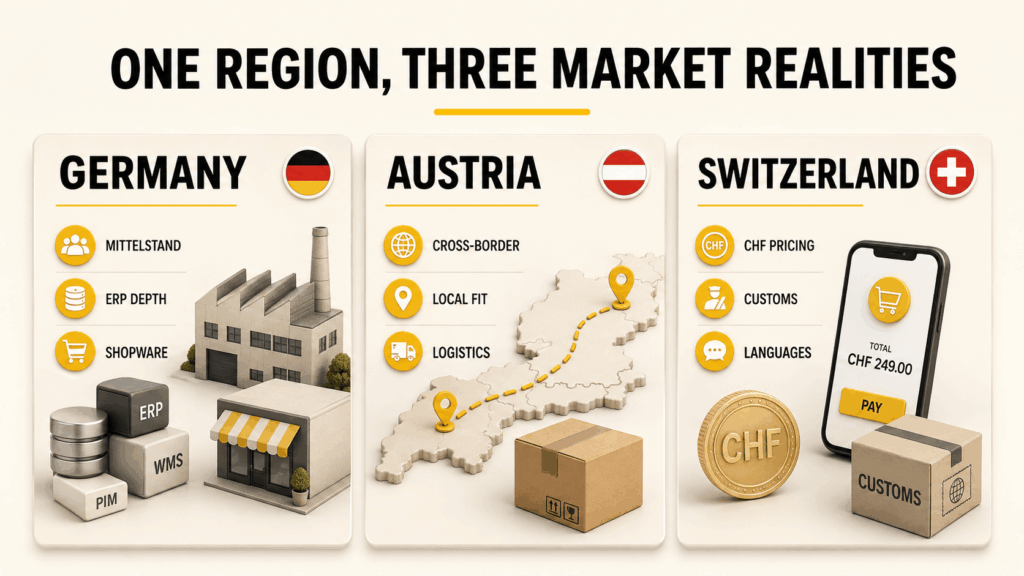
The German-speaking market rewards preparation. Buyers expect clear product information, dependable delivery and familiar payment options. Consumer law, data protection and accessibility add detailed obligations. Switzerland introduces its own currency, customs and tax processes, while Austria often works as both a local market and a bridge into German-language cross-border commerce.
Technology has a regional character too. Shopware grew in Germany and remains highly relevant for Mittelstand retailers, manufacturers and B2B sellers. SAP runs deep inside larger companies. ERP, PIM, CRM and warehouse systems often hold decades of process logic that a new storefront must respect.
As a result, the hard part of a DACH commerce program is rarely choosing a prettier shop theme. It’s connecting commercial goals with pricing rules, product data, customer-specific assortments, procurement workflows, legal requirements and internal ownership.
International teams entering the region should start with the complete guide to the DACH market. A consultant with local experience can then turn that market context into a practical operating plan.
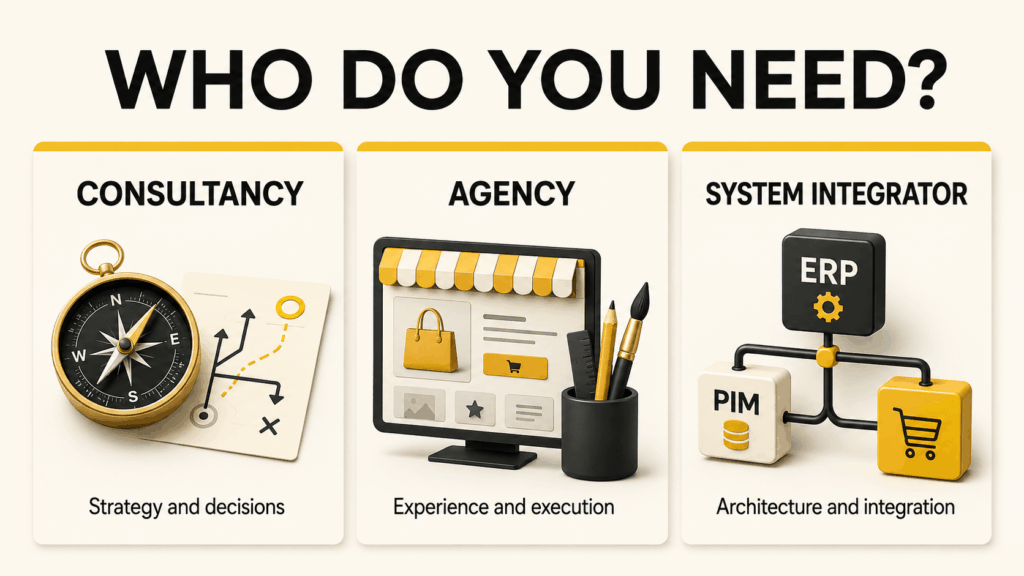
Ecommerce consultancy vs agency vs system integrator
These labels overlap, so judge a provider according to what it will own in your project.
| Partner type | Primary job | Typical deliverables | Best moment to hire |
| Ecommerce consultancy | Decide what the business should do and why | Business case, roadmap, platform requirements, vendor evaluation, operating model, KPI framework | Before committing to a platform or major transformation |
| Ecommerce agency | Design and improve the customer-facing experience | UX/UI, storefront development, content, campaigns, CRO and ongoing optimization | When the strategy and commercial priorities are already clear |
| System integrator | Make complex systems work together at scale | Architecture, ERP/PIM/CRM integration, migration, testing, security and managed operations | When enterprise technology and process integration drive the scope |
A single firm can cover all three roles. That can reduce handovers, but it also creates a potential conflict: a partner may recommend the platform it knows best. Ask shortlisted firms to separate advisory fees from implementation fees and explain how they compare technology outside their own partner portfolio.
What an ecommerce consultant should deliver
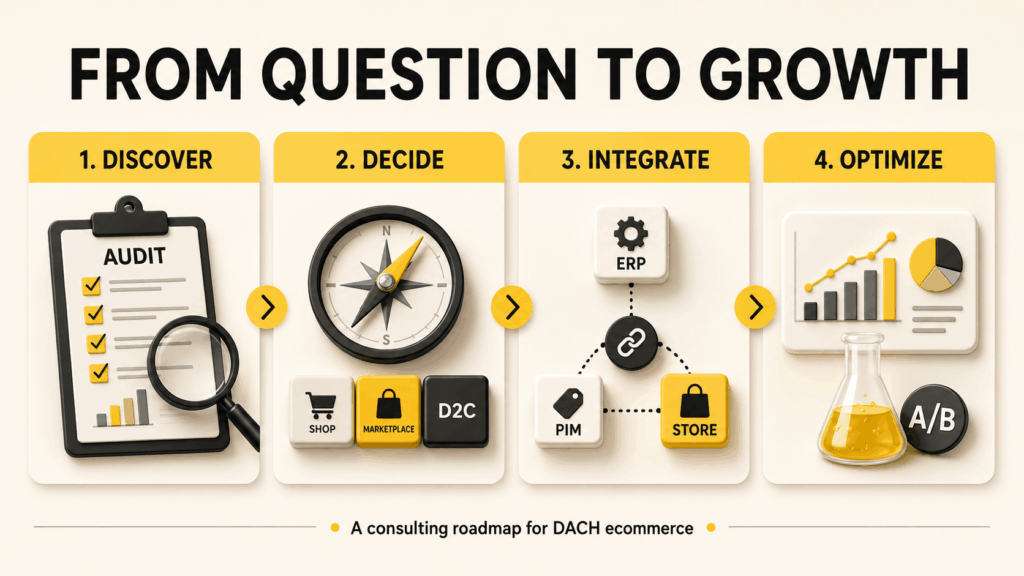
A credible engagement leaves the client with decisions, evidence and a route to execution. Common workstreams include:
- Commerce strategy: target segments, value proposition, channel roles, revenue logic and prioritized use cases.
- Platform selection: requirements, total cost of ownership, request for proposal, vendor scoring and proof-of-concept design. Our overview of leading ecommerce platforms in DACH provides a useful starting point.
- Replatforming: current-state audit, migration scope, architecture, sequencing, risk controls and launch planning.
- ERP and PIM integration: ownership of product, price, inventory, customer and order data across the system landscape.
- B2B digitization: customer-specific pricing, roles and approvals, quotes, repeat ordering, sales-rep workflows and self-service.
- Market entry: localization, payments, logistics, returns, tax, customer service and channel selection.
- Growth and CRO: funnel analysis, experimentation, merchandising, retention and commercial KPI management.
The outcome shouldn’t be a large slide deck with no owner. Good consultants identify who must make each decision, what evidence is still missing and what can be tested before a costly build begins.
Ecommerce consulting companies in Germany and DACH
Strategy-led ecommerce consultancies
1. Simon-Kucher
Best fit: Pricing, commercial growth and channel strategy for larger brands, retailers and manufacturers
Core consulting: Ecommerce growth strategy, pricing, promotions, assortment and customer journey economics
Platforms: Vendor-neutral at strategy level
DACH presence: Multiple German and Swiss offices, with global delivery
Simon-Kucher is a strong candidate when the central question is commercial rather than technical: how to grow profitably, structure prices, manage channel conflict or improve conversion economics. It isn’t a storefront implementation specialist, so companies commonly pair its strategy work with an agency or integrator.
2. elaboratum
Best fit: Mid-market and enterprise organizations that want independent digital commerce strategy with behavioral-science depth
Core consulting: Digital strategy, customer journeys, system landscapes, data, AI and program delivery
Platforms: Broad, with vendor selection tied to client requirements
DACH presence: Germany and Zurich
elaboratum describes itself as a strategic ecommerce and digital consultancy. Its work stretches from strategy and concept to implementation support. The firm suits companies that need a structured decision process and stakeholder alignment before technology delivery begins.
3. Commerce Advisory Network
Best fit: Owners, ecommerce leaders and mid-sized brands seeking senior hands-on advice
Core consulting: Digital strategy, marketplaces, business models, growth and transformation
Platforms: Vendor-neutral
DACH presence: Germany, network-based delivery
Commerce Advisory Network is the most consultancy-like boutique in this selection. It focuses on analysis, strategy and implementation support, drawing on a wider specialist network where needed. That model can work well when a client wants experienced sparring partners without buying a large delivery team at the outset.
Commerce transformation consultancies
4. diconium
Best fit: Enterprises and global manufacturers with complex digital sales programs
Core consulting: Strategy, digital operating models, customer experience, data, AI and commerce delivery
Platforms: Composable and enterprise ecosystems, including commercetools and Salesforce capabilities
DACH presence: Founded in Stuttgart, with several German offices
diconium combines management consulting, product design and software delivery. It is especially relevant for automotive, industrial and enterprise programs where ecommerce forms one part of a larger digital sales system.
5. KPS
Best fit: Large retailers, consumer brands and B2B organizations with SAP-heavy operations
Core consulting: Retail transformation, process design, ERP-to-CX integration and commerce modernization
Platforms: SAP Commerce Cloud, commercetools and connected SAP systems
DACH presence: Headquartered near Munich, with European delivery
KPS connects customer experience and ecommerce with back-office transformation. Its strongest use case is an end-to-end program where commercial processes, SAP ERP and digital channels must change together.
6. valantic
Best fit: Mid-market and enterprise companies seeking consulting plus implementation across the DACH region
Core consulting: Commerce strategy, customer experience, data, integration and managed services
Platforms: Shopify Plus, Adobe Commerce, SAP, Salesforce and other enterprise ecosystems
DACH presence: Extensive office network in Germany, Austria and Switzerland
valantic is a large digital consulting and solutions group rather than a narrow ecommerce boutique. Its breadth makes it useful when commerce touches CRM, analytics, enterprise applications and long-term operations. Buyers should still check which specific valantic team and legal entity will staff the engagement.
7. AOE
Best fit: Enterprises building complex digital products, platforms and transactional ecosystems
Core consulting: Product strategy, system modernization, architecture and custom software
Platforms: Composable, cloud-native and custom architectures
DACH presence: Wiesbaden, Germany
AOE combines strategic consulting with deep engineering. It fits programs that extend beyond a conventional online store, such as multi-service platforms, marketplaces or digital products with demanding integration and scale requirements.
Specialist consultants with implementation depth
8. dotSource
Best fit: German mid-market and enterprise B2B or B2C companies
Core consulting: Commerce strategy, requirements, system selection, PIM, CRM, marketing and implementation
Platforms: SAP Commerce, Salesforce, Adobe Commerce and other major commerce systems
DACH presence: Jena and other German locations
dotSource offers a clear consulting path before implementation, including requirements analysis, landscape assessment and system selection. It is suitable for firms that want one partner from discovery through build, provided the vendor-evaluation process stays transparent.
9. netz98, a valantic company
Best fit: Complex Adobe Commerce and Magento projects, especially B2B
Core consulting: Ecommerce strategy, technical audits, architecture, performance and SAP integration
Platforms: Adobe Commerce and Magento Open Source
DACH presence: Mainz, Germany, inside the valantic group
netz98 is a specialist rather than a platform-neutral advisor. That focus is valuable when Adobe Commerce or Magento is already selected, or when a client needs a rigorous assessment of an existing installation. It is less suitable for an open platform-selection exercise unless another advisor validates the shortlist.
10. Lemundo
Best fit: Mid-sized B2B and DTC brands seeking strategy, platform delivery and growth support
Core consulting: Ecommerce strategy, digital experience, technology selection, marketing and optimization
Platforms: Commerce and CMS/DXP ecosystems, selected around the project
DACH presence: Hamburg and Stuttgart
Lemundo positions itself as an ecommerce consultancy and digital agency. Its combined model can suit brands that want commercial advice and execution in one team, with fewer handovers between platform, experience and acquisition work.
11. SUNZINET
Best fit: German mid-market companies linking commerce with broader digital transformation
Core consulting: Digital, process, AI and technology consulting plus platform delivery
Platforms: Shopware, Shopify, Pimcore, Salesforce and connected experience tools
DACH presence: Cologne headquarters plus German and Austrian locations
SUNZINET covers strategy consulting, web development and digital marketing. Its partner portfolio supports multi-system work, though clients should ask how the firm keeps platform selection independent when it also sells implementation services.
12. diva-e Conclusion
Best fit: Enterprise B2B and B2C transformation with substantial experience, data and integration needs
Core consulting: Digital strategy, customer experience, commerce, PIM/MDM, marketing and operations
Platforms: Spryker, SAP Commerce, Salesforce and other enterprise technologies
DACH presence: Multiple German locations
diva-e Conclusion combines strategic advice with enterprise delivery. Its references include replatforming and SAP-connected digital sales, making it relevant where commerce architecture and experience work must move together.
Comparison table: which ecommerce consultant fits which need?
| Consulting company | Strongest fit | Typical client scale | Independence profile | Delivery model |
| Simon-Kucher | Pricing and profitable growth | Enterprise | High at platform level | Strategy-led |
| elaboratum | Independent strategy and customer behavior | Mid-market to enterprise | High | Advisory with implementation guidance |
| Commerce Advisory Network | Senior boutique advice and marketplaces | SME to mid-market | High | Boutique and specialist network |
| diconium | Digital sales transformation | Enterprise | Medium | Consulting through engineering |
| KPS | SAP-centered retail and commerce transformation | Enterprise | Medium | End-to-end consulting and integration |
| valantic | Broad DACH transformation | Mid-market to enterprise | Medium | Multi-disciplinary delivery group |
| AOE | Complex digital platforms and products | Enterprise | Medium to high | Strategy and custom engineering |
| dotSource | Platform selection through implementation | Mid-market to enterprise | Medium | Full-service commerce delivery |
| netz98 | Adobe Commerce and Magento | Mid-market to enterprise | Low outside its specialty | Specialist consulting and implementation |
| Lemundo | B2B/DTC strategy plus growth | Mid-market | Medium | Consultancy-agency hybrid |
| SUNZINET | Commerce within digital transformation | Mid-market | Medium | Consulting plus implementation |
| diva-e Conclusion | Enterprise commerce, experience and data | Enterprise | Medium | End-to-end transformation |
“Independence” here describes the business model, not the quality of advice. Platform specialists can make excellent consultants once a technology direction is set. A client running a genuine vendor selection, however, should understand every commercial partnership and delivery incentive.
How to choose an ecommerce consultant
Start with the decision you need to make. “We need a new shop” is too broad. A better brief might ask: Should we replace our current platform, which B2B journeys deserve investment first and what operating model can our team support over five years?
Ask every shortlisted consultant:
- Who will do the daily work, and how much ecommerce operating experience do they have?
- How do you separate platform advice from implementation sales?
- Which assumptions will you test before recommending a major investment?
- How will you assess ERP, PIM, CRM, OMS, tax and logistics dependencies?
- What will our team own after the engagement?
- Can you show anonymized examples of the actual deliverables?
- How do you define success six and twelve months after launch?
Red flags include a platform recommendation before discovery, a proposal dominated by junior delivery roles, unclear data ownership, no plan for internal change and an architecture discussion that ignores commercial priorities.
A good scope names the decisions, workstreams, stakeholders, deliverables, exclusions and acceptance criteria. It also contains a checkpoint where the client can stop, change direction or tender implementation separately.
Typical ecommerce consulting costs in Germany
Most firms don’t publish rate cards, and a large transformation shouldn’t be priced from a generic online average. Still, buyers need a planning range. The following figures reflect common market practice rather than fixed quotes:
| Engagement | Indicative budget, excluding VAT |
| Focused audit or senior workshop | €5,000–€20,000 |
| Ecommerce strategy and roadmap | €20,000–€75,000 |
| Platform selection or replatforming discovery | €30,000–€120,000 |
| Fractional senior advisor or retained consulting | €5,000–€25,000 per month |
| Mid-market implementation program | €100,000–€500,000+ |
| Enterprise transformation with major integrations | €500,000 to several million euros |
Specialist day rates often sit around €900–€1,800. Senior partners, scarce technical experts and large strategy firms can cost more. Nearshore delivery can lower the blended rate, but it doesn’t reduce the need for senior local ownership.
Compare commercial models as well as totals. A fixed-price discovery gives cost control if the scope is precise. Time and materials fits uncertain technical work. A retainer suits continuous optimization. Outcome-linked fees can work for measurable growth projects, but only when attribution, baseline data and decision rights are agreed in advance.
Austria and Switzerland: when local consulting matters
A Germany-based playbook can cover much of Austria, but it shouldn’t erase local payments, logistics, tax, language and consumer expectations. Austria-based TOWA is one example of a regional partner combining B2B consulting and commerce delivery across Germany, Austria and Switzerland.
Switzerland demands a more distinct plan. CHF pricing, import and customs processes, multilingual content and local service expectations can affect both architecture and economics. Unic has Swiss roots and develops composable and headless commerce solutions that fit complex system landscapes. elaboratum and valantic also maintain Swiss capabilities.
Channel strategy may differ across borders too. Review the major online marketplaces in Germany before assuming that a direct store should carry the full market-entry burden. Companies comparing expansion regions can also use our analysis of DACH versus CEE growth potential.
Final take
The best ecommerce consultant isn’t the firm with the longest platform list. It’s the one that can frame the right decision, expose weak assumptions and give your team a plan it can actually operate.
Choose a strategy specialist when pricing, channels, organization or investment logic remain unclear. Choose a commerce transformation consultancy when the work spans operating model and technology. Bring in a platform specialist after the direction is set, particularly for demanding Shopware, Adobe Commerce, SAP Commerce, Shopify Plus or composable builds.
For many DACH companies, the strongest setup uses more than one partner: an independent advisor to shape and challenge the case, followed by a specialist implementation team with clear accountability.
FAQ
Which are the top ecommerce consulting companies in Germany?
Strong options include Simon-Kucher, elaboratum, diconium, KPS, valantic, AOE, dotSource, netz98, Lemundo, SUNZINET and diva-e Conclusion. The right choice depends on the job. Simon-Kucher is suited to pricing and growth strategy, elaboratum to independent digital commerce advice, KPS to SAP-centered transformation and netz98 to Adobe Commerce specialization.
What services do ecommerce consultants provide?
They develop ecommerce strategies, assess operating models, select platforms, plan replatforming, map ERP and PIM integrations, design B2B journeys, support market entry and build CRO or growth programs. Some remain independent advisors, while others also implement and operate the solution.
What’s the difference between an ecommerce consultancy and an agency?
A consultancy concentrates on business decisions, requirements, economics, governance and roadmaps. An agency normally concentrates on customer experience, creative work, development or marketing execution. Many providers combine both, so buyers should judge the proposed team and deliverables rather than the label.
How do I choose an ecommerce consultant in Germany?
Define the decision first, then check DACH experience, platform independence, senior team involvement, ERP/PIM knowledge and post-project ownership. Ask for sample deliverables and a transparent explanation of technology partnerships. Run a paid discovery phase before committing to a multi-year program.
How much does ecommerce consulting cost in Germany?
A focused audit may cost €5,000–€20,000, while strategy or platform-selection work often runs from €20,000 to more than €100,000. Specialist day rates commonly range from about €900 to €1,800, with senior partners and rare technical skills above that level. Implementation is a separate budget and can range from six figures to several million euros.
Do the Big Four offer ecommerce consulting in Germany?
Yes. Deloitte, PwC, EY and KPMG all have German practices covering retail, digital transformation, customer experience, technology and related commerce topics. They tend to fit large, multi-country transformations where governance, tax, finance, operations and enterprise technology matter as much as the storefront. A specialist boutique may offer more direct senior access for a narrower ecommerce decision.
What’s the most-used ecommerce platform in Germany?
There is no single authoritative answer across every segment. Shopware has particular strength in the German mid-market, while Shopify and WooCommerce have broad adoption among smaller merchants and brands. Adobe Commerce, SAP Commerce, Salesforce and composable platforms appear more often in complex mid-market and enterprise environments. The installed base alone shouldn’t determine platform fit.
Do ecommerce consultants provide post-launch support?
Many do. Support can include KPI reviews, experimentation, roadmap governance, product ownership, technical audits and vendor management. Firms that also implement may offer maintenance and managed operations. Agree service levels, ownership and exit terms before launch so the client retains control of data, documentation and supplier access.