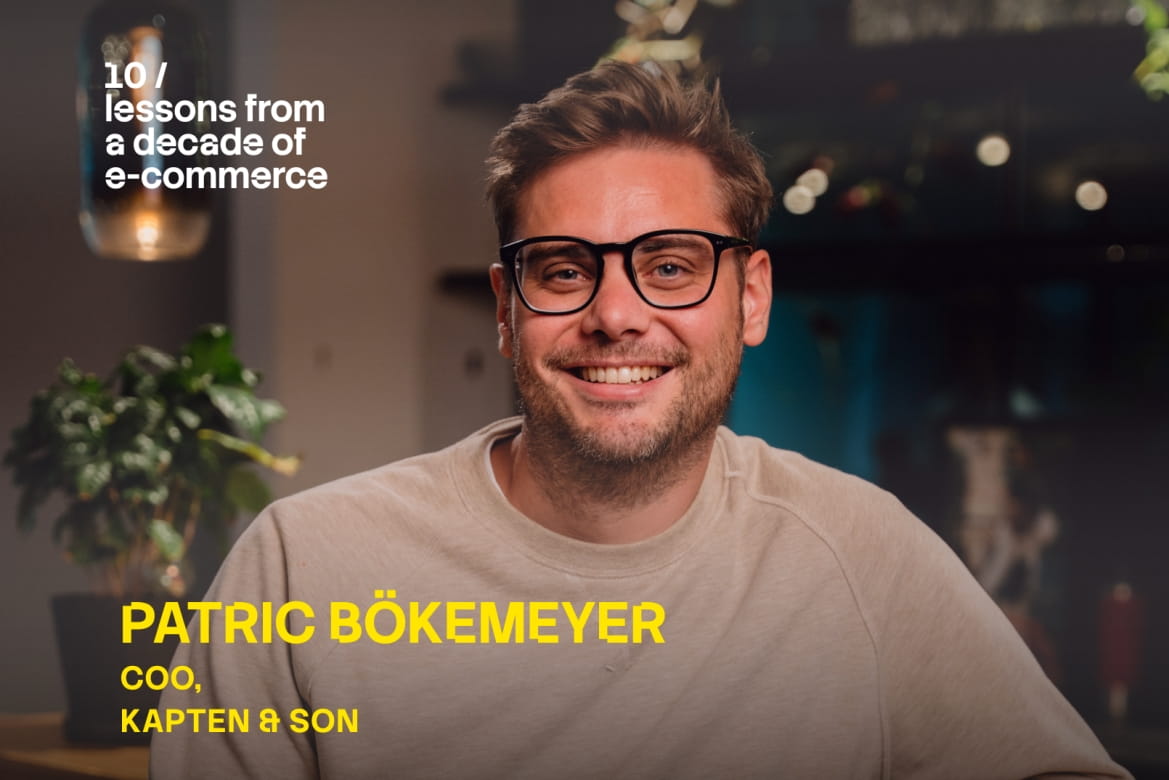
“Treat e‑commerce less as a growth machine and more as a long‑term responsibility”: 10 LESSONS FROM Patric Bökemeyer, COO at Kapten & Son
Written by
Editorial TeamPublished on
Discover 10 valuable e-commerce lessons from Patric Bökemeyer, COO at Kapten & Son, as he shares his insights on the future of online retail to mark the 10th anniversary of the E-commerce Berlin Expo. [EXCLUSIVE INTERVIEW SERIES]
The E-commerce Berlin Expo celebrated its 10th anniversary in 2026. To mark this milestone, we interviewed some of the world’s most influential leaders about the future of online retail, asking them to share their 10 valuable lessons in e-commerce. Their insights were featured in our special album, showcasing the most powerful voices in online retail, which we decided to share with you on E-commerce Germany News.
This time, we’re featuring an exclusive interview with Patric Bökemeyer, COO at Kapten & Son. See what e-commerce lessons he shared with us below!
What first drew you to this industry?
PATRIC: What first drew me to e‑commerce (and also operations) was the combination of measurable impact and complex problem‑solving. Early in my consulting career, I saw how even small process improvements could significantly change delivery reliability, customer satisfaction and especially customer experience, which I found incredibly motivating. E‑commerce enables data-driven decision-making and allows ideas to be tested and scaled very quickly. What excites me most is that true customer experience only happens when frontend, technology, fulfillment, and post-purchase work together seamlessly. That intersection is exactly where I feel at home today as the COO of Kapten & Son.
Which early failure taught you something that still guides you today?
PATRIC: One of the experiences that still shapes how I approach complex, far‑reaching decisions is not a classic “failure”, but rather a very bold – and, in hindsight, quite risky – decision. Around three years ago, at Kapten & Son, we decided to rebuild our entire tech stack almost from scratch: from the shop architecture and OMS to ERP and our complete post‑purchase environment. Throughout this process, I learned how important it is not to label previous solutions as “wrong”, but to recognize that they were perfectly adequate for a certain stage of scale. The real turning point is understanding when those solutions hit their limits, and a more scalable architecture becomes a prerequisite for further growth. This mindset still guides me today: I try not to judge legacy systems and processes in retrospect, but to assess whether they can support the goals of the next growth phase – and based on that, make technology and operations decisions that are both more conscious and more courageous.
Quote / Patric Bökemeyer, COO at Kapten & Son(…) roughly 20% of decisions, processes or products create 80% of the impact. The real leverage comes from identifying these few levers – key customer problems, core markets, critical systems or processes – and aligning the organization relentlessly around them.
When you think of the past decade of e-commerce, what do you miss – and what are you glad we left behind?
PATRIC: What I sometimes miss from the past decade of e‑commerce is a bit of the simplicity in tech stacks – fewer tools, fewer integrations, but very clear ownership of the end‑to‑end customer journey. At the same time, I’m genuinely glad we’ve left behind the mindset that e‑commerce is just “a webshop plus some ads”. The industry has matured into a much more connected ecosystem of marketplaces, owned stores, retail, logistics, fulfillment, CX and data, which allows us to design better and more consistent experiences. I’m also happy we’re moving away from dark patterns, pure discount battles, and gut‑feeling decisions toward more transparent, data‑driven, and customer‑centric models. Ideally, we now combine the curiosity and agility of the early days with the professionalism, tooling, and scalability we’ve built over the last ten years.
What is the single most important business lesson you have learned throughout your career?
PATRIC: The single most important business lesson I’ve learned is that focus beats brilliance – and that most things follow the 80/20 rule. In almost every role, from consulting to Kapten & Son, I’ve seen that roughly 20% of decisions, processes or products create 80% of the impact. The real leverage comes from identifying these few levers – key customer problems, core markets, critical systems or processes – and aligning the organization relentlessly around them. This mindset also makes tough choices clearer: saying no to projects, tools or features that don’t move the needle. In a world full of shiny opportunities, consistently applying this 80/20 focus has created far more sustainable growth than any single “big idea”.
How would you define success in e-commerce today, and how has your view of it changed over time?
PATRIC: Today, I would define success in e‑commerce as sustainable, customer‑centric growth that a business can operationally and financially support – not just impressive GMV slides. It means building a model where unit economics work, repeat customers return because the experience is consistently strong, and the organization behind it can truly deliver on its promises in terms of delivery, service, and quality. Metrics like LTV, contribution margin, fulfillment reliability, and NPS have become much more important to me – not instead of revenue growth, but as its foundation.
Earlier in my career, I measured success much more through classic growth KPIs: traffic, orders, conversion rate, or speed of international expansion. Today, I see success in a far more holistic way: How robust is our tech and tool stack? How resilient is our supply chain? How well are marketing, e‑commerce, operations, and customer service really working together? In short, my perspective has shifted from “How fast can we grow?” to “How healthily can we grow – and are we equipped to weather the next market cycle?”
Quote / Patric Bökemeyer, COO at Kapten & Son GmbHI strongly believe that clear ownership is important, but it should never turn into ego-driven silo thinking.
What do you see as the biggest opportunity in e-commerce today?
PATRIC: One of the biggest opportunities in e‑commerce today is to truly connect data, AI and operations to create experiences that feel both personal and reliably delivered. Many brands have strong frontends and a lot of data points, but the real upside lies in using that data – responsibly – to orchestrate the entire journey: from personalized discovery and pricing to inventory placement, fulfillment options, and post‑purchase communication. AI & automation can help us move from static rules to adaptive systems: smarter forecasting, dynamic logistics routing, proactive customer service, and much more relevant content.
At the same time, there’s a huge opportunity in treating marketplaces, owned stores, and retail not as competing channels, but as one connected commerce ecosystem built around the customer’s context. Brands that manage to align tech stack, logistics & fulfillment, CX and organizational setup around this idea will not only grow faster, but also with healthier unit economics.
What’s the most counterintuitive or unconventional thing your company does today that actually works?
PATRIC: Interestingly, we are deliberately investing in a channel that many e‑commerce brands are currently scaling back: our own app. While others are shutting down their apps or barely developing them further, we launched the Kapten & Son Experience App in 2025 and clearly see it as a strategic touchpoint. Beyond pure shopping, we offer exclusive content and high-quality giveaways – such as trips to New York or special experience journeys – turning the app into its own immersive universe around the brand. Our goal is not to cannibalize the webshop, but to complement it at critical moments in the journey. In the long run, we view the app as an independent channel within our commerce ecosystem, enabling us to engage with customers in a much closer, more relevant and more regular way than through classic web and performance touchpoints alone.
What guiding principle do you personally refuse to compromise on, no matter the trend or pressure?
PATRIC: The one guiding principle I refuse to compromise on is that we can only truly win as a team – there is no room for pure solo players. In e‑commerce and operations, almost every result is the outcome of many hands and minds: tech, logistics, CX, product, marketing and so on. When everyone aligns behind a shared goal, the quality of the outcome is consistently higher than when individuals primarily optimize for their own visibility or success. I strongly believe that clear ownership is important, but it should never turn into ego-driven silo thinking. My role is to create an environment where collaboration is valued more than personal spotlight, and where we celebrate joint achievements instead of individual hero stories. Over time, this mindset has proven to be not only healthier for the culture but also a real performance driver.
Looking ahead, what will define the next decade of e-commerce, and how does thinking about the future make you feel – optimistic, excited, concerned, or something else?
PATRIC: I believe the next decade of e‑commerce will be defined by AI‑driven orchestration and truly connected ecosystems. We’ll move from standalone shops to networks of channels, data and services that dynamically adapt to each customer’s context across discovery, purchase and fulfillment. At the same time, I’m consciously cautious, because the temptation to use data and AI in ways that erode trust will grow just as fast. I’m also not convinced that, in the future, every purchase will be made “by” or purely through AI – especially in fashion, many decisions are deeply emotional and personal. That’s why I’m convinced that human relationships will remain a very relevant touchpoint in the long run, whether through retail experiences, customer service or communities around a brand.
If you could leave a message for future e-commerce leaders, what would it be?
PATRIC: If I could leave one message for future e‑commerce leaders, it would be this: treat e‑commerce less as a growth machine and more as a long‑term responsibility. You are not only optimizing funnels and tech stacks – you’re shaping how people consume, how supply chains are built, and how resources are used. Use data and AI to make things smarter and simpler, but never let them replace sound judgement, empathy and common sense. Remember that most real wins come from the “boring” 20% of work that drives 80% of the impact: clean operations, reliable delivery, honest communication and a team that truly pulls in the same direction. Don’t chase every trend; build systems, cultures and brands that can survive several cycles of hype. And if you ever have to choose, choose trust over a short‑term spike – with customers, partners and your own team; it will compound more than any campaign ever could.
PATRIC’S BIO
Patric Bökemeyer is currently the COO at Kapten & Son. Over the past years, he has built and scaled e-commerce and operations functions across multiple roles. He focuses on operational excellence, high-performance logistics and fulfillment structures, and a tech stack that ensures a strong and consistent customer experience. Prior to joining Kapten & Son, he worked as a consultant in supply chain management and logistics, where he built the analytical and process-oriented foundation for his current leadership responsibilities.