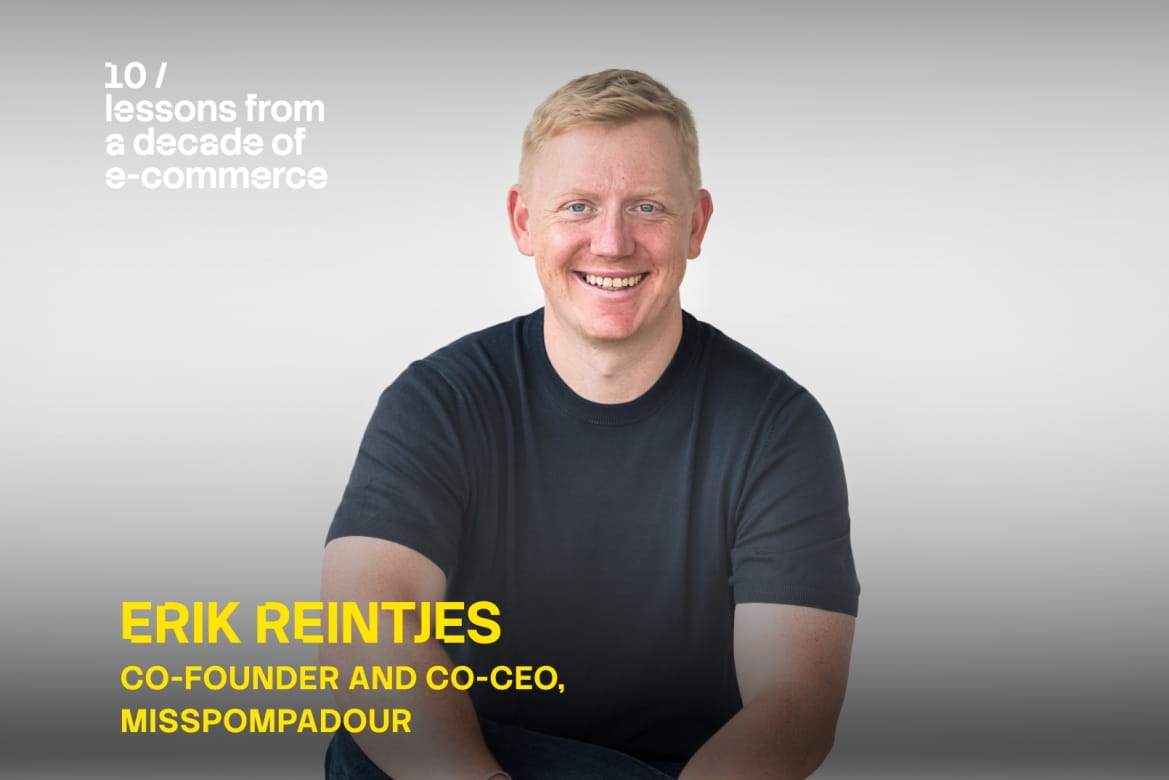
“True strength lies in surrounding yourself with people who are better than you in their respective fields”: 10 lessons from Erik Reintjes, Co-Founder and Co-CEO of MissPompadour
Discover 10 valuable e-commerce lessons from Erik Reintjes, Co-Founder and Co-CEO of MissPompadour, as he shares his insights on the future of online retail to mark the 10th anniversary of the E-commerce Berlin Expo. [EXCLUSIVE INTERVIEW SERIES]
The E-commerce Berlin Expo celebrated its 10th anniversary in 2026. To mark this milestone, we interviewed some of the world’s most influential leaders about the future of online retail, asking them to share their 10 valuable lessons in e-commerce. Their insights were featured in our special album, showcasing the most powerful voices in online retail, which we decided to share with you on E-commerce Germany News.
This time, we’re featuring an exclusive interview with Erik Reintjes, Co-Founder and Co-CEO of MissPompadour. See what e-commerce lessons he shared with us below!
No one can be successful alone
What first drew you to this industry?
Erik: I originally trained as a retail salesperson and started my career in the most traditional way – on the shop floor. I only came into contact with e-commerce later, when I worked at Sport Schuster in Munich and had the opportunity to get a first glimpse into online retail. That was when I really got to know the world of e-commerce from the inside – with all its challenges, but also its opportunities! Looking back, ending up in e-commerce was more of a coincidence than a plan. I realised: If I’m going to work in retail, then not only in physical stores, but in a place where I can shape the future: online.
Which early failure taught you something that still guides you today?
Erik: One of my most formative early setbacks was failing my final school exam. At that moment, I realised that up to that point, I had mostly followed a path shaped more by external expectations than by my own goals. It was painful, but it taught me a lesson that has stayed with me ever since: I have to take responsibility for my path and actively decide where I want to go. I then changed school, completed my degree on my own terms, and pursued my own interests. This experience taught me not to blindly follow existing structures, but to actively shape them – both in my personal life and in my career. Today, this mindset helps me in our company: we don’t rely on things simply working out somehow, but take responsibility – for example, by shaping our work environment, minimising our CO₂ footprint, or reducing dependencies by always having a plan B ready.
When you think of the past decade of e-commerce, what do you miss – and what are you glad we left behind?
Erik: When I look back at the past decade in e-commerce, I genuinely miss the days when advertising wasn’t that expensive, and you could achieve enormous reach with a manageable budget. Back then, everything felt more experimental and playful – you could test ideas without every click costing a small fortune. Today, the competitive pressure is much higher, and e-commerce relies heavily on discounts, which often leads to a pure price battle and devalues products. What I am truly glad about, however, is that we have largely moved past the myth of free shipping. It is increasingly accepted that shipping is a real service that incurs costs: customers are increasingly understanding that shipping is allowed to have a price.
In a world full of automation, genuine closeness is a powerful lever.
What is the single most important business lesson you have learned throughout your career?
Erik: The most important business lesson of my career is that no one can be successful alone – not even in e-commerce. No one can be an expert in every area and make every decision by themselves. Anyone who believes otherwise only slows down their own growth and makes unnecessary mistakes. True strength lies in surrounding yourself with people who are better than you in their respective fields – and actually trusting them. A strong team elevates a company to a level that one could never reach alone. This realization guides me every day and shapes how I make decisions, distribute responsibility, and steer our growth.
How would you define success in e-commerce today, and how has your view of it changed over time?
Erik: For me, success in e-commerce today primarily means building a sustainable and profitable business model. In the past, e-commerce was strongly driven by the idea of growing as quickly as possible, securing market share, and burning money if necessary – profitability was more of a later goal. Today, this has changed significantly: success is no longer measured solely by reach or revenue, but by whether a company is economically healthy in the long term and creates real added value for its customers. This includes keeping margins in mind, designing processes efficiently, and not relying on short-term effects. Success, for me, is therefore not just rapid growth, but the ability to grow steadily, remain profitable, and build a company that endures.
What do you see as the biggest opportunity in e-commerce today?
Erik: For me, the greatest opportunity in e-commerce still lies in its enormous reach. A good product can be discovered by millions of people. While brick-and-mortar retail is always tied to a physical location, online retail offers the possibility to tap into new markets, address target groups with precision, and grow independently of geography. This international visibility – combined with digital tools that allow us to truly understand our customers – is, in my view, the greatest potential in e-commerce.
The impact of personal consultation
What’s the most counterintuitive or unconventional thing your company does today that actually works?
Erik: We talk to our customers! In doing so, we are consciously moving against the current trend of reducing customer contact or using AI as the first point of interaction. Instead, we deliberately invest in genuine, personal consultation. At first glance, this doesn’t sound particularly scalable and may even seem a bit outdated – but it works well. Our customers appreciate being able to ask questions and receive personal advice about their painting projects. For us, this is a measurable competitive advantage: better purchasing decisions, significantly lower return rates, higher revenue per customer, and longer-lasting customer relationships. In a world full of automation, genuine closeness is a powerful lever.
I remain optimistic: e-commerce will change, but those who take customer closeness seriously and use technology wisely – enhancing rather than replacing everything – will have a bright future.
What guiding principle do you personally refuse to compromise on, no matter the trend or pressure?
Erik: At MissPompadour, we began early on to evaluate every decision based on two questions. First: “Does it make our customers happy?” and second: “Will it help us sell one more can of paint?” These questions accompany every strategic consideration and help us avoid chasing short-term trends or losing focus. At the same time, we assume social responsibility that shapes our decisions – for example, toward people with disabilities, whom we deliberately integrate into our teams, even if this does not always make economic sense. This principle also applies to our supply chain: we produce exclusively in Germany, consciously forgoing higher margins, but in return gaining quality, transparency, and a significantly better ecological footprint.
Looking ahead, what will define the next decade of e-commerce, and how does thinking about the future make you feel – optimistic, excited, concerned, or something else?
Erik: I am convinced that the next decade in e-commerce will be strongly shaped by artificial intelligence. AI will not only automate processes, but also influence product development and business models. Companies will increasingly try to act in a data-driven way – often with the goal of generating as much output as possible with as little staff as possible. To me, this poses a risk: if everything becomes optimised, predictable, and interchangeable, commerce will lose part of its passion, creativity, and authenticity. At the same time, I also see great opportunities. Customers are buying more and more online, and brands that build genuine relationships, show personality, and live their values will benefit from this trend. We are well-positioned because we maintain a very close relationship with our customers – and that kind of relationship cannot be easily replaced by AI-generated, off-the-shelf brands. What concerns me more are rising costs: advertising budgets, tools, systems, personnel – these factors put pressure on companies and will further consolidate the market. Nevertheless, I remain optimistic: e-commerce will change, but those who take customer closeness seriously and use technology wisely – enhancing rather than replacing everything – will have a bright future.
If you could leave a message for future e-commerce leaders, what would it be?
Erik: Don’t lose sight of your customer. I believe that’s the most important thing of all.
Erik Reintjes’s bio
Erik Reintjes is the co-founder and co-CEO of MissPompadour, a paint company that manufactures products for DIY painting in Germany and distributes them across Europe. The company now employs around 170 people.