Women in business: Europe’s hidden advantage
Here’s the impact of women in business on Europe’s economy. Gain insights into their unique advantages and the transformative role they play.

Europe loves talking about innovation, digital skills, AI adoption, or Green tech. But the continent’s real advantage is something far more human. It’s the growing force of female entrepreneurs building companies with a different rhythm, a different sense of purpose, and a different understanding of value.
The report Female Entrepreneurs: Europe’s Untapped Competitive Edge by Frontier shows it clearly: Europe has been sitting on a massive economic lever for years without pulling it. Women in business are one of the strongest, most consistent growth drivers available to this continent — yet they remain underrepresented in almost every stage of the business journey. And the moment you see the data, the opportunity becomes almost impossible to ignore.
This article presents the findings, distills them into practical insights, and helps us understand why unlocking the potential of female entrepreneurs is a strategic advantage.
Let’s go step by step.
Europe’s untapped power: female entrepreneurs
Female entrepreneurship in Europe sits in a strange spot. Everyone talks about diversity, yet the numbers show how far the market still needs to travel. And that gap may be one of the reasons Europe keeps leaving growth, productivity, and innovation on the table.
Because the current system filters female entrepreneurs so heavily, only the most productive women-led firms tend to survive. This creates a strong selection effect that makes these firms, on average, about 10% more productive than male-led firms. When barriers drop, more women enter the market, and these new female-led businesses still bring higher productivity levels. As they scale, they gradually replace less productive male-led firms, lifting overall national performance through steady reallocation.
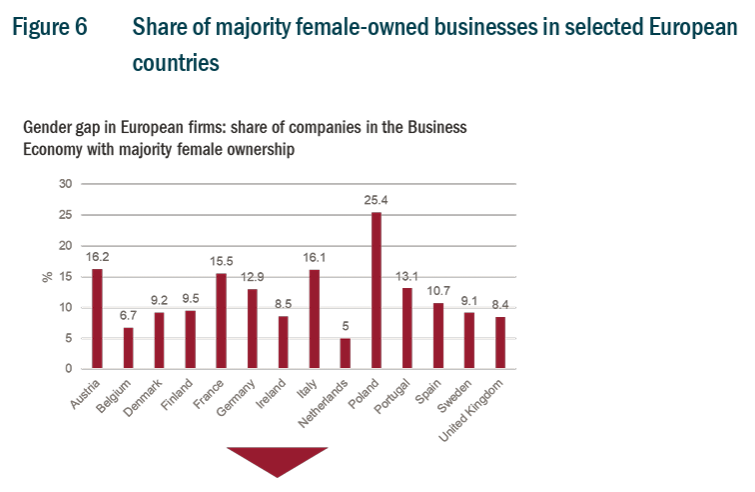
In simple terms: the talent is already there. The conditions are what hold the numbers down. When those conditions improve, the number of female entrepreneurs rises and productivity across the economy rises with them.
Why gender parity transforms economies
The report shows something many policymakers underestimate: gender parity changes long-term productivity. And it’s measurable.
Female-led firms often show higher productivity because of strong selection effects. In simple terms, when barriers are high, only the most capable women make it through the pipeline. The result is a pool of firms that tend to be well-run and efficient.
Now imagine what happens when those barriers go down. Instead of a handful of highly resilient founders, Europe gets a broader group of women in business — each with the potential to build firms that strengthen entire industries.

What do the numbers predict?
Improving gender representation could lift economic output significantly by 2040. It’s grounded in expected gains from closing gaps in business creation, scaling, and survival.
The model works like this:
- More women start companies.
- More of those companies survive the early, fragile years.
- More of them scale into employers.
- Productivity rises because the market benefits from more diversity in decision-making.
Think of a woman who wanted to start a business five years ago but didn’t. Maybe she lacked access to capital. Maybe the childcare burden made the risk unrealistic. Maybe she had talent but no network.
Now picture her entering the market with real support. She builds a company with stable processes, strong customer relationships, and long-term planning — all patterns seen frequently among female entrepreneurs.
One founder like this changes one household. One hundred change a city. Thousands change a continent.
The real barriers behind the gap (and why they matter now)
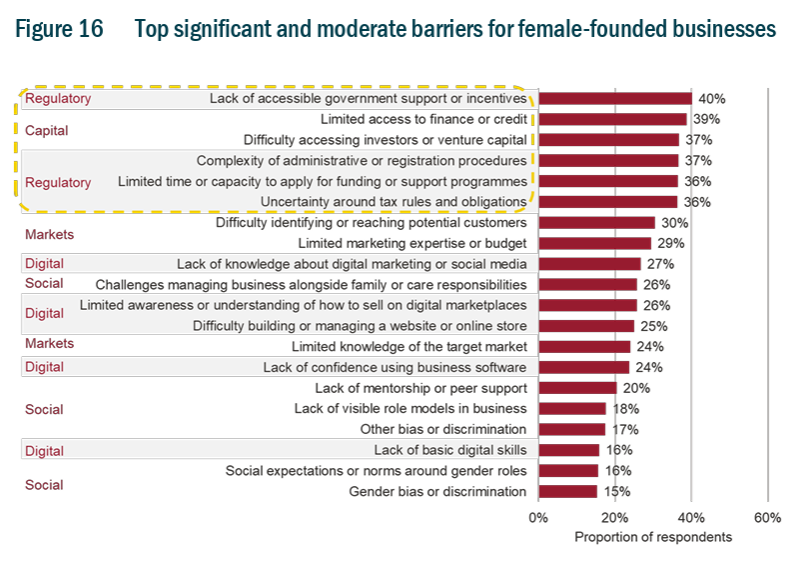
When you look closely at the data, you see two layers of barriers. The visible ones are administrative. The harder ones are social. And they rarely appear in isolation.
The benchmark includes interviews and survey responses from 600 entrepreneurs across six European countries. When you read their stories, a pattern emerges. Women in business face all the typical startup challenges, but the intensity is different. The weight is heavier. And the obstacles show up earlier.
Administrative friction
The report highlights that regulatory complexity is a significant barrier. It slows down first steps and makes every decision feel more expensive. For experienced founders, paperwork is an annoyance. For first-time founders — especially women balancing parallel responsibilities — it becomes a deterrent.
It’s a steady problem. A friction that adds up. When you add long registration processes, unclear rules, and inconsistent local guidance, the entry threshold becomes harder to cross.
Capital access
Access to capital remains one of the biggest challenges for European female entrepreneurs. The issue isn’t lack of ideas. It’s the lower likelihood of receiving investment, slower approval timelines from financial institutions, and stricter requirements for collateral.
All of this pushes women toward self-financing, which limits scale. It also increases risk aversion, especially when support systems are thin.
Social norms
Many respondents described challenges tied to confidence, perceived credibility, and balancing care responsibilities. Women often face questions men never hear. Investors may test their “commitment” to growth. Banks may ask about family responsibilities. These things seem small, but they chip away at momentum.
Digital readiness
The benchmark notes that digital skills and confidence differ across genders in the early stages of entrepreneurship. Women are fully capable, but they often self-assess more cautiously. That slows down adoption of digital tools that would otherwise speed up operations, marketing, or financial planning.
Together, these top barriers make the path harder. And whenever the path gets harder, fewer people walk it.
What female entrepreneurs actually need to thrive
Women explain what support would make the biggest difference. You can see a pattern that feels consistent across countries, backgrounds, and sectors.
Clearer information & easier access to capital
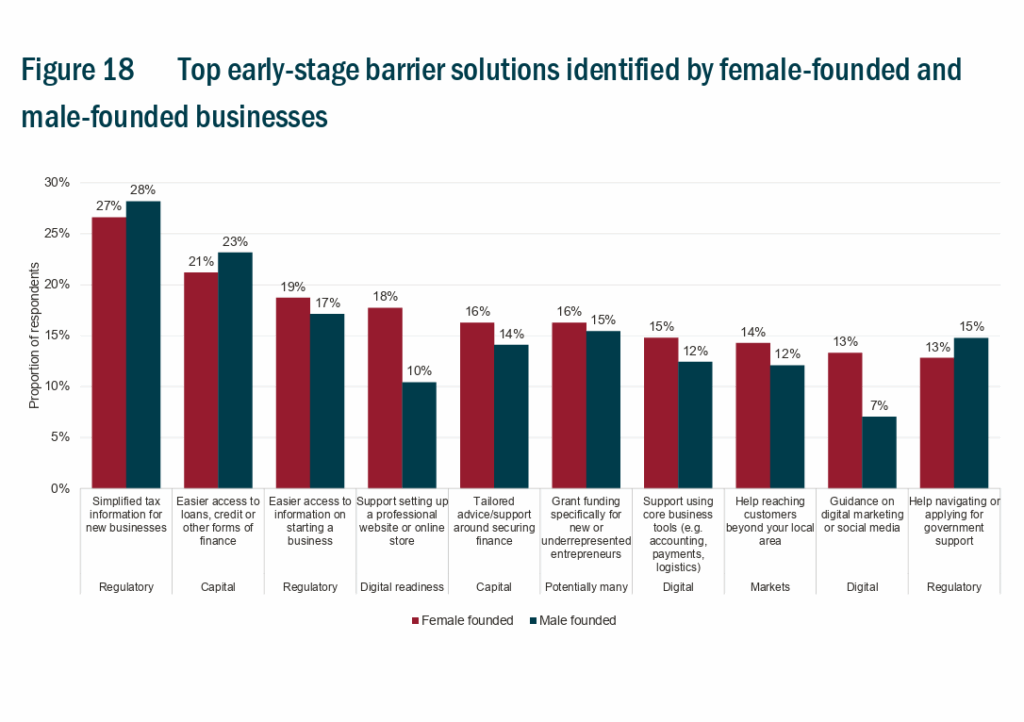
27% of women surveyed want transparency on taxes, especially for new businesses, and 21% identified easier access to capital as one of the most impactful support mechanisms.
Going further, 19% want easier access to information on starting a business and 16% grant funding specifically for new or underrepresented entrepreneurs.
Predictability. Clear rules. And timelines they can plan around. This kind of clarity shifts the landscape. When founders know the process and the criteria, they can make decisions faster.
Confidence-building through mentorship and support
The report highlights a strong demand for support and mentorship for setting up a professional website or online store (18%). Women need structured spaces where they can test ideas, learn from industry peers, and gain confidence. 16% also want tailored advice/support around securing finance. Moreover, 15% need support using core business tools (e.g. accounting, payments, logistics).
Thus, there is a real need for training that strengthens digital confidence and business planning skills. And we think this isn’t about ability – more about reassurance. When founders understand the tools, they move faster and make fewer expensive mistakes.
A good network and programs could remove doubt. It also accelerates growth because it gives founders someone to call when something goes wrong.
As we can see, women expressed a strong desire for streamlined processes that remove bureaucratic delays. They want faster onboarding for new businesses, clearer tax guidance, and user-friendly digital tools. Small administrative wins free time and energy — two things entrepreneurs rarely have enough of.
Funding: the decisive unlock for women in business
Funding shapes the journey more than anything else. When access is slow or complicated, momentum fades. When the criteria feel unpredictable, women start second-guessing their ideas. And when rejection happens without clear reasons, they stop early.
Sadly, this isn’t theory. You can almost hear it — founders saying they feel confident about their ideas, but less confident about entering systems that don’t recognize their potential.
Often, women rely more on personal savings and informal family support. That means higher personal risk. Less room for early mistakes. And slower scaling.
If you start with less capital, you hire later. You market later. You build later. So the gap widens long before investors enter the picture.
The confidence gap
Women really tend to doubt their readiness, despite possessing strong skills. And when they underestimate their readiness, they postpone key steps: raising capital, applying for grants, hiring senior talent, or expanding abroad.
Sadly, hesitation has a price.
A three-month delay in applying for a grant. A year-long delay in hiring the first salesperson. A slow launch of a digital store because the tools feel unfamiliar. Over time, these delays compound. They shrink market share before the company even gets started.
How to fix confidence — the practical way
This short, helpful list can actually make big changes. You don’t need a lot of money or huge programs, just try simple ideas or join communities:
- mentorship from experienced founders
- peer communities
- practical business workshops
- visible success stories of women
- straightforward recognition from institutions
These things sound simple because they are. When a woman hears, “You’re ready,” from someone credible, she steps forward. When she sees another founder with a similar background succeed, she steps forward faster.
Markets change when society changes
Another layer of barriers sits in the everyday work of building a business:
- understanding the market,
- reaching the right people,
- and promoting a product with confidence.

Many female entrepreneurs describe this part as more time-consuming and more frustrating than expected. It’s not that they lack ideas. It’s that the market often feels like a moving target, and early-stage founders rarely have the luxury of big research budgets or dedicated marketing teams.
When you’re running a young business, you’re wearing every hat at once. You’re trying to get clarity on who your ideal customer actually is. You’re figuring out how to reach them without wasting precious budget. And you’re learning marketing on the go — often while handling operations, finances, and customer service. That pressure creates hesitation. Founders worry about choosing the wrong channel, spending money in the wrong place, or misreading demand.
These barriers slow down growth even when the product is strong. If you can’t pinpoint the market, every decision feels riskier. If reaching customers feels uncertain, campaigns get delayed. And when marketing expertise is limited, founders default to small, cautious moves instead of confident expansion.
This is why female entrepreneurs often talk about wanting clearer guidance, practical playbooks, and hands-on support. But the challenge is turning a good idea into something customers can actually find, understand, and trust.
That’s why they need training.
Training that actually works
Sometimes the simplest solutions are the easiest. If you don’t know something, it’s time to learn it. And women have made it clear what they need – short, applicable training in areas like:
- digital marketing
- customer identification
- market identification
- financial dashboards
- e-commerce platforms
- automation tools
- cybersecurity basics
- etc
And no, it’s not about full-degree programs. Just targeted confidence boosters.
Workshops are a good idea, too.
They can help with real tasks like mapping the first 12 months, prioritizing spending, forecasting with simple tools, and translating strategy into weekly steps.
When training produces something tangible — a financial model, a plan, a pitch — confidence rises.
There are also peer-to-peer formats.
Women in business respond strongly to peer learning (from benchmark, p.34). Listening to someone who solved the same problem last year hits differently than generic advice. It feels believable. Achievable. Practical.
This is why networks work. They shrink the emotional distance between “idea” and “execution.”
The big takeaway: women in business are Europe’s growth engine
Europe keeps searching for new engines of growth, but the most promising one is already here. It lives in the daily work of women building companies, applying their skills, and pushing through barriers that should not exist anymore.
The message is: female entrepreneurs can enhance productivity, boost economic output, and establish firms that operate with stability and long-term thinking.
And the good news? Most of the obstacles holding women back are fixable. Administrative friction can be reduced. Access to capital can be widened. Digital confidence can be trained. Networks can be built. These are practical steps, not distant dreams.
Women in business are not a side topic. They’re a strategic resource. Every improvement in their journey adds value to the entire economy. And the more visible their progress becomes, the more young women step forward with ideas of their own.