Best small business opportunities in Germany in 2026: our list
Explore practical small business opportunities in Germany in 2026, from local services and digital freelancing to niche ecommerce and buying an existing business.
Germany is a strong market for small businesses, but the best opportunity is rarely the trendiest one.
The businesses with the best chance of lasting tend to solve a clear problem, price their offer transparently and build trust over time. They may be local services with recurring customers, specialist freelance work, niche ecommerce stores or established firms looking for a successor.
That matters in 2026. Germany saw around 690,000 new founders in 2025, up from 585,000 in 2024. About 70% started part time, suggesting many people are testing a business alongside employment before committing fully.
This guide covers the small business opportunities worth considering in Germany today, the risks behind each model and the practical rules to understand before launch.
TL;DR: the best small business opportunities in Germany
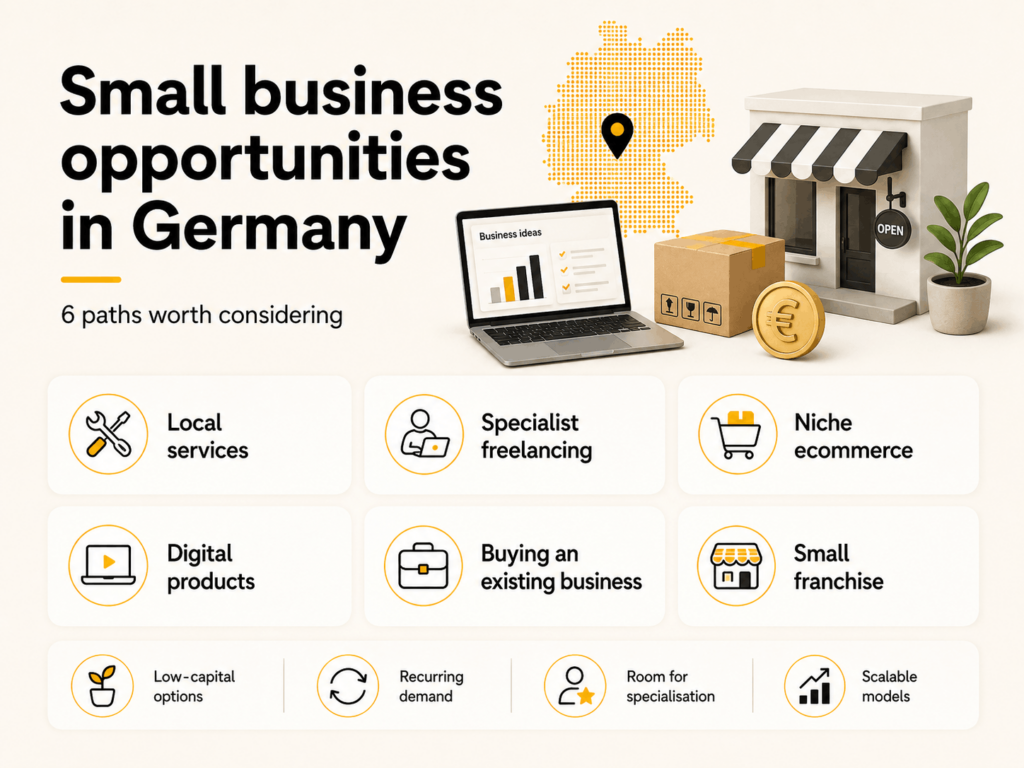
| Business model | Best for | Start-up cost | Main challenge |
| Local recurring services | Pet care, repair, cleaning, tutoring | Low to medium | Building local trust |
| Specialist freelancing | Automation, design, development, content, analytics | Low | Standing out from generic providers |
| Digital education | Tutoring, language training, professional learning | Low | Marketing and differentiation |
| Niche ecommerce | Specialist products, bundles, personalised goods | Medium | Margins, returns and compliance |
| Local experience business | Tours, workshops, small events | Low to medium | Seasonality and permits |
| Buying an existing business | Local services, trades, B2B firms, ecommerce brands | Medium to high | Finance and due diligence |
| Marketplace-first microbrand | Product-led businesses with tested demand | Medium | Fees, price pressure and product data |
What makes a business idea work in Germany?
A successful business in Germany does not need to be revolutionary.
It needs to be useful, credible and financially realistic. Customers often compare prices carefully, expect clear communication and reward businesses that keep their promises.
The strongest ideas usually share a few traits:
- They solve a specific customer problem.
- Their pricing is easy to understand.
- Their operations are reliable.
- They can build repeat demand.
- They have a clear niche or local advantage.
- They still make money after tax, insurance, marketing and support costs.
For ecommerce businesses, that also means being realistic about delivery, payments and returns. Germany is a large online retail market, but it is also highly competitive and marketplace-heavy. Read our complete guide to understanding the DACH market for the wider context.
How to choose the right small business model
Before choosing an idea, assess it against five practical questions.
| Question | Why it matters |
| Is there visible demand? | A good idea needs customers who already feel the problem |
| Can customers understand the offer quickly? | Complex positioning makes early sales harder |
| Is the service or product repeatable? | Repeat revenue reduces reliance on constant acquisition |
| Can you deliver it reliably? | Trust is often more valuable than novelty |
| Does the model survive realistic costs? | Revenue is not profit |
A useful rule: start with a narrow problem, a defined customer type and a manageable service area.
“Marketing support for everyone” is vague. “LinkedIn lead generation for German B2B manufacturing firms” is more concrete.
“Pet care” is broad. “Weekday dog walking for older dogs in Hamburg-Eimsbüttel” is easier to explain, market and price.
Best local-service business opportunities in Germany
1. Specialist pet care services
Pet care remains a strong local-service category because it is recurring, trust-led and difficult to replace with a marketplace purchase.
The opportunity is not necessarily opening a generic pet shop. It can be a focused service such as:
- dog walking for working households;
- grooming for specific breeds;
- pet transport;
- support for older or anxious pets;
- holiday care;
- mobile nail clipping or grooming;
- premium pet-sitting for frequent travellers.
The strongest operators usually specialise. A clear niche can make a one-person business feel more credible than a broad “we do everything” offer.
Pet products can also work online, particularly for replenishment, personalised accessories or specialist categories. For product inspiration, see the most popular online shopping categories in Germany.
2. Mobile repair and home services
Germany has strong demand for services that save customers time.
Mobile bike repair, minor home repairs, appliance troubleshooting, IT support, furniture assembly and basic smart-home assistance can work well in cities and suburban areas.
The model is attractive because customers value convenience and clear pricing. A technician who arrives on time, explains the issue and sends a proper invoice can build strong repeat business.
Potential niches include:
| Service | Possible customer group |
| Mobile bike repair | Commuters, families and delivery riders |
| Home tech support | Older households and busy professionals |
| Furniture assembly | Renters, new homeowners and relocation customers |
| Smart-home setup | Homeowners using connected devices |
| Small repairs | Landlords, short-term rentals and households |
| Appliance maintenance | Households, cafés and small offices |
Be careful with regulated trades. Electrical work, gas installations and structural repairs may require specific qualifications, licences or insurance. Check the relevant local chamber or trade authority before marketing a service.
3. Senior-friendly non-medical support
Germany’s ageing population creates opportunities for services that help people stay independent at home.
This does not mean providing regulated medical care without qualifications. It can mean practical, non-medical support such as:
- technology setup and digital help;
- grocery organisation;
- appointment coordination;
- light household support;
- transport assistance;
- home organisation;
- family communication services;
- local errand management.
The best approach is to define clear boundaries. Do not present non-medical support as nursing, therapy or clinical care.
This category works because it is based on trust and repeat relationships. It can also be paired with local partnerships, such as pharmacies, mobility providers, community centres or property managers.
4. Local B2B support for tradespeople and SMEs
Many small German businesses are excellent at their craft but struggle with digital operations.
A local trades business may need help with online booking, customer follow-up, website updates, Google Business Profile management, quote templates, CRM setup or basic analytics.
This creates an opportunity for service providers who understand both digital tools and local business realities.
Examples:
- appointment-booking setup for salons, workshops or clinics;
- website and local SEO for tradespeople;
- CRM and follow-up systems for service businesses;
- quoting and invoice workflow setup;
- WhatsApp Business implementation;
- lead-generation landing pages;
- simple AI or automation workflows.
Germany’s business landscape remains highly decentralised, which means these opportunities are not limited to Berlin or Munich. Smaller cities often have strong local businesses with fewer specialist digital suppliers.
For a closer look at the technology side, see AI companies in Germany and how a central ERP system can support data protection.
5. Fitness and health coaching for specific groups
Fitness remains a viable small-business opportunity, but generic personal training is competitive.
The stronger route is specialisation.
Examples include:
- strength training for women over 40;
- low-impact fitness for older adults;
- mobility programmes for office workers;
- postnatal movement classes;
- outdoor training for beginners;
- running groups for international residents;
- corporate wellbeing programmes for small teams.
A hybrid model can work well: local classes paired with online programming, video libraries, accountability groups or paid workshops.
Check insurance requirements and professional qualifications carefully. Customers may not always ask about them before booking, but they matter if something goes wrong.
6. Specialist event and experience businesses
Germany has a large events market, but generic event planning is crowded.
The opportunity lies in clear positioning:
- bilingual weddings;
- corporate offsites;
- trade-fair support;
- sustainable event production;
- small destination weddings;
- food and drink experiences;
- local cultural workshops;
- team-building for distributed companies.
A good local experience business can combine service income with digital sales. For example, a wine-tour operator could sell guides, gift vouchers or local subscription products online.
The main risks are seasonality, permits, public liability insurance and customer acquisition. Build partnerships early with venues, local guides, caterers and accommodation providers.
The business opportunity many founders miss: buying an existing company
Starting from zero is not the only way to become an entrepreneur in Germany.
Business succession is becoming a serious issue across the Mittelstand. KfW reported that around 231,000 SME owners planning to hand over control were considering closure by the end of 2025, often because they could not find a successor. Another 310,000 were considering closure within the following three to five years.
That creates an opportunity to acquire an existing business with customers, systems, staff and revenue already in place.
Possible targets include:
- local service companies;
- specialist trades;
- B2B agencies;
- small manufacturers;
- ecommerce brands;
- repair businesses;
- cleaning companies;
- local retailers with strong customer loyalty;
- niche software or digital-service providers.
| Why acquisition can work | What to investigate |
| Existing customers | Customer concentration and churn |
| Existing cash flow | Profit quality and owner withdrawals |
| Existing staff | Key-person dependency |
| Existing supplier relationships | Contract transferability |
| Existing reviews and reputation | Google reviews, complaints and local sentiment |
| Faster route to revenue | Equipment, leases and liabilities |
| Existing operational systems | Whether they are documented or only in the owner’s head |
This is not an easy route. It requires financing, legal advice and detailed due diligence. But it can be more predictable than building a business from zero.
The German Chambers of Commerce have also highlighted a major mismatch between businesses ready for transfer and people interested in taking them over.
Best online business opportunities in Germany
7. Specialist freelancing and fractional services
Freelancing remains one of the lowest-cost ways to start a business in Germany.
But broad offers are becoming harder to sell. “Social media management”, “copywriting” or “web design” alone can feel interchangeable.
A stronger approach is to combine a skill with a defined customer type.
Examples:
| General service | Stronger niche version |
| Copywriting | Product pages for German B2B manufacturers |
| Design | Shopify stores for sustainable consumer brands |
| Paid media | Meta ads for private clinics or wellness brands |
| Development | Customer portals for local logistics companies |
| Analytics | GA4 and dashboard setup for DACH ecommerce brands |
| Social media | LinkedIn content for technical founders |
| SEO | Content refreshes for SaaS companies selling in Europe |
A small portfolio, clear offer and transparent process can be more effective than a large agency-style website.
For ecommerce marketing ideas, see 7 successful ecommerce marketing strategies to drive sales and ways to grow ecommerce traffic without buying ads.
8. B2B automation and AI implementation
Many small and mid-sized businesses want to use AI and automation, but they do not need a huge transformation programme.
They need practical help:
- automating lead follow-up;
- summarising customer enquiries;
- routing support tickets;
- creating quote drafts;
- organising internal knowledge;
- improving reporting;
- connecting CRM, email and booking tools;
- reducing repetitive admin.
This is a promising service category because the value is easy to explain: less manual work, faster response times and clearer workflows.
The most credible providers will focus on a specific business process rather than claiming to “do AI”.
9. Online tutoring and professional education
Online education can work well when it solves a specific need.
Potential areas include:
- German as a foreign language;
- business German;
- maths, science or exam support;
- coding for non-technical professionals;
- professional writing;
- job-search support;
- AI literacy for small businesses;
- industry-specific compliance training.
The challenge is not creating a course. It is convincing people to buy it.
Live cohorts, small-group teaching and practical outcomes can be easier to sell than a generic video library. Consider combining courses with templates, office hours, communities or coaching.
10. Local lead-generation businesses
A local lead-generation business helps service providers get more qualified enquiries.
For example, you might build a website and SEO presence around “roof repair in Leipzig”, “English-speaking therapist in Munich” or “wedding photographer in Cologne”, then partner with providers who pay for leads or booked jobs.
This model needs careful quality control. Leads must be relevant, consent-based and delivered transparently.
It can work best in categories with high customer value and fragmented local supply:
- home improvement;
- legal services;
- private healthcare;
- moving services;
- education;
- wedding services;
- premium pet care;
- local repairs.
Local SEO, reviews and clear landing pages matter more than fancy branding.
11. Niche ecommerce with EU sourcing
Ecommerce can still work in Germany, but generic dropshipping is much harder than it used to be.
A store selling the same low-cost product as Amazon, Temu or AliExpress will often struggle with margin, trust and delivery expectations. The better route is niche ecommerce with a clear advantage:
- specialist products;
- curated bundles;
- personalised goods;
- products difficult to compare directly;
- local or EU sourcing;
- expert-led product selection;
- strong content and guides;
- refill or replenishment models.
| Better ecommerce fit | Why it works |
| Personalised gifts | Harder to compare directly |
| Specialist pet products | Repeat demand and niche advice |
| Hobby and maker kits | Content and community can support sales |
| Accessibility products | Clear customer problem and expertise |
| Premium local food | Origin story and gifting potential |
| Home organisation products | Bundling and visual merchandising |
| B2B consumables | Repeat purchase and account value |
| Sustainable replacements | Value comes from education, not only price |
Germany’s ecommerce market is large, but customers expect reliable delivery, clear returns and familiar payment methods. For practical guidance, see top dropshipping companies in Germany, top payment providers in DACH and top fulfilment centres and logistics operators in Germany.
12. Digital products, templates and paid communities
Digital products have lower delivery complexity than physical goods.
They can include:
- spreadsheet templates;
- Notion systems;
- industry-specific checklists;
- design assets;
- teaching materials;
- business calculators;
- workflow templates;
- paid newsletters;
- membership communities.
The best digital products solve a small but costly problem.
A generic “productivity template” is difficult to sell. A “German VAT invoice tracker for small ecommerce sellers” is more useful because it serves a defined need.
Digital products can work well alongside a service business. A consultant can sell templates. A tutor can sell revision packs. A local guide can sell downloadable itineraries.
13. Subscription and replenishment models
Subscription businesses can create recurring revenue, but they are not automatically easy.
A subscription works best when customers already reorder regularly. That can include:
- pet food;
- specialty coffee;
- skincare replenishment;
- household essentials;
- B2B consumables;
- niche food products;
- hobby materials.
A surprise box is harder because it relies on novelty and customer retention. A replenishment model is usually easier to explain because it solves a practical problem.
Before launching, calculate:
- product cost;
- packaging;
- delivery;
- payment fees;
- cancellations;
- refunds;
- support;
- retention after three and six months.
Before starting: practical business setup checklist
Germany is a structured market. That can feel demanding, but it also gives customers confidence when businesses are set up properly.
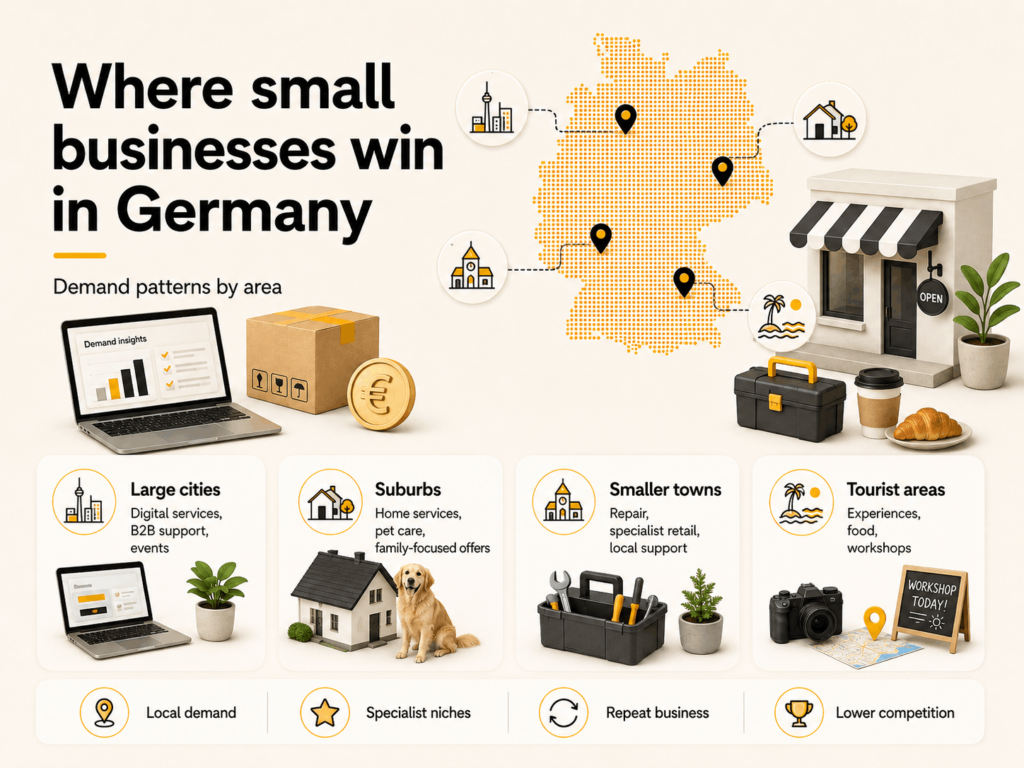
This is not legal or tax advice. Requirements depend on your legal form, sector, location and whether you sell products or services.
| Area | What to clarify before launch |
| Legal form | Freelancer, sole trader, UG or GmbH |
| Registration | Gewerbeanmeldung or notification to the Finanzamt |
| Tax | VAT, invoicing, bookkeeping and tax adviser support |
| Insurance | Health insurance and professional liability where relevant |
| Ecommerce | Impressum, privacy policy, returns and consumer rights |
| Packaging | LUCID registration and system participation where required |
| Product safety | GPSR, CE, food, cosmetics or category-specific obligations |
| Local permits | Tourism, food, transport, events or regulated trades |
| Cash flow | Setup cost, insurance, marketing, stock and working capital |
| Contracts | Supplier terms, customer terms, employment and data-processing agreements |
For ecommerce sellers, packaging rules deserve special attention. The German Packaging Register states that online retailers distributing packaged goods commercially in Germany must register with LUCID. Depending on the packaging type, system participation and regular volume reporting may also apply.
That includes many businesses that assume their supplier or fulfilment partner “handles it”. The legal responsibilities depend on the arrangement, so check them before launch.
For online selling, also consider product data, returns and pricing transparency. Price comparison platforms in DACH, top shopping apps in Germany and best online marketplaces in Germany all show how quickly customers can compare an offer.
Low-capital vs medium-capital business ideas
| Low-capital opportunities | Medium-capital opportunities |
| Specialist freelancing | Niche ecommerce store |
| Online tutoring | Subscription business |
| Social media and local SEO services | Mobile repair service |
| Digital templates | Professional fitness studio |
| Pet sitting and dog walking | Grooming business |
| Local lead generation | Event-production company |
| Translation or business support | Buying an existing business |
| Workshop facilitation | Inventory-led retail or food business |
Starting part time can reduce risk. KfW’s latest entrepreneurship data shows that part-time founders made up a record 70% of new founders in 2025.
That does not mean every business should stay a side project. It means testing demand before taking on rent, inventory or employees can be sensible.
FAQ: small business opportunities in Germany
What are the best small business opportunities in Germany in 2026?
Strong opportunities include local recurring services, specialist freelancing, B2B automation support, online tutoring, niche ecommerce, pet care, mobile repairs, local lead generation and business succession opportunities.
Can I start a business in Germany part time?
Yes. Part-time entrepreneurship is common in Germany. KfW estimated that 70% of new founders in 2025 began part time.
What business can I start with low capital in Germany?
Freelancing, tutoring, local support services, pet care, digital products, workshops and lead-generation businesses can often start with relatively low upfront costs.
Is dropshipping profitable in Germany?
It can be, but generic dropshipping is difficult. Competition from marketplaces, delivery expectations, returns, packaging rules and advertising costs can quickly reduce margins. A specialist niche, EU sourcing and strong product information are safer starting points.
Do freelancers need a Gewerbeanmeldung in Germany?
It depends on whether the activity is treated as a freelance profession or a commercial trade. Many freelancers notify the Finanzamt rather than registering a trade, while commercial businesses generally need a Gewerbeanmeldung. Check the classification with a tax adviser or local authority.
What legal requirements apply to an online store in Germany?
Common requirements can include an Impressum, privacy policy, consumer-information obligations, return policies, VAT setup, product-safety rules and packaging obligations. The exact requirements depend on what you sell and how you operate.
Is buying an existing business a good opportunity in Germany?
It can be. Buying an existing business may provide customers, revenue, staff and supplier relationships from day one. It also requires careful due diligence around profit quality, liabilities, customer concentration and owner dependency.
Which local businesses have repeat demand?
Pet services, household support, cleaning, tutoring, fitness coaching, maintenance, repair, food-related services and B2B support often have repeat demand when they are delivered reliably.
Conclusion
The best small business opportunities in Germany are not necessarily the most glamorous.
They are the ones with a clear customer problem, transparent pricing, realistic operations and a reason customers come back. That may mean helping a local business digitise, serving a narrow consumer niche, building a practical online education product or taking over a company whose owner is ready to retire.
Start with the economics, not the hype.
A focused offer, honest customer communication and reliable execution will usually outperform a broad idea with no clear reason to exist.
***