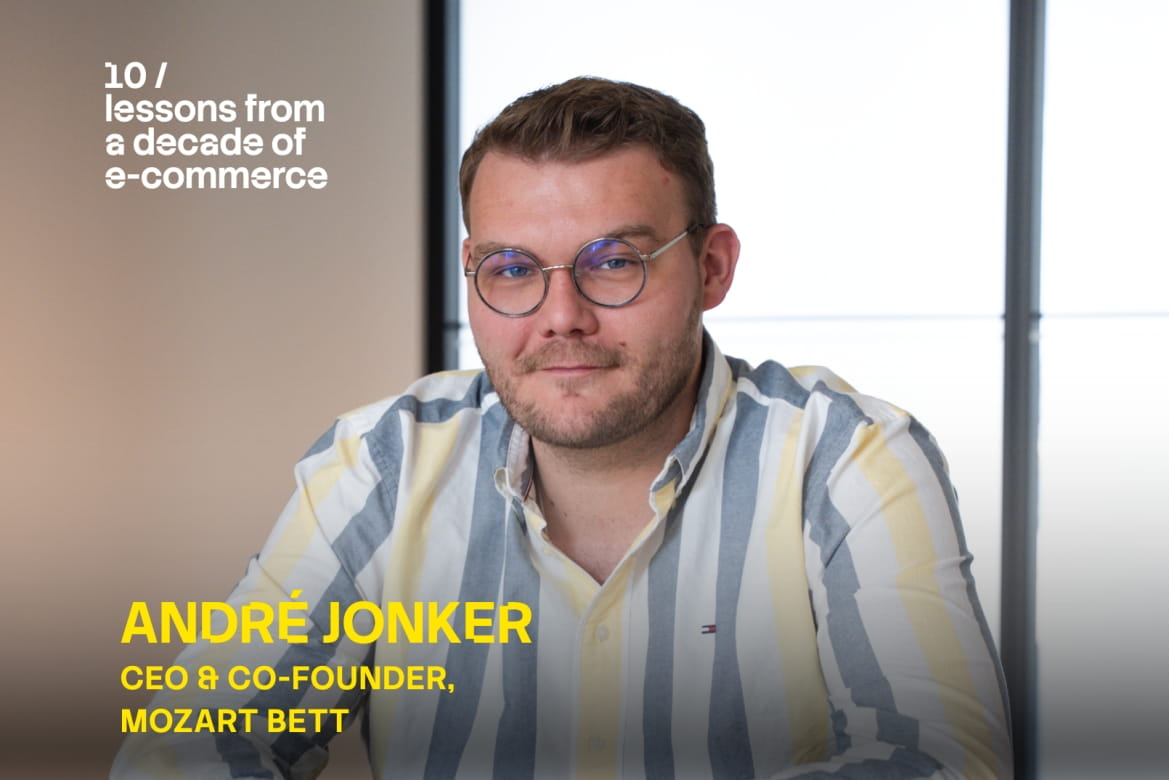
“Data beats ego”: 10 lessons from André Jonker, CEO & Co-Founder of Mozart Bett
Written by
Editorial TeamPublished on
Discover 10 valuable e-commerce lessons from André Jonker, CEO & Co-Founder of Mozart Bett, as he shares his insights on the future of online retail to mark the 10th anniversary of the E-commerce Berlin Expo. [EXCLUSIVE INTERVIEW SERIES]
The E-commerce Berlin Expo celebrated its 10th anniversary in 2026. To mark this milestone, we interviewed some of the world’s most influential leaders about the future of online retail, asking them to share their 10 valuable lessons in e-commerce. Their insights were featured in our special album, showcasing the most powerful voices in online retail, which we decided to share with you on E-commerce Germany News.
This time, we’re featuring an exclusive interview with André Jonker, CEO & Co-Founder of Mozart Bett. See what e-commerce lessons he shared with us below!
What first drew you to this industry?
ANDRÉ: I didn’t dream of boxspring beds as a kid – I just wanted to build good, efficient digital companies. I started out with some friends at a small agency in Nordhorn, where we created websites and later the first online shops for local clients. At some point, we launched our own projects – “Rollrasen Rudi”, “Hecken Helge”, “Holz Harry” – all markets that were barely digitalised at the time, where you could get to the top of Google with smart online marketing and solid execution. We are talking about bulky products that are not necessarily searched for on Amazon. That phase showed me how much leverage there is in e-commerce when you think of marketing, operations, and data as one system. Mozart Bett was the next step: building a real company with a complex product, self-funded, out of the provinces. That mix of technology, entrepreneurship, and the challenge of rethinking supposedly “unsexy” categories in a digital way is what kept me in this industry.
Which early failure taught you something that still guides you today?
ANDRÉ: One of my biggest mistakes was underestimating the real costs of complex, high-explanation products – especially in marketing. Boxspring beds are expensive, bulky, and full of decisions: fabric, firmness, topper, dimensions. In the beginning, we thought a clean shop and performance campaigns would be enough to explain all that. In reality, our customer acquisition costs climbed faster than expected because we had invested too little in content, creatives, and brand. At the same time, we treated topics like controlling and liquidity planning as secondary – until it became clear that they are the foundation of stability. Today, whenever I look at a new idea, I think first in numbers, cash flows, and micro-conversions, and only then in emotion. That makes us slower in PowerPoint, but a lot faster in real life.
Quote / André Jonker, CEO & Co-Founder of Mozart Bett(…) data beats ego. My gut feeling likes me, but it tends to lie – data doesn’t, as long as it’s cleanly structured and quality-checked.
When you think of the past decade of e-commerce, what do you miss – and what are you glad we left behind?
ANDRÉ: I miss the pioneer days when you could take a good niche product, a sharp landing page, and a bit of Google discipline and see clear results very quickly. A few guys from Nordhorn, a niche like roll-out turf or hedging plants – and suddenly you’re at the top of the search results. It was radically direct feedback. At the same time, I’m glad we’re leaving behind the phase where e-commerce was often driven by gut feeling, pretty slides, and pure reach logic. Today, we talk about data models, predictive analytics, and the transition between online and offline – for example, when customers configure their bed online, then test it in the showroom, and we bring the data from both worlds together. That maturity is good for the industry: less romance, more reliable mechanics.
Data doesn’t lie
What is the single most important business lesson you have learned throughout your career?
ANDRÉ: The most important lesson fits into three words: data beats ego. My gut feeling likes me, but it tends to lie – data doesn’t, as long as it’s cleanly structured and quality-checked. Whether it’s marketing channels, creatives, assortments, or showroom locations: we’ve repeatedly seen the numbers contradict our intuition – and be right in the end. That’s why we work heavily with micro-conversions. Fabric sample orders, saved configurations, and click paths are often more important to us than the headline conversion rate in a monthly report. This mindset makes decisions more uncomfortable at times, but it protects you from very expensive detours – especially when you’re bootstrapped, and every mistake hurts twice.
How would you define success in e-commerce today, and how has your view of it changed over time?
ANDRÉ: In the past, I probably would have defined success with revenue curves: higher, faster, more. Today, my definition is much broader. A successful e-commerce company is profitable, data-competent, customer-centric, and able to act independently – even without external capital. We look very closely at whether our activities create real buying intent: fabric sample requests, saved configurations, showroom appointments. Success also means that customers come back, bring their friends, and trust us even though they spend a lot of money online. And it means we’ve built a team that wants and is able to take ownership – not just for campaigns but for the whole system behind them.
What do you see as the biggest opportunity in e-commerce today?
ANDRÉ: The biggest opportunity lies where complexity has long been seen as a problem: in products and business models that you can’t just “throw onto a marketplace”. If you can use technology, data, and advice to radically simplify complex purchase decisions, you build very robust businesses. For us, that’s our configurator, which connects AI-powered recommendations, data analysis, and the showroom experience. In parallel, I see huge potential in AI that genuinely works for us – not as a gimmick, but as a team member: from making A/B testing easier and more efficient, to automated dashboard creation and answering a large share of our support tickets. If you take these technologies seriously early on and build them into your processes, you can create very large levers with relatively small teams.
Quote / André Jonker, CEO & Co-Founder of Mozart BettBuild real companies, not slides. Learn to read numbers before you craft big visions and take the time to shape your business models for profitability and resilience.
What’s the most counterintuitive or unconventional thing your company does today that actually works?
ANDRÉ: We deliberately chose a bulky, logistically demanding product – beds – and built it as a self-funded business out of a small town on the Dutch border. That conflicts with almost every classic startup playbook, where everything should be easy to ship, investor-funded, and based in a major city. At the same time, we’re bringing a large part of the value creation to Nordhorn: in-house IT, in-house marketing teams, and in-house data competence instead of outsourcing everything. And we don’t use AI first for flashy campaign visuals, but in the places that sound dry – building dashboards, streamlining support, automating internal workflows. The result is a company that runs very efficiently, stays close to its customers, and still invests heavily in technology – without being under pressure from external capital.
Build real companies, not slides
What guiding principle do you personally refuse to compromise on, no matter the trend or pressure?
ANDRÉ: There are two things I don’t like to compromise on: independence and straight talk. Independence for me means being financially set up so that we don’t have to chase every hype – that’s why we built Mozart Bett without investors and always linked growth to profitability. Straight talk means saying what we do and doing what we say – in our advertising, to customers, and internally within the team. That includes naming problems, even when it hurts, and tying decisions to data rather than egos. In the long run, that pays off: it builds trust, attracts the right people, and filters out the wrong ones.
Looking ahead, what will define the next decade of e-commerce, and how does thinking about the future make you feel – optimistic, excited, concerned, or something else?
ANDRÉ: The next ten years will be shaped by three developments: AI becoming a co-worker in every system, new interfaces beyond the classic online shop, and a much tighter integration of online and offline. We already see how AI allows us to analyse data in seconds, build dashboards automatically, and gradually automate content production – and that’s just the beginning. At the same time, purchase decisions will increasingly be made in dialog-driven environments: assistants, agents, personalised advice across touchpoints, from the website to the showroom. I’m “optimistically pragmatic”: companies that engage seriously with data, AI, and structure early on will unlock huge efficiency gains. I’m more worried about those who treat AI as a marketing buzzword instead of infrastructure – they’re the ones who’ll fall behind.
If you could leave a message for future e-commerce leaders, what would it be?
ANDRÉ: Build real companies, not slides. Learn to read numbers before you craft big visions and take the time to shape your business models for profitability and resilience. Use AI consistently – but as a tool, not a substitute for thinking. Look for products and categories other people consider “too complicated” and make them manageable through technology and clear processes. And maybe most importantly: let your ego compete with your data on a regular basis. If you let the data win, the chances that your company survives go up significantly.
ANDRÉ JONKER’S BIO
André Jonker is a serial founder and e-commerce entrepreneur. With Mozart Bett, he and his team have built a premium, data-driven D2C brand for boxspring beds, scaling from zero to tens of millions in revenue within just a few years – bootstrapped and run out of the town of Nordhorn near the Dutch border. His focus: lean processes, a strong brand, deep digital expertise, and the smart use of AI to make complex customer journeys simple.