“Success today means having a structural advantage, not just operational excellence”: 10 lessons from Paul Krauss, Partner AI at Team One
Written by
Editorial TeamPublished on
Discover 10 valuable e-commerce lessons from Paul Krauss, Partner AI at Team One, as he shares his insights on the future of online retail to mark the 10th anniversary of the E-commerce Berlin Expo. [EXCLUSIVE INTERVIEW SERIES]
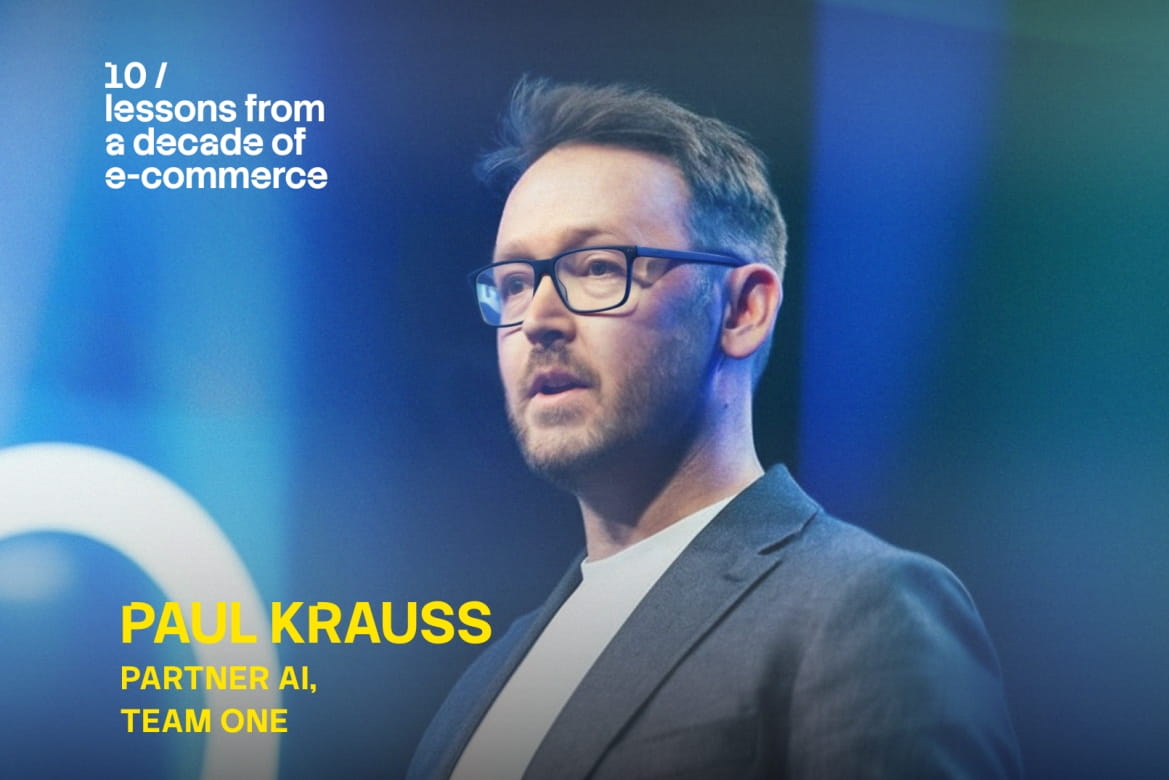
The E-commerce Berlin Expo celebrated its 10th anniversary in 2026. To mark this milestone, we interviewed some of the world’s most influential leaders about the future of online retail, asking them to share their 10 valuable lessons in e-commerce. Their insights were featured in our special album, showcasing the most powerful voices in online retail, which we decided to share with you on E-commerce Germany News.
This time, we’re featuring an exclusive interview with Paul Krauss, Partner AI at Team One. See what e-commerce lessons he shared with us below!
Process, data and execution
What first drew you to this industry?
PAUL: I’m drawn to complex systems with no shortcuts, where outcomes emerge from structure rather than hacks. Coming from content automation and distribution, it was obvious how broken distribution and monetization had become. Commerce exposed those failures at scale. Tight margins forced discipline: process over theatrics, data over opinion, execution over endless debate.
Which early failure taught you something that still guides you today?
PAUL: Failure culture matters – but some failures are structural, not educational. Building without user feedback is one. Another is undercapitalizing a good idea and pretending it’s a learning phase. Early on, I built a digital publishing product, saw the opportunity, but didn’t take the necessary all‑in bets: capital, speed, and open collaboration. Another persistent failure in platform economies is mistaking caution for strategy. Treating competitors as enemies, fetishizing “small steps”, and underfunding conviction is not prudence – it’s self-sabotage. If the opportunity is real, incrementalism isn’t safer. It’s how you guarantee you lose slowly.
Quote / Paul Krauss, Partner AI at Team OneStrong ideas emerge from teams, from productive disagreement, and from early experimentation, not from big budgets, consensus, or organizational silos.
When you think of the past decade of e-commerce, what do you miss – and what are you glad we left behind?
PAUL: I miss real innovation and intellectual courage: new business models, new interfaces, and attempts to rethink commerce from first principles. The last decade mostly optimized around symptoms, not causes – like adding lanes to a traffic jam instead of asking why everyone is driving the same road. I’m glad we’re slowly leaving behind blind growth, CAC addiction, and the illusion that traffic arbitrage is a sustainable strategy.
What is the single most important business lesson you have learned throughout your career?
PAUL: Progress is not a breakthrough; it’s a habit – and it compounds through networks. Strong ideas emerge from teams, from productive disagreement, and from early experimentation, not from big budgets, consensus, or organizational silos. I was fortunate early on to work with deep‑tech founders, including teams building photonic AI chips like Q.ant, and to see how conviction and endurance matter more than favorable odds. That kind of founder drive is systematically undervalued, yet it’s where real progress comes from. Talent compounds when given responsibility early; most people outperform expectations if trusted before they are fully ready. That creates second‑order effects: motivation, learning speed, and durable innovation. You can’t skip fundamentals, but networks accelerate those who do the work.
The meaning of success
How would you define success in e-commerce today, and how has your view of it changed over time?
PAUL: Success today means having a structural advantage, not just operational excellence. Owning the customer relationship matters more than owning the interface. Platform economics dominate, margins matter again, and technology alone no longer differentiates – but lacking it is fatal. D2C is a good example of how the bar keeps rising while behavior lags behind. It was long reduced to “having a shop” and treated as secondary, especially in categories like fashion, food, or home, where experiences remained purely transactional, and loyalty stayed low. Meanwhile, platforms raised expectations around convenience, context, and integration. The result is a widening gap: the requirements increase, but most players are still playing the old game. Markets don’t reward ambition or intent, only the speed at which organizations learn and adjust to the new baseline.
Quote / Paul Krauss, Partner AI at Team OneMarkets reward trust, and trust collapses the moment you try to sell in the middle of the conversation. You wouldn’t pitch your friends over dinner – at least you shouldn’t. Doing it in business isn’t strategy – it’s just bad manners at scale.
What do you see as the biggest opportunity in e-commerce today?
PAUL: AI and Robotics. Not primarily a growth lever, but a structural one: it compresses decision-making, collapses coordination costs, and removes large parts of the uncertainty tax embedded in commerce. Robotics will do the same for physical execution. The real, still underexploited opportunity is collective action, e.g., shared R&D, open standards, and alliances that create learning curves no single firm can afford alone. In this environment, advantage accrues to those who either move first with conviction or learn faster than the rest. Everyone else optimizes locally while the system shifts underneath them.
In both AI and commerce, the user increasingly is the product. That’s uncomfortable, but also explanatory: models like Temu emerge as much from demand as from supply. People vote with their wallets, even when they don’t like the outcome.
There is a growing layer of platform-adjacent data that exists because the system needs it: user-consented, GDPR-compliant data aggregated to solve cold-start problems, build synthetic twins, and realign incentives so participation becomes economic rather than ideological, which is why I advise and support companies like Owndata, because if AI and data generate outsized value, the creators of that data must share in it, or the system eventually breaks.
Don’t be a follower
What’s the most counterintuitive or unconventional thing your company does today that actually works?
PAUL: As Stefan Wenzel puts it: “If everyone zigs, zag”. When everyone optimizes for reach and likes, we optimize for relevance. For a small number of people with real intent, not an audience metric. We produce high‑quality content with no sales agenda: no funnel, no LinkedIn bait, no attribution theatre. Not because it’s virtuous, but because it works. Markets reward trust, and trust collapses the moment you try to sell in the middle of the conversation. You wouldn’t pitch your friends over dinner – at least you shouldn’t. Doing it in business isn’t strategy – it’s just bad manners at scale.
What guiding principle do you personally refuse to compromise on, no matter the trend or pressure?
PAUL: Trustworthiness is everything; the rest will follow. That means hosting a great dinner and never asking guests to buy your cookware or to even mention that you produce it: that’s exactly why they trust the chef. Being a trusted advisor requires radical honesty, even when it hurts short-term goals or revenue. You can’t directly measure these positive effects, and you shouldn’t, but you see them in long-term relationships, referrals, and cross-industry credibility.
Looking ahead, what will define the next decade of e-commerce, and how does thinking about the future make you feel – optimistic, excited, concerned, or something else?
PAUL: Excited as hell. The next decade of e-commerce is like switching from GPS suggestions to a self-driving car. Amazing if you’re inside early, terrifying if you’re still holding the paper map. There is so much going on: Agent-based commerce, context-driven decisions, and the shift from co-pilot to autopilot will redefine where value is created. AI agents will reduce uncertainty and increasingly make decisions on behalf of users. I’m optimistic, but only for companies that adapt early. For everyone else, the rising waterline will feel like a sudden flood. Better learn to surf.
If you could leave a message for future e-commerce leaders, what would it be?
PAUL: Evolution doesn’t do PowerPoint.
Europe faces a classic innovator’s dilemma, equally structural, cultural, and largely self-inflicted. E‑commerce once disrupted retail and now clings to its own digital catalog. The issue isn’t platforms, but how companies organize around them. The ingredients are there: infrastructure, talent, capital. What’s missing is the willingness to change the business itself, not just optimize its operation. Optimizing dependencies is easy; building resilient models is hard. Complaining is cheap. Adaptation isn’t.
PAUL’S BIO
Paul Krauss is Partner AI at Team One, a technology consulting partner for digital products, scalable architectures, and AI-powered business models – with tech expertise proven in real-world projects. He helps organizations turn AI from a buzzword into real enablement, agentic products, and new revenue streams. As editor of AI:D, a specialist magazine on AI in e‑commerce, lecturer at AITI (DFKI), and supporter of the Futurumundo initiative, his team shapes applied AI practice in commerce and enables teams to leverage AI at scale.